Hardly any other country marks the end of World War II with the same fanfare and fervor as Russia, for which the victory over Nazi Germany 80 years ago remains a source of immense pride and a defining moment of history.
Victory Day, celebrated on May 9, is Russia’s most important secular holiday, reflecting its wartime sacrifice. But it's also used by the Kremlin to bolster patriotism and regain the superpower prestige it lost when the Soviet Union collapsed in 1991.
President Vladimir Putin, who has ruled Russia for 25 of those 80 years, has turned Victory Day into a key pillar of his tenure and has tried to use it to justify his 3-year-old invasion of Ukraine.
He has also sought to underline the failure of Western efforts to isolate Moscow by inviting Chinese President Xi Jinping and other leaders to the festivities, which this year have been overshadowed by reports of Ukrainian drone attacks targeting Moscow and severe disruptions at the capital’s airports, as well as cellphone internet outages on Wednesday.
A look at why Victory Day is so important for Russia and Putin:
The Soviet Union lost a staggering 27 million people in what it calls the Great Patriotic War from 1941-45. That sacrifice left a deep scar in the national psyche.
Nazi Germany invaded the Soviet Union on June 22, 1941, and quickly overran the western part of the country. They got as close as 30 kilometers (under 19 miles) from Moscow by October of that year, but the Red Army rebounded and routed the invaders.
Soviet troops dealt crushing defeats to Germany in 1943 in Stalingrad and Kursk. and then drove the Nazi forces back across the western Soviet Union all the way to Berlin.
Putin has noted that every seventh Soviet citizen was killed, while the United Kingdom lost one out of every 127 and the United States one out of 320.
“The Soviet Union and the Red Army, no matter what anyone is trying to prove today, made the main and crucial contribution to the defeat of Nazism,” Putin wrote in 2020.
Putin is deeply emotional to the history of World War II, saying “we will always remember the high price the Soviet people paid for the victory.”
He often invokes stories from his parents, Vladimir and Maria, in the war, and the death of his 2-year-old brother, Viktor, known as “Vitya,” during the 2 1/2-year Nazi siege of his home of Leningrad, now called St. Petersburg.
”It was the place where my mother miraculously managed to survive," Putin wrote. "My father, despite being exempt from active duty, volunteered to defend his hometown.”
He also recalled in a magazine article how his father talked about a scouting mission behind Nazi lines when his comrades were killed and he survived by hiding in a swamp and breathing through a reed while German soldiers walked a few steps away.
Putin's father was badly wounded. After leaving the hospital, he walked home on crutches to see morgue workers taking his wife’s body away for burial.
“He came up to her and it seemed to him that she was breathing, and he said to the orderlies, ‘She’s still alive!’” Putin's father recounted to his son.
The morgue workers replied, “She’ll die on the way, she won’t survive.” But Putin said his father pushed them away with crutches and forced them to carry her back to their apartment.
Putin’s emphasis on World War II history reflects not only his desire to showcase Russia’s military might but also his effort to rally the country behind his agenda.
World War II is a rare event in the nation’s divisive history under Communist rule that is revered by all political groups, and the Kremlin has used that sentiment to encourage national pride and underline Russia's position as a global power.
Victory Day parades are a massive show of its armed forces, with thousands of troops and scores of heavy equipment, including mobile launchers carrying nuclear-capable intercontinental ballistic missiles, rolling across Red Square, and flyovers of dozens of warplanes. Military parades, fireworks and other festivities are held in cities across the country.
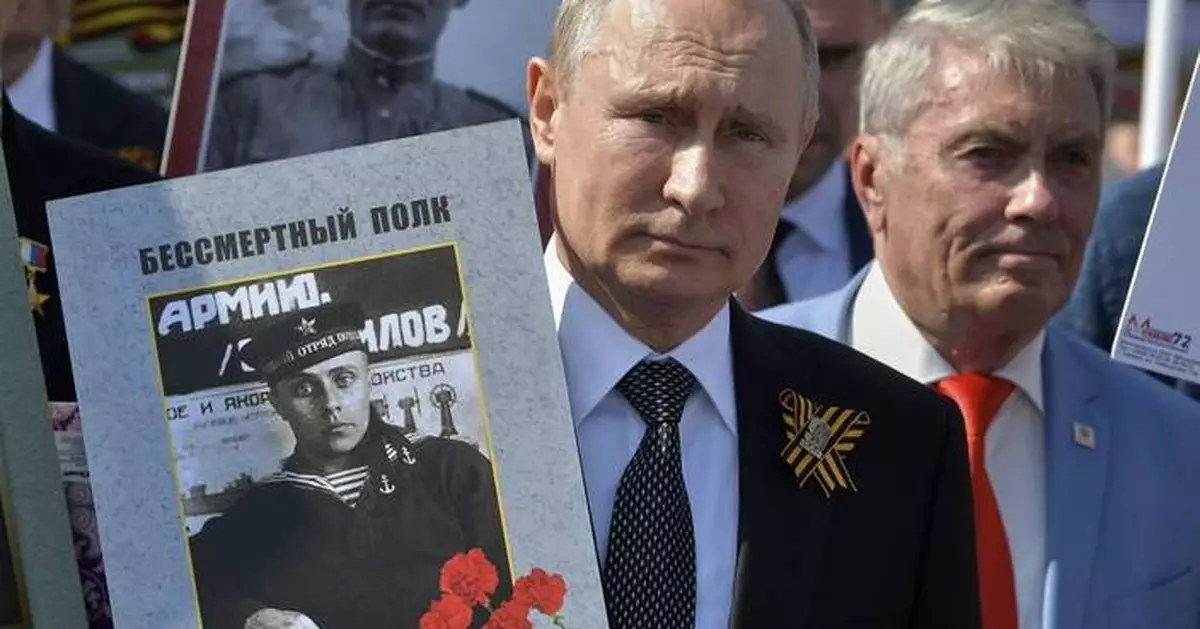
Authorities also encourage May 9 demonstrations featuring what is known as the “Immortal Regiment,” in which people carry photos of relatives who fought in World War II. Putin joined those rallies for several years, carrying a picture of his father.
When Russia launched its full-scale invasion of Ukraine on Feb. 24, 2022, Putin declared it was aimed at the “demilitarization” and “denazification” of its neighbor, falsely alleging that neo-Nazi groups were shaping Ukraine’s politics under President Volodymyr Zelenskyy, who is Jewish. The claims were vehemently dismissed by Kyiv and its Western allies.
Putin tried to cast Ukraine’s veneration of some of its nationalist leaders who cooperated with the Nazis in World War II as a sign of Kyiv’s purported Nazi sympathies. He regularly made references to Ukrainian nationalist figures such as Stepan Bandera, who was killed by a Soviet spy in Munich in 1959, as an underlying justification for the Russian military action in Ukraine.
“The Kremlin has mixed those issues and used the victory over Nazi Germany as a foundation for building anti-Ukrainian narratives,” said political analyst Nikolai Petrov. “In Putin’s mind and in the Kremlin’s plans, the victory over Nazis rhymes with the victory over the Ukrainian neo-Nazism as they put it.”
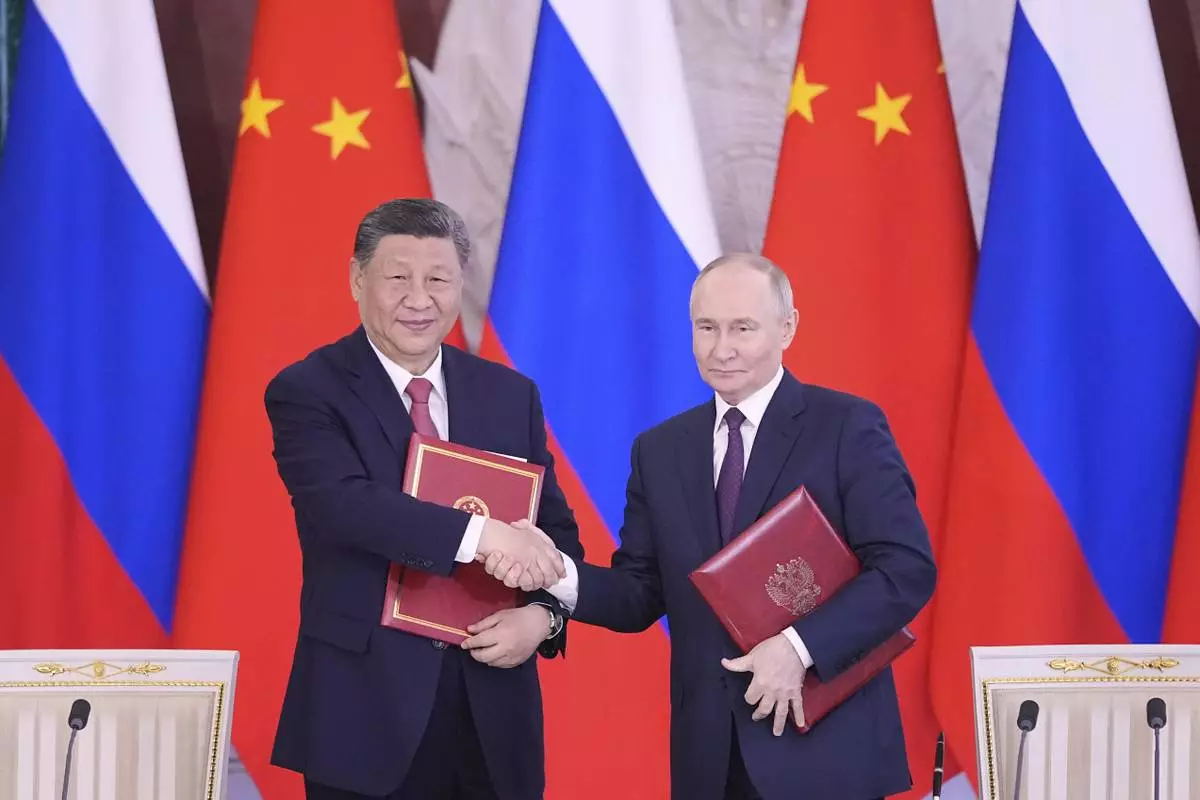
Russian President Vladimir Putin, right, and Chinese President Xi Jinpin attend a signing ceremony after their meeting at the Kremlin in Moscow, Russia, Thursday, May 8, 2025, ahead of celebrations of the 80th anniversary of the Soviet Union's victory over Nazi Germany during the World War II. (AP Photo/Pavel Bednyakov)
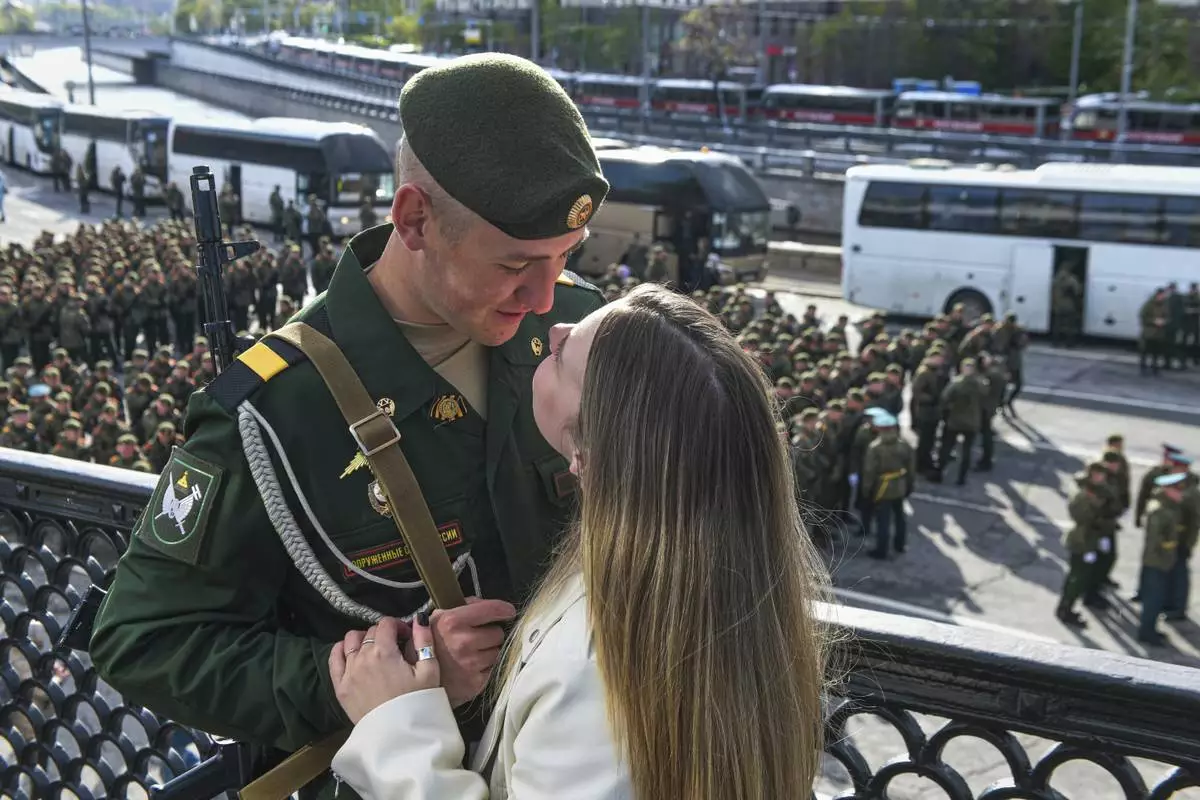
FILE - A Russian soldier and young woman share a tender moment as soldiers wait to attend the Victory Day military parade in Moscow on May 9, 2024. (AP Photo, File)
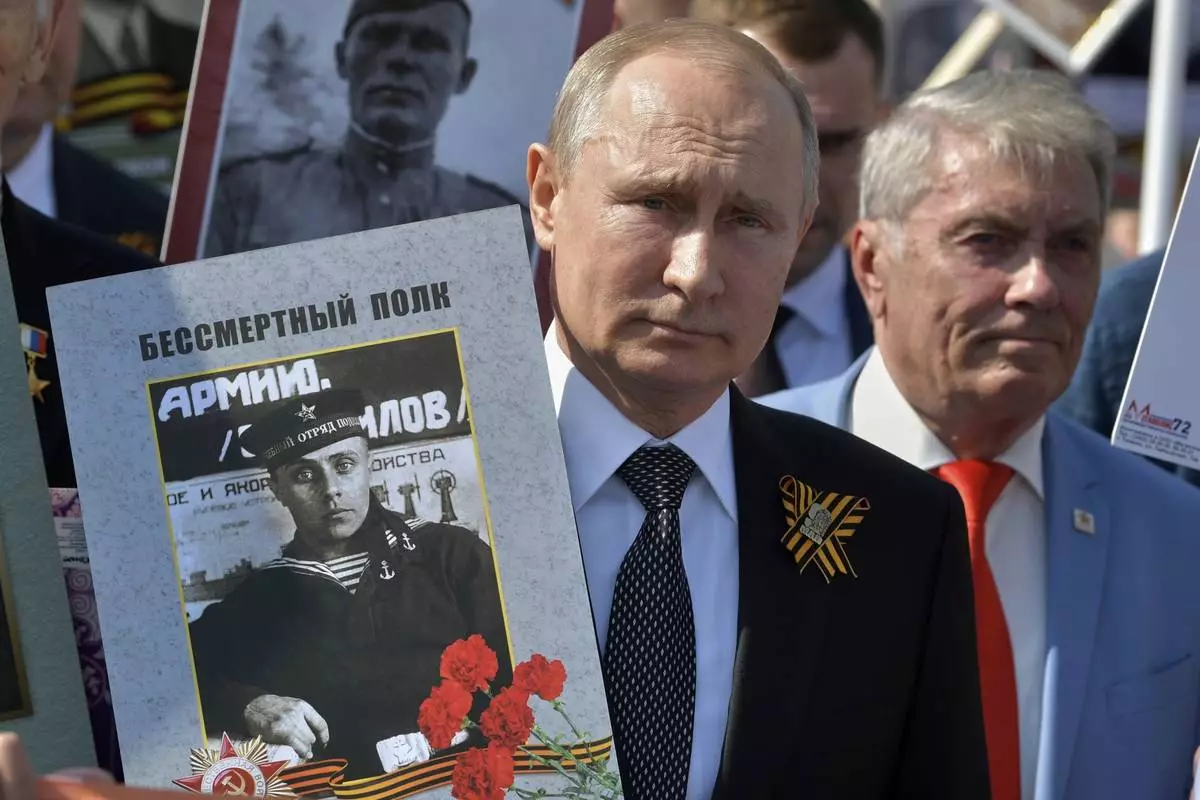
FILE - Russian President Vladimir Putin, center, holds a portrait of his father, also named Vladimir, as he walks with others carrying pictures of their relatives who fought in World War II, during celebrations in Red Square, in Moscow on May 9, 2019. (Alexei Druzhinin, Sputnik, Kremlin Pool Photo via AP, File)
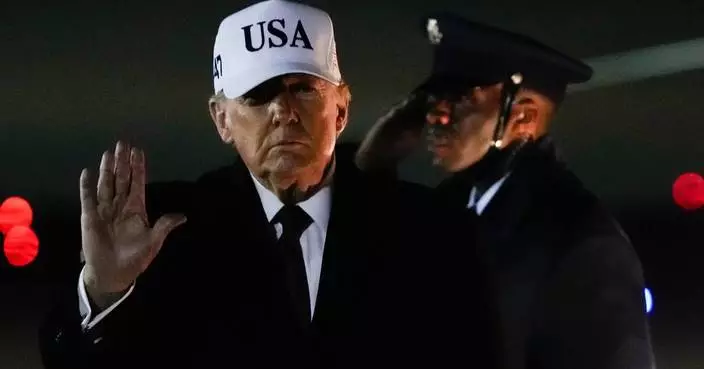
U.S. President Donald Trump says Iran has proposed negotiations after his threat to strike the Islamic Republic as a crackdown on demonstrators has led to hundreds of deaths.
Trump said late Sunday his administration was in talks to set up a meeting with Tehran, but cautioned that he may have to act before then as reports of deaths mount and the government continues to arrest protesters.
“Iran called, they want to negotiate,” Trump told reporters on Air Force One.
Iran did not acknowledge Trump’s comments immediately. It has previously warned the U.S. military and Israel would be “legitimate targets” if America uses force to protect demonstrators.
The U.S.-based Human Rights Activists News Agency, which has accurately reported on past unrest in Iran, said at least 572 people have been killed, including 503 protesters and 69 members of security forces. It said more than 10,600 people have been detained over the two weeks of protests. The group relies on supporters in Iran cross-checking information.
With the internet down in Iran and phone lines cut off, gauging the demonstrations from abroad has grown more difficult. Iran’s government has not offered overall casualty figures.
The Latest:
A senior Turkish official voiced opposition to foreign interventions in Iran, warning that such actions could worsen the country’s crisis.
Omer Celik, spokesman for President Recep Tayyip Erdogan’s ruling party, acknowledged on Monday that Iran faces internal challenges but stressed they must be resolved through “its own dynamics and the will of the state.”
“We would never wish for any chaos to emerge in our neighbor Iran,” Celik said, adding that outside interference would only produce “worse outcomes.”
He cautioned that regional instability could escalate further if external involvement is driven by what he described as “Israeli provocations.”
Video circulating online purports to show dozens of bodies in a morgue on the outskirts of Iran’s capital.
People with knowledge of the facility and the U.S.-based Human Rights Activists News Agency said Monday that the video shows the Kahrizak Forensic Medicine Center.
People are seen walking by bodies in body bags laid out in a large room, attempting to identify them. Another video, widely shared by activists, purportedly shows people gathered around a television monitor at the morgue, looking at images of corpses’ faces. Outside, people can be heard wailing in grief. The footage matches other images of the facility online.
—- By Jon Gambrell in Dubai, United Arab Emirates, and Melanie Lidman in Jerusalem
A witness told the AP that the streets of Tehran empty at the sunset call to prayers each night.
Part of that stems from the fear of getting caught in the crackdown. Police sent the public a text message that warned: “Given the presence of terrorist groups and armed individuals in some gatherings last night and their plans to cause death, and the firm decision to not tolerate any appeasement and to deal decisively with the rioters, families are strongly advised to take care of their youth and teenagers.”
Another text, addressed “Dear parents,” which claimed to come from the intelligence arm of the paramilitary Revolutionary Guard, also directly warned people not to take part in demonstrations.
The witness spoke to the AP on condition of anonymity due to the ongoing crackdown.
—- By Jon Gambrell in Dubai, United Arab Emirates
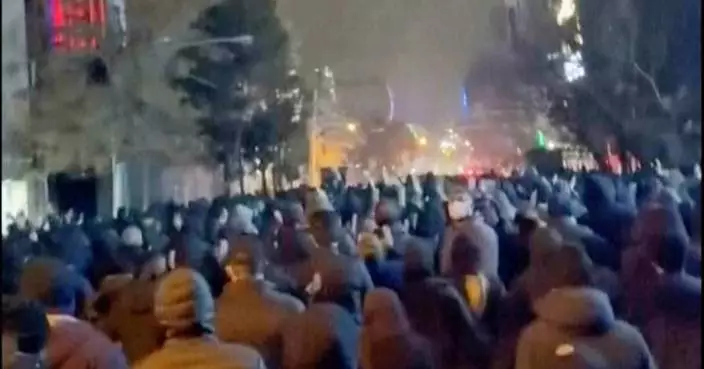
Iran drew tens of thousands of pro-government demonstrators to the streets Monday in a show of power after nationwide protests challenging the country’s theocracy.
Iranian state television showed images of demonstrators thronging Tehran toward Enghelab Square in the capital.
It called the demonstration an “Iranian uprising against American-Zionist terrorism,” without addressing the underlying anger in the country over the nation’s ailing economy. That sparked the protests over two weeks ago.
State television aired images of such demonstrations around the country, trying to signal it had overcome the protests, as claimed by Iranian Foreign Minister Abbas Araghchi earlier in the day.
China says it opposes the use of force in international relations and expressed hope the Iranian government and people are “able to overcome the current difficulties and maintain national stability.”
Chinese Foreign Ministry spokesperson Mao Ning said Monday that Beijing “always opposes interference in other countries’ internal affairs, maintains that the sovereignty and security of all countries should be fully protected under international law, and opposes the use or threat of use of force in international relations.”
German Chancellor Friedrich Merz condemned “in the strongest terms the violence that the leadership in Iran is directing against its own people.”
He said it was a sign of weakness rather than strength, adding that “this violence must end.”
Merz said during a visit to India that the demonstrators deserve “the greatest respect” for the courage with which “they are resisting the disproportional, brutal violence of Iranian security forces.”
He said: “I call on the Iranian leadership to protect its population rather than threatening it.”
Iran’s Foreign Ministry spokesman on Monday suggested that a channel remained open with the United States.
Esmail Baghaei made the comment during a news conference in Tehran.
“It is open and whenever needed, through that channel, the necessary messages are exchanged,” he said.
However, Baghaei said such talks needed to be “based on the acceptance of mutual interests and concerns, not a negotiation that is one-sided, unilateral and based on dictation.”
The semiofficial Fars news agency in Iran, which is close to the paramilitary Revolutionary Guard, on Monday began calling out Iranian celebrities and leaders on social media who have expressed support for the protests over the past two weeks, especially before the internet was shut down.
The threat comes as writers and other cultural leaders were targeted even before protests. The news agency highlighted specific celebrities who posted in solidarity with the protesters and scolded them for not condemning vandalism and destruction to public property or the deaths of security forces killed during clashes. The news agency accused those celebrities and leaders of inciting riots by expressing their support.
Canada said it “stands with the brave people of Iran” in a statement on social media that strongly condemned the killing of protesters during widespread protests that have rocked the country over the past two weeks.
“The Iranian regime must halt its horrific repression and intimidation and respect the human rights of its citizens,” Canada’s government said on Monday.
Iran’s foreign minister claimed Monday that “the situation has come under total control” after a bloody crackdown on nationwide protests in the country.
Abbas Araghchi offered no evidence for his claim.
Araghchi spoke to foreign diplomats in Tehran. The Qatar-funded Al Jazeera satellite news network, which has been allowed to work despite the internet being cut off in the country, carried his remarks.
Iran’s foreign minister alleged Monday that nationwide protests in his nation “turned violent and bloody to give an excuse” for U.S. President Donald Trump to intervene.
Abbas Araghchi offered no evidence for his claim, which comes after over 500 have been reported killed by activists -- the vast majority coming from demonstrators.
Araghchi spoke to foreign diplomats in Tehran. The Qatar-funded Al Jazeera satellite news network, which has been allowed to work despite the internet being cut off in the country, carried his remarks.
Iran has summoned the British ambassador over protesters twice taking down the Iranian flag at their embassy in London.
Iranian state television also said Monday that it complained about “certain terrorist organization that, under the guise of media, spread lies and promote violence and terrorism.” The United Kingdom is home to offices of the BBC’s Persian service and Iran International, both which long have been targeted by Iran.
A huge crowd of demonstrators, some waving the flag of Iran, gathered Sunday afternoon along Veteran Avenue in LA’s Westwood neighborhood to protest against the Iranian government. Police eventually issued a dispersal order, and by early evening only about a hundred protesters were still in the area, ABC7 reported.
Los Angeles is home to the largest Iranian community outside of Iran.
Los Angeles police responded Sunday after somebody drove a U-Haul box truck down a street crowded with the demonstrators, causing protesters to scramble out of the way and then run after the speeding vehicle to try to attack the driver. A police statement said one person was hit by the truck but nobody was seriously hurt.
The driver, a man who was not identified, was detained “pending further investigation,” police said in a statement Sunday evening.
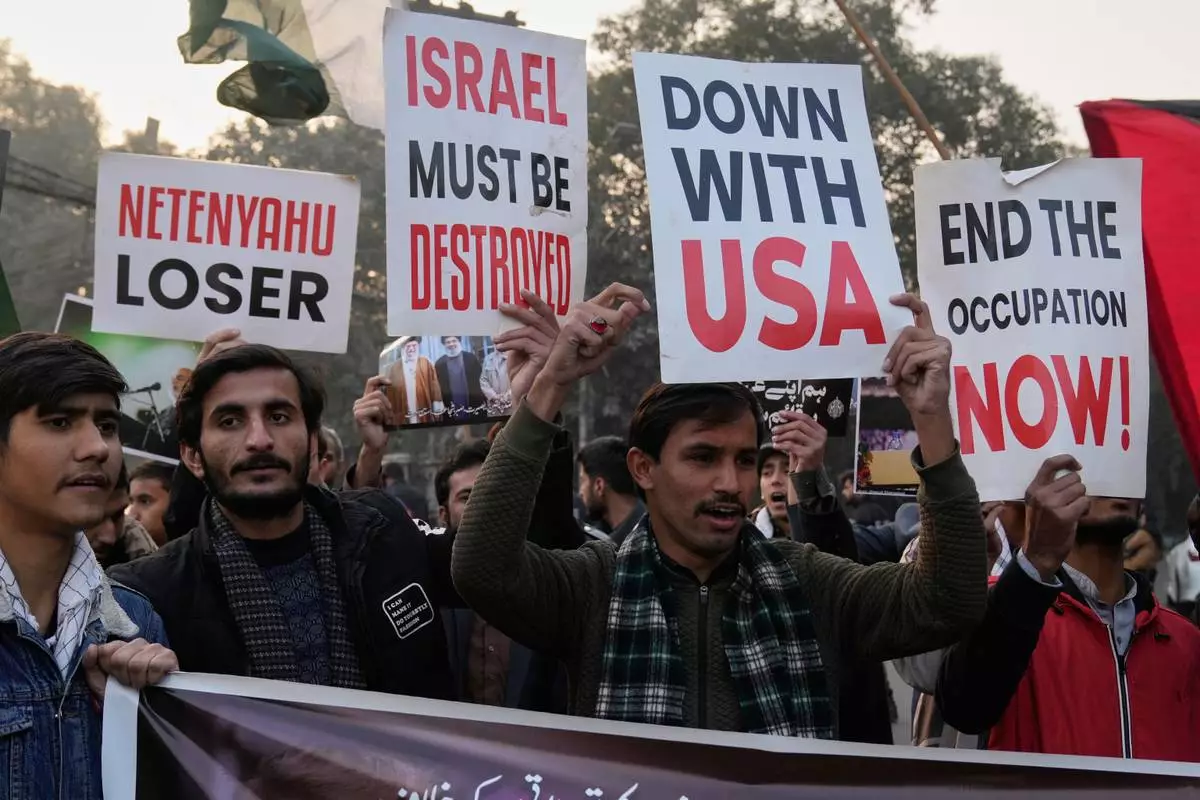
Shiite Muslims hold placards and chant slogans during a protest against the U.S. and show solidarity with Iran in Lahore, Pakistan, Sunday, Jan. 11, 2026. (AP Photo/K.M. Chaudary)
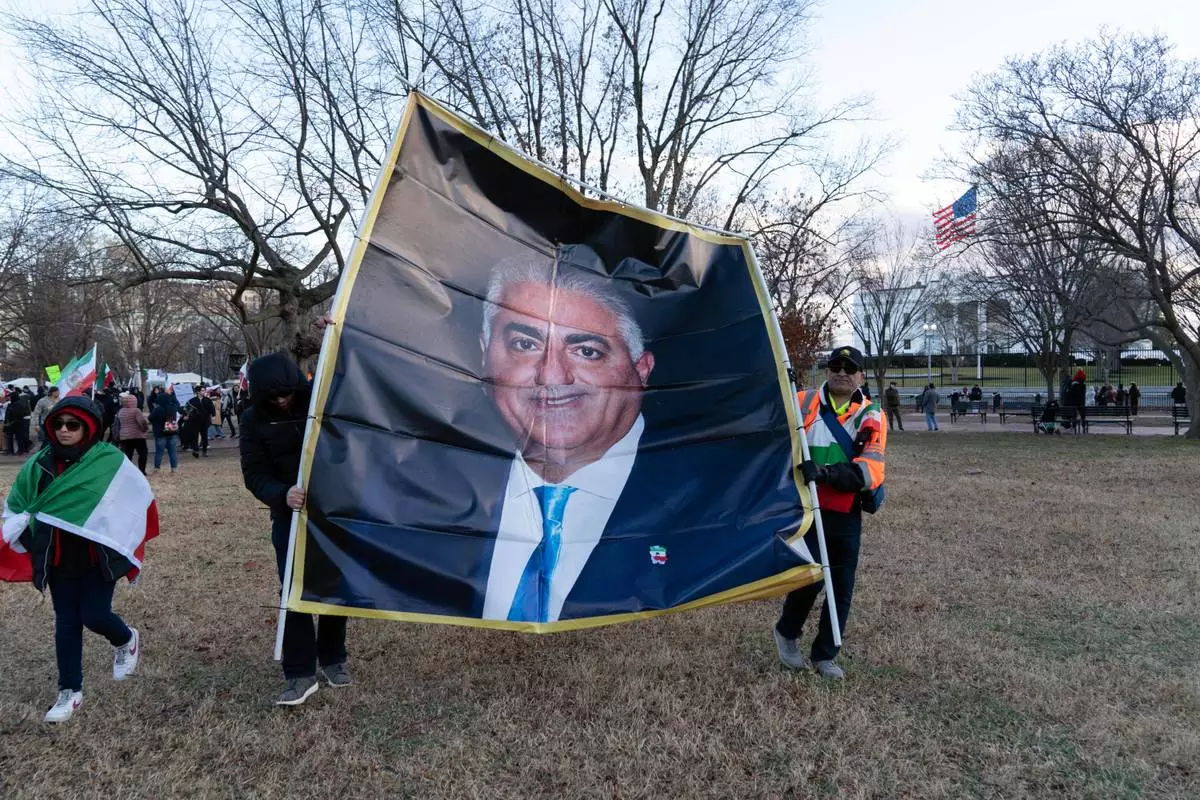
Activists carrying a photograph of Reza Pahlavi take part in a rally supporting protesters in Iran at Lafayette Park, across from the White House, in Washington, Sunday, Jan. 11, 2026. (AP Photo/Jose Luis Magana)
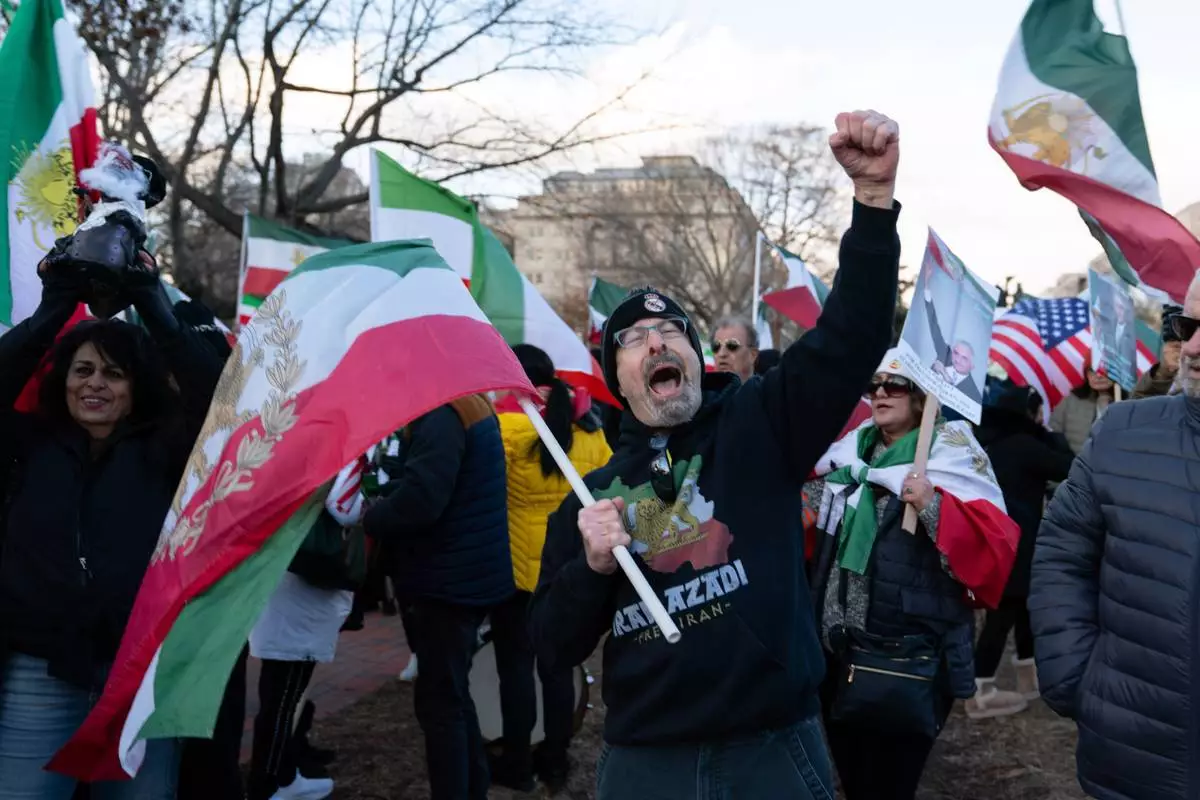
Activists take part in a rally supporting protesters in Iran at Lafayette Park, across from the White House in Washington, Sunday, Jan. 11, 2026. (AP Photo/Jose Luis Magana)
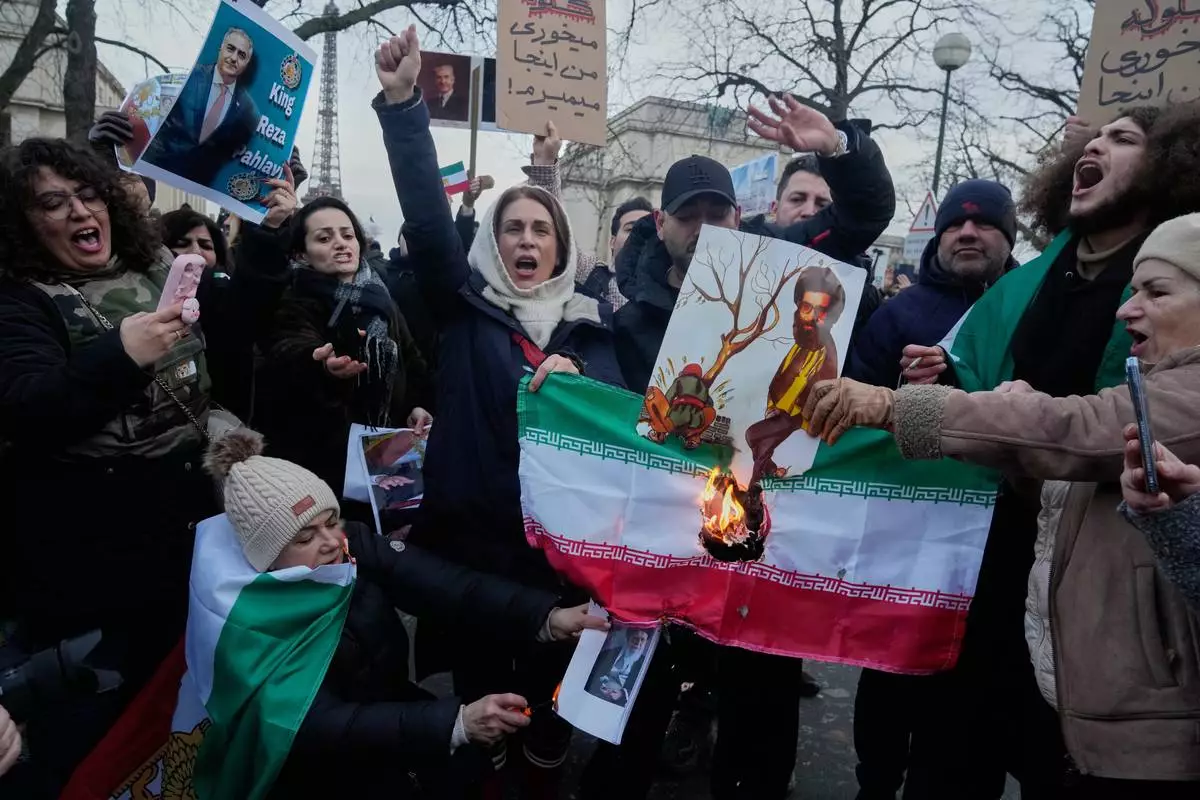
Protesters burn the Iranian national flag during a rally in support of the nationwide mass demonstrations in Iran against the government in Paris, Sunday, Jan. 11, 2026. (AP Photo/Michel Euler)