WELLINGTON, New Zealand (AP) — The vast number of sheep in New Zealand relative to the country’s scant human population has long been the subject of jokes aimed at New Zealanders abroad. It’s true: The country is one of a handful in the world that’s still home to more sheep than people.
But humans are catching up, according to new figures released Tuesday. With a population of 23.6 million sheep and 5.3 million people, there are about 4.5 sheep for each New Zealander, government statistics agency data showed.
That’s down from 22 sheep per person in 1982, when farming sheep for meat and wool was New Zealand’s biggest earner. Now, years of falling wool prices prompted by a global shift to synthetic fibers have led farmers to change what they do with their land, the sector’s biggest lobby group said.
By land area, New Zealand is about the size of the United Kingdom, but it has a human population 13 times smaller than the U.K. That means there’s plenty of room for sheep.
For close to 150 years, the sheep industry was the backbone of New Zealand’s economy and numbers boomed — peaking in 1982 when there were more than 70 million sheep and just 3.2 million people. Before “Lord of the Rings” brought waves of tourists to the country, images of green fields filled with placid sheep against backdrops of snow-capped mountains dominated the country’s marketing abroad.
But over years of decline for global wool prices since — and despite recent rallies — the national flock has steadily diminished. Now dairy holds the biggest share of New Zealand’s agriculture and horticulture-dominant export market.
In 2023, Stats NZ, a government agency, said New Zealand in 2022 dipped below five sheep per person for the first time. The national flock had lost a million more sheep in Tuesday’s figures, which recorded livestock numbers as of June 2024.
Toby Williams, a spokesperson for sector lobby group Federated Farmers, said sheep farmers have switched to more lucrative pursuits — dairy, or the conversion of land from farming to pine forestry in order to sell carbon offsets.
“If I’m really honest, the wool industry is almost at that tipping point, if not already there, of not having a wool industry anymore,” he said.
The government has drawn up measures intended to slow the decline, including an announcement in 2024 that they will place limits on the scale of farmland that can be converted to carbon forestry.
New government procurement guidelines launched in April urge the use of New Zealand wool products — such as carpets and insulation — in newly constructed or refurbished public buildings. But those measures are not expected to halt declining sheep numbers.
Some sheep-farming countries are recording similar trends. New Zealand’s closest neighbor Australia — the source of most of the sheep jokes about New Zealanders — is also home to more sheep than people, but the national flock is shrinking there too.
The gap is slimmer: There are about three sheep per Australian.
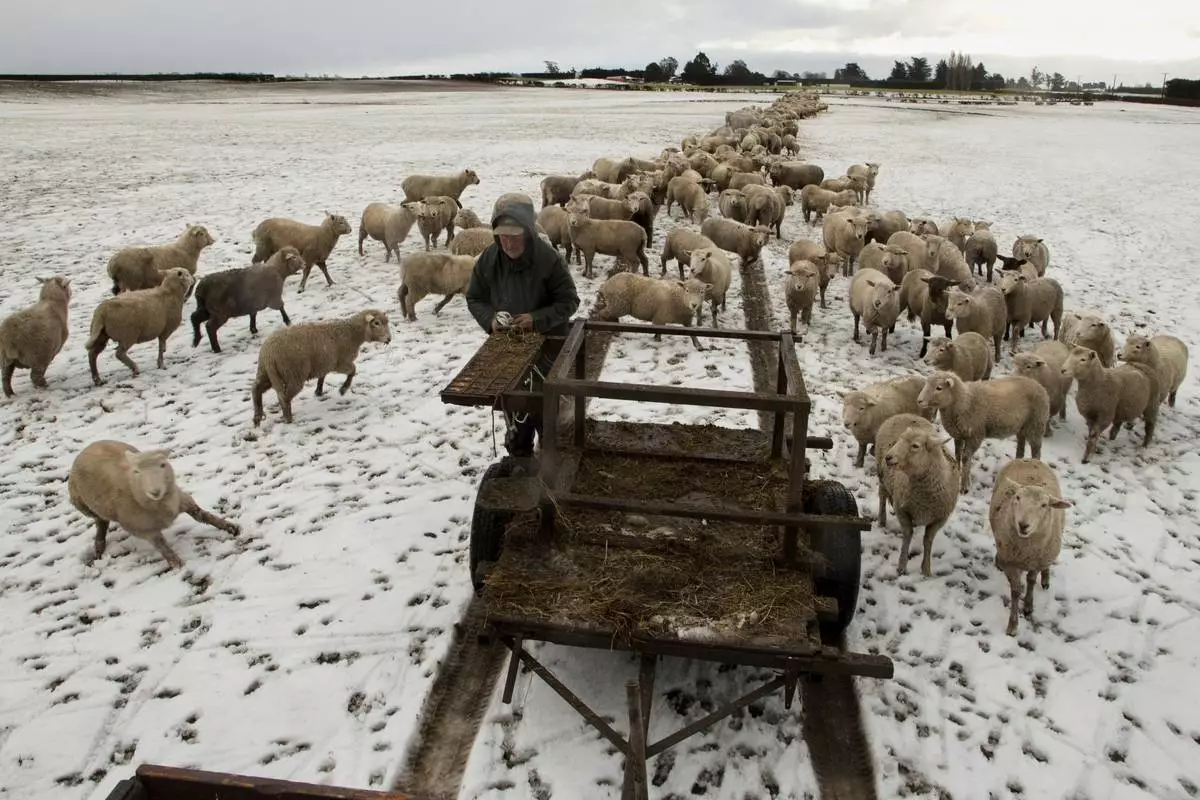
FILE - Farmer Ross Turner feeds his sheep hay in his snow covered paddocks on the outskirts of Christchurch, New Zealand, July 12, 2017. (AP Photo/Mark Baker, File)

FILE - Farmer Ross Turner feeds his sheep hay in his snow covered paddocks on the outskirts of Christchurch, New Zealand, July 12, 2017. (AP Photo/Mark Baker,File)
NEW YORK (AP) — Thousands of nurses in three hospital systems in New York City went on strike Monday after negotiations through the weekend failed to yield breakthroughs in their contract disputes.
The strike was taking place at The Mount Sinai Hospital and two of its satellite campuses, with picket lines forming. The other affected hospitals are NewYork-Presbyterian and Montefiore Medical Center in the Bronx.
About 15,000 nurses are involved in the strike, according to New York State Nurses Association.
The strike, which comes during a severe flu season, could potentially force the hospitals to transfer patients, cancel procedures or divert ambulances. It could also put a strain on city hospitals not involved in the contract dispute, as patients avoid the medical centers hit by the strike.
The hospitals involved have been hiring temporary nurses to try and fill the labor gap during the walkout, and said in a statement during negotiations that they would “do whatever is necessary to minimize disruptions.” Montefiore posted a message assuring patients that appointments would be kept.
The work stoppage is occurring at multiple hospitals simultaneously, but each medical center is negotiating with the union independently. Several other hospitals across the city and in its suburbs reached deals in recent days to avert a possible strike.
The nurses’ demands vary by hospital, but the major issues include staffing levels and workplace safety. The union says hospitals have given nurses unmanageable workloads.
Nurses also want better security measures in the workplace, citing incidents like a an incident last week, when a man with a sharp object barricaded himself in a Brooklyn hospital room and was then killed by police.
The union also wants limitations on hospitals’ use of artificial intelligence.
The nonprofit hospitals involved in the negotiations say they’ve been working to improve staffing levels, but say the union’s demands overall are too costly.
Nurses voted to authorize the strike last month.
Both New York Gov. Kathy Hochul and Mayor Zohran Mamdani had expressed concern about the possibility of the strike. As the strike deadline neared, Mamdani urged both sides to keep negotiating and reach a deal that “both honors our nurses and keeps our hospitals open.”
“Our nurses kept this city alive through its hardest moments. Their value is not negotiable,” Mamdani said.
The last major nursing strike in the city was only three years ago, in 2023. That work stoppage, at Mount Sinai and Montefiore, was short, lasting three days. It resulted in a deal raising pay 19% over three years at those hospitals.
It also led to promised staffing improvements, though the union and hospitals now disagree about how much progress has been made, or whether the hospitals are retreating from staffing guarantees.

Nurses strike outside Mount Sinai West Hospital, Monday, Jan. 12, 2026, in New York. (AP Photo/Yuki Iwamura)

Nurses strike outside Mount Sinai West Hospital, Monday, Jan. 12, 2026, in New York. (AP Photo/Yuki Iwamura)

Nurses strike outside Mount Sinai West Hospital, Monday, Jan. 12, 2026, in New York. (AP Photo/Yuki Iwamura)

Nurses strike outside Mount Sinai West Hospital, Monday, Jan. 12, 2026, in New York. (AP Photo/Yuki Iwamura)

FILE - A medical worker transports a patient at Mount Sinai Hospital, April 1, 2020, in New York. (AP Photo/Mary Altaffer, File)