Three golden snub-nosed monkeys from China made their public debut on Wednesday at the Beauval Zoo in France, marking the species' first journey outside Asia.
The golden snub-nosed monkey, or Sichuan snub-nosed monkey, is native to the mountainous forests of central and southwest China. Known for its striking golden fur and distinctive upturned nose, the golden snub-nosed monkey is a national treasure in China and is under its top-level state protection.
With their golden fur, striking blue faces, and playful antics, swinging from ropes and darting between trees, the monkeys quickly won over French visitors.
Sylvie Taccon, a visitor, expressed her enthusiasm fluently in Chinese.
"I love golden snub-nosed monkeys!" she said.
"I am really excited and emotional. There are a lot of emotional (moments). It is a beautiful place and monkeys are so amazing. So amazing to see them in reality. For me it is too much. It is really too much," said Catherine Langevin, an animal photography enthusiast.
The three primates, one male and two females, arrived in early April from the Shanghai Wild Animal Park, accompanied by a Chinese caretaker, and have since completed a month-long quarantine period.
Their arrival is part of a ten-year partnership between the Beauval Zoo and the China Wildlife Conservation Association, aimed at enhancing bilateral cooperation in wildlife protection and conservation.
Their enclosure, named "The Heights of China" alongside the adjacent giant panda habitat, features traditional Chinese architecture, including glazed tiles, blue-and-white porcelain motifs, and winding corridors. The exhibit replicates the Qinling-Bashan mountain ecosystem, complete with climbing structures, hiding spots, and foliage from the monkeys' native habitat, including their favorite leaves.
At a welcoming ceremony on Wednesday, the zoo's director, Rodolphe Delord, unveiled the names of the new residents: Jindou (golden seed), Jinbao (golden treasure) and Jinhua (golden flower). These names were chosen through an online naming competition launched earlier this year.
The Beauval Zoo previously welcomed giant pandas Huan Huan and Yuan Zai from China in 2012, launching a Sino-French cooperation program on panda breeding. With the arrival of the golden snub-nosed monkeys, the zoo has become the first outside Asia to host this rare and endangered species.
"We are the only zoo outside China to exhibit both golden snub-nosed monkeys and giant pandas. This is a tremendous opportunity and honor. We at Beauval Zoo will continue to foster these exchange and collaboration projects between France and China," said Delord.
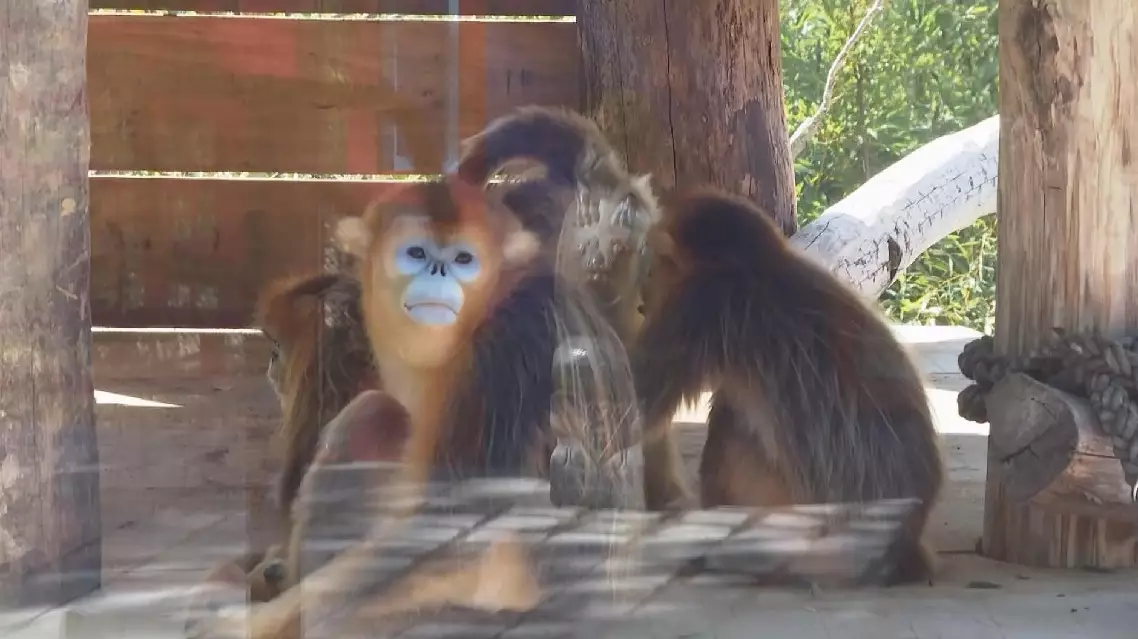
Golden snub-nosed monkeys from China make public debut at French zoo

The Guangdong–Hong Kong–Macao Greater Bay Area (GBA) is emerging as a key engine for China's fast-growing low-altitude economy by leveraging its dense industrial networks, efficient logistics systems, and rapid innovation capacity.
From logistics and manufacturing to urban services, the region is building an integrated industrial chain that allows low-altitude industries to scale up at unprecedented speed, thus turning drone-based applications from isolated trials into large-scale, commercial operations.
China's 15th Five-Year Plan, covering 2026 to 2030, calls for the cultivation of new pillar industries and the accelerated development of strategic emerging industrial clusters, including the low-altitude economy.
At a drone operations center in Bao'an District, Shenzhen City in south China's Guangdong Province, a dozen logistics drones take off and land within minutes. Urgently needed production parts, documents, and small parcels are dispatched from here to cities in the province including Dongguan, Zhongshan, and Zhuhai.
Behind these high-flying aircraft lies what observers describe as an "invisible industrial chain", built on speed and efficiency.
"Look at this aircraft. About 90 percent of its components come from nearby areas. Relying on Shenzhen's strong logistics capabilities and its complete supply chain, these parts can be delivered to our factory within half an hour for assembly, processing, and production," said Li Kunhuang, person-in-charge of Shenzhen GODO Innovation Technology Co., Ltd.
Once a new product is unveiled, testing and calibration begin immediately at the drone testing field. As soon as the process is completed, the new models can be put into real-world operation, realizing almost “zero delay” from research and development to application.
Supported by a robust industrial chain, low-altitude routes in Shenzhen are effectively connecting the urban landscape. From its Bao'an District to Songshan Lake in Dongguan City, production components can be delivered within one hour. Supplies are transported between Zhuhai City's Xiangzhou Port to Dong'ao Island in just 25 minutes. And light industrial goods can travel round-trip within a single day between Guzhen Town in Zhongshan City and Xinhui District in Jiangmen City.
More low-altitude application scenarios are expected to be implemented in the near future.
In Qianhai District, Shenzhen is accelerating the construction of a pilot demonstration zone of low-altitude integrated three-dimensional transportation hub.
"We have built the country's first low-altitude integrated three-dimensional transportation hub, and are gradually developing a pilot flight zone that integrates multiple scenarios such as inspection, logistics, and cultural tourism. This will provide technical support for the next step of commercializing cross-border logistics and emergency rescue services across the Guangdong–Hong Kong–Macao Greater Bay Area," said Wu Xuemin, head of the Shenzhen Qianhai Low-Altitude Integrated Three-Dimensional Transportation Hub Pilot Demonstration Zone.
Integrated supply chains propel Greater Bay Area's low-altitude economy growth