NEW YORK (AP) — The founder and former CEO of the cryptocurrency lending platform Celsius Network was sentenced Thursday to 12 years in prison after a prosecutor labeled him a predator who “preyed on hope” by enticing vulnerable customers to risk their life savings for a supposedly safe investment.
Alexander Mashinsky, 59, was sentenced by U.S. District Judge John G. Koeltl, who said a substantial term in prison was necessary for someone who engaged in “extremely serious” crimes that enabled him to pocket over $45 million while some of his customers lost everything and suffered severe psychological harm.
Celsius declared bankruptcy in 2022, exposing risky financial bets Mashinsky had made with some of the $20 billion that thousands of customers poured into the company. He had promised that their money would be safe and secure at Celsius, which pitched itself as a modern-day bank where crypto assets could earn interest.
The defense blamed the collapse of Celsius on a “cataclysmic downturn” of cryptocurrency markets in May and June of 2022 and said in court papers that Mashinsky's “actions were never predatory, exploitative or venal. He never acted with the intent to hurt anyone.”
But Assistant U.S. Attorney Allison Nichols cast him as a financial predator, telling the judge Thursday that Mashinsky had deceived customers from the start by exaggerating Celsius' ability to build momentum.
“He preyed on hope,” she said. “Mashinsky knew exactly what he was doing — selling these people hope.”
She said the customers were not going to be made financially whole regardless of money that can be recovered through bankruptcy proceedings.
Before he was sentenced, Mashinsky sobbed several times as he apologized to customers and referenced his difficult past as his family was able to leave a small Ukrainian town in the former Soviet Union with help from the United States when he was 7.
The family moved to Israel, where Mashinsky served three years in the Israeli Defense Forces as a fighter pilot before coming to America.
Mashinsky said he “never meant to hurt anybody here after all this country has done for me.”
“I'm truly sorry,” he said, describing himself as someone “who came from nothing.”
When he pleaded guilty in December, Mashinsky admitted to misleading customers between 2018 and 2022 by promising their investments were safe even as he fabricated Celsius' profitability and put customers' funds at the mercy of uncollateralized loans and undisclosed risky market bets.
His attorney, Marc Mukasey, said victim impact statements submitted to the court were “rather brutal” toward his client.
“We hear the intensity of their pain,” he said. “Our sympathies are with everyone.”
Several victims spoke at the sentencing hearing.
Cameron Crewes, who serves on a victims' committee, called for a “harsh sentence,” saying nearly 250 victims died before they could see justice served or get adequately compensated for losses.
“Many people have been wiped out,” he said.
In a statement, U.S. Attorney Jay Clayton said Mashinsky “made tens of millions of dollars while his customers lost billions.”
He added: “America's investors deserve better. The case for tokenization and the use of digital assets is strong, but it is not a license to deceive. The rules against fraud still apply.”
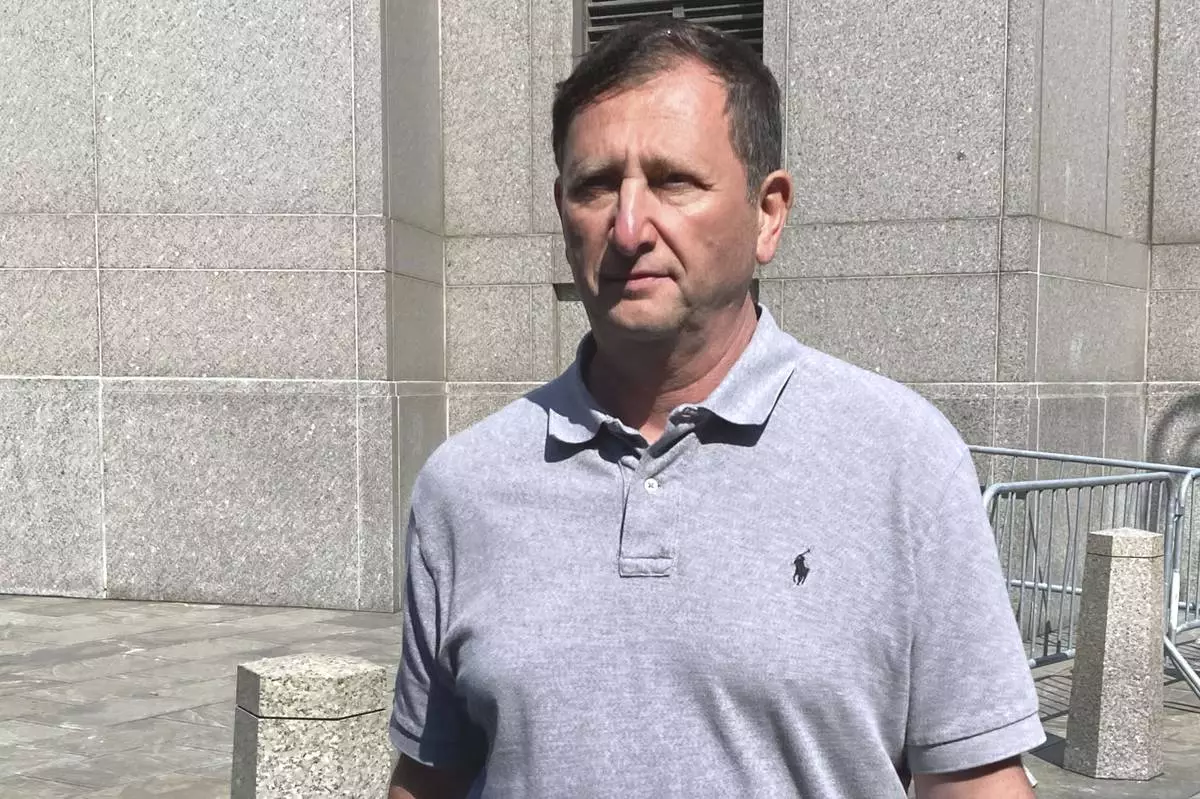
FILE - Alexander Mashinsky, founder and former chief executive of the failed cryptocurrency lending platform Celsius Network, leaves Manhattan federal court, July 13, 2023, in New York. (AP Photo/Lawrence Neumeister, File)

FILE - Alexander Mashinsky, founder and former chief executive of the failed cryptocurrency lending platform Celsius Network, leaves Manhattan federal court with his legal team, Tuesday, July 25, 2023, in New York. (AP Photo/John Minchillo, File)
DUBAI, United Arab Emirates (AP) — A tenuous ceasefire appeared to be holding Saturday after the United States struck two Iranian oil tankers, while the country that hosts the U.S. Navy’s regional headquarters said it arrested dozens of people it alleged were linked to Iran’s Revolutionary Guard.
Attacks Friday cast doubt on the month-old ceasefire that the United States has insisted is still in effect. Washington is awaiting an Iranian response to its latest proposal for a deal to end the war, reopen the Strait of Hormuz and roll back Tehran’s disputed nuclear program.
The U.S. military said Friday that its forces had disabled two Iranian tankers that were trying to breach an American blockade of Iran’s ports. Hours earlier, the military said it thwarted attacks on three Navy ships and struck Iranian military facilities in the strait.
Meanwhile, in the small Gulf island of Bahrain, the nation's Ministry of Interior said Saturday it had arrested 41 people it alleges are part of a group affiliated with Iran’s Revolutionary Guard. It said investigations are ongoing to take further action against anyone affiliated with the group but did not provide further details.
Bahrain is led by a Sunni Muslim monarchy but, like Iran, its population is majority Shiite. Rights groups have said that the kingdom has used the war between Iran and the U.S., which bases its Fifth Fleet in the country, as an excuse to crack down on dissent at home.
Iran has mostly blocked the critical waterway for global energy since the U.S. and Israel launched the war on Feb. 28, causing a global spike in fuel prices and rattling world markets. The U.S. has imposed its own blockade of Iran’s ports.
The U.S. military posted video of the two Iranian tankers as their smokestacks were struck by an American fighter jet on Friday. Earlier in the week, an American military jet shot out the rudder of a tanker the U.S. military said was attempting to breach its blockade.
A U.S. strike overnight killed at least one sailor and injured 10 others aboard a cargo vessel that caught fire, a news agency affiliated with Iran's judiciary reported. It was not clear if the ship was one of the two tankers the U.S. acknowledged striking.
Despite the attacks, U.S. President Donald Trump has insisted the ceasefire is holding. He also has reiterated threats to resume full-scale bombing if Iran doesn’t accept an agreement to reopen the strait and roll back its nuclear program.
On Friday, Iranian foreign ministry spokesperson Esmail Baghaei said the country was not paying attention to “deadlines” and Tehran continues reviewing a U.S. proposal related to ongoing negotiations, according to state-run IRNA.
A top Iranian official also said Friday that the country's Supreme Leader Mojtaba Khamenei was in “complete health" and that he would eventually appear in public.
The comments were made by Mazaher Hosseini, who is affiliated with the office of Iran’s former Supreme Leader, at a pro-government gathering. Hosseini said Mojtaba had suffered knee and back injuries but that they’ve largely healed and he’s now in good condition.
Khamenei hasn't been seen in public since the war began and the continued absence of verified images, audio, or video of him has fueled speculation about his status. Remarks such as Hosseini's are seen by some as attempts to counter doubts that he may no longer be alive.
Britain’s defense ministry said it was deploying a warship to the Middle East to join a potential mission to protect commercial ships in the Strait of Hormuz.
The ministry said the destroyer HMS Dragon will “pre-position” in the region, ready to join a U.K.- and French-led security plan once hostilities end. France also announced this week it was moving its aircraft carrier strike group into the Red Sea in preparation for a potential mission in the strait.
Britain and France have led planning meetings involving several dozen countries on a coalition to reestablish freedom of navigation in the strait. But they stress it won’t start until there is a sustainable ceasefire and the maritime industry is reassured ships can go through the strait safely.
Satellite images reviewed by The Associated Press show what appears to be an oil slick in the Persian Gulf emanating from the western side of Kharg Island, Iran’s main crude export terminal.
Images taken Friday show the slick covering about 71 square kilometers (27 square miles) and appear to show oil still leaking from the terminal, said Ami Daniel, CEO of maritime intelligence firm Windward AI.
Daniel estimated that the equivalent of roughly 80,000 oil barrels has spilled from Kharg Island since the slick was first detected by satellite images Tuesday. It’s unknown whether the spill was caused by a malfunction, an airstrike or something else.
He said the spill appears to be spreading southwest and within the next two weeks could potentially reach the shores of the UAE, Qatar or Saudi Arabia.
The Pentagon declined to comment on whether the U.S. military was tracking the spill or whether there had been recent strikes on the Iranian island. Based on the imagery taken earlier this week, the spill occurred before the most recent round of U.S. strikes.
As tensions escalate there's been a flurry of diplomacy across the globe.
Russia’s foreign ministry said Saturday that it, as well as Saudi Arabia, is calling for continued diplomatic efforts to reach a “sustainable, long-term agreement” to end the war, according to Russia's foreign ministry.
Egyptian and Qatari top diplomats have also have reiterated that diplomacy is the sole path to finding a solution, according to a readout of a Saturday phone call between Egyptian Foreign Minister Badr Abdelatty and his Qatari counterpart Sheikh Mohammed bin Abdulrahman Al Thani.
Pakistani Prime Minister Shehbaz Sharif said his country has been in contact with the U.S. and Iran “day and night” in an effort to extend the ceasefire and reach a peace deal.
——
Magdy reported from Cairo, Egypt. Associated Press reporter Jill Lawless contributed from London.
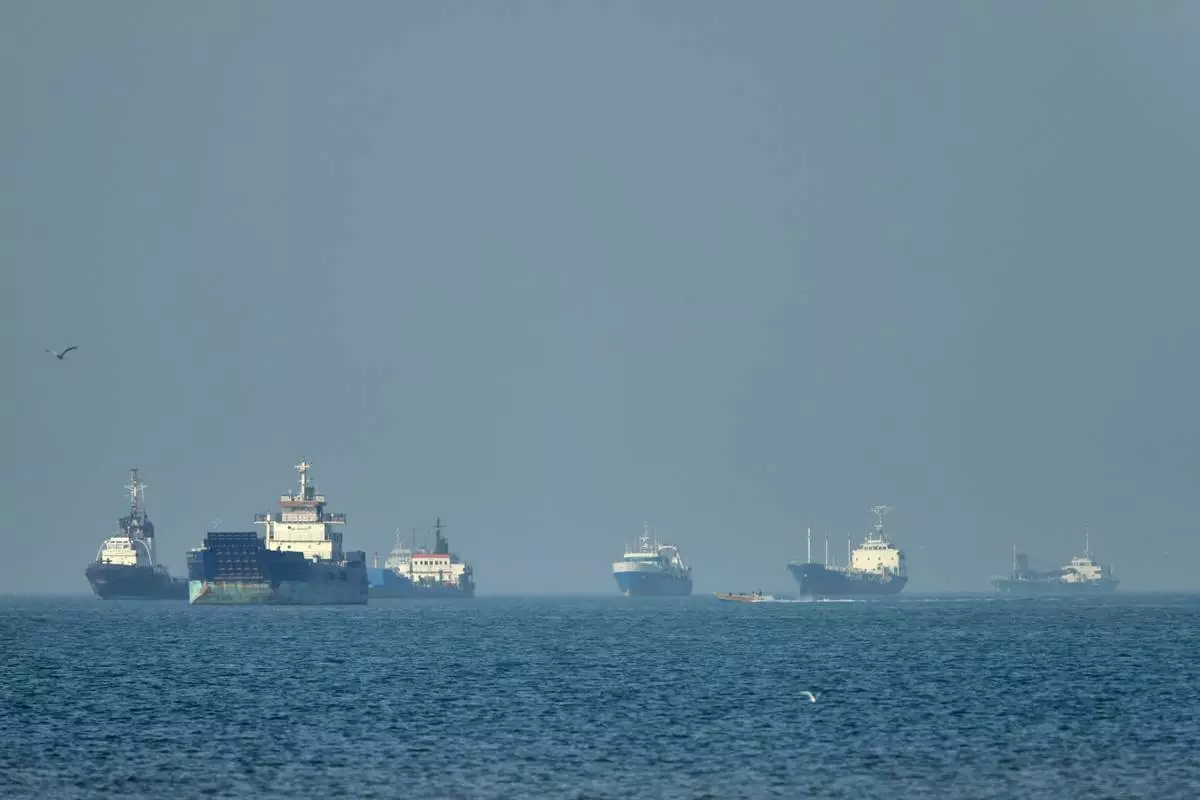
Cargo ships, including bulk carriers and general cargo vessels, sit at anchor offshore as a small motorboat passes in the foreground, in the Strait of Hormuz off Bandar Abbas, Iran, Monday, May 4 , 2026.(Amirhosein Khorgooi/ISNA via AP)
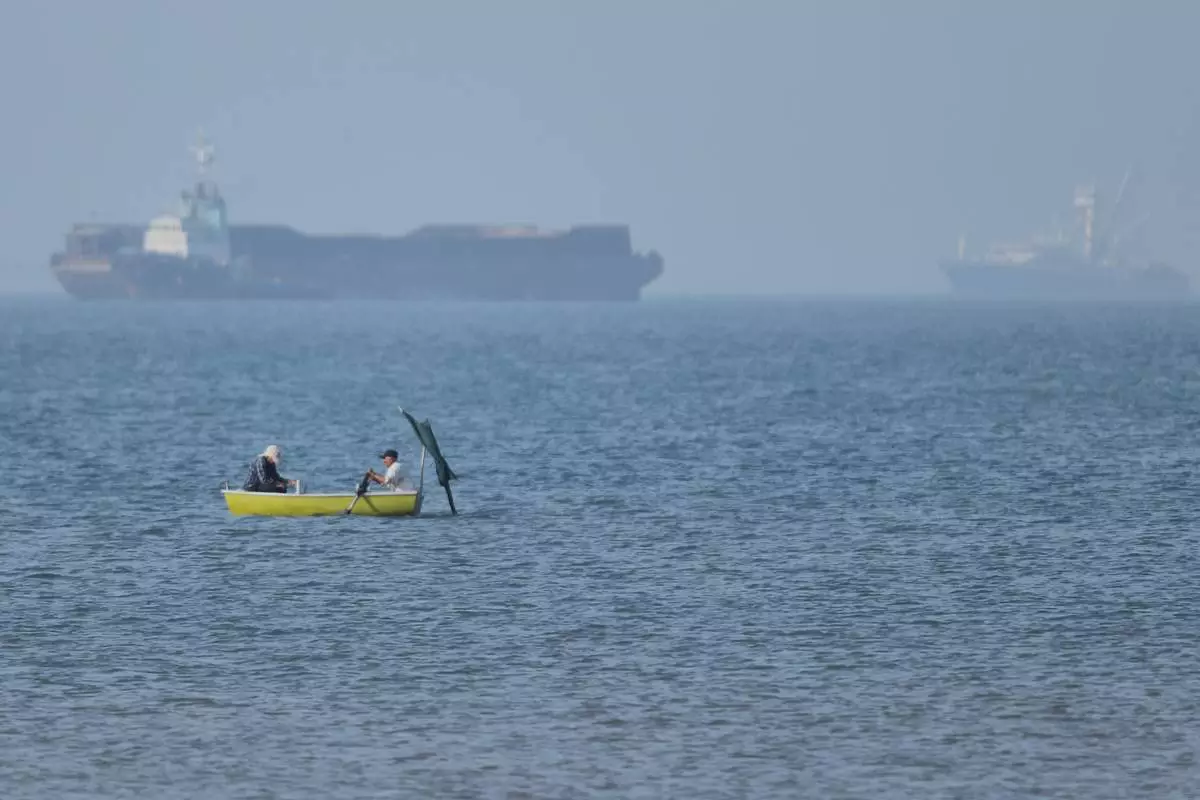
Two men sit in a small boat on the water as cargo ships are anchored in the background in the Strait of Hormuz off Bandar Abbas, Iran, Monday, May 4, 2026. (Amirhosein Khorgooi/ISNA via AP)