Skip to Content Facebook Feature Image

Seeing the Unseen: International Chameleon Day 2025 Spotlights Hidden Threats and Community Solutions

News

Seeing the Unseen: International Chameleon Day 2025 Spotlights Hidden Threats and Community Solutions
News

News

Seeing the Unseen: International Chameleon Day 2025 Spotlights Hidden Threats and Community Solutions

2025-05-09 17:59 Last Updated At:18:10

ANTANANARIVO, Madagascar--(BUSINESS WIRE)--May 9, 2025--

Wildlife Madagascar proudly announces the second annual International Chameleon Day, celebrated globally on May 9 th. This year, the theme shifts to not only celebrating the beauty and diversity of chameleons but also spotlighting the invisible threats they face—and the innovative, community-based solutions being deployed to protect them.

This press release features multimedia. View the full release here: https://www.businesswire.com/news/home/20250509774694/en/

Madagascar is home to nearly half of the world’s chameleon species, many of which are found nowhere else on Earth. Yet these remarkable reptiles—famous for their color-shifting abilities and incredible camouflage—are increasingly difficult to spot in the wild, not only due to their disguises but also because many are disappearing.

In 2025, Wildlife Madagascar launched a bold new chapter in the chameleon conservation program thanks to a grant from the Mohamed bin Zayed Species Conservation Fund, supporting the study of two unique species: the Critically Endangered Namoroka leaf chameleon ( Brookesia bonsi ) at its Namoroka field site and the Endangered globe-horned chameleon ( Calumma globifer ) at its La Mananara field site. These efforts aim to close urgent knowledge gaps and guide future protection strategies.

Additionally, with financial support from the Chameleon Academy and Michael Nash, MD, PhD, Wildlife Madagascar created an educational poster designed to be distributed in Malagasy communities where the invasive plant, silverleaf desmodium ( Desmodium uncinatum ), is overtaking native habitats and threatening local reptile populations through entanglement. This poster empowers communities to identify and remove the harmful plant species to support local biodiversity.

"International Chameleon Day is more than a celebration—it's a chance to mobilize action," said Dr. Tim Eppley, Chief Conservation Officer at Wildlife Madagascar. “By linking science, education, and community knowledge, we can address hidden threats like invasive species and empower local solutions that benefit both people and wildlife.”

Also new this year is the launch of a secondary school curriculum, building on last year’s successful K-6 program. Developed by Wildlife Madagascar with the support of the Hervey Family Fund at the San Diego Foundation, the full educational suite—now available in English, French, and Malagasy—includes classroom activities, worksheets, fact sheets, and art-based learning tools that introduce students to chameleon biology, ecology, and conservation.

“In Madagascar, chameleons are part of our natural heritage, but many children grow up without realizing how endangered they are,” said Dr. Jacques Rakotondranary, Project Manager at Wildlife Madagascar’s La Mananara field site. “Our International Chameleon Day activities are opening eyes—not only to the secret lives of these fascinating reptiles but also to the shared responsibility we all have to protect the forest. By educating students and engaging communities, we are planting the seeds of stewardship that will help ensure a future where both people and wildlife thrive.”

Wildlife Madagascar works year-round to build that future by engaging children and local communities in hands-on conservation education. From school visits to reforestation projects, the organization provides opportunities for Malagasy youth to explore nature, discover the incredible wildlife found only on their island, and become part of the solution to safeguarding it. These programs empower the next generation of conservation leaders while addressing the everyday challenges that rural communities face.

From zoos in the E.U. to classrooms in Madagascar, over 50 partners have joined in this global celebration of chameleons, bringing awareness and education to every corner of the world. Joining the chameleon call to action are these partners: IUCN SSC Chameleon Specialist Group, Madagascar’s Ministry of the Environment and Sustainable Development, Madagascar National Parks, Anderson Lab at University of South Dakota, Asity Madagascar, Aspinall Foundation, Association Fanamby, Caméléon Center Conservation, Centre ValBio, Chester Zoo, National Center for Training, Studies and Research in Environment and Forestry in Morondava (CNFEREF), National Center for Environmental Research in Morondava (CNRE), Conservation Fusion, Conservation International, Centre de Recherche en Education Environnementale d’Antananarivo (CREE- ENS), Fondation pour les Aires Protégées et la Biodiversité de Madagascar (FAPBM), Fondation Tany Meva, Frank Glaw of the Bavarian State Collection of Zoology in Munich (SNSB), Full Forests at Montclair State University, Groupe d'Étude et de Recherche sur les Primates de Madagascar (GERP), Impact Madagascar, Institute of Forest Ecology at the Slovak Academy of Sciences, Israel Nature and Parks Authority, Institut Supérieur de Sciences, Environnement & Développement Durable (ISSEDD) at the Université de Toamasina, Lemur Conservation Foundation, Lemur Conservation Network, Madagascar Biodiversity Partnership, Madagascar Fauna and Flora Group (MFG), Madagasikara Voakajy, Malagasy Youth Biodiversity Network, Mention Anthropobiologie et Développement Durable at the Université d’Antananarivo, Mention Foresterie et Environnement de l'Ecole Supérieure des Sciences Agronomiques (ESSA-Forêts) at the Université d’Antananarivo, Mention Sciences Agronomiques & Environnementales at the Université d’Antsiranana, Mention Zoologie et Biodiversité Animale at the Université d’Antananarivo, Mikajy Natiora, Money for Madagascar, ONG Cameleon Madagascar, ONG l'Homme et l'Environnement, ONG Move Up Madagascar, Planet Madagascar, Section of Herpetology at the National Museums of Kenya, SEED Madagascar, TBSE, The Dr. Abigail Ross Foundation for Applied Conservation, The Peregrine Fund, Université de Vakinankaratra, University of Hamburg, Vinako4Madagascar, Vision Madagascar NGO, WCS, World Wide Fund for Nature-Madagascar (WWF), and Zoo Vienna.

This May 9 th, individuals, educators, and conservationists are encouraged to:

For more information about International Chameleon Day, access to the education materials, or to get involved, visit: https://wildlifemadagascar.org/news-and-stories/international-chameleon-day/.

About Wildlife Madagascar

Wildlife Madagascar, a community-based conservation organization, is dedicated to the preservation and protection of Madagascar's unique biodiversity through a multifaceted strategy and collaborative efforts.
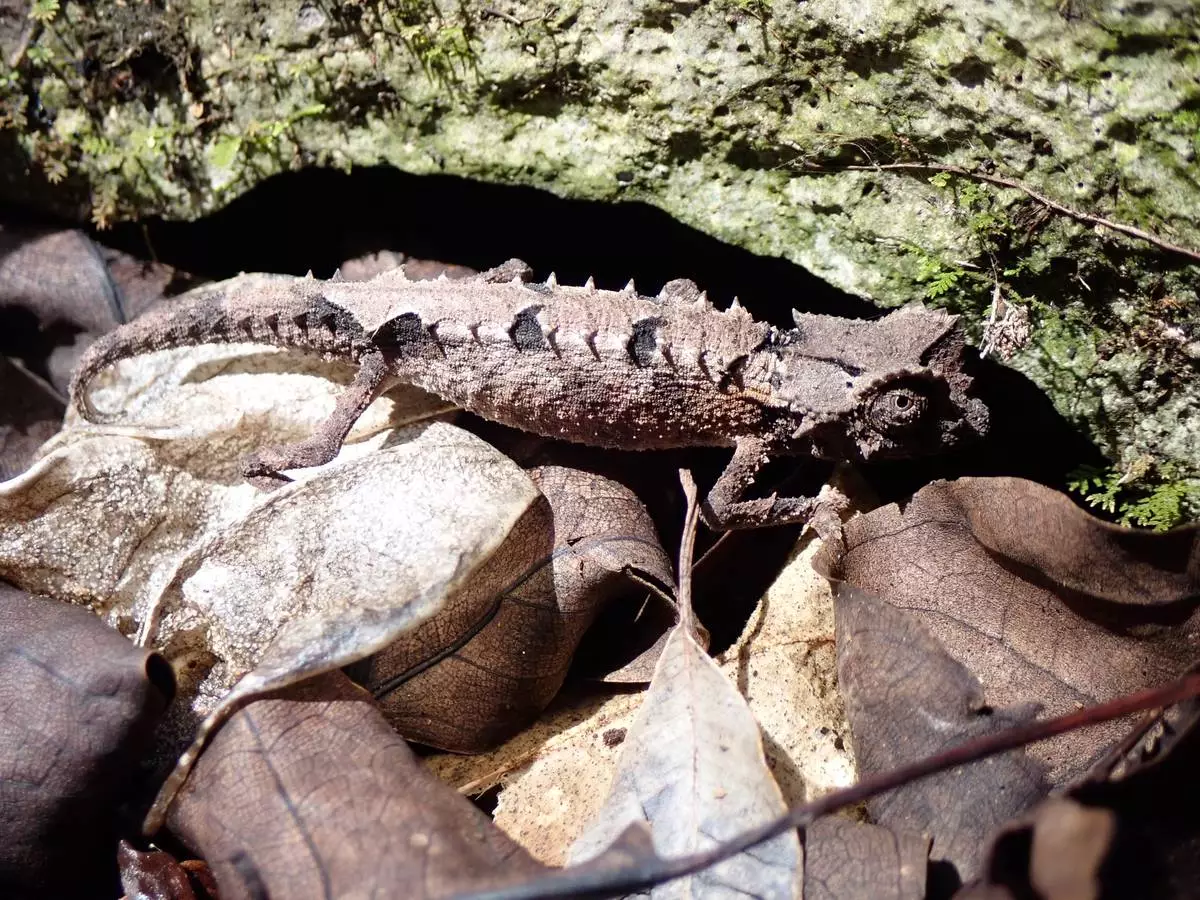
The elusive Namoroka leaf chameleon (Brookesia bonsi). This Critically Endangered species, first described in 1980, is found only in a tiny area of Namoroka National Park, spanning less than 39 square miles. Like other wildlife within the national park, the Namoroka leaf chameleon is threatened by habitat loss and degradation due to forest clearing for livestock, slash-and-burn agriculture, and logging.

The elusive Namoroka leaf chameleon (Brookesia bonsi). This Critically Endangered species, first described in 1980, is found only in a tiny area of Namoroka National Park, spanning less than 39 square miles. Like other wildlife within the national park, the Namoroka leaf chameleon is threatened by habitat loss and degradation due to forest clearing for livestock, slash-and-burn agriculture, and logging.
RHO, Italy (AP) — No ice is colder and harder than speedskating ice. The precision it takes has meant that Olympic speedskaters have never competed for gold on a temporary indoor rink – until the 2026 Milan Cortina Winter Games.

In the pursuit of maximum glide and minimum friction, Olympic officials brought on ice master Mark Messer, a veteran of six previous Olympic speedskating tracks and the ice technician in charge of the Olympic Oval in Calgary, Canada — one of the fastest tracks in the world with over 300 records.

Messer has been putting that experience to work one thin layer of ice at a time since the end of October at the new Speed Skating Stadium, built inside adjacent trade fair halls in the city of Rho just north of Milan.

“It’s one of the biggest challenges I’ve had in icemaking,’’ Messer said during an interview less than two weeks into the process.

If Goldilocks were a speedskater, hockey ice would be medium hard, for fast puck movement and sharp turns. Figure skating ice would be softer, allowing push off for jumps and so the ice doesn’t shatter on landing. Curling ice is the softest and warmest of all, for controlled sliding.

For speedskating ice to be just right, it must be hard, cold and clean. And very, very smooth.

“The blades are so sharp, that if there is some dirt, the blade will lose the edge,’’ Messer said, and the skater will lose speed.

Speedskater Enrico Fabris, who won two Olympic golds in Turin in 2006, has traded in his skates to be deputy sports manager at the speedskating venue in Rho. For him, perfect ice means the conditions are the same for all skaters — and then if it's fast ice, so much the better.

"It's more of a pleasure to skate on this ice,'' he said.

Messer’s first Olympics were in Calgary in 1988 — the first time speedskating was held indoors. “That gave us some advantages because we didn’t have to worry about the weather, wind blowing or rain,’’ he said. Now he is upping the challenge by becoming the first ice master to build a temporary rink for the Olympics.

Before Messer arrived in Italy, workers spent weeks setting up insulation to level the floor and then a network of pipes and rubber tubes that carry glycol — an antifreeze — that is brought down to minus 7 or minus 8 degrees Celsius (17.6 to 19.4 degrees Fahrenheit) to make the ice.

Water is run through a purification system — but it can’t be too pure, or the ice that forms will be too brittle. Just the right amount of impurities “holds the ice together,’’ Messer said.

The first layers of water are applied slowly, with a spray nozzle; after the ice reaches a few centimeters it is painted white — a full day’s work — and the stripes are added to make lanes.

“The first one takes about 45 minutes. And then as soon as it freezes, we go back and do it again, and again and again. So we do it hundreds of times,’’ Messer said.

As the ice gets thicker, and is more stable, workers apply subsequent layers of water with hoses. Messer attaches his hose to hockey sticks for easier spreading.

What must absolutely be avoided is dirt, dust or frost — all of which can cause friction for the skaters, slowing them down. The goal is that when the skaters push “they can go as far as possible with the least amount of effort,’’ Messer said.

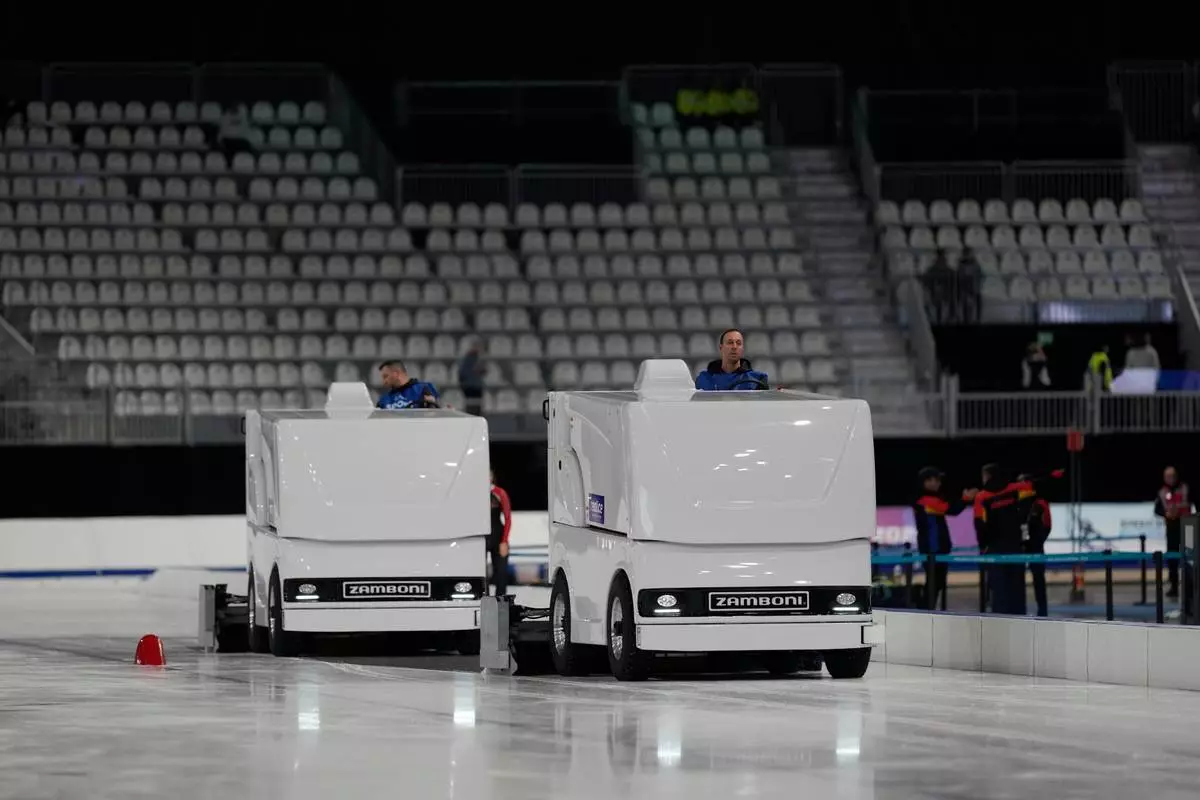
The Zamboni ice resurfacing machine plays a key role in keeping the track clean, cutting off a layer and spraying water to make a new surface.

One challenge is gauging how quickly the water from the resurfacing machine freezes in the temporary rink.

Another is getting the ice to the right thickness so that the Zamboni, weighing in at six tons, doesn’t shift the insulation, rubber tubing or ice itself.

“When you drive that out, if there’s anything moving it will move. We don’t want that,’’ Messer said.

The rink got its first big test on Nov. 29-30 during a Junior World Cup event. In a permanent rink, test events are usually held a year before the Olympics, leaving more time for adjustments. “We have a very small window to learn,’’ Messer acknowledged.

Dutch speedskater Kayo Vos, who won the men’s neo-senior 1,000 meters, said the ice was a little soft — but Messer didn’t seem too concerned.

“We went very modest to start, now we can start to change the temperatures and try to make it faster and still maintain it as a safe ice,’’ he said.

Fine-tuning the air temperature and humidity and ice temperature must be done methodically — taking into account that there will be 6,000 spectators in the venue for each event. The next real test will be on Jan. 31, when the Olympians take to the ice for their first training session.

“Eighty percent of the work is done but the hardest part is the last 20 percent, where we have to try to find the values and the way of running the equipment so all the skaters get the same conditions and all the skaters get the best conditions,’’ Messer said.

AP Winter Olympics: https://apnews.com/hub/milan-cortina-2026-winter-olympics

Serpentines are set on the ice of the stadium where speed skating discipline of the Milan Cortina 2026 Winter Olympics will take place, in Rho, outskirt of Milan, Tuesday, Nov. 11, 2025. (AP Photo/Luca Bruno)

Serpentines are set on the ice of the stadium where speed skating discipline of the Milan Cortina 2026 Winter Olympics will take place, in Rho, outskirt of Milan, Tuesday, Nov. 11, 2025. (AP Photo/Luca Bruno)

Ice Master Mark Messer poses in the stadium where speed skating discipline of the Milan Cortina 2026 Winter Olympics will take place, in Rho, outskirt of Milan, Tuesday, Nov. 11, 2025. (AP Photo/Luca Bruno)

Ice Master Mark Messer poses in the stadium where speed skating discipline of the Milan Cortina 2026 Winter Olympics will take place, in Rho, outskirt of Milan, Tuesday, Nov. 11, 2025. (AP Photo/Luca Bruno)

Workers clean the ice surface during a peed skating Junior World Cup and Olympic test event, in Rho, near Milan, Italy, Saturday, Nov. 29, 2025. (AP Photo/Luca Bruno)

Workers clean the ice surface during a peed skating Junior World Cup and Olympic test event, in Rho, near Milan, Italy, Saturday, Nov. 29, 2025. (AP Photo/Luca Bruno)

Ice Master Mark Messer poses in the stadium where speed skating discipline of the Milan Cortina 2026 Winter Olympics will take place, in Rho, outskirt of Milan, Tuesday, Nov. 11, 2025. (AP Photo/Luca Bruno)

Ice Master Mark Messer poses in the stadium where speed skating discipline of the Milan Cortina 2026 Winter Olympics will take place, in Rho, outskirt of Milan, Tuesday, Nov. 11, 2025. (AP Photo/Luca Bruno)

Ice Master Mark Messer poses in the stadium where speed skating discipline of the Milan Cortina 2026 Winter Olympics will take place, in Rho, outskirt of Milan, Tuesday, Nov. 11, 2025. (AP Photo/Luca Bruno)

Ice Master Mark Messer poses in the stadium where speed skating discipline of the Milan Cortina 2026 Winter Olympics will take place, in Rho, outskirt of Milan, Tuesday, Nov. 11, 2025. (AP Photo/Luca Bruno)

Recommended Articles