Colombia this week took a leading position in Latin America for Indigenous rights and forest protection by formalizing Indigenous local governments across swaths of the Amazon, raising hopes that other countries in the region will follow its lead.
Activists say Monday's decision gives Indigenous communities not just land titles, but actual self-governing authority — complete with public budgets and administrative power. The process, underway since 2018, now has a legal framework enabling Indigenous councils to function as official local governments.
“This puts Colombia in the lead when it comes to recognizing Indigenous rights — not just to land, but to identity, autonomy, and decision-making over their own development,” said Mayu Velasco Anderson, head of the Peru and Colombia program at nongovernmental organization Rainforest Foundation Norway.
Patricia Suárez, Indigenous leader and adviser to the National Organization of Indigenous Peoples of the Colombian Amazon, called the presidential decree “historic.”
“We have been seeking recognition of our autonomy and self-determination as Indigenous Territorial Entities for over 30 years,” Suárez said. “This progress is a milestone in the consolidation of the rights of Indigenous Peoples as autonomous governments.”
In contrast, other Latin American countries typically only grant land titles. Brazil, for example, has extensive Indigenous territories that frequently intersect multiple municipalities, forcing communities to navigate conflicting public systems and undermining their self-governance.
“In Brazil, even demarcated and regularized Indigenous lands fall under the administrative boundaries of states and municipalities, and communities depend on these governments to access public policies,” said Inés Luna Maira, head of institutional partnerships at Rainforest Foundation Norway. “They have to deal with a patchwork of public systems and elected officials that don’t reflect Indigenous governance.”
Suriname, home to some of the most intact forests and Indigenous and Maroon communities, lags furthest behind other nations in the region on this issue.
Colombia's new framework gives Indigenous groups direct authority over their territories, streamlining governance and boosting protections for forests that are critical to combating climate change.
Julia Urrunaga, director of Peru Programs at the nonprofit Environmental Investigation Agency welcomed the move and expressed hope that her country would follow Colombia’s example.
“We celebrate this victory for the Indigenous Peoples of Colombia,” she said. “Sadly, the Peruvian government has been walking in the opposite direction — passing laws that affect Indigenous rights without prior consultation, which goes against Peru’s own constitution.”
Urrunaga pointed to what environmental activists have dubbed Peru´s “Anti-Forest Law," which activists say legalizes illegal deforestation in Indigenous territories, and to the government’s promotion of palm oil plantations over Amazonian forest.
“Peru’s Indigenous Peoples are still struggling to receive recognition of their ancestral territories,” she said. “And even when they obtain it, they don’t get the support they deserve from the state to protect their land and forests for the benefit of all humanity.”
The Associated Press’ climate and environmental coverage receives financial support from multiple private foundations. AP is solely responsible for all content. Find AP’s standards for working with philanthropies, a list of supporters and funded coverage areas at AP.org.
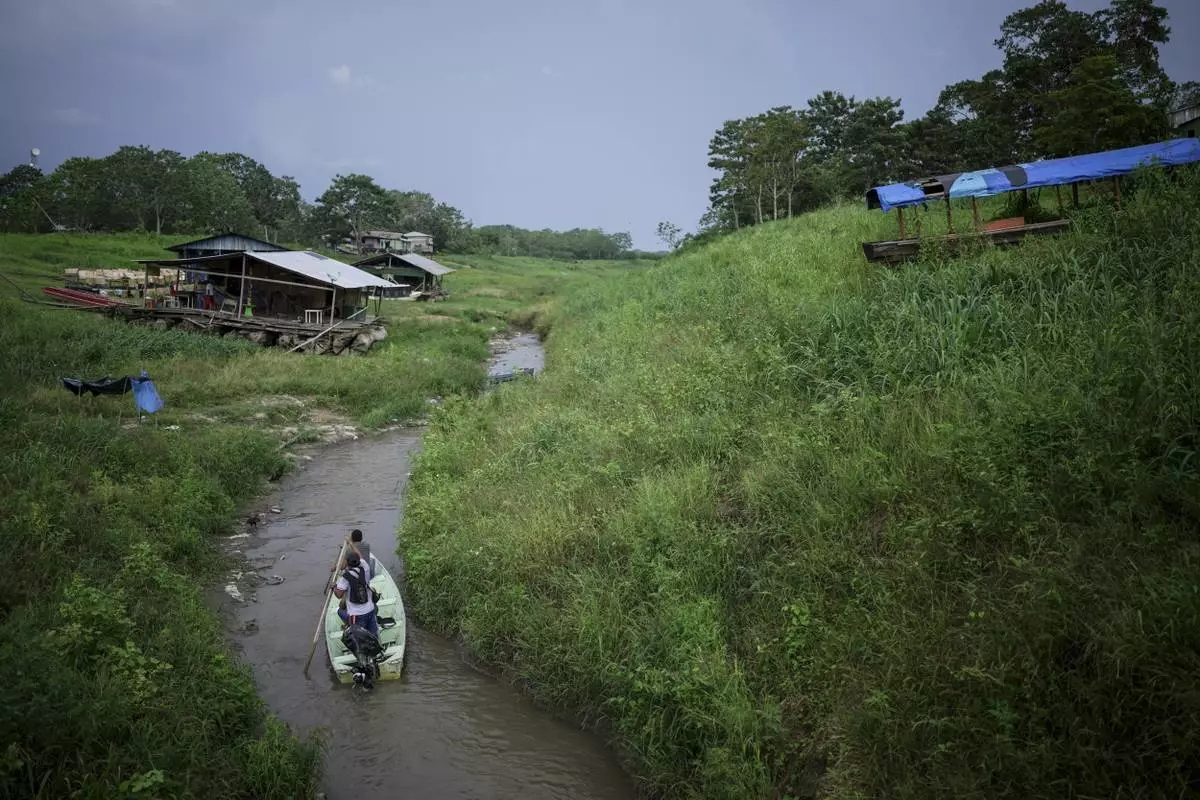
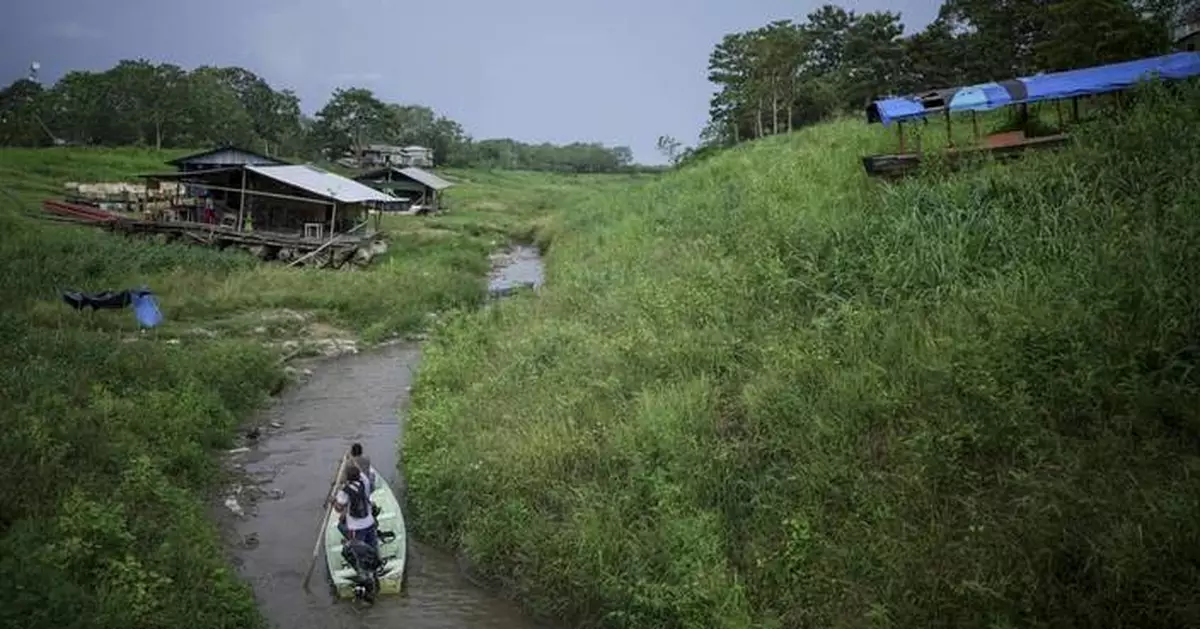
FILE - People maneuver by boat through the low water levels of a tributary that connects with the Amazon River, in Isla de la Fantasia, on the outskirts of Leticia, Colombia, Oct. 20, 2024. (AP Photo/Ivan Valencia, File)
Iran's top judge hinted at fast trials and executions for those who were detained in nationwide protests against the country's theocracy, even as activists said Wednesday that the death toll rose to levels unseen in decades, with at least 2,571 people killed so far.
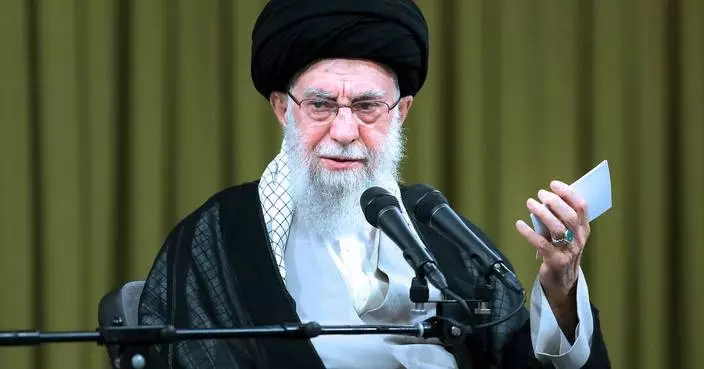
Iran’s judiciary chief Gholamhossein Mohseni-Ejei, made the comments about trials and executions in a video Tuesday, despite a warning from U.S. President Donald Trump that he would “take very strong action” if executions take place.
The U.S.-based Human Rights Activists News Agency said the number of dead climbed to at least 2,571 early Wednesday. The figure dwarfs the death toll from any other round of protest or unrest in Iran in decades and recalls the chaos surrounding the country’s 1979 Islamic Revolution.
After Trump was informed of the number of deaths, he warned Iran's leaders that he was terminating any negotiations and would “act accordingly.”
Details of the crackdown began emerging Tuesday as Iranians made phone calls abroad for the first time in days after authorities severed communications countrywide when the protests broke out.
Here is the latest:
Tens of thousands of mourners thronged the streets near Tehran University for the funeral of more than 300 security forces and civilians on Wednesday.
Many held Iranian flags and identical photos of Ayatollah Ali Khamenei and their relatives. The caskets, covered in Iranian flags, were stacked at least three high in the backs of trucks and covered with red and white roses and framed photographs of people who were killed. The crowd chanted and beat their chests in response to an emcee speaking from a stage.
One man in the crowd held up a photo of U.S. President Donald Trump during the Pennsylvania assassination attempt, emblazoned with: “The arrow doesn’t always miss!”
India's Embassy in Tehran urged Wednesday all Indian nationals to leave Iran, citing what it called an “evolving situation” in the Islamic Republic.
The statement, posted on X, also advised Indian citizens to remain highly vigilant and avoid areas where protests are taking place.
German police said Wednesday the two climbed over a fence into embassy grounds and tore down an Iranian flag. Both wanted to hoist two pre-Islamic Republic flags but failed, German news agency dpa reported.
They left the grounds when guards used pepper spray and were detained on the sidewalk outside.
The incident happened late Tuesday.
Major Middle East governments were discouraging the Trump administration from waging a war with Iran, fearing “unprecedented consequences” in the volatile region, an Arab Gulf diplomat said Wednesday.
The Cairo-based diplomat, who was given anonymity because he wasn't authorized to speak to the media, said major governments in the region, including Turkey, Egypt, Saudi Arabia and Pakistan, have been “in constant contact” with the U.S. administration over a potential American strike on Iran that could explode into a “full-blown war.”
Such a war will “certainly” have dire repercussions “not only on the Middle East but also on the global economy," he said.
Iranian state television said Wednesday’s mass funeral in Tehran would include 300 bodies of security force members and civilians. The funeral is expected to take place at Tehran University under heavy security.
The U.S.-based Human Rights Activists News Agency said the crackdown killed at least 2,571 people. It said 2,403 of the dead were protesters and 147 were government-affiliated. Twelve children were killed, along with nine civilians it said were not taking part in protests. More than 18,100 people have been detained, the group said.
Gauging the demonstrations and the death toll from abroad has grown more difficult. The Associated Press has been unable to independently assess the toll, given the communications being disrupted in the country.
Melanie Lidman contributed from Jerusalem.
Trump’s decision to impose a 25% tariff on countries that trade with Iran could impact India, an expert said, as New Delhi already faces existing 50% U.S. trade levies due to its purchases of Russian oil.
Abhijit Mukhopadhyay, a senior economist at the Chintan Research Foundation in New Delhi, said the bigger risk is not India-Iran trade, but India’s access to the U.S. market, as its exports to Iran are modest.
India mainly exports rice, tea, sugar, pharmaceuticals and electrical machinery to Iran, while importing dry fruits and chemical products. Textiles and garments, gems and jewelry and engineering goods are likely to be the most vulnerable sectors, he said.
Trump’s latest move also could affect India’s investments in Iran, including the strategically important Chabahar port, which gives India a trade route to Afghanistan, Central Asia and Europe while bypassing Pakistan, Mukhopadhyay said.
Iran’s judiciary chief signals fast trials and executions for those detained in nationwide protests.
Gholamhossein Mohseni-Ejei made the comment in a video shared by Iranian state television on Wednesday.
He emphasized the need for swift action, saying delays would lessen the impact.
His remarks challenge Trump, who warned Iran about executions in an interview aired Tuesday.
Trump stated the U.S. would take strong action if Iran proceeded with executions. The situation highlights escalating tensions between the two countries over the handling of the protests.
Dozens of Pakistani students studying in Iran have returned home through a remote southwestern border crossing, a Pakistani immigration official said Wednesday.
Federal Investigation Agency spokesperson in Quetta city, Samina Raisani, said about 60 students crossed into Pakistan on Tuesday through Gabd border in Balochistan province with valid travel documents.
More students were expected to return through the same crossing later Wednesday, she said.
Mudassir Tipu, Pakistan’s ambassador to Iran, said Tuesday that Iranian universities had rescheduled exams and permitted international students to leave the country.
The satellite internet provider Starlink now offers free service to people in Iran who have access to the company's receivers, activists said Wednesday.
Mehdi Yahyanejad, a Los Angeles-based activist who helped get the units into Iran, told The Associated Press that the free service had started. Other activists also confirmed in messages online that the service was free.
Starlink has been the only way for Iranians to communicate with the outside world since authorities shut down the internet Thursday night as nationwide protests swelled and they began a bloody crackdown against demonstrators.
Starlink did not immediately acknowledge the decision.

This frame grab from videos taken between Jan. 9 and Jan. 11, 2026, and circulating on social media purportedly shows images from a morgue with dozens of bodies and mourners after crackdown on the outskirts of Iran's capital, in Kahrizak, Tehran Province. (UGC via AP)