CHARLOTTE, N.C. (AP) — A hole-by-hole look at Quail Hollow Club, site of the 107th PGA Championship to be played May 15-18:
A strong opening hole. A big left-to-right tee shots leaves players atop an elevated landing zone beyond the dogleg. The approach is mid-iron to a narrow, undulated green guarded by three big bunkers.
A 280-yard drive reaches a slight turn in the fairway, leaving about 170 yards to an elevated green that slopes from back to front.
The tee shot must be long and straight, avoiding a deep bunker on the right. The approach is to an elevated green that is surrounded by three bunkers and divided by a small ridge that separates the back from the front.
The shortest par 3 is framed by pine trees and features a large, undulating green guarded by three bunkers in the front. Anything long will end up below the green and leave a tough par save.
The hole slightly drops then heads up a shallow valley to a green that is situated on a hillside behind the sixth tee. The fairway has bunkers on both sides, and the green is narrow with a front right bunker.
The long par 3 plays downhill and asks a player to be accurate with a hybrid or a long iron. The green slopes back to front, and is guarded by a front right bunker.
The shortest and most exciting of the par 5s, this is easily reachable in two provided the tee shot avoids bunkers on the left and water on the right that runs long the fairway and cuts in front of the green. The green is surrounded by bunkers. It should be a birdie, but can lead to a big number.
Depending on the tees and the wind, players can try to drive the green or lay up and attack with a wedge. Two bunkers on the left side must be avoided, and a large bunker guards the right side of the green.
Typically among the toughest par 4s, the drive should avoid a bunker on the right for a player to have a clear shot with a long iron up the hill toward the green. Two front bunkers guard the green, which has a lot of movement to it.
Players can reach this in two provided they avoid the bunker on the left and trees on the right. The green is sloped from back to front and right to left, so position is everything to convert birdie chances. Bunkers are situated on both sides of the green.
Two large bunkers guard the corner of the slight dogleg, and deep bunkers are in play to the left of a slightly elevated green.
The fairway is narrow with trees tightly guarding both sides. From the fairway, players face a short iron to an elevated green that slopes severely from back to front. It’s crucial to keep the ball below the cup to have a chance at birdie or avoid potential three-putts.
The green is situated between two large bunkers. The putting surface has two levels with a collection area on the right middle portion, along with a severe slope from back to front. Par shouldn’t be a problem. Birdies figure to be difficult.
Players can go for the green or lay up with an iron. The water down the left side presents the risk with driver off the tee. From the fairway, the green is long and narrow and can be difficult to get it close to the pin. Birdies are as common as bogeys.
The final par 5 is deceptively challenging with water on the left and trees to the right. It plays uphill, and anything in the fairway should leave a fairway metal into the green, which has a ridge down the middle that can feed the ball close or repel it further away. This is the last easy birdie opportunity.
The green sits on the edge of the water. The tee shot to a slight dogleg right should avoid a bunker on the right side, and a mid-iron to a green with a bunker on the right and water on the left.
The signature hole at Quail Hollow is a peninsula green that requires a carry of 195 yards from the back tees. With a firm green, players have to be careful with back pin positions so the ball doesn’t run off the back into the water. The popular miss is to the right, which leaves a tough up-and-down.
One of the strongest closing holes, players must avoid a bunker on the right and a creek that meanders down the left side of the hole, with a steep slope to the left of the creek. The second shot is uphill with bunkers right and the creek to the left.
AP golf: https://apnews.com/hub/golf

FILE - Justin Thomas poses with the Wanamaker Trophy after winning the PGA Championship golf tournament at the Quail Hollow Club Sunday, Aug. 13, 2017, in Charlotte, N.C. (AP Photo/Chris O'Meara, File)
SEOUL, South Korea (AP) — A South Korean court sentenced former President Yoon Suk Yeol to five years in prison Friday in the first verdict from eight criminal trials over the martial law debacle that forced him out of office and other allegations.
Yoon was impeached, arrested and dismissed as president after his short-lived imposition of martial law in December 2024 triggered huge public protests calling for his ouster.
The most significant criminal charge against him alleges that his martial law enforcement amounted to a rebellion, An independent counsel has requested the death sentence over that charge, and the Seoul Central District Court will decide on that in a ruling on Feb. 19.
Yoon has maintained he didn’t intend to place the country under military rule for an extended period, saying his decree was only meant to inform the people about the danger of the liberal-controlled parliament obstructing his agenda. But investigators have viewed Yoon’s decree as an attempt to bolster and prolong his rule, charging him with rebellion, abuse of power and other criminal offenses.
In Friday’s case, the Seoul court sentenced Yoon for defying attempts to detain him and fabricating the martial law proclamation. He was also sentenced for sidestepping a legally mandated full Cabinet meeting, which deprived some Cabinet members who were not convened of their rights to deliberate on his decree.
Judge Baek Dae-hyun said in the televised ruling that imposing “a heavy punishment” was necessary because Yoon hasn’t shown remorse and has only repeated “hard-to-comprehend excuses.” The judge also said restoring legal systems damaged by Yoon’s action was necessary.
Yoon’s defense team said they will appeal the ruling, which they believe was “politicized” and reflected “the unliberal arguments by the independent counsel.” Yoon’s defense team argued the ruling “oversimplified the boundary between the exercise of the president’s constitutional powers and criminal liability.”
Park SungBae, a lawyer who specializes in criminal law, said there is little chance the court would decide Yoon should face the death penalty in the rebellion case. He said the court will likely issue a life sentence or a sentence of 30 years or more in prison.
South Korea has maintained a de facto moratorium on executions since 1997 and courts rarely hand down death sentences. Park said the court would take into account that Yoon’s decree didn’t cause casualties and didn’t last long, although Yoon hasn’t shown genuine remorse for his action.
South Korea has a history of pardoning former presidents who were jailed over diverse crimes in the name of promoting national unity. Those pardoned include strongman Chun Doo-hwan, who received the death penalty at a district court over his 1979 coup, the bloody 1980 crackdowns of pro-democracy protests that killed about 200 people, and other crimes.
Even if Yoon is spared the death penalty or life imprisonment at the rebellion trial, he may still face other prison sentences in the multiple smaller trials he faces.
Some observers say Yoon is likely retaining a defiant attitude in the ongoing trials to maintain his support base in the belief that he cannot avoid a lengthy sentence but could be pardoned in the future.
On the night of Dec. 3, 2024, Yoon abruptly declared martial law in a televised speech, saying he would eliminate “anti-state forces” and protect “the constitutional democratic order.” Yoon sent troops and police officers to encircle the National Assembly, but many apparently didn’t aggressively cordon off the area, allowing enough lawmakers to get into an assembly hall to vote down Yoon’s decree.
No major violence occurred, but Yoon's decree caused the biggest political crisis in South Korea in decades and rattled its diplomacy and financial markets. For many, his decree, the first of its kind in more than 40 years in South Korea, brought back harrowing memories of past dictatorships in the 1970s and 1980s, when military-backed leaders used martial law and emergency measures to deploy soldiers and tanks on the streets to suppress demonstrations.
After Yoon's ouster, his liberal rival Lee Jae Myung became president via a snap election last June. After taking office, Lee appointed three independent counsels to look into allegations involving Yoon, his wife and associates.
Yoon's other trials deal with charges like ordering drone flights over North Korea to deliberately inflame animosities to look for a pretext to declare martial law. Other charges accuse Yoon of manipulating the investigation into a marine’s drowning in 2023 and receiving free opinion surveys from an election broker in return for a political favor.

A supporter of former South Korean President Yoon Suk Yeol shouts slogans outside Seoul Central District Court, in Seoul, South Korea, Friday, Jan. 16, 2026. (AP Photo/Lee Jin-man)

Supporters of former South Korean President Yoon Suk Yeol hold signs and flags outside Seoul Central District Court, in Seoul, South Korea, Friday, Jan. 16, 2026. (AP Photo/Lee Jin-man)
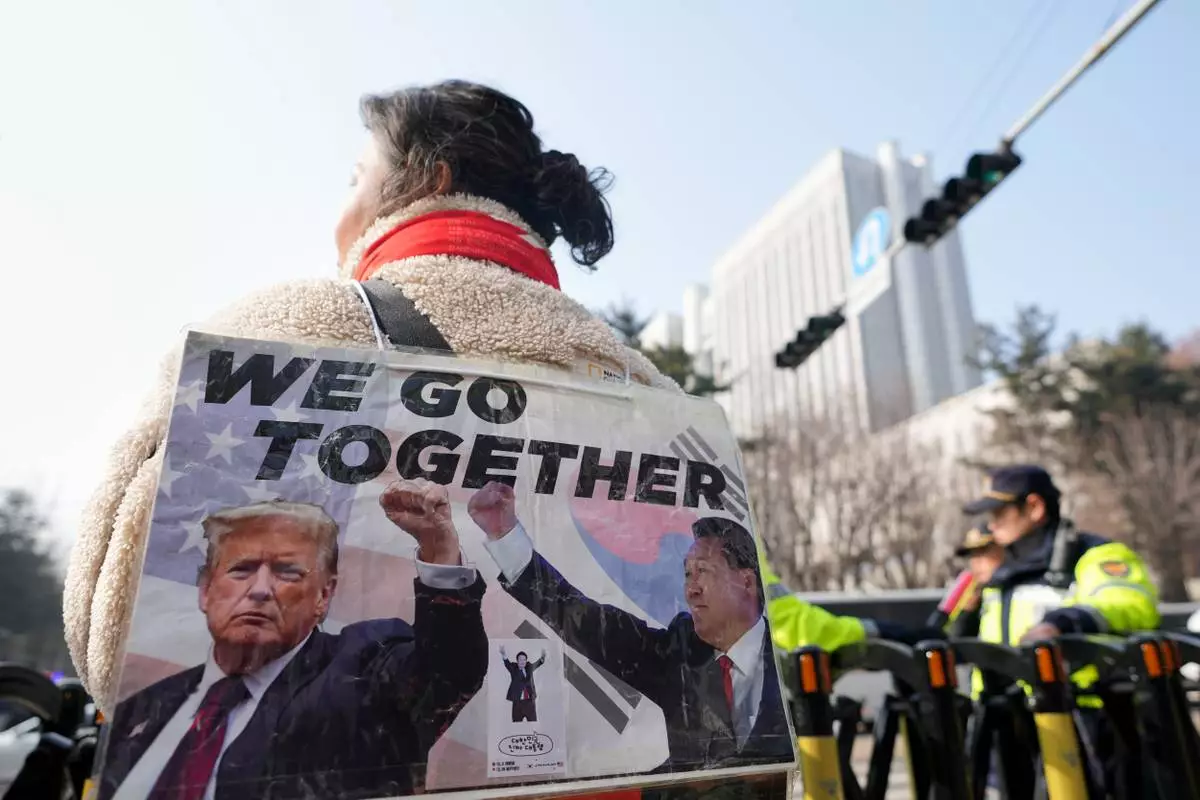
A supporter of former South Korean President Yoon Suk Yeol waits for a bus carrying former South Korean President Yoon Suk Yeol outside Seoul Central District Court, in Seoul, South Korea, Friday, Jan. 16, 2026. (AP Photo/Lee Jin-man)
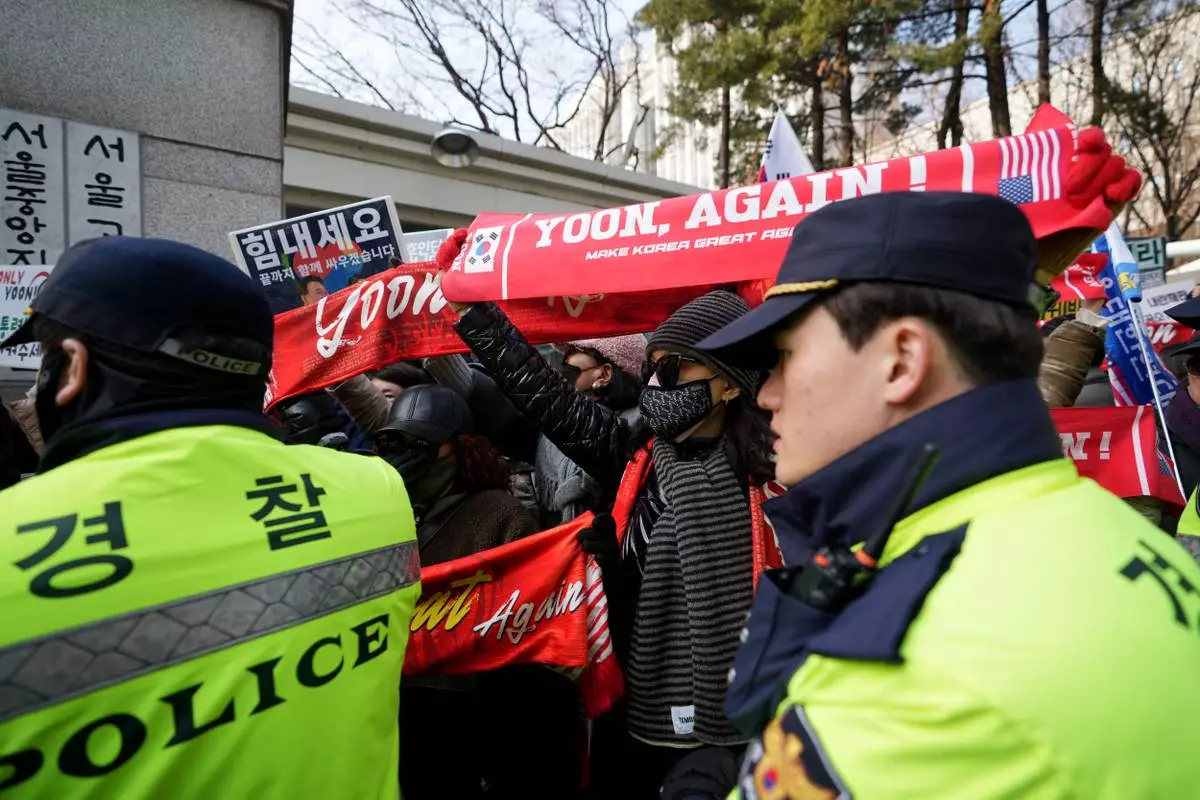
Supporters of former South Korean President Yoon Suk Yeol hold signs as police officers stand guard outside Seoul Central District Court, in Seoul, South Korea, Friday, Jan. 16, 2026. (AP Photo/Lee Jin-man)
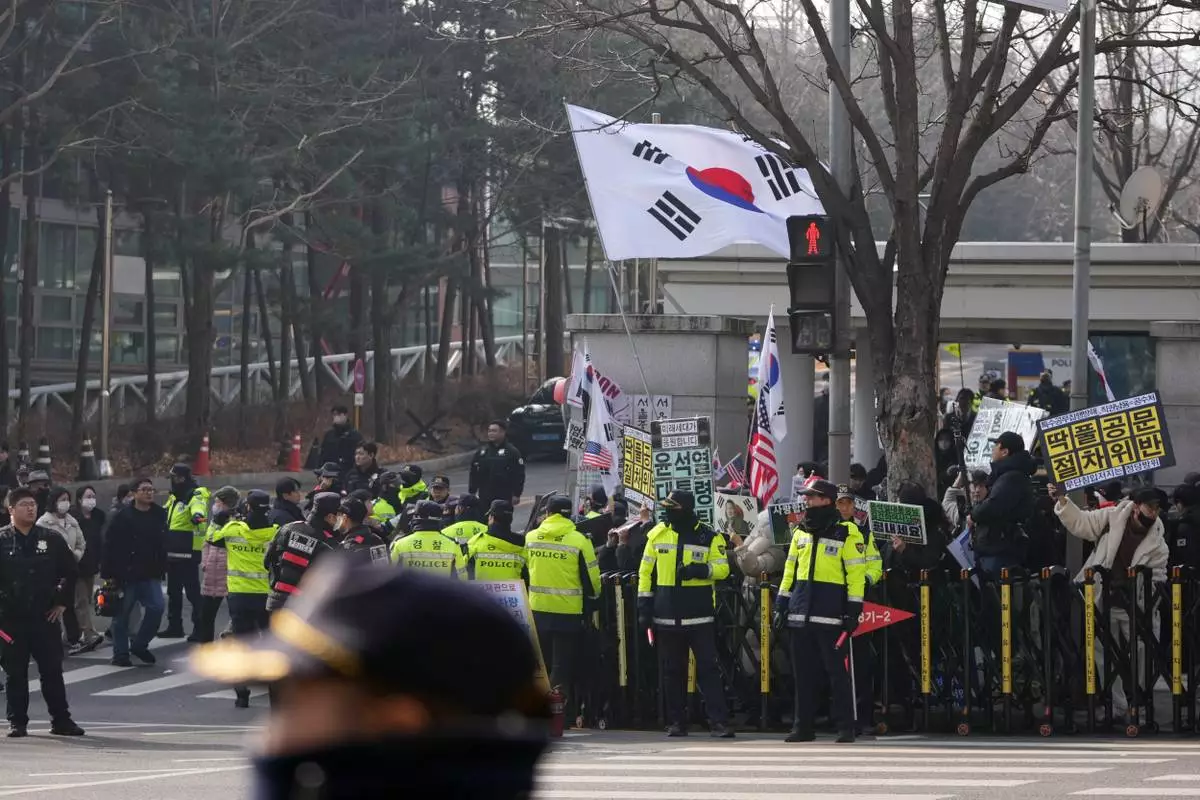
Supporters of former South Korean President Yoon Suk Yeol hold signs and flags outside Seoul Central District Court, in Seoul, South Korea, Friday, Jan. 16, 2026. (AP Photo/Lee Jin-man)
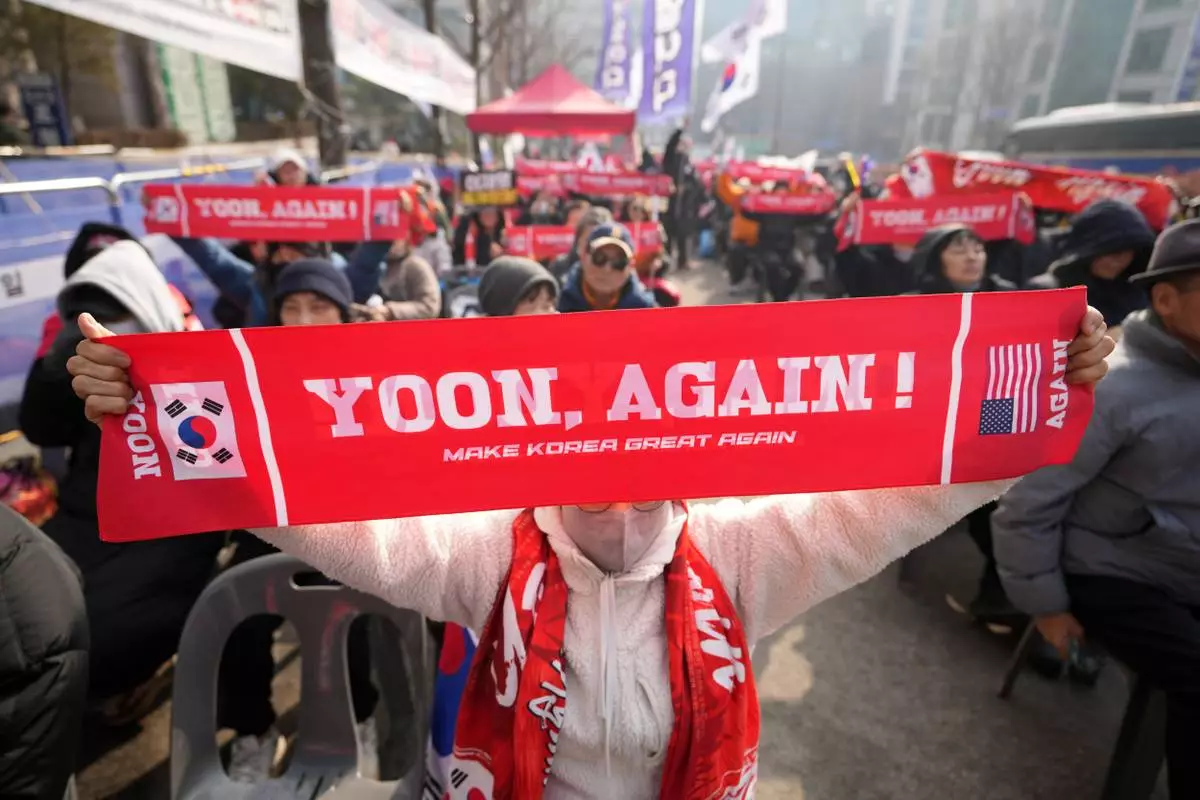
Supporters of former South Korean President Yoon Suk Yeol hold signs outside Seoul Central District Court, in Seoul, South Korea, Friday, Jan. 16, 2026. (AP Photo/Lee Jin-man)
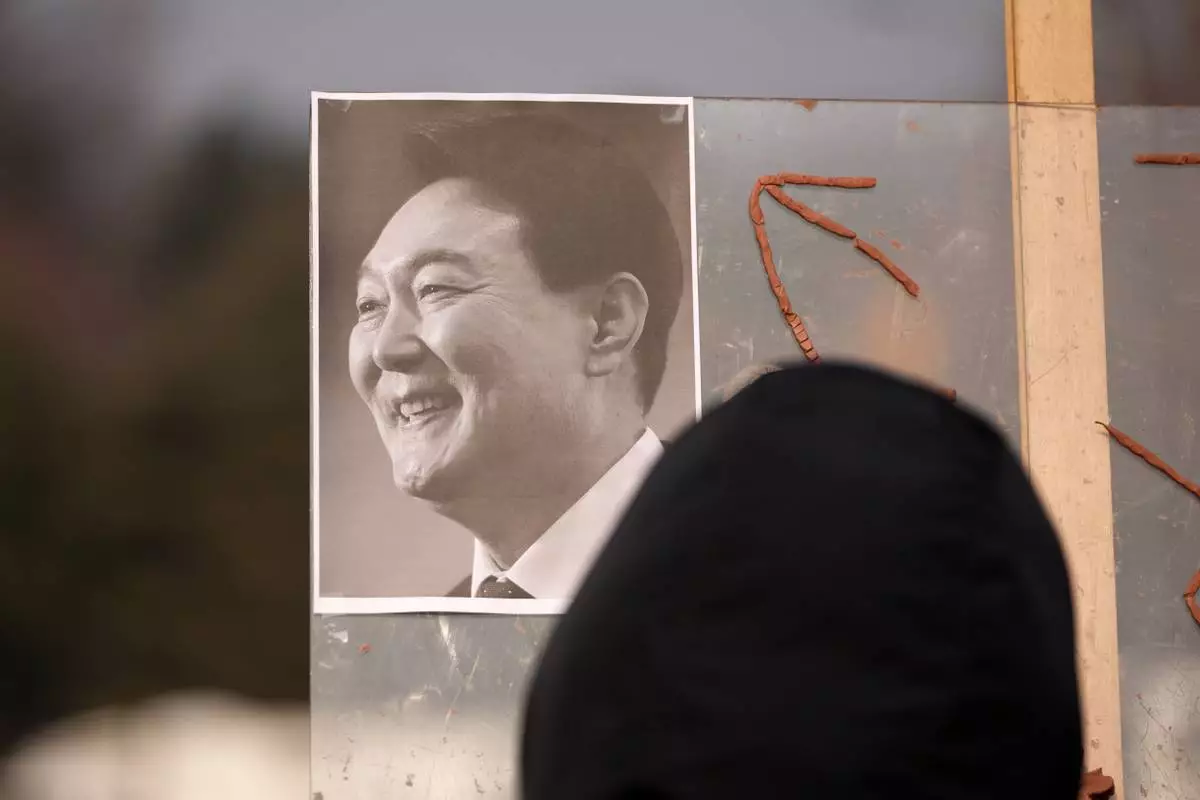
A picture of former South Korean President Yoon Suk Yeol is placed on a board as supporters gather outside Seoul Central District Court, in Seoul, South Korea, Friday, Jan. 16, 2026. (AP Photo/Lee Jin-man)