WASHINGTON (AP) — Saudi Arabia wants U.S. help developing its own civil nuclear program, and the Trump administration says it is “very excited” at the prospect. U.S.-Saudi cooperation in building reactors for nuclear power plants in the kingdom could shut the Chinese and Russians out of what could be a high-dollar partnership for the American nuclear industry.
Despite that eagerness, there are obstacles, including fears that helping the Saudis fulfill their long-standing desire to enrich their own uranium as part of that partnership would open new rounds of nuclear proliferation and competition. Saudi Arabia's pursuit of a nuclear agreement is likely to play into the ever-evolving bargaining on regional security issues involving the U.S., Iran and Israel.
This coming week, Republican President Donald Trump will make his first trip to Saudi Arabia of his second term. Here’s a look at key issues involved in the Saudi request.
Energy Secretary Chris Wright, who traveled to Saudi Arabia before Trump's trip, said the world can expect to see “meaningful developments” this year on helping the kingdom build a commercial nuclear power industry. Wright said the U.S. was “very excited” about it.
That does not necessarily mean there will be any big breakthroughs on Trump’s trip, said Jon Alterman, head of the Mideast program at the Center for Strategic and International Studies in Washington. Something smaller that still signals to the Saudis and the Iranians — with whom Trump is pushing for an agreement limiting Tehran's nuclear program — that Washington is interested in cooperating on Saudi efforts could be the U.S. aim for now.
“There would be a lot of ways to show progress toward an agreement on a Saudi nuclear program without fully committing to a partnership on it,” Alterman said.
Saudi Arabia is a global oil giant, but it is also largely a desert. Running all those air conditioners uses a lot of petroleum that the kingdom would rather be exporting. The Saudis' own oil consumption burns up one-third of what the country produces.
Crown Prince Mohammed bin Salman also is pushing to build up Saudi Arabia's mining and processing of its own minerals. That includes Saudi reserves of uranium, a fuel for nuclear reactors.
For the Trump administration, any deal with Iran that lets Tehran keep its own nuclear program or continue its own enrichment could increase Saudi pressure for the same.
That's even though Saudi Arabia and other Gulf states have toned down their enmity toward Iran in recent years and are supporting the U.S. efforts to limit Iran’s nuclear program peacefully.
For the U.S., any technological help it gives the Saudis as they move toward building nuclear reactors would be a boon for American companies.
Internationally, there is support for U.S. efforts to strike a nuclear deal with Saudi Arabia, given that the Saudis could turn to the Chinese and Russians for help developing a nuclear industry, with fewer safeguards.
The feeling is “if the U.S. doesn’t provide it, then someone else will,” said Hasan Alhasan, a senior fellow in Bahrain for the International Institute for Strategic Studies.
“Without a doubt, if Iran developed a nuclear bomb, we would follow suit as soon as possible,” Prince Mohammed said in 2018, at a time of higher tension between Arab states and Iran.
Saudi Arabia and other Gulf states stress better relations and diplomacy with Iran now. But Prince Mohammed's comments — and other Saudi officials said similar — have left open the possibility that nuclear weapons are a strategic goal of the Saudis.
The Saudis long have pushed for the U.S. to build a uranium enrichment facility in the kingdom as part of any nuclear cooperation between the two countries. That facility could produce low-enriched uranium for civilian nuclear reactors. But without enough controls, it could also churn out highly enriched uranium for nuclear bombs.
Trump administration officials cite the Saudis' desire to make use of their country’s uranium deposits. The kingdom has spent tens of millions of dollars, with Chinese assistance, to find and develop those deposits. But the uranium ore that it has identified so far would be “severely uneconomic” to develop, the intergovernmental Nuclear Energy Agency says.
It has been decades since there has been any state-sanctioned transfer of that kind of technology to a nonnuclear-weapon state, although a Pakistani-based black-market network provided enrichment technology to Iran, North Korea, Libya and possibly others about 20 years ago, Robert Einhorn noted for the Brookings Institute last year.
Allowing Saudi Arabia — or any other additional country — to host an enrichment facility would reverse long-standing U.S. policy. It could spur more nuclear proliferation among U.S. allies and rivals, Einhorn wrote.
Under Democratic President Joe Biden, the U.S. and Saudi Arabia had looked at nuclear cooperation as just one part of broader negotiations that also involved Saudi desires for U.S. arms and security guarantees and for a satisfactory long-term deal on behalf of Palestinians. The U.S., meanwhile, had tied the cooperation to Saudi Arabia agreeing to normalize relations with Israel.
The Trump administration seems to have unpacked some of that big bundle.
But the administration may still see holding off on any major civil nuclear agreement as leverage in brokering what would be historic diplomatic relations between the kingdom and Israel, Alterman noted. Getting to that agreement, part of what’s known as the Abraham Accords between Arab states and Israel, has been a chief goal for Trump.
After Wright's trip, some Israelis expressed their opposition to allowing Saudi Arabia to enrich uranium, and Iran and Saudi Arabia are both carefully watching the other's talks with the U.S. on their nuclear issues.
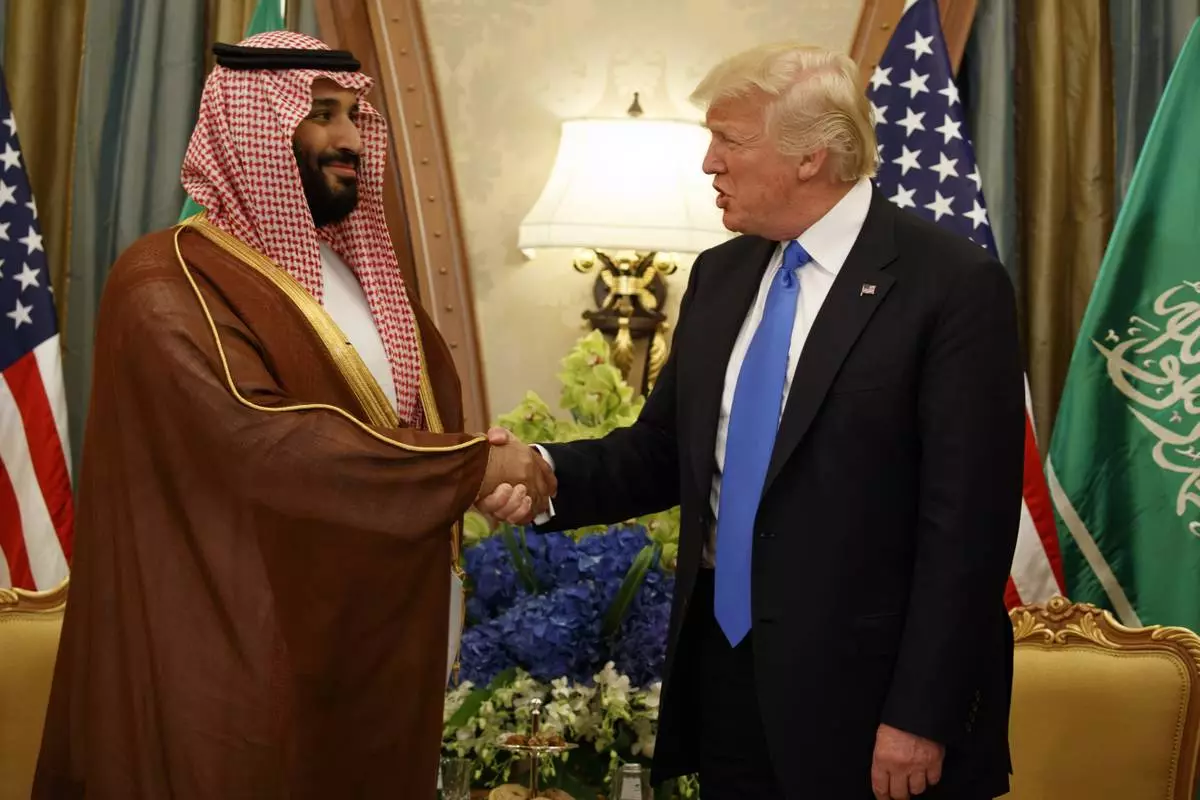
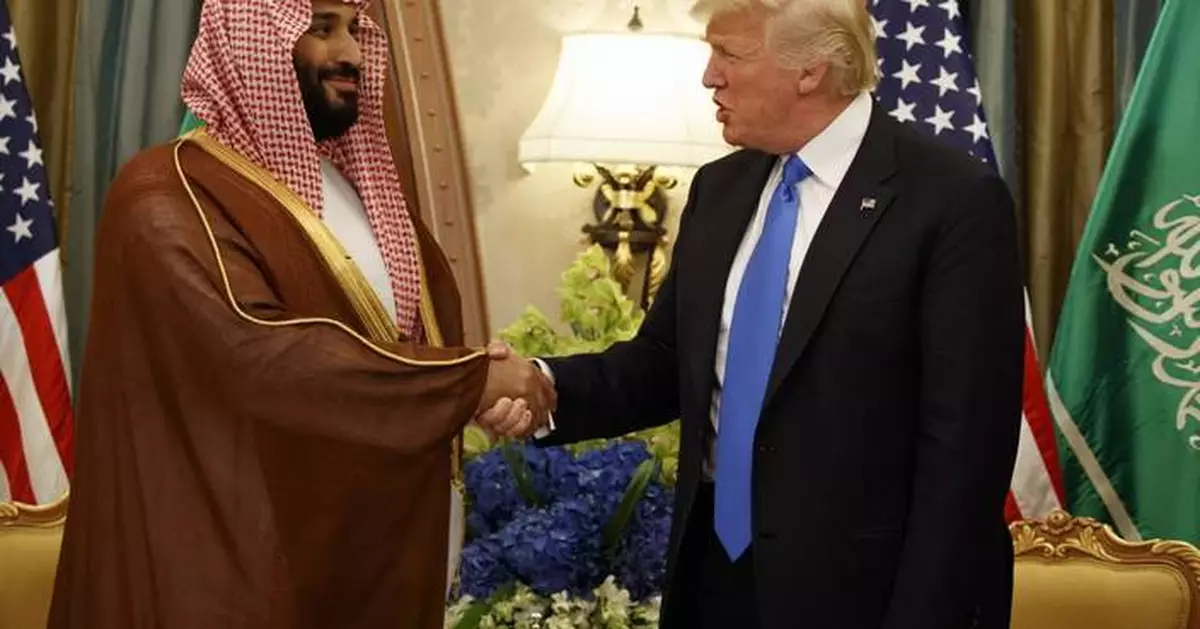
FILE- President Donald Trump, right, shakes hands with Saudi Deputy Crown Prince and Defense Minister Mohammed bin Salman during a bilateral meeting, in Riyadh, May 20, 2017. (AP Photo/Evan Vucci, File)
U.S. President Donald Trump says Iran has proposed negotiations after his threat to strike the Islamic Republic as an ongoing crackdown on demonstrators has led to hundreds of deaths.
Trump said late Sunday that his administration was in talks to set up a meeting with Tehran, but cautioned that he may have to act first as reports mount of increasing deaths and the government continues to arrest protesters.
“The meeting is being set up, but we may have to act because of what’s happening before the meeting. But a meeting is being set up. Iran called, they want to negotiate,” Trump told reporters on Air Force One on Sunday night.
Iran did not acknowledge Trump’s comments immediately. It has previously warned the U.S. military and Israel would be “legitimate targets” if America uses force to protect demonstrators.
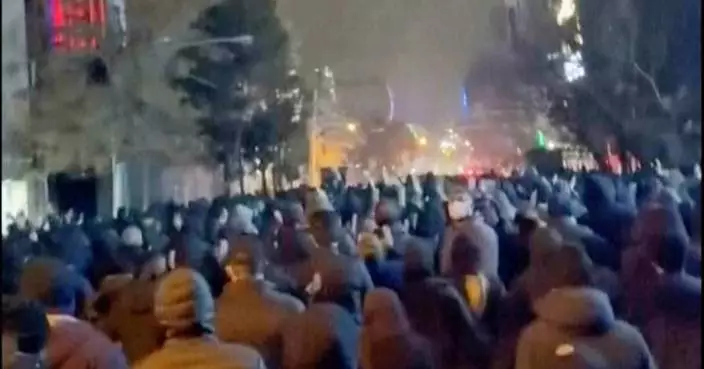
The U.S.-based Human Rights Activists News Agency, which has accurately reported on past unrest in Iran, gave the death toll. It relies on supporters in Iran cross checking information. It said at least 544 people have been killed so far, including 496 protesters and 48 people from the security forces. It said more than 10,600 people also have been detained over the two weeks of protests.
With the internet down in Iran and phone lines cut off, gauging the demonstrations from abroad has grown more difficult. Iran’s government has not offered overall casualty figures.
The Latest:
A witness told the AP that the streets of Tehran empty at the sunset call to prayers each night.
Part of that stems from the fear of getting caught in the crackdown. Police sent the public a text message that warned: “Given the presence of terrorist groups and armed individuals in some gatherings last night and their plans to cause death, and the firm decision to not tolerate any appeasement and to deal decisively with the rioters, families are strongly advised to take care of their youth and teenagers.”
Another text, addressed “Dear parents,” which claimed to come from the intelligence arm of the paramilitary Revolutionary Guard, also directly warned people not to take part in demonstrations.
The witness spoke to the AP on condition of anonymity due to the ongoing crackdown.
—- By Jon Gambrell in Dubai, United Arab Emirates
Iran drew tens of thousands of pro-government demonstrators to the streets Monday in a show of power after nationwide protests challenging the country’s theocracy.
Iranian state television showed images of demonstrators thronging Tehran toward Enghelab Square in the capital.
It called the demonstration an “Iranian uprising against American-Zionist terrorism,” without addressing the underlying anger in the country over the nation’s ailing economy. That sparked the protests over two weeks ago.
State television aired images of such demonstrations around the country, trying to signal it had overcome the protests, as claimed by Iranian Foreign Minister Abbas Araghchi earlier in the day.
China says it opposes the use of force in international relations and expressed hope the Iranian government and people are “able to overcome the current difficulties and maintain national stability.”
Chinese Foreign Ministry spokesperson Mao Ning said Monday that Beijing “always opposes interference in other countries’ internal affairs, maintains that the sovereignty and security of all countries should be fully protected under international law, and opposes the use or threat of use of force in international relations.”
German Chancellor Friedrich Merz condemned “in the strongest terms the violence that the leadership in Iran is directing against its own people.”
He said it was a sign of weakness rather than strength, adding that “this violence must end.”
Merz said during a visit to India that the demonstrators deserve “the greatest respect” for the courage with which “they are resisting the disproportional, brutal violence of Iranian security forces.”
He said: “I call on the Iranian leadership to protect its population rather than threatening it.”
Iran’s Foreign Ministry spokesman on Monday suggested that a channel remained open with the United States.
Esmail Baghaei made the comment during a news conference in Tehran.
“It is open and whenever needed, through that channel, the necessary messages are exchanged,” he said.
However, Baghaei said such talks needed to be “based on the acceptance of mutual interests and concerns, not a negotiation that is one-sided, unilateral and based on dictation.”
The semiofficial Fars news agency in Iran, which is close to the paramilitary Revolutionary Guard, on Monday began calling out Iranian celebrities and leaders on social media who have expressed support for the protests over the past two weeks, especially before the internet was shut down.
The threat comes as writers and other cultural leaders were targeted even before protests. The news agency highlighted specific celebrities who posted in solidarity with the protesters and scolded them for not condemning vandalism and destruction to public property or the deaths of security forces killed during clashes. The news agency accused those celebrities and leaders of inciting riots by expressing their support.
Canada said it “stands with the brave people of Iran” in a statement on social media that strongly condemned the killing of protesters during widespread protests that have rocked the country over the past two weeks.
“The Iranian regime must halt its horrific repression and intimidation and respect the human rights of its citizens,” Canada’s government said on Monday.
Iran’s foreign minister claimed Monday that “the situation has come under total control” after a bloody crackdown on nationwide protests in the country.
Abbas Araghchi offered no evidence for his claim.
Araghchi spoke to foreign diplomats in Tehran. The Qatar-funded Al Jazeera satellite news network, which has been allowed to work despite the internet being cut off in the country, carried his remarks.
Iran’s foreign minister alleged Monday that nationwide protests in his nation “turned violent and bloody to give an excuse” for U.S. President Donald Trump to intervene.
Abbas Araghchi offered no evidence for his claim, which comes after over 500 have been reported killed by activists -- the vast majority coming from demonstrators.
Araghchi spoke to foreign diplomats in Tehran. The Qatar-funded Al Jazeera satellite news network, which has been allowed to work despite the internet being cut off in the country, carried his remarks.
Iran has summoned the British ambassador over protesters twice taking down the Iranian flag at their embassy in London.
Iranian state television also said Monday that it complained about “certain terrorist organization that, under the guise of media, spread lies and promote violence and terrorism.” The United Kingdom is home to offices of the BBC’s Persian service and Iran International, both which long have been targeted by Iran.
A huge crowd of demonstrators, some waving the flag of Iran, gathered Sunday afternoon along Veteran Avenue in LA’s Westwood neighborhood to protest against the Iranian government. Police eventually issued a dispersal order, and by early evening only about a hundred protesters were still in the area, ABC7 reported.
Los Angeles is home to the largest Iranian community outside of Iran.
Los Angeles police responded Sunday after somebody drove a U-Haul box truck down a street crowded with the the demonstrators, causing protesters to scramble out of the way and then run after the speeding vehicle to try to attack the driver. A police statement said one person was hit by the truck but nobody was seriously hurt.
The driver, a man who was not identified, was detained “pending further investigation,” police said in a statement Sunday evening.
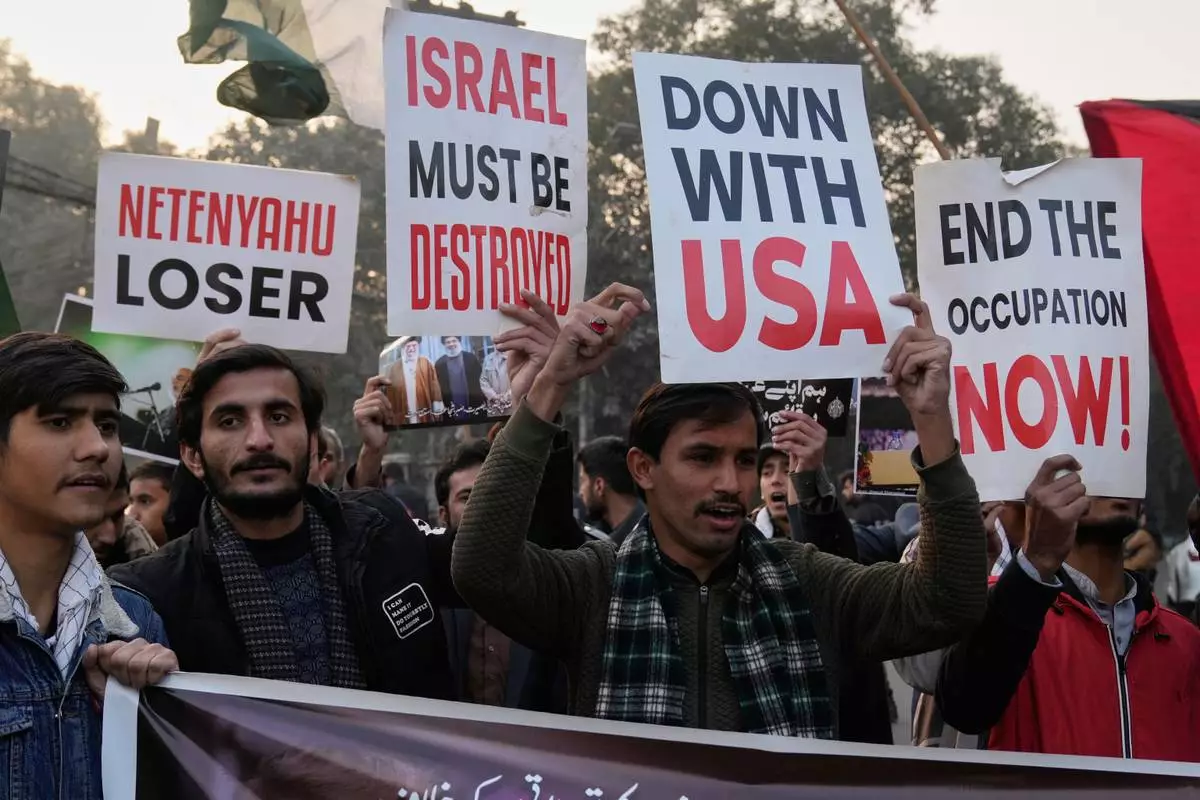
Shiite Muslims hold placards and chant slogans during a protest against the U.S. and show solidarity with Iran in Lahore, Pakistan, Sunday, Jan. 11, 2026. (AP Photo/K.M. Chaudary)
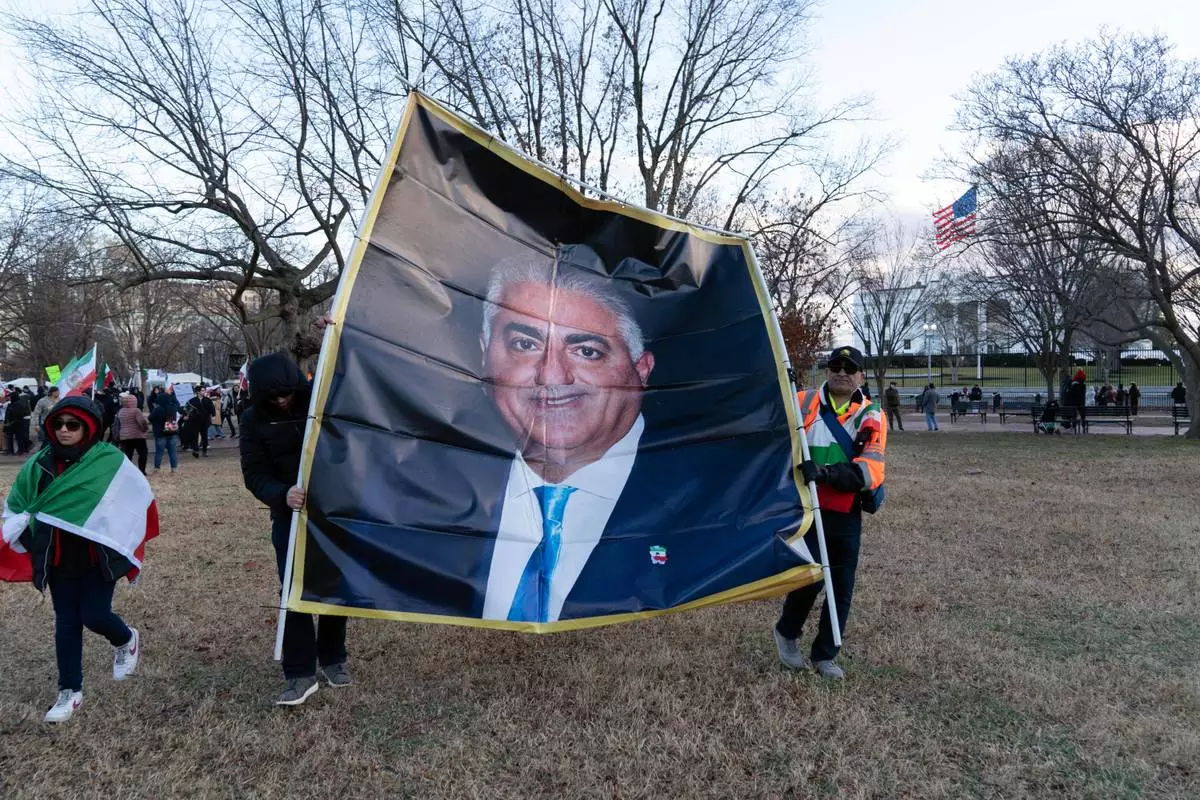
Activists carrying a photograph of Reza Pahlavi take part in a rally supporting protesters in Iran at Lafayette Park, across from the White House, in Washington, Sunday, Jan. 11, 2026. (AP Photo/Jose Luis Magana)
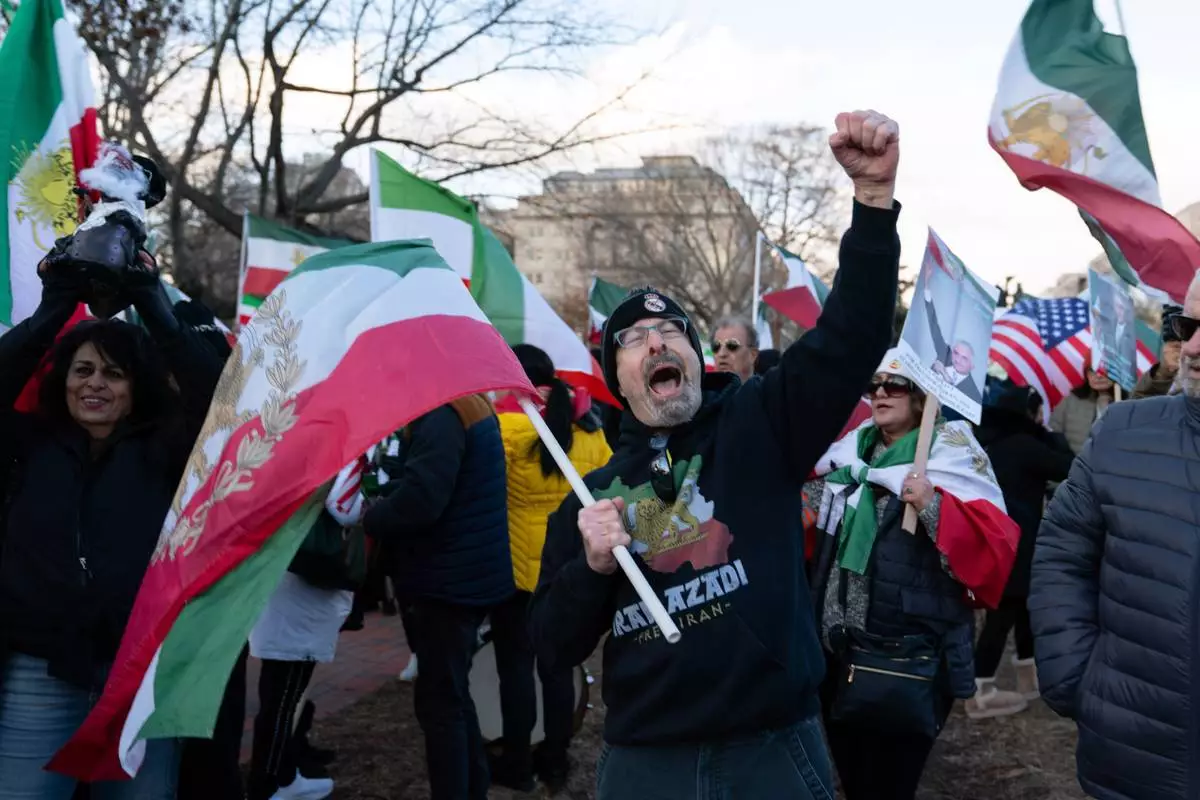
Activists take part in a rally supporting protesters in Iran at Lafayette Park, across from the White House in Washington, Sunday, Jan. 11, 2026. (AP Photo/Jose Luis Magana)
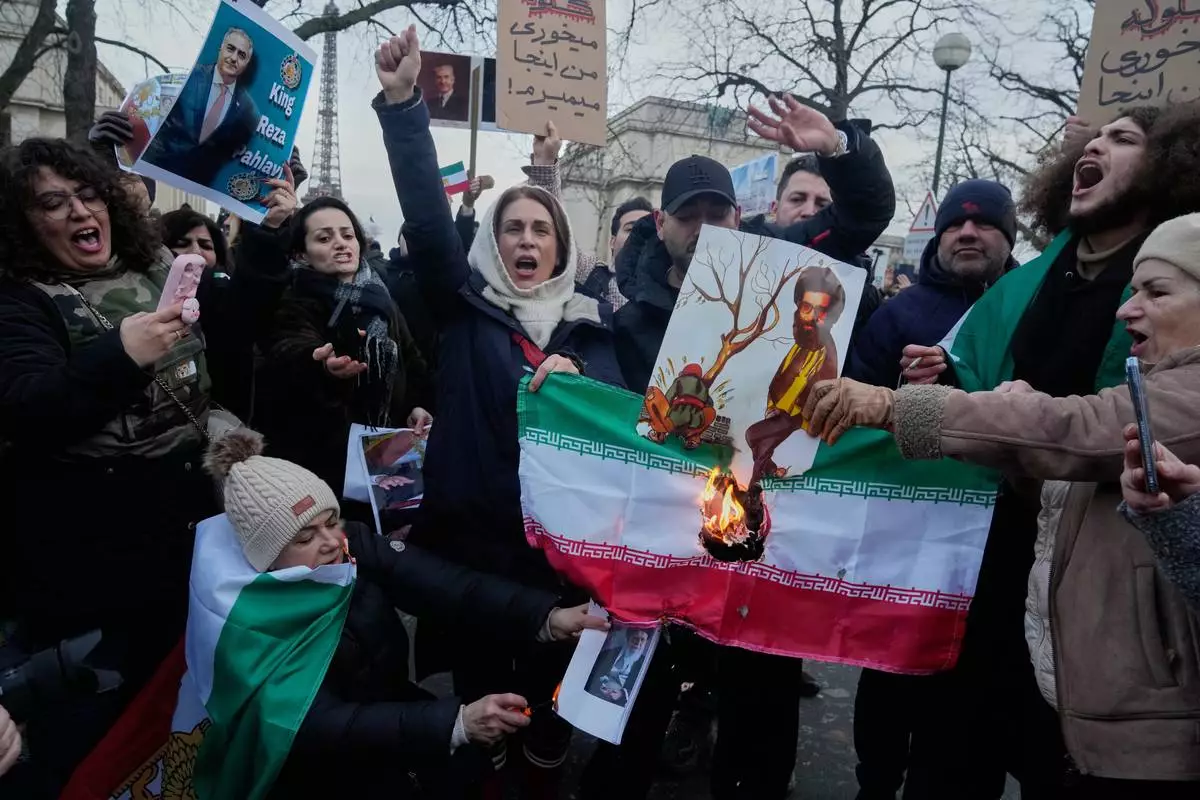
Protesters burn the Iranian national flag during a rally in support of the nationwide mass demonstrations in Iran against the government in Paris, Sunday, Jan. 11, 2026. (AP Photo/Michel Euler)