Leading an honest and frugal life, practicing strict self-discipline, dedication to work, and commitment to the greater good -- these are all the valuable life lessons Chinese President Xi Jinping has learned from his mother Qi Xin since childhood, and these virtues have played a key role in making Xi the man he is today and shaping his values and priorities as the top leader of China.
Xi was born in a revolutionary family and from a young age his mother' life experiences have left an indelible imprint on him, such as adopting a frugal and simple lifestyle.
During the 1980s when Xi worked in Zhengding County in north China's Hebei Province, a piece of bedding that belonged to Xi used to catch the attention of those around him. It was carefully patched together with pieces of old clothes by Xi's mother and had stayed with and cherished by him since he was 15 years old.
The bedding both represented the mother's love for her son and served to remind Xi of always being thrifty in life.
The deep affection and familial responsibilities Qi showed for her children have also influenced Xi to this day.
Back in the 1970s, Qi worked at a farm in central China's Henan Province all the while caring her younger son, while Xi worked with local farmers in Liangjiahe, a small village in the northwestern Shaanxi Province, and his two sisters worked and lived in other parts of the country's countryside.
Whenever she had free time, Qi would travel all the way to see her children, no matter how long and tough the journey was. At that time, transportation services were far from being developed and long-distance trips were usually associated with hardship.
In her life, Qi also built deep bonds with the country's working people after spending two years near the frontline during the Chinese People's War of Resistance Against Japanese Aggression, and another eight years working alongside farmers in northwestern China. And she considered it her duty to impart to her children what living alongside and serving the people meant, a lesson that deeply influenced Xi when he did farm work with local villagers in Liangjiahe.
Strict discipline is also what Qi taught her children. After Xi became a senior government official, Qi gathered the family for a meeting, during which she demanded her other children not run businesses in fields in which Xi Jinping was involved. In many letters she wrote to Xi Jinping, Qi always asked him to follow the family tradition, not to feel privileged, and be strict with himself.
Influenced by Qi, Xi Jinping was also strict with his family members. He warned relatives and friends not to run any business or do anything in his name. In the many years during which his career took him to Fujian Province, Zhejiang Province and Shanghai Municipality, Xi told the officials there that no one was allowed to seek private gain in his name and he welcomed everyone's supervision.
Since he became general secretary of the Communist Party of China Central Committee, Xi has intensified efforts to fight corruption. On numerous occasions, Xi has stressed that Party members must be incorruptible and fully devote themselves to serving the people.
In 1944, Qi wed Xi Zhongxun -- Xi Jinping's father -- in a rural cave house in Shaanxi, which, together with other northwestern areas, played central roles in the communist revolution of China. Qi had since cherished fond memories of the northwestern revolutionary bases and remained committed to the Party's revolutionary cause.
In the summer of 2000, Qi paid a visit to the folks in the northwestern areas. After seeing the tough conditions of a primary school in Zhaojin Township in Tongchuan City of Shaanxi, she decided to help and led her family to make a donation of 150,000 yuan (20,700 U.S. dollars) for the relocation and rebuilding of the school.
The mother's deep feelings toward the old revolutionary bases finds resonance in her son. Ahead of the Chinese New Year in 2015, Xi also came to Zhaojin Township during his inspection tour of Shaanxi, where he chatted with the locals, learned about what difficulties they faced, and asked the government officials to solve the people's problems.
As a filial son, Xi has always tried to spend time with his mother when possible. However, with more work duties calling, Xi could not always be with his mother.
"Doing your job well is the greatest filial piety to your father and mother," Qi told her son.
Xi took that to heart, serving the public with the goal of achieving a good life for Chinese families.
As Xi said at the closing meeting of the first session of the 14th National People's Congress, the people's trust is the biggest motivation that drives him to march on and is a great responsibility he shoulders.
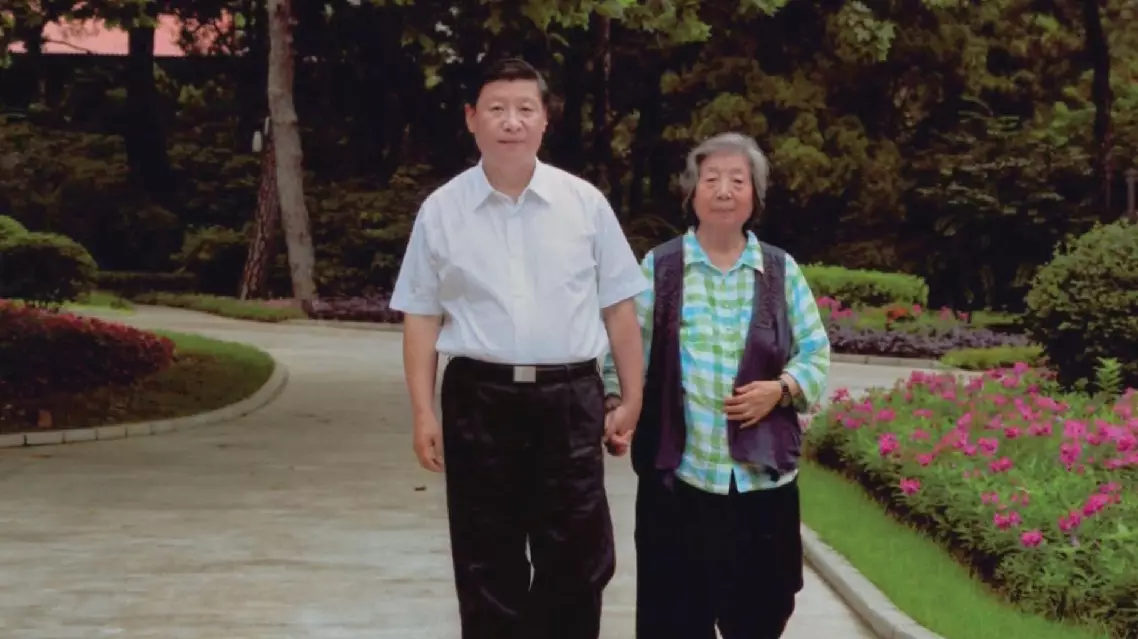
Mother's love shines lifelong impact on Xi