An export-oriented cable manufacturer in east China’s Zhejiang Province is actively exploring business opportunities in non-U.S. markets, charting new paths in Europe, South America, and beyond amid sweeping U.S. tariffs.
Zhejiang Tianjie Industrial Co., Ltd., a company specialized in cable manufacturing and sales, has over 50 percent of its business in the U.S. market. Last year, the company's sales volume exceeded one billion yuan (about 140 million U.S. dollars), showing strong growth momentum. However, many American clients had to suspend their orders in the face of the sudden imposition of high tariffs, which quickly led to sales difficulties for Tianjie.
After the United States imposed additional tariffs, the company's order volume in the second quarter dropped by 30 to 40 percent, and several production lines were even brought to a halt.
"Based on the current tariff rate, it's almost impossible for us to do business in the U.S. market. If we don't have other plans, our sales this year may drop [from 1 billion] to around 500 to 600 million yuan," said Chen Xiaolin, chairman of the company.
For such export-oriented companies with a large share of their business in the U.S. market, they must quickly find a way to break through barriers. Tianjie has shifted its main overseas sales focus to markets outside the United States, setting up representative offices in countries such as the UK, Germany and Brazil.
"In fact, as early as last July, we had already instructed our sales teams to step up efforts in developing non-U.S. markets. When the U.S. imposed two consecutive 10 percent tariff hikes in February and March this year, it served as a wake-up call for us -- this might not be the end. So, this year, we're even more determined to expand into non-U.S. markets," said Chen.
Over the past period of time, Tianjie has intensified its efforts to develop non-U.S. markets, such as those in Europe, the Middle East and Southeast Asia by participating in trade fairs like the Canton Fair and leveraging online platforms. The company aims to increase the share of exports to non-U.S. markets to 70 to 80 percent.
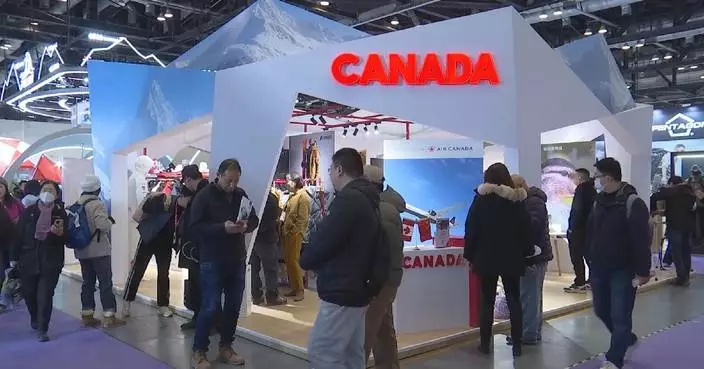
At the just concluded 137th Canton Fair in Guangzhou, Tianjie has reached preliminary cooperation intentions with new clients from countries including Poland, Portugal and Peru. A Portuguese client has even come to the factory to look for products that meet their needs.
"The purpose of our visit to Tianjie is to search for a trustful supplier for power cables, and who knows, may be land cables and coaxial cables. What I find more interesting is the capacity that they have for producing with all the European Union's certificates that we need in search, and the capacity they have to produce in short time, and also, of course, with a very interesting competitive price," said Vitor Ribeiro, a Portuguese buyer.
To expand into larger markets, Tianjie has further enhanced the performance of its products by further accelerating cost reduction and efficiency improvement and vigorously advancing digital transformation.
"We have digitalized every production line, improving [production] efficiency by over 30 percent. Our quality, efficiency and costs have all improved significantly. We have to make greater efforts in terms of production. The first is to ensure quality, and then we need to improve efficiency and reduce costs, so as to enhance our capability of coordination and responsiveness to better support market development," said Chen.
In April, the company's power cable orders totaled 9.5 million U.S. dollars, of which 5.6 million came from non-U.S. markets, accounting for 58.9 percent of the total.
"If, for various reasons, we lose 60 to 70 million U.S. dollars in the U.S. market, our goal is to make up for it in the non-U.S. markets over the next two to three years. We are actively pushing forward with our transformation, and we are fully confident in it. We also believe we can overcome [the difficulties] brought by this tariff war," said Chen.

Chinese export-oriented cable manufacturer actively expands non-US markets amid sweeping tariffs