A time-honored canned food company in east China's coastal Zhejiang Province has actively adjusted its sales model and channels to shift toward the domestic market, with support from the local government and major e-commerce platforms, after being severely impacted by steep U.S. tariff hikes.
Zhejiang Tiantong Food Co., Ltd., based in Kaihua County of Quzhou City in Zhejiang, used to relied on overseas markets for half of its sales -- primarily to the United States and Europe. The company has seen U.S. orders abruptly canceled since the U.S. administration significantly raised tariffs.
With assistance from the local government, the company established a partnership with the Zhejiang branch of Sinopec Easy Joy Sales Co. Ltd, a major convenience store chain, to distribute its products domestically.
However, initial sales volume fell short of expectations.
"At the beginning, sales in our stores were not strong. On the first day, the total sales volume of the two canned products was only about 70 cans," said Yang Xu, deputy general manager of the Zhejiang branch of Sinopec Easy Joy Sales Co., Ltd.
After analysis, the company discovered that the initial batch of products sold in convenience stores was packaged for American hypermarkets and did not align with the consumption habits of domestic convenience store shoppers. In response, the company quickly adjusted its sales strategy, repackaging the products into smaller sizes at more affordable prices. The move significantly boosted sales, making the canned goods one of the best-selling items in the stores.
In the nine days following the adjustment, the cumulative sales exceeded 3,000 cans, with peak daily sales surpassing 500 cans.
"From 100 to 200, 300 and 500 cans per day -- such a sales trend has reassured us. A large portion of our export goods can now be redirected to the domestic market, which has helped us overcome considerable challenges," said Li Pichong, head of the company.
With support from the local government, the company's canned food products are now being sold at canteens in government institutions and various local supermarkets.
Currently, the company is planning to develop new products tailored to the domestic market, and its previously expanded export capacity will also be redirected toward domestic sales.
"I'm full of confidence. Every difficulty can be overcome. After the United States closes its doors to us, we can seek markets in other countries and within our own borders. With a population of over 1.4 billion and tremendous consumption power, our domestic market is enormous. I'm very optimistic about it," Li said.
In efforts to help Chinese foreign trade companies to tide over the current hardships in business operation, major e-commerce platforms in China are actively leveraging their channel advantages to open up domestic sales pathways for foreign trade enterprises hit hard by the U.S. tariff hikes, thereby helping stabilize foreign trade and boost consumption.
For instance, JD.com has launched an export-to-domestic sales support plan. It has offered to purchase no less than 200 billion yuan (about 27.6 billion U.S. dollars) worth of goods over the next year from Chinese foreign trade companies for domestic resale. Similarly, Taobao and Tmall have rolled out the "Export Select" program, targeting at least 10,000 foreign trade operators and 100,000 export products, with a range of initiatives to help foreign trade operators swiftly shift from export markets to the domestic market.
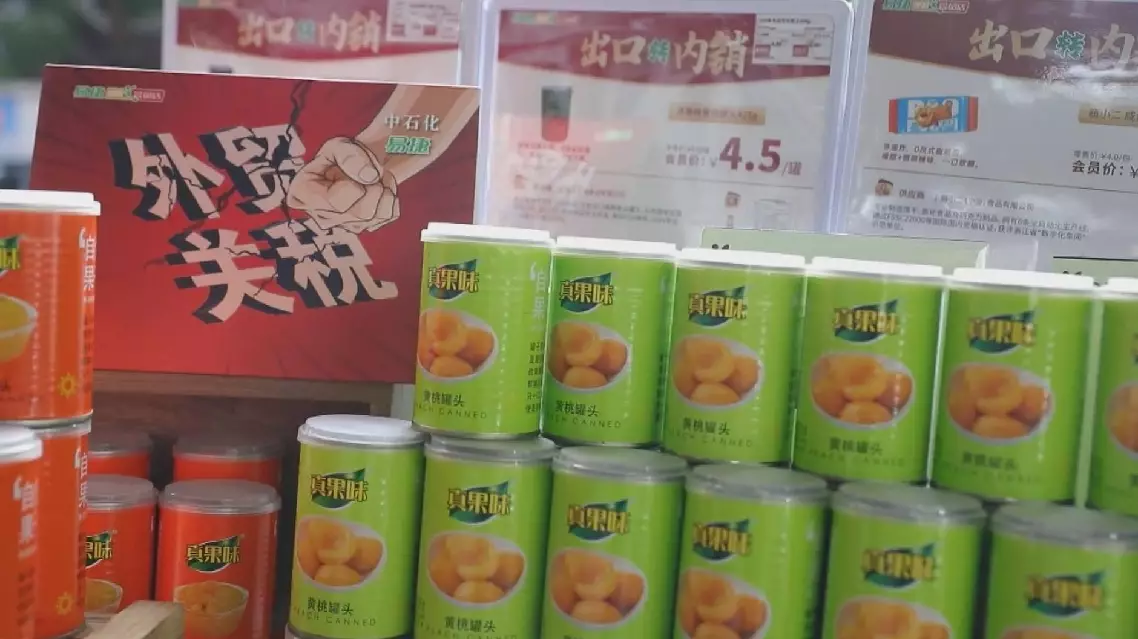
Tariff-hit canned food maker in China adjusts sales model, channels to tap domestic market