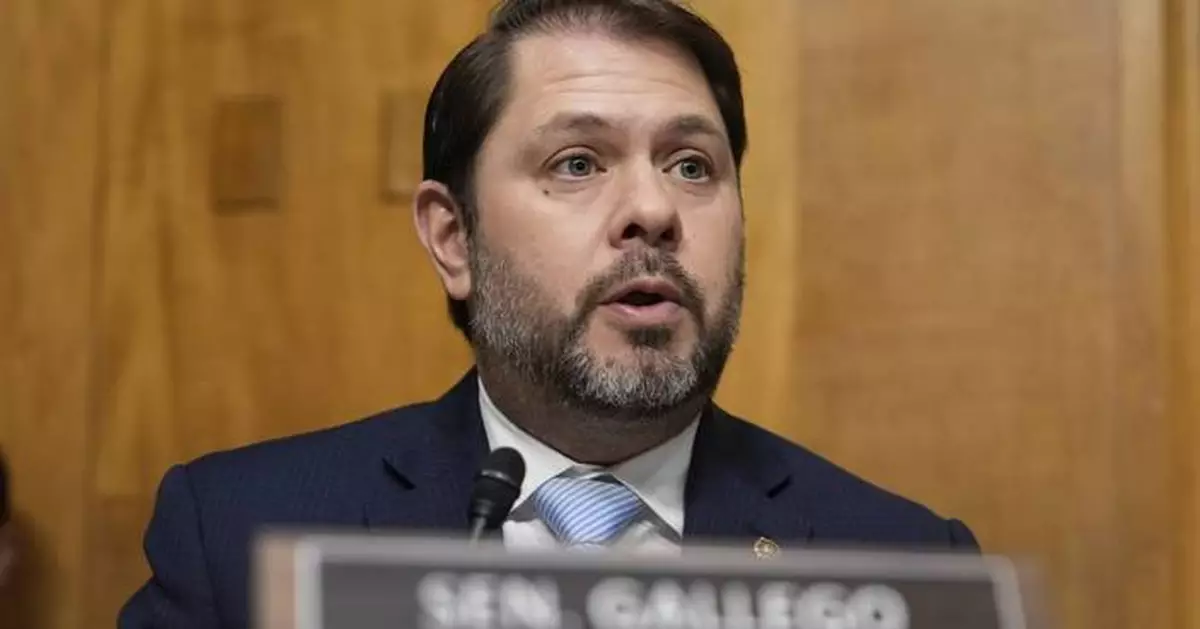
WASHINGTON (AP) — Democratic Arizona Sen. Ruben Gallego is wading into one of Washington's most contentious and intractable political problems as he puts forward a plan Monday aimed at reforming the country's immigration system and beefing up border security.
The plan by Gallego, who beat Republican Kari Lake in last fall's tight Senate race, calls for hiring more Border Patrol agents; using technology to stop fentanyl smuggling; reforming the asylum system; adding more ways for people to come to the U.S.; and a pathway to citizenship for some immigrants.
Gallego's plan comes three months into President Donald Trump's administration as Trump seeks to deliver on campaign promises of carrying out mass deportations. His plan — or any other from Democrats — is unlikely to get much traction with Trump in the White House, but it illustrates that the debate about legislative solutions carries on.
Many members of Congress have tried and failed to change the immigration system. A small group of senators, led by Gallego's predecessor, Krysten Sinema, negotiated for months in 2023 and 2024 over a border bill that would have toughened asylum protocols for migrants arriving at the U.S.-Mexico border; hired more officers to evaluate asylum claims and Border Patrol agents; and given money to local governments seeing influxes of migrants.
That effort ran into a wall of opposition just hours after the bill was released.
The last time Congress even came close to a breakthrough on immigration reform was in 2013, when a bipartisan group of senators pushed forward legislation creating a pathway to citizenship for millions of people in the country illegally and expanding work visas while tightening border security and mandating that employers verify workers’ legal status. The Senate approved that proposal, but it was rejected by the House.
Gallego's plan includes some elements that likely will find bipartisan support, such as his calls to beef up border security. But other parts — like efforts to legalize anyone already in the country illegally — will prove much more contentious.
“We don’t have to choose between border security and immigration reform. We can and should do both," Gallego said in a news release Monday. He said “for decades, Congress has tried and failed to take action because politics got in the way. It’s time to push forward and enact a plan that works.”
Gallego, a Marine Corps veteran who served in Iraq, replaced Sinema, a Democrat-turned Independent from Arizona who often was on the forefront on immigration and border security legislation.
Here's a look at the 21-page plan:
Gallego argues that tougher immigration enforcement alone isn’t the answer and that it should be paired with more ways for people to come to the U.S. legally.
The plan calls for increasing the annual allotment of some visas and Green Cards and removing or significantly increasing “arbitrary per-country caps.” He also wants to create new visa categories, boost refugee resettlement and expedite the naturalization process for immigrants who serve in the military.
He also calls for gradually implementing E-Verify, which makes it easy to check if potential employees can legally work in the U.S. E-Verify has often faced resistance over concerns it would lead to widespread labor shortages.
Arguing on moral and economic grounds, Gallego calls for a pathway to citizenship for immigrants brought to the U.S. as children.
There’s no exact number of how many people this would encompass, although some estimates put the number as high as 3.4 million people.
Gallego’s plan also calls for a pathway to citizenship for spouses of U.S. citizens who are in the country illegally. President Joe Biden tried something similar last year in a program that would have covered an estimated 550,000 people, but it was swiftly held up by a judge.
Noting that migrant border arrivals started dropping back in June of last year, Gallego warns that a surge can come at any time so investments should be made now. The senator calls for better pay and addressing issues like workforce safety to help hire and retain Border Patrol agents; investments in technology and infrastructure to detect drugs or human smuggling; and focusing efforts of Immigration and Customs Enforcement on removing people who pose a safety threat.
Gallego, who often speaks about the toll of migrant surges on Arizona's border towns, also is proposing money to help affected communities.
Instead of having asylum cases decided in backlogged immigration courts, Gallego wants to hire more asylum officers and give them the power to decide those cases. He also is proposing making the asylum standard higher and cutting back on asylum access during border surges.
Gallego argues the U.S. needs to figure out why migrants are leaving their home countries in the first place and address those problems.
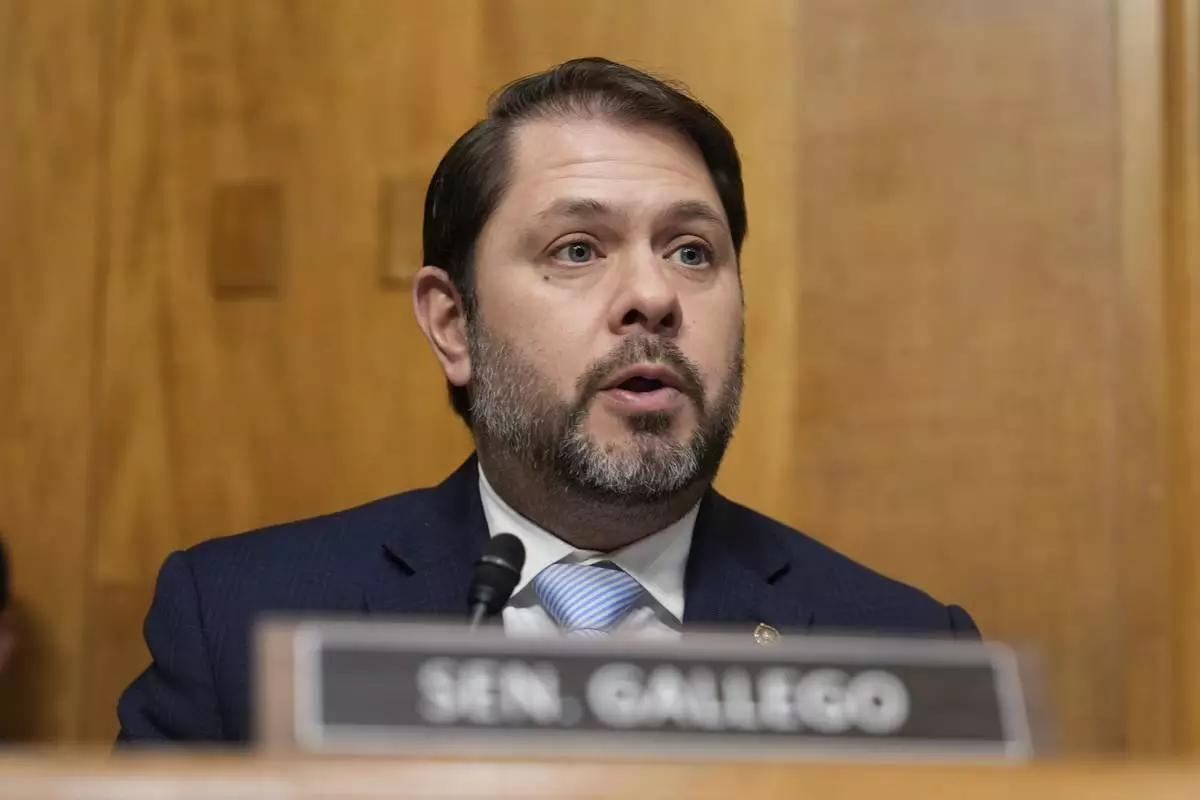
FILE - Sen. Ruben Gallego, D-Ariz., speaks at the Senate Homeland Security and Governmental Affairs Committee confirmation hearing for South Dakota Gov. Kristi Noem, President-elect Donald Trump's nominee to be Secretary of Homeland Security, at the Capitol in Washington, Jan. 17, 2025. (AP Photo/Ben Curtis, File)
RHO, Italy (AP) — No ice is colder and harder than speedskating ice. The precision it takes has meant that Olympic speedskaters have never competed for gold on a temporary indoor rink – until the 2026 Milan Cortina Winter Games.
In the pursuit of maximum glide and minimum friction, Olympic officials brought on ice master Mark Messer, a veteran of six previous Olympic speedskating tracks and the ice technician in charge of the Olympic Oval in Calgary, Canada — one of the fastest tracks in the world with over 300 records.
Messer has been putting that experience to work one thin layer of ice at a time since the end of October at the new Speed Skating Stadium, built inside adjacent trade fair halls in the city of Rho just north of Milan.
“It’s one of the biggest challenges I’ve had in icemaking,’’ Messer said during an interview less than two weeks into the process.
If Goldilocks were a speedskater, hockey ice would be medium hard, for fast puck movement and sharp turns. Figure skating ice would be softer, allowing push off for jumps and so the ice doesn’t shatter on landing. Curling ice is the softest and warmest of all, for controlled sliding.
For speedskating ice to be just right, it must be hard, cold and clean. And very, very smooth.
“The blades are so sharp, that if there is some dirt, the blade will lose the edge,’’ Messer said, and the skater will lose speed.
Speedskater Enrico Fabris, who won two Olympic golds in Turin in 2006, has traded in his skates to be deputy sports manager at the speedskating venue in Rho. For him, perfect ice means the conditions are the same for all skaters — and then if it's fast ice, so much the better.
"It's more of a pleasure to skate on this ice,'' he said.
Messer’s first Olympics were in Calgary in 1988 — the first time speedskating was held indoors. “That gave us some advantages because we didn’t have to worry about the weather, wind blowing or rain,’’ he said. Now he is upping the challenge by becoming the first ice master to build a temporary rink for the Olympics.
Before Messer arrived in Italy, workers spent weeks setting up insulation to level the floor and then a network of pipes and rubber tubes that carry glycol — an antifreeze — that is brought down to minus 7 or minus 8 degrees Celsius (17.6 to 19.4 degrees Fahrenheit) to make the ice.
Water is run through a purification system — but it can’t be too pure, or the ice that forms will be too brittle. Just the right amount of impurities “holds the ice together,’’ Messer said.
The first layers of water are applied slowly, with a spray nozzle; after the ice reaches a few centimeters it is painted white — a full day’s work — and the stripes are added to make lanes.
“The first one takes about 45 minutes. And then as soon as it freezes, we go back and do it again, and again and again. So we do it hundreds of times,’’ Messer said.
As the ice gets thicker, and is more stable, workers apply subsequent layers of water with hoses. Messer attaches his hose to hockey sticks for easier spreading.
What must absolutely be avoided is dirt, dust or frost — all of which can cause friction for the skaters, slowing them down. The goal is that when the skaters push “they can go as far as possible with the least amount of effort,’’ Messer said.
The Zamboni ice resurfacing machine plays a key role in keeping the track clean, cutting off a layer and spraying water to make a new surface.
One challenge is gauging how quickly the water from the resurfacing machine freezes in the temporary rink.
Another is getting the ice to the right thickness so that the Zamboni, weighing in at six tons, doesn’t shift the insulation, rubber tubing or ice itself.
“When you drive that out, if there’s anything moving it will move. We don’t want that,’’ Messer said.
The rink got its first big test on Nov. 29-30 during a Junior World Cup event. In a permanent rink, test events are usually held a year before the Olympics, leaving more time for adjustments. “We have a very small window to learn,’’ Messer acknowledged.
Dutch speedskater Kayo Vos, who won the men’s neo-senior 1,000 meters, said the ice was a little soft — but Messer didn’t seem too concerned.
“We went very modest to start, now we can start to change the temperatures and try to make it faster and still maintain it as a safe ice,’’ he said.
Fine-tuning the air temperature and humidity and ice temperature must be done methodically — taking into account that there will be 6,000 spectators in the venue for each event. The next real test will be on Jan. 31, when the Olympians take to the ice for their first training session.
“Eighty percent of the work is done but the hardest part is the last 20 percent, where we have to try to find the values and the way of running the equipment so all the skaters get the same conditions and all the skaters get the best conditions,’’ Messer said.
AP Winter Olympics: https://apnews.com/hub/milan-cortina-2026-winter-olympics

Serpentines are set on the ice of the stadium where speed skating discipline of the Milan Cortina 2026 Winter Olympics will take place, in Rho, outskirt of Milan, Tuesday, Nov. 11, 2025. (AP Photo/Luca Bruno)

Ice Master Mark Messer poses in the stadium where speed skating discipline of the Milan Cortina 2026 Winter Olympics will take place, in Rho, outskirt of Milan, Tuesday, Nov. 11, 2025. (AP Photo/Luca Bruno)
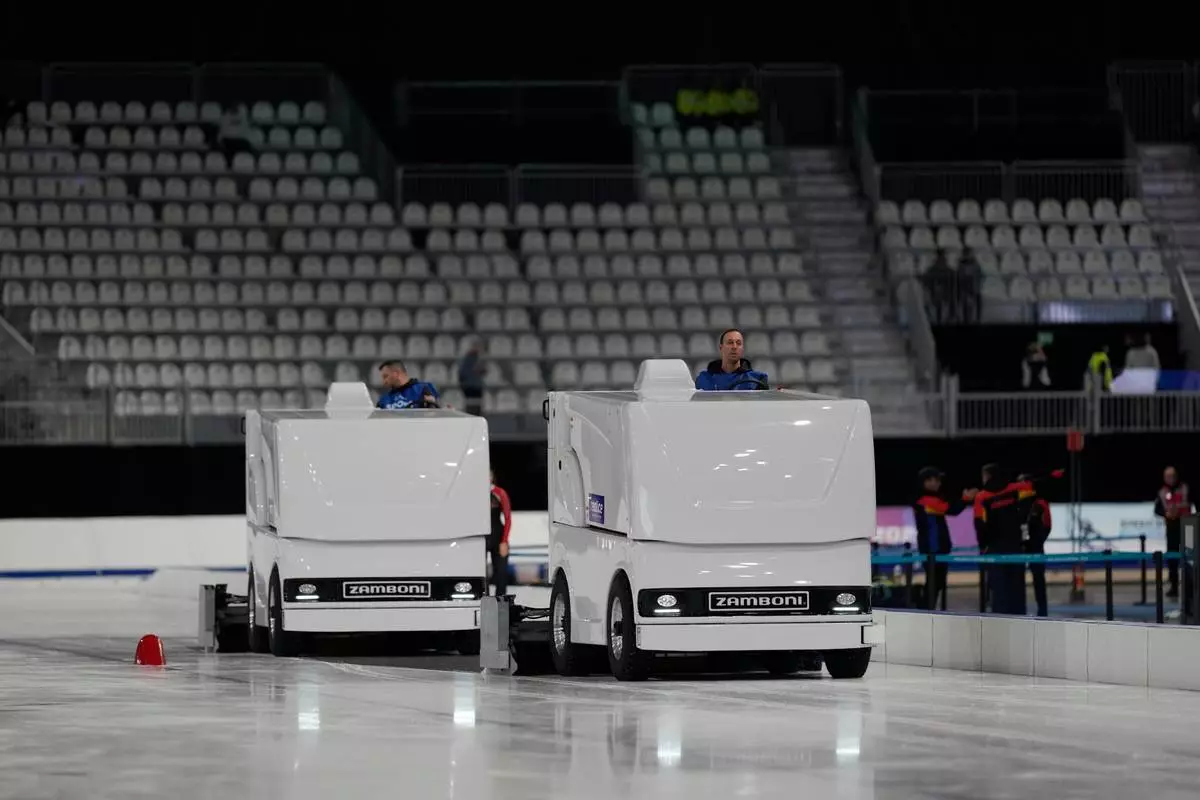
Workers clean the ice surface during a peed skating Junior World Cup and Olympic test event, in Rho, near Milan, Italy, Saturday, Nov. 29, 2025. (AP Photo/Luca Bruno)

Ice Master Mark Messer poses in the stadium where speed skating discipline of the Milan Cortina 2026 Winter Olympics will take place, in Rho, outskirt of Milan, Tuesday, Nov. 11, 2025. (AP Photo/Luca Bruno)

Ice Master Mark Messer poses in the stadium where speed skating discipline of the Milan Cortina 2026 Winter Olympics will take place, in Rho, outskirt of Milan, Tuesday, Nov. 11, 2025. (AP Photo/Luca Bruno)