Colombian President Gustavo Petro arrived in Beijing on Monday for the fourth ministerial meeting of the China-CELAC (Community of Latin American and Caribbean States) Forum, which is set to open on Tuesday.
Colombia succeeded Honduras to assume CELAC's rotating presidency in April this year.
In recent years, President Petro has maintained frequent exchanges with Chinese President Xi Jinping, attaching great importance to developing bilateral relations.
In February this year, Xi and Petro exchanged congratulations on the 45th anniversary of the establishment of diplomatic ties between China and Colombia.
In his message, Xi noted that Petro had paid a successful state visit to China in October 2023, during which the two heads of state had a fruitful meeting, and jointly announced the establishment of a strategic partnership between the two countries, guiding China-Colombia relations into a new era.
For his part, Petro noted that he paid a state visit to China after taking office, and bilateral ties have been steadily strengthened with the continuous increase in trade and investment.
He said Colombia is willing to work with China to jointly advance the global agenda of mutual concern, including world peace, energy transition and tackling climate change.
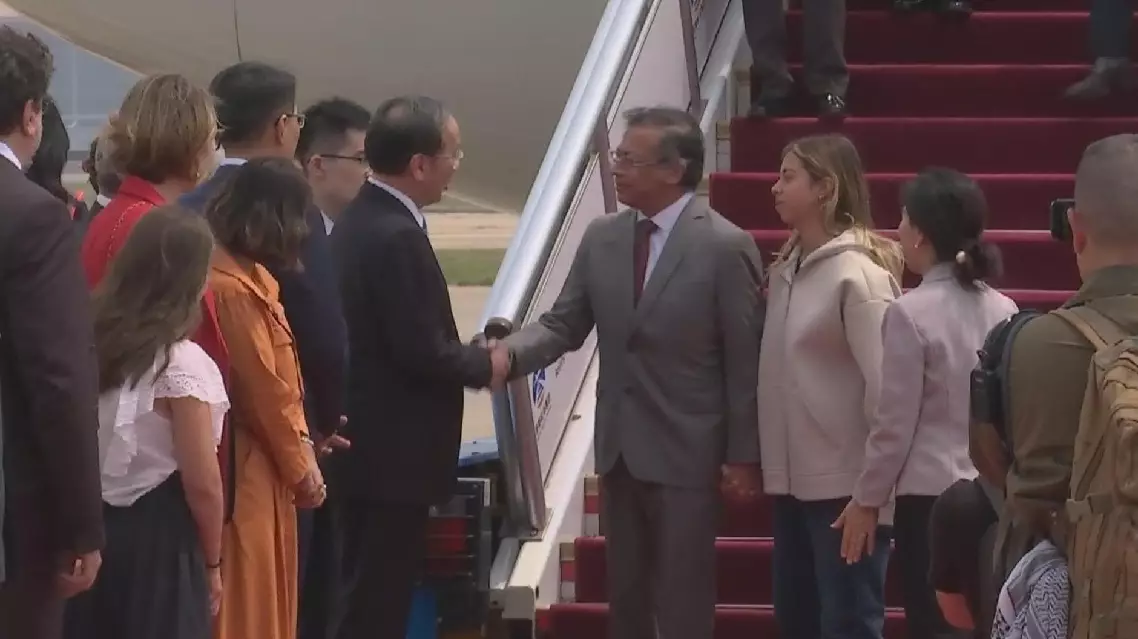
Colombian president arrives in Beijing for 4th ministerial meeting of China-CELAC Forum
Voting for the second phase of Myanmar's multi-party democratic general election concluded on Sunday afternoon.
Voting began at 06:00 local time on Sunday. At 16:00, an election official at a polling station in Yangon's Latha township announced the closure of the polling station.
Following the closure, election staff at the polling station, in the presence of domestic and international media, candidates, and observers, counted the votes, including advance votes, for seats in the Pyithu Hluttaw (Lower House), Amyotha Hluttaw (Upper House), and State and Region Hluttaws (State and Region Parliaments).
The second phase of the election was held in 100 townships across 12 of the 14 regions and states. In the Yangon region, it was held in 16 townships, including the townships of Latha, Bahan, Kyimyindaing and Kawhmu.
"We welcome the election, which is expected to bring new changes to the country," said a Yangon resident.
"I hope the parties can lead us and make it a better country, which is why I support the election," said another voter.
Myanmar's multi-party democratic general election is being held in three phases, with the first phase held in 102 townships on Dec 28 last year, and the third phase scheduled for Jan 25 this year in 63 townships.
"The parliament is scheduled to convene in March. Following the conclusion of the session, the new government will officially take office in April. We hope that more foreign investment will flow into Myanmar, enabling the public to enjoy the opportunities generated by the country's economic development more fully," said Zaw Min Tun, leader of the Information Team of Myanmar's National Defense and Security Council.
The Union Election Commission (UEC) said that about 5,000 candidates from 57 political parties are competing in the three phases of the election, adding that it plans to set up over 21,000 polling stations across the country for all three phases of the general election.
The election will produce the elected members of the Union Parliament (Pyithu Hluttaw and Amyotha Hluttaw) and State and Region Parliaments; the new Union Parliament will then elect a new president, who will form a new Union Government.

Voting for 2nd phase of Myanmar's general election concludes