Government launches public consultation on updating Hong Kong Biodiversity Strategy and Action Plan
The Government today (May 12) commences a public consultation on updating Hong Kong's Biodiversity Strategy and Action Plan (BSAP). The two-month consultation period will end on July 11.
The Government is committed to conserving Hong Kong's natural heritage, safeguarding biodiversity and achieving sustainable development. To complement the country's implementation of the United Nations' Convention on Biological Diversity, the Government launched the first phase of the BSAP in 2016, proposing a total of 67 specific measures in four main areas. With the concerted efforts of various sectors of the community, stakeholders and the Government, the first phase of the BSAP has achieved fruitful outcomes.
A spokesman for the Agriculture, Fisheries and Conservation Department (AFCD) said, "Biodiversity is an integral part of our daily lives and is intricately linked to the prosperity of our city and the well-being and quality of life of our citizens. Hong Kong has extraordinary biodiversity relative to a city of its size. To strike a balance between meeting development needs and conserving biodiversity, all sectors of the community should work together to ensure sustainable development."
To update the strategic areas and actions for the next phase of the BSAP, the Government launched a public consultation today to gather views from various sectors of the community. Taking into account the latest global and national biodiversity initiatives, including the Kunming-Montreal Global Biodiversity Framework and the China National Biodiversity Conservation Strategy and Action Plan (2023-2030), local circumstances and conditions, and views received during the consultation period, the Government will complete updating the BSAP later this year to step up the work on biodiversity conservation and sustainable development, and to support the latest global and national initiatives.
The consultation document proposes four strategic areas:
(1) Nature conservation: Building on years of dedicated efforts and the implementation of the first phase of the BSAP, the Government has already implemented numerous conservation measures. The Government proposes to continue implementing nature conservation measures to ensure the preservation of healthy ecosystems, for example, by exploring the implementation of area-based conservation measures, restoring degraded or declining habitats, and strengthening the protection of species of concern;
(2) Deepening mainstreaming: The first phase of the BSAP has raised the awareness of biodiversity across society. The Government proposes to further promote the adoption of biodiversity-friendly practices across all sectors of society, for example, through mobilising resources to support the sustainable use and conservation of natural resources, encouraging various sectors to leverage biodiversity opportunities, supporting communities to develop stewardship responsibilities towards nature, etc, with a view to building a prosperous city that coexists harmoniously with nature;
(3) Capacity building: The Government has continued to invest in biodiversity-related knowledge products and research projects, including the establishment of the Hong Kong Biodiversity Information Hub and setting up various funding schemes. The Government proposes to continue to strategically invest resources in promoting research and nurturing talent, for example, by enabling innovative and high-quality research, promoting knowledge transfer and talent development, strengthening institutions to support capacity building, etc, for enhancing individual and collective capacities and empowering everyone to actively contribute to the conservation of biodiversity; and
(4) Collaborative partnering: Hong Kong has a unique set of strengths, including international talent, a diverse cultural environment and close connections with international networks. The Government proposes to foster a culture of collaboration to extend the benefits of nature conservation to broader communities, for example, by jointly taking actions with cross-boundary and international partners, promoting exchange of experience and information on various fronts, encouraging cross-disciplinary collaborations, etc.
The consultation document can be downloaded from the AFCD's website (www.afcd.gov.hk/english/conservation/Con_hkbsap/updating_bs
ap/updating_bsap.html). Members of the public can send in their views on or before July 11 by email (bsap@afcd.gov.hk), by post (Biodiversity Conservation Division, AFCD, 5/F, Cheung Sha Wan Government Offices, 303 Cheung Sha Wan Road, Kowloon, Hong Kong), or by fax (2314 2802).
The Government will also invite organisations from relevant sectors during the consultation period to attend the consultation sessions to collect views.
EDB reminds parents to choose primary schools under Central Allocation process for their children
The Education Bureau (EDB) today (January 12) reminded parents that children who have joined the Primary One Admission (POA) System for 2026 but have not yet secured a discretionary place can take part in the Central Allocation process for a Primary One (P1) place in a government or aided primary school. Parents concerned should make their choice of schools within the period from January 19 to 25.
Digitalisation of POA
---------------------------
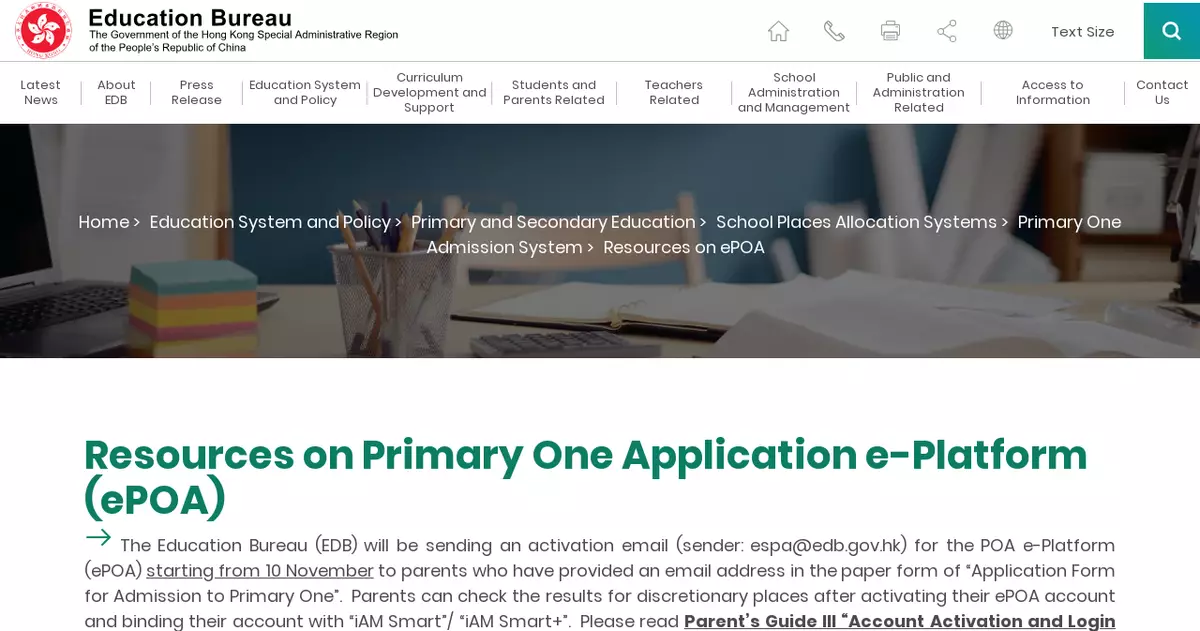
In line with the Smart Government strategy, the EDB has fully implemented digitalisation of the POA. Parents who have registered as POA e-Platform (ePOA) users and have bound their account to "iAM Smart+" may submit the Choice of Schools Form for Central Allocation from January 19 to 25 through the ePOA. Please refer to the related videos and Parent's Guide on the EDB's website (www.edb.gov.hk/en/edu-system/primary-secondary/spa-systems/primary-1-admission/poa_eplatform/index.html) for details of the procedures for activating and logging into an ePOA account and for making school choices for the Central Allocation of POA via the e-Platform.
Making school choices at Central Allocation Centres
-----------------------------------------------------------------
The EDB will send letters to parents on January 14 inviting them to make their choice of schools. To cater for the needs of different parents, parents can still submit the Choice of Schools Form in paper form by visiting the designated Central Allocation Centre at the suggested time slot (i.e. 9.30am to 12.30pm or 1.30pm to 4.30pm on January 24 (Saturday) or 9.30am to 12.30pm on January 25 (Sunday)) stated in the letter.
Parents who are ePOA users may choose to submit the Central Allocation Application via the ePOA or in paper form to the Central Allocation Centre but should not submit duplicate applications. Parents who have not yet received the letter by January 19 should call the School Places Allocation Section of the EDB (Hotline: 2832 7700) as soon as possible.
Only one parent of an applicant child is required to complete the school choice-making procedures. Parents are advised not to take their children to the Central Allocation Centre if possible. Parents who cannot make school choices within the suggested time slot can go to the designated Central Allocation Centre from 1.30pm to 4.30pm on January 25. The Choice of Schools Form will be sent together with the letter to parents who have submitted a paper Application Form at the Discretionary Places stage for filling out in advance.
In the event of adverse weather or other special conditions on any day during the period of making school choices, please pay heed to radio or television announcements on the relevant special arrangements.
Unable to submit application within specified choice-making period
------------------------------------------------------------------------------------
For individual parents who are unable to use the ePOA or go to the Central Allocation Centre to make school choices, they can authorise in writing a representative to bring the completed Choice of Schools Form and their signed Letter of Authorisation to the Central Allocation Centre to proceed with the related procedures.
To apply for POA 2026 for their children after January 25, parents need to complete necessary procedures with the School Places Allocation Section, which will separately arrange P1 places for the applicant children in June.
Change of residential address
--------------------------------------
An EDB spokesman reminded parents that, if they have recently moved their residence or have such plans in the near future, they are required to inform the School Places Allocation Section as soon as possible so that they can make school choices in the POA School Net where their new home is located. Parents should fill in the actual residential address of their child. If they provide a false address for securing a P1 place, the POA application of their child will be rendered void and the P1 place allocated will be withdrawn.
The EDB has put in place a monitoring mechanism to verify the residential addresses of applicant children as given by the parents. Random checks have also been stepped up. The public may call the School Places Allocation Section to report suspected cases of using a false address by parents for their children's POA application. The EDB will take action against false address cases.
Mechanism of Central Allocation
----------------------------------------
Central Allocation is composed of two parts. Part A, which takes up 10 per cent of the P1 places earmarked for Central Allocation, is for unrestricted school choices. Parents can choose up to three government or aided primary schools in any school net. Part B takes up the remaining 90 per cent of the P1 places earmarked for Central Allocation. Parents of applicant children residing in the school net concerned are to select schools from the "Choice of Schools List for Central Allocation (Primary One Admission 2026)" of their school net, while parents of applicant children who intend to commute daily to schools in Hong Kong are to select schools from the "2026 Choice of Schools List for Central Allocation (For Applicant Children who intend to commute daily to schools in Hong Kong)". Parents should fill in the Choice of Schools Form in the order of their preference.
The mechanism of the Central Allocation is based on parents' choices in general. The computer-programmed allocation will first process the school choices in Part A and then the school choices in Part B. For oversubscribed schools, the order of priority in allocating places will be determined by random numbers generated by the computer for individual applicants to ensure fairness.
For information about the procedures for Central Allocation, please call the EDB's 24-hour automatic telephone enquiry service at 2891 0088.
Release of Central Allocation results
----------------------------------------------
For parents who have already activated their ePOA account via "iAM Smart" or "iAM Smart+", they will receive their Central Allocation results through the ePOA from 10am on June 3. Parents who wish to receive the allocation results via SMS on June 3 may choose such an option in the Choice of Schools Form. In addition, the allocation results will be sent to parents by post on June 3 and 4.
Source: AI-found images