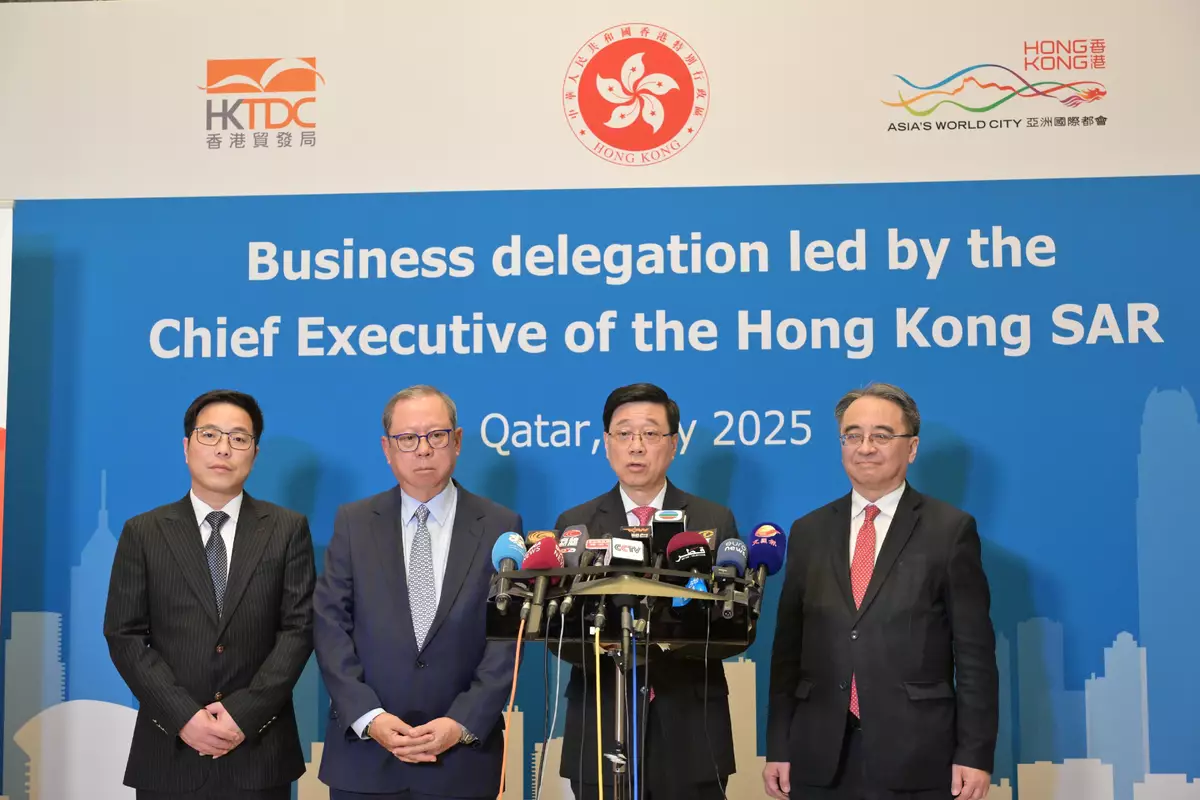
Remarks by CE at media session in Doha (with photo/video)
The Chief Executive, Mr John Lee, concluded the visit of the business delegation comprising representatives from Hong Kong and Mainland enterprises to Qatar together with the Chairman of the Hong Kong Trade Development Council, Dr Peter Lam; the Chief Executive Officer of the MTR Corporation Limited, Dr Jacob Kam; and the Chairman of the Luyi Investment Limited, Mr Yin Haijie, in Doha, Qatar, today (May 12, Doha time). Following are the remarks by Mr Lee:
Chief Executive: I will now turn to our English-speaking friends in the media.
This marks my second duty visit to the Middle East since taking office. Our delegation comprises over 50 professionals and leaders of enterprises from Hong Kong plus Mainland China. The composition of the delegation demonstrates Hong Kong's unique role as a "super connector" and "super value-adder" under the principle of "one country, two systems". Hong Kong is dedicated to capitalising on its connectivity with both Mainland China and the world, collaborating and synergising with economies and enterprises that are eager to pursue high-quality development with us.
I have set out three major goals for our visit to the Middle East this time. First, to strengthen government-to-government relations; second, to explore new areas of co-operation; third, to make friends and expand our network.
Yesterday, I had the honour of meeting His Highness the Amir of the State of Qatar, followed by a meeting with the Prime Minister and Minister of Foreign Affairs. We also visited the Qatar Investment Authority. I introduced to them Hong Kong's latest developments in finance, professional services, and innovation and technology. We agreed to deepen collaboration across sectors between Hong Kong and Qatar.
We have also expanded our business networks. During this visit, we have achieved 35 MOUs and agreements spanning trade, investment, technology, legal co-operation, financial markets and so on.
In addition to Hong Kong-Qatar co-operation, two agreements were reached between enterprises from Mainland China and Qatar, supporting the development of financial services and advanced manufacturing.
A tripartite agreement among organisations from Hong Kong, Mainland China and Qatar was also reached, focusing on fintech collaboration, showcasing Hong Kong's bridging role between different economies.
The delegation has first-hand insights from the visit. The delegation visited the Qatar Foundation to learn about its R&D, education and community projects, and visited Lusail City to better understand the smart infrastructure in Qatar's second-largest city.
Later today, I will visit an autonomous vehicle project at the airport — a project designed by a Mainland Chinese tech firm with its international headquarters in Hong Kong, and first piloted in the Hong Kong International Airport. This exemplifies our role as a launchpad for global innovation.
Tonight, we will depart for Kuwait and will announce the outcome of our duty visit later.
Reporter: Thank you honourable sir. I wanted to ask you if you could you give a rough figure of the value of the 35 memorandums of understanding (MOUs) that have been signed today? And if you can go into a little bit more about the sectors whereby Qatar and Hong Kong can both benefit from each other? For example, you mentioned earlier technology in autonomous vehicles manufactured by Yutong.
Chief Executive: There are 35 agreements signed within two days. I think that is quite a record. I am very glad that delegate members, plus our counterparts in Qatar, both have been very active and supportive in developing co-operation, collaboration and networking, and I see them really spending their time exchanging contact details and also exchanging ideas on how they can develop the relationship. The 35 co-operation agreements cover areas including economic co-operation, investment, technology, legal co-operation, finance, banking and also capital arrangement. If you want to look at the 35 areas of co-operation, I think if you look at the fullest, then you will see the focus areas of co-operation.
The result of these 35 agreements will have to be judged by those who will then continue their work. What a visit led by the Chief Executive will achieve, and can achieve, is opening the doors first with governments, so that the delegates, business players and entrepreneurs can then continue the liaison to open more doors, windows and opportunities. It is up to them to work hard, and this is something I will be demanding – for them to work hard. But if you look at my last visit to the Middle East, which was about two years ago, after we signed a number of MOUs, we have seen companies producing hydrogen buses for a country in the Middle East. We have seen, for example, on the stock exchange side, stock exchanges exchanging agreements for dual listing. We also see professionals set up their offices in the countries that I visited in the Middle East last time, and they have been receiving work orders and doing their services. I expect the delegates to continue these liaisons amongst themselves. But I am glad to inform you that the amount of enthusiasm is very strong. I will say that there will be more exchanges between not just governments, but in the private sector, chambers, businessmen and associations. And I will see not just exchanges between themselves, but also their participation in some of the events organised in Hong Kong, including both conferences, a lot of match-making deals, etc. I am very positive that the momentum will continue.
(Please also refer to the Chinese portion of the remarks.)
Remarks by CE at media session in Doha (with photo/video) Source: HKSAR Government Press Releases
Update on chikungunya fever
The Centre for Health Protection (CHP) of the Department of Health announced that, as of 5pm today (January 11), no new cases of chikungunya fever (CF) had been recorded.
Latest surveillance data
------------------------------
Hong Kong has recorded a total of 82 confirmed CF cases last year. Among them, 11 were local cases, and the rest were imported cases.
Since the beginning of 2025, and as of December 10, 2025, a total of 502 264 CF cases and 186 CF-related deaths have been reported in over 40 countries/territories. Cases have been reported in the Americas, Africa, Asia, and Europe. Although the northern hemisphere has entered the winter season, temperatures in subtropical and some temperate regions remain elevated due to climate change, creating favourable conditions for mosquito breeding. In addition, CF outbreaks continue to occur in many countries worldwide. The risk of imported cases persists. Members of the public should check the situation of the destinations before travelling abroad, especially when travelling to Southeast Asian countries.
Government's comprehensive follow-up actions
-----------------------------------------------------
Given that some local cases of CF have visited the Tsing Yi Nature Trails or the surrounding area in November last year, the trails are currently closed until further notice. Relevant government departments continue to conduct large-scale mosquito control and prevention efforts along the trails, and the CHP appeals to the public not to enter the area in order to reduce the risk of contracting CF and to avoid exposure to chemicals or interfering with the mosquito control operations. Since the confirmation on December 10, 2025, of a case involving a person who had visited the Tsing Yi Nature Trails on November 30, 2025, no further local cases have been recorded to date. The CHP continues to urge individuals who have recently hiked along the Tsing Yi Nature Trails to seek medical attention as soon as possible if they develop relevant symptoms and to call the enquiry hotline (Tel: 2125 2373), which operates from 9am to 6pm.
The Food and Environmental Hygiene Department (FEHD) has been continuously conducting intensive fogging operations to eliminate adult mosquitoes along the Tsing Yi Nature Trails and the surrounding area. At suitable locations, large ultra-low volume foggers have been deployed, and a robot dog is being put on trial to enhance operational effectiveness. The FEHD has also set up new mosquito trapping devices, cleared discarded containers and garbage that could cause stagnant water, and applied larvicide oil or larvicides in areas with stagnant water that cannot be removed immediately. The FEHD has been collaborating with the Kwai Tsing District Office, the Lands Department and the Drainage Services Department to strengthen efforts in eliminating potential mosquito breeding sites along the Tsing Yi Nature Trails. Pamphlets have been distributed to hikers in the area, urging citizens to be vigilant against mosquito infestations and take personal protective measures. The FEHD has also held meetings of the interdepartmental task forces on anti-mosquito work across districts to discuss the latest developments regarding the situation and plan accordingly to co-ordinate relevant departments and stakeholders in strengthening mosquito prevention and control measures in areas under their purview.
Continuously strengthening prevention and control
---------------------------------------------------------
The FEHD and relevant departments have comprehensively enhanced the mosquito control operations in Hong Kong since July last year, and this has continued. Among these, the FEHD has conducted vector investigations and targeted mosquito control operations against the imported and local cases. In light of the local case, the FEHD has immediately conducted follow-up actions, including:
 carrying out intensive fogging in scrubby areas within a 250-metre radius of the relevant locations to kill adult mosquitoes;
carrying out inspections of the locations, removing stagnant water, applying insecticides and disposing of abandoned water containers every week with a view to preventing mosquito breeding; and
enhancing public education efforts through organising health talks, setting up mobile education stations, and distributing publicity leaflets.
carrying out intensive fogging in scrubby areas within a 250-metre radius of the relevant locations to kill adult mosquitoes;
carrying out inspections of the locations, removing stagnant water, applying insecticides and disposing of abandoned water containers every week with a view to preventing mosquito breeding; and
enhancing public education efforts through organising health talks, setting up mobile education stations, and distributing publicity leaflets.
The abovementioned measures will be continued. Furthermore, the Government will further enhance the mosquito control efforts in addition to the existing measures.
Preventive measures to be taken by the public
----------------------------------------------------
Members of the public should use DEET-containing insect repellents or other effective active ingredients properly to prevent mosquito bites, but the following precautions should be taken when using them:
read the label instructions carefully first;
apply right before entering an area with a risk of mosquito bites;
apply on exposed skin and clothing;
use DEET of up to 30 per cent for pregnant women and up to 10 per cent for children (for children who travel to countries or areas where mosquito-borne diseases are endemic or epidemic and where exposure is likely, those aged 2 months or above can use DEET-containing insect repellents with a DEET concentration of up to 30 per cent);
apply sunscreen first, then insect repellent;
reapply only when needed and follow the instructions; and
in addition to DEET, there are other insect repellents available on the market containing different active ingredients, such as IR3535 and picaridin. When using any insect repellent, the public should follow the usage instructions and precautions on the product label.
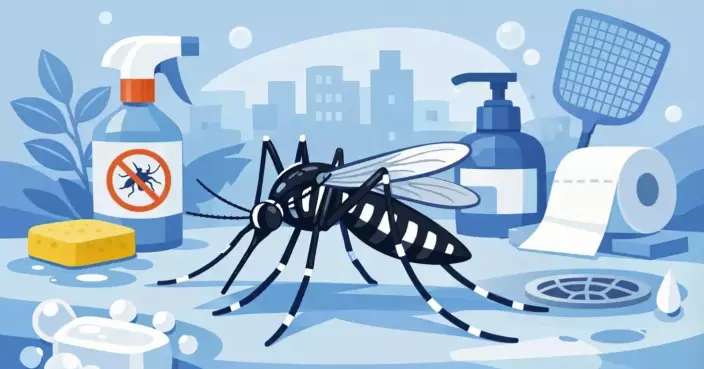
The FEHD also appeals to members of the public to continue to stay alert and work together to carry out mosquito prevention and control measures early, including inspecting their homes and surroundings to remove potential breeding grounds, changing water in vases and scrubbing their inner surfaces, removing water in saucers under potted plants at least once a week, and properly disposing of containers such as empty cans and lunch boxes. The FEHD also advises members of the public and property management agencies to keep drains free of blockage and level all defective ground surfaces to prevent the accumulation of water. They should also scrub all drains and surface sewers with an alkaline detergent at least once a week to remove any mosquito eggs.
The public should call 1823 in case of mosquito problems, and may visit the following pages for more information: the CF page of theCHPand theTravel Health Service, the latestTravel Health News,tips for using insect repellents, and the CHPFacebook Page,Instagram AccountandYouTube Channel, and also theMosquito Prevention and Control dedicated pageof the FEHD.
Source: AI-found images