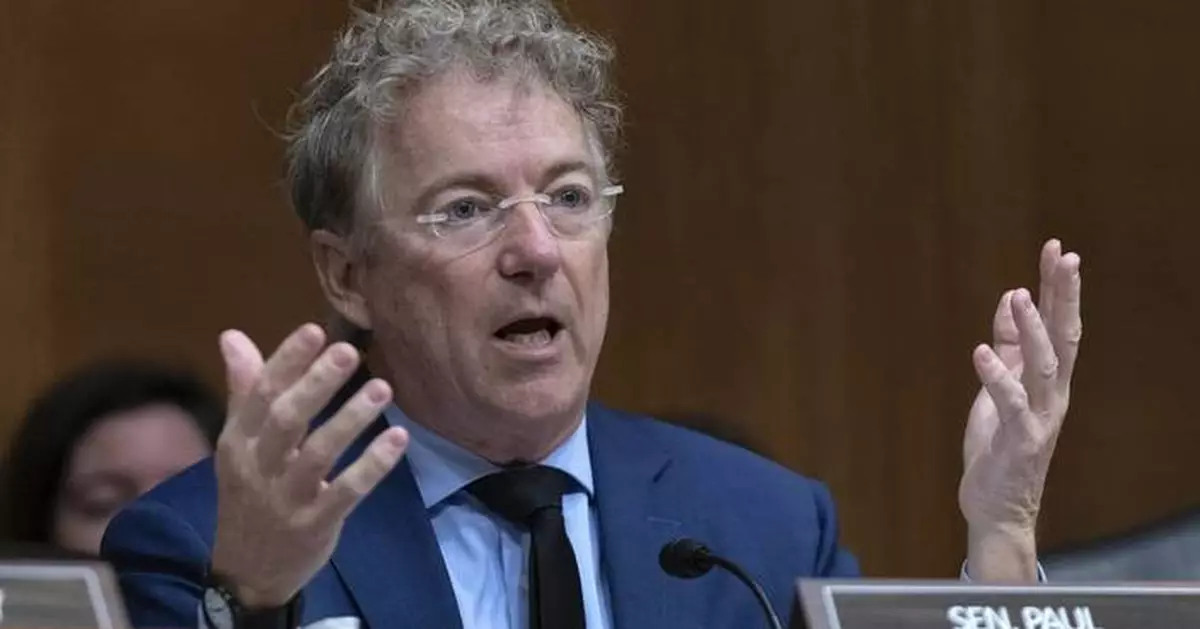
LOUISVILLE, Ky. (AP) — In solidly Republican Kentucky, resistance to President Donald Trump's trade wars has sprung up from a cross-section of key business sectors, GOP Sen. Rand Paul said Monday.
Paul said he's heard concerns from agriculture, the auto sector, bourbon production, home building and package shipping in response to Trump's aggressive use of tariffs. Paul — among the few GOP senators willing to challenge Trump on tariffs — met with a group of Louisville business leaders on Monday.
"Virtually every business that I have met in Kentucky has said they’re not excited about having tariffs and that international trade has been good for their company and good for the consumer by bringing lower prices,” the libertarian-leaning Paul told reporters afterward.
Paul welcomed the sudden de-escalation of the trade conflict between the U.S. and China, when the two global economic powerhouses agreed Monday to slash their massive recent tariffs. The 90-day truce creates time for U.S. and Chinese negotiators to reach a more substantive agreement.
As for prospects of a longer-term deal, the senator said: "We’ll see how it shakes out.”
“Anything we can do to bring down tariffs is good,” Paul said. “I said I’ll be the first person to compliment President Trump if the end of this shakes out and in six months, all the tariffs are lower and there’s more trade. I’m perfectly willing and big enough to say: ‘Good job, Mr. President.’”
Trump used tariffs in his first term and has been even more aggressive and unpredictable about imposing them in his second. He’s slapped a 10% tariff on a myriad of countries, blowing up the rules that had governed global trade for decades.
Trump dominated Kentucky in each presidential election since 2016, but the GOP lawmakers willing to speak out against his trade wars include Paul and Sen. Mitch McConnell.
Trump's tariffs forged a rare bipartisan alliance in Kentucky among the senators and Democratic Gov. Andy Beshear. They raised concerns that trade wars would drive up prices for consumers and damage key business sectors, including the bourbon industry. In Canada, some liquor stores cleared American spirits from their shelves amid trade acrimony and Trump’s calls to make Canada the 51st state.
Trump views tariffs as an all-purpose economic tool that can raise money for the U.S. Treasury, protect American industries, lure factories to the United States and pressure other countries to bend to his will, even on issues such as immigration and drug trafficking.
Paul, who ran for president in 2016, has called for Congress to reassert its authority on the issue.
“Tariffs are taxes, and the power to tax belongs to Congress — not the president," Paul said in a release last month. “Our Founders were clear: tax policy should never rest in the hands of one person.”
Asked Monday if he trusts the president's tactics on trade, Paul replied: "I would prefer we weren’t putting tariffs on.”
Paul also raised concerns about the on-again, off-again nature of Trump's tariff policies, noting that “businesses like certainty.”
“It’s really why most of us who believe in the free market think that government shouldn’t be involved in so many decisions," he said. “These are the decisions that should be left to the marketplace to determine prices."
Among the business leaders who met with Paul on Monday was Sarah Davasher-Wisdom, CEO of Greater Louisville Inc., the metro chamber of commerce in Kentucky's largest city. Participants updated the senator on what impacts the tariffs are having on their businesses, she told reporters.
“The tariffs are creating a lot of uncertainty for businesses, and that makes it very difficult to operate. And it’s driving up prices,” she said. “And the uncertainty itself is making it difficult for businesses to plan capital expenditures, making it difficult for them to plan out 90 days, 120 days.”
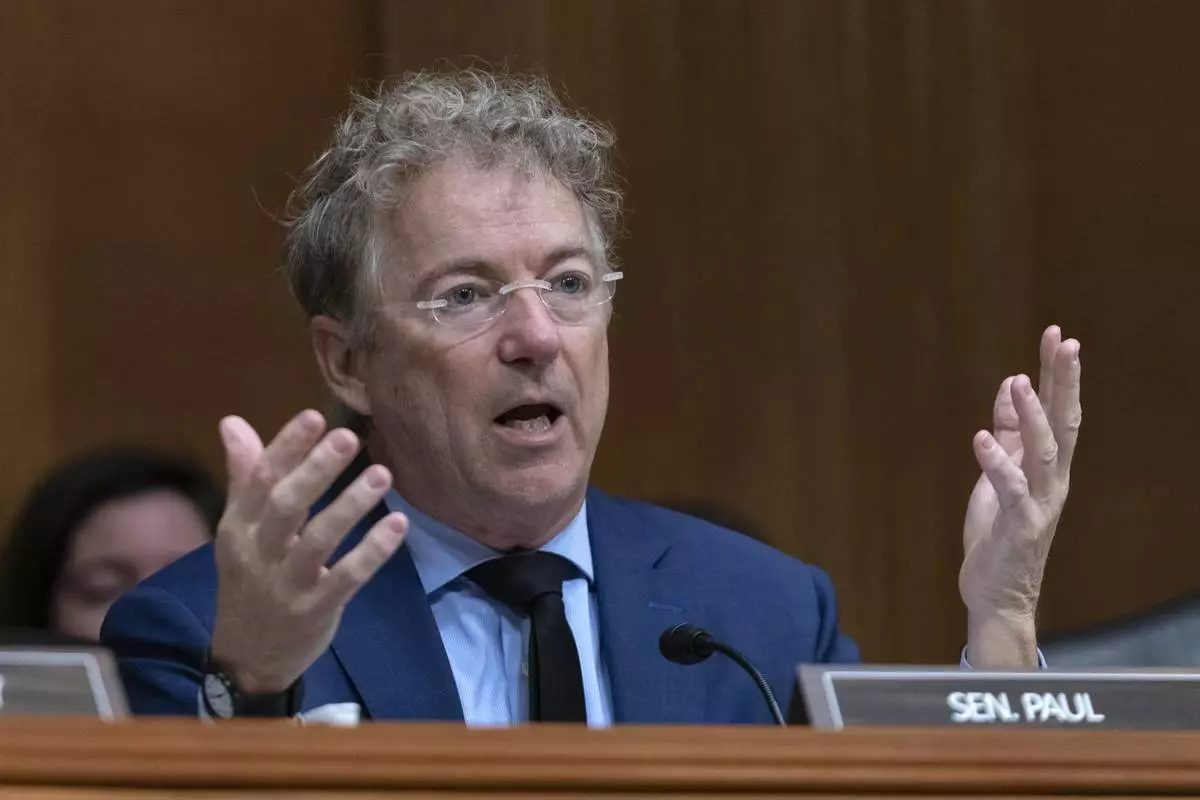
FILE - Sen. Rand Paul, R-Ky., speaks during the Senate Committee on Health, Education, Labor and Pensions hearing on the nomination of Martin Makary to serve as Commissioner of Food and Drugs at the Department of Health and Human Services, on Capitol Hill Thursday, March 6, 2025, in Washington. (AP Photo/Jose Luis Magana, file)
WASHINGTON (AP) — Sluggish December hiring concluded a year of weak employment gains that have frustrated job seekers even though layoffs and unemployment have remained low.
Employers added just 50,000 jobs last month, nearly unchanged from a downwardly revised figure of 56,000 in November, the Labor Department said Friday. The unemployment rate slipped to 4.4%, its first decline since June, from 4.5% in November, a figure also revised lower.
The data suggests that businesses are reluctant to add workers even as economic growth has picked up. Many companies hired aggressively after the pandemic and no longer need to fill more jobs. Others have held back due to widespread uncertainty caused by President Donald Trump’s shifting tariff policies, elevated inflation, and the spread of artificial intelligence, which could alter or even replace some jobs.
Still, economists were encouraged by the drop in the unemployment rate, which had risen in the previous four straight reports. It had also alarmed officials at the Federal Reserve, prompting three cuts to the central bank's key interest rate last year. The decline lowered the odds of another rate reduction in January, economists said.
“The labor market looks to have stabilized, but at a slower pace of employment growth,” Blerina Uruci, chief economist at T. Rowe Price, said. There is no urgency for the Fed to cut rates further, for now."
Some Federal Reserve officials are concerned that inflation remains above their target of 2% annual growth, and hasn't improved since 2024. They support keeping rates where they are to combat inflation. Others, however, are more worried that hiring has nearly ground to a halt and have supported lowering borrowing costs to spur spending and growth.
November's job gain was revised slightly lower, from 64,000 to 56,000, while October's now shows a much steeper drop, with a loss of 173,000 positions, down from previous estimates of a 105,000 decline. The government revises the jobs figures as it receives more survey responses from businesses.
The economy has now lost an average of 22,000 jobs a month in the past three months, the government said. A year ago, in December 2024, it had gained 209,000 a month. Most of those losses reflect the purge of government workers by Elon Musk's Department of Government Efficiency.
Nearly all the jobs added in December were in the health care and restaurant and hotel industries. Health care added 38,500 jobs, while restaurants and hotels gained 47,000. Governments — mostly at the state and local level — added 13,000.
Manufacturing, construction and retail companies all shed jobs. Retailers cut 25,000 positions, a sign that holiday hiring has been weaker than previous years. Manufacturers have shed jobs every month since April, when Trump announced sweeping tariffs intended to boost manufacturing.
Wall Street and Washington are looking closely at Friday's report as it's the first clean reading on the labor market in three months. The government didn’t issue a report in October because of the six-week government shutdown, and November’s data was distorted by the closure, which lasted until Nov. 12.
The hiring slowdown reflects more than just a reluctance by companies to add jobs. With an aging population and a sharp drop in immigration, the economy doesn't need to create as many jobs as it has in the past to keep the unemployment rate steady. As a result, a gain of 50,000 jobs is not as clear a sign of weakness as it would have been in previous years.
And layoffs are still low, a sign firms aren't rapidly cutting jobs, as typically happens in a recession. The “low-hire, low-fire” job market does mean current workers have some job security, though those without jobs can have a tougher time.
Ernesto Castro, 44, has applied for hundreds of jobs since leaving his last in May. Yet the Los Angeles resident has gotten just three initial interviews, and only one follow-up, after which he heard nothing.
With nearly a decade of experience providing customer support for software companies, Castro expected to find a new job pretty quickly as he did in 2024.
“I should be in a good position,” Castro said. “It’s been awful.”
He worries that more companies are turning to artificial intelligence to help clients learn to use new software. He hears ads from tech companies that urge companies to slash workers that provide the kind of services he has in his previous jobs. His contacts in the industry say that employees are increasingly reluctant to switch jobs amid all the uncertainty, which leaves fewer open jobs for others.
He is now looking into starting his own software company, and is also exploring project management roles.
December’s report caps a year of sluggish hiring, particularly after April's “liberation day” tariff announcement by Trump. The economy generated an average of 111,000 jobs a month in the first three months of 2025. But that pace dropped to just 11,000 in the three months ended in August, before rebounding slightly to 22,000 in November.
Last year, the economy gained just 584,000 jobs, sharply lower than that more than 2 million added in 2024. It's the smallest annual gain since the COVID-19 pandemic decimated the job market in 2020.
Subdued hiring underscores a key conundrum surrounding the economy as it enters 2026: Growth has picked up to healthy levels, yet hiring has weakened noticeably and the unemployment rate has increased in the last four jobs reports.
Most economists expect hiring will accelerate this year as growth remains solid, and Trump's tax cut legislation is expected to produce large tax refunds this spring. Yet economists acknowledge there are other possibilities: Weak job gains could drag down future growth. Or the economy could keep expanding at a healthy clip, while automation and the spread of artificial intelligence reduces the need for more jobs.
Productivity, or output per hour worked, a measure of worker efficiency, has improved in the past three years and jumped nearly 5% in the July-September quarter. That means companies can produce more without adding jobs. Over time, it should also boost worker pay.
Even with such sluggish job gains, the economy has continued to expand, with growth reaching a 4.3% annual rate in last year's July-September quarter, the best in two years. Strong consumer spending helped drive the gain. The Federal Reserve Bank of Atlanta forecasts that growth could slow to a still-solid 2.7% in the final three months of last year.
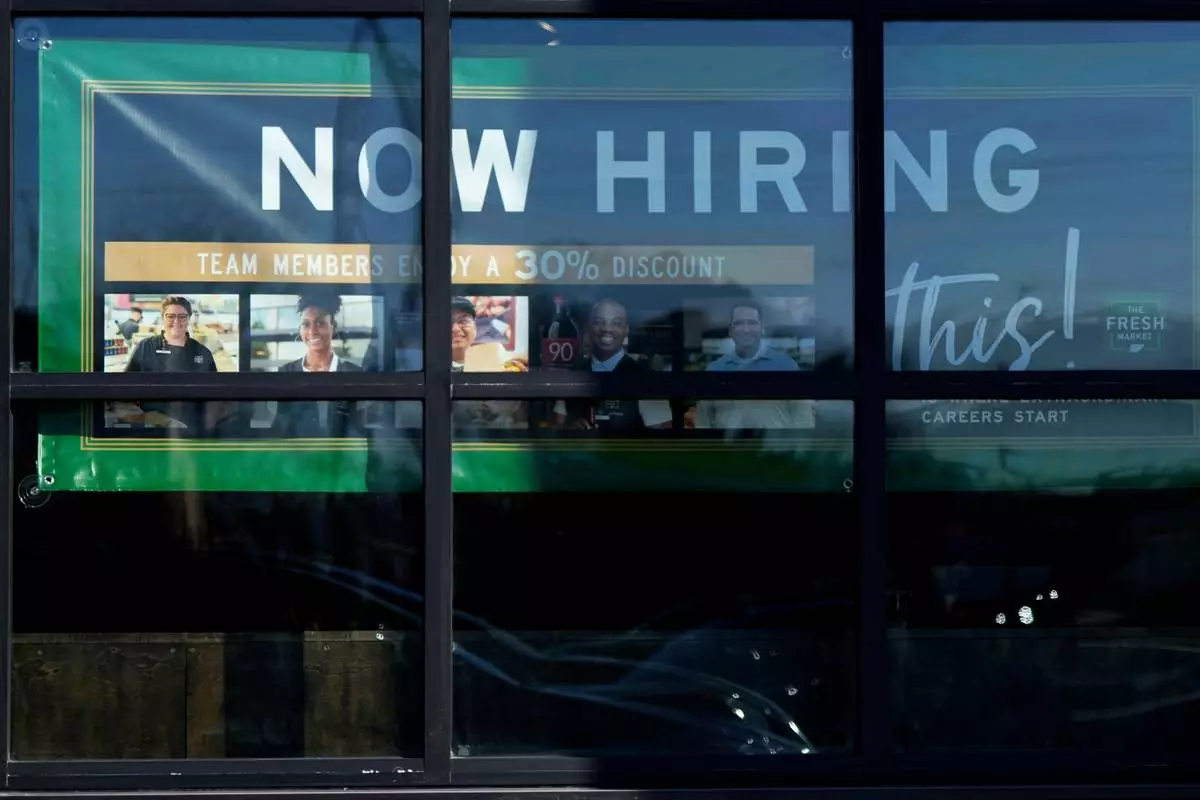
FILE - A hiring sign is displayed at a grocery store in Northbrook, Ill., Tuesday, Jan. 21, 2025. (AP Photo/Nam Y. Huh)