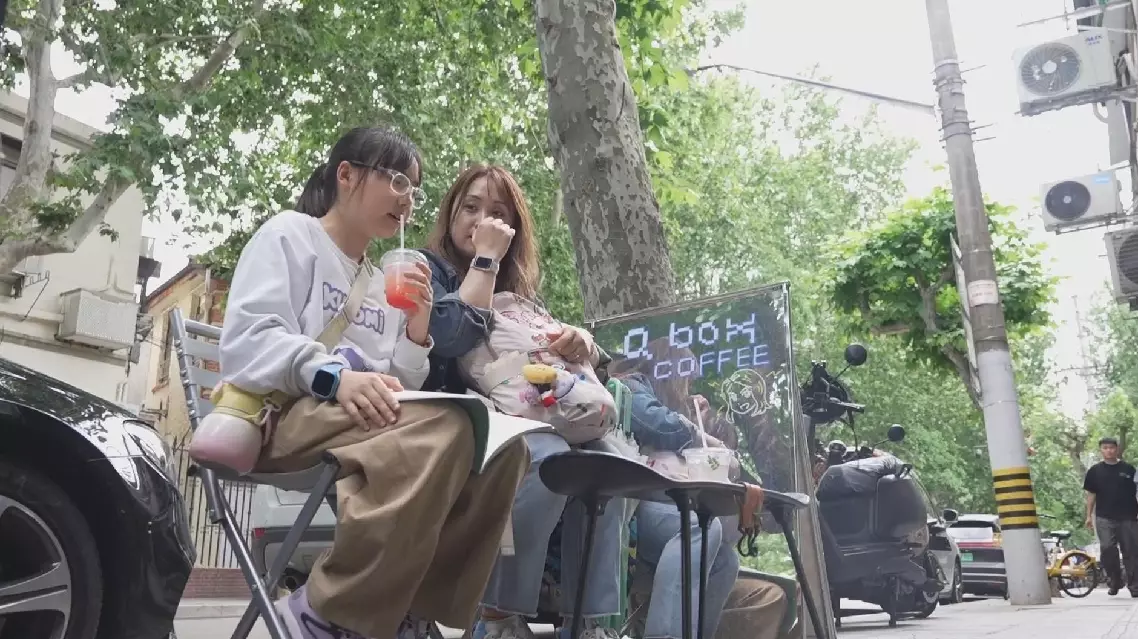
Cafes on a tranquil street in Shanghai have been transforming into hubs for creative expression and social connection, allowing them to tap into youth spending while also providing young people with spaces for idea-sharing and inspiration.
Coffee culture among Chinese youth has blown up in recent years, particularly in major urban centers. Shanghai's Xuhui District is now home to nearly 150 coffee and beverage shops in an area of less than 3 kilometers.
The district's Tianping Road has one of the highest densities of coffee shops in the city. One is run by twenty-six-year-old Qin Shuqi, who opened her shop after resigning from her job at a web-based company to pursue her dream.
However, as a new small business owner, she was at first perplexed about how to stand out among so many other cafes.
"At the begining, I can't help but worry about customer traffic and rent every morning when I wake up. My store isn't in a prime location -- there aren't any office buildings or shopping areas nearby -- so I saw very few customers during the weekdays. It was really stressful," she said.
Opportunity presented itself when Qin realized that a large number of students would pass by her cafe each day after 17:00. After talking with them, she learned that they prefer non-caffeinated drinks. Qin swiftly adjusted her marketing strategy, designing a variety of drinks catering to young people's tastes. To get them hooked, she launched a special offer. "We offer a 'buy one, get one free' deal on non-coffee drinks from 17:00 to 18:30 on weekdays to attract students right after school. Many students go home in groups, so they can share drinks with their classmates and parents. We've been running this promotion for three months, and sales have been great," said the coffee shop owner.
Building on this momentum, Qin's cafe and others on Tianping Road have been increasingly catering to the students and parents in the area, where over 20 primary and secondary schools are situated. Beyond drinks and student discounts, many of these shops now organize after-school gatherings.
One cafe where such gatherings are held also offers a series of products geared toward learners, such as canvas bags to hold books and coffee mugs with inspirational quotes.
To help spur consumption on the street, Xuhui District launched a specialized survey to find out the challenges and innovation needs of coffee shops and young shop owners in the district. Based on the results, the district invited professionals in art design, advertising and marketing to hold discussions and exchanges with them and provide training programs.
"We hope to stimulate the innovative vitality of our neighborhoods by integrating various resources. This will not only solve the operation and development problems of small shops, but also meet our aspiration of serving young people in emerging fields so as to create a vibrant neighborhood atmosphere and boost the youth economy," said Li Binbin, secretary of the Coffee Industry Working Committee under the Xuhui District Committee of the Communist Youth League of China.
Shanghai's coffee shops emerge as new creative hubs for city's youth