WAVERLY, Minn. (AP) — Minnesota farmer Dan Glessing isn’t ready to get too upset over President Donald Trump’s trade wars.
Farm country voted heavily for Trump last November. Now Glessing and many other farmers are taking a wait-and-see attitude toward the Republican president's disputes with China and other international markets.
China normally would buy about one row out of every four of the Minnesota soybean crop and took in nearly $13 billion worth of soybeans from the U.S. as a whole last year. More than half of U.S. soybeans are exported internationally, with roughly half of those going to China, so it's a critical market.
Trump last month raised U.S. tariffs on products from China to 145%, and China retaliated with 125%. But Monday's announcement of a 90-day truce between the two countries backed up the reluctance of many farmers to hit the panic button.
More good news came in an updated forecast from the U.S. Department of Agriculture on Monday that projected higher corn exports and only slightly lower corn prices. The report also predicted somewhat lower soybean exports but higher domestic consumption, resulting in higher prices. Soybean futures surged.
After he finished planting his soybean crop on Monday, Glessing said he was excited by the news and hopes to see more progress. But he said he wasn't really surprised.
On a bright, sunny day last week, as he began planting soybeans, Glessing said tariffs were only one of the things he's worried about — and not necessarily the biggest. Farming, after all, is an enterprise built on loose soil, the whims of weather and other uncontrollable factors.
“Am I concerned about tariffs? Yeah. I mean, there’s uncertainty that comes with that," Glessing said. "Is that the number one driving factor in these poor commodity prices the last two years? No.”
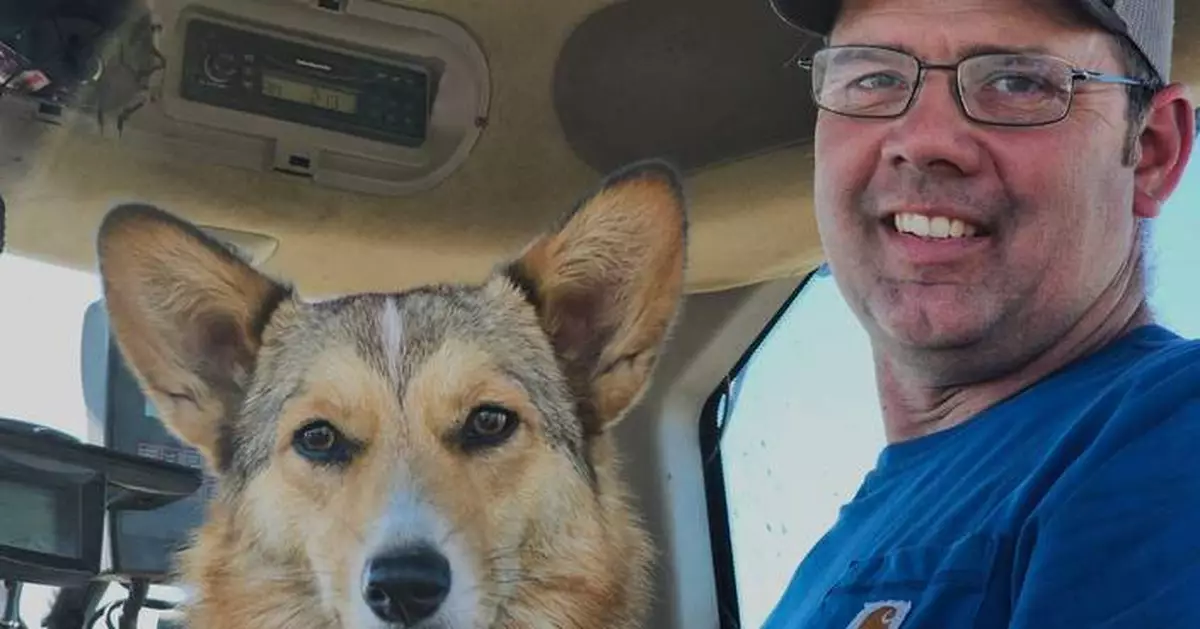
As he steered his 25-year-old Case IH tractor over a gently rolling field near the town of Waverly, he towed a planter that inserted his seeds through the stubble of last year’s corn crop. As he laid down the long rows, he rumbled past a pond where wild swans paddled about.
Riding shotgun was Georgie the Corgi, who alternated between roaming around his cab and half-dozing at his feet.
Perhaps more skeptical than Glessing is Matt Griggs, one of many soybean farmers in Tennessee paying close attention to the trade war. On Monday, he said the ripple effects on farmers might still be coming.
“We’re only on a 90-day pause,” Griggs said. “Who knows what is going to come after that?”
Joe Janzen, an agricultural economist at the University of Illinois, said the commodity markets have largely shaken off the initial shock of the trade war, including Trumps’ declaration of April 2 as “Liberation Day,” when he announced stiff worldwide tariffs.
“Our markets have largely rebounded and are back where we were around April Second,” Janzen said. “Tariffs have not had a major impact on prices yet.”
Even something that might seem like good news — ideal planting conditions across much of the Midwest — has its downside. The potential for bigger crops sent prices downward, Glessing noted. High interest rates, seed and fertilizer costs pose additional challenges.
“There’s so many other factors besides just tariffs and my market price,” Glessing said.
But Glessing said he was encouraged by that morning’s news of a trade deal with the United Kingdom and said he hopes the current uncertainty in talks with China and other countries ultimately leads to better trade deals going forward.
Glessing had finished planting his corn the day before on the other half of a field that he rents from his father’s cousin, split between 45 acres of corn and 45 acres of beans. It's at the farm where his grandfather grew up, and it's part of the approximately 700 acres he plants on average. He locked in those planting decisions months earlier as he made deals for seeds, fertilizer and other supplies.
Back on his “home farm” closer to Waverly — where his late grandfather’s house, made of local brick, still stands and a cacophony of house sparrow songs filled the air — Glessing was pleased to spot the first signs of corn he had planted there about 10 days earlier poking above the soil.
Waverly is about an hour west of Minneapolis. Its most famous resident was Democratic former Vice President Hubert Humphrey. It’s in the congressional district represented by Republican House Majority Whip Tom Emmer.
Glessing’s post as president of the Minnesota Farm Bureau puts him in close touch with other influential politicians, too. He and his wife, Seena, were Democratic Sen. Amy Klobuchar’s guests at the Capitol for Trump’s inauguration in January. Glessing declined to say who he voted for.
The Glessings have four kids, milk about 75 dairy cows, and grow corn, soybeans and alfalfa on a combination of parcels they own or rent. He uses the alfalfa and corn primarily to feed his cows. He sells his soybeans to a processing plant in Mankato, where some of them become soybean meal he adds to his animal feed. The milk from his cows goes to a co-op cheese plant in Litchfield that sells internationally.
Because Glessing has local buyers locked in and doesn’t directly export his crops, he's partially cushioned from the volatility of world markets. But he’s quick to point out that everything in the agricultural economy is interconnected.
On his farm near Humboldt, Tennessee, roughly midway between Memphis and Nashville, Griggs weathered the 2018 trade war during Trump’s first term and said he feels more prepared this time around.
“Back in 2018, prices were about the same as what they are now, and due to the trade war with China, prices dropped around 15%,” he said. “They dropped significantly lower, and they dropped in a hurry, and due to that, we lost a lot of demand from China.”
Griggs said exports to China never fully rebounded. But he doesn't think the impact of the current dispute will be nearly as drastic.
Griggs — who raises approximately 1,600 acres of cotton, corn, soybeans and wheat — said tariffs were just one consideration as he planned out this year’s crops. Growing a variety of crops helps him minimize the risk that comes with weather, volatile prices, and now the prospect of a trade war.
Griggs said he’s going to be watching for opportunities to sell when market volatility causes upticks in prices.
“The main thing I learned in 2018 was that if you do have a price period where prices have risen some, go ahead and take advantage of it instead of waiting for it to go higher,” said Griggs. “Because when it comes to the tariffs and everything, the markets can be very unpredictable. So my lesson learned was, ‘Don’t hold out for a home run, be satisfied with a double.’”
He said a temporary subsidy called the Market Facilitation Program helped soybean farmers withstand some of the losses last time could help if something similar is revived this year. But he said no farmer wants to make a living off government subsidies.
“We just want fair access to markets,” Griggs said. “And a fair price for the products we produce.”
This story was first published on May 13, 2025. It was published again on May 15, 2025, to correct that the Glessings have four kids, not three.
AP videographer Kristin M. Hall reported from Humboldt, Tennessee. AP videographer Mark Vancleave also contributed from Waverly.
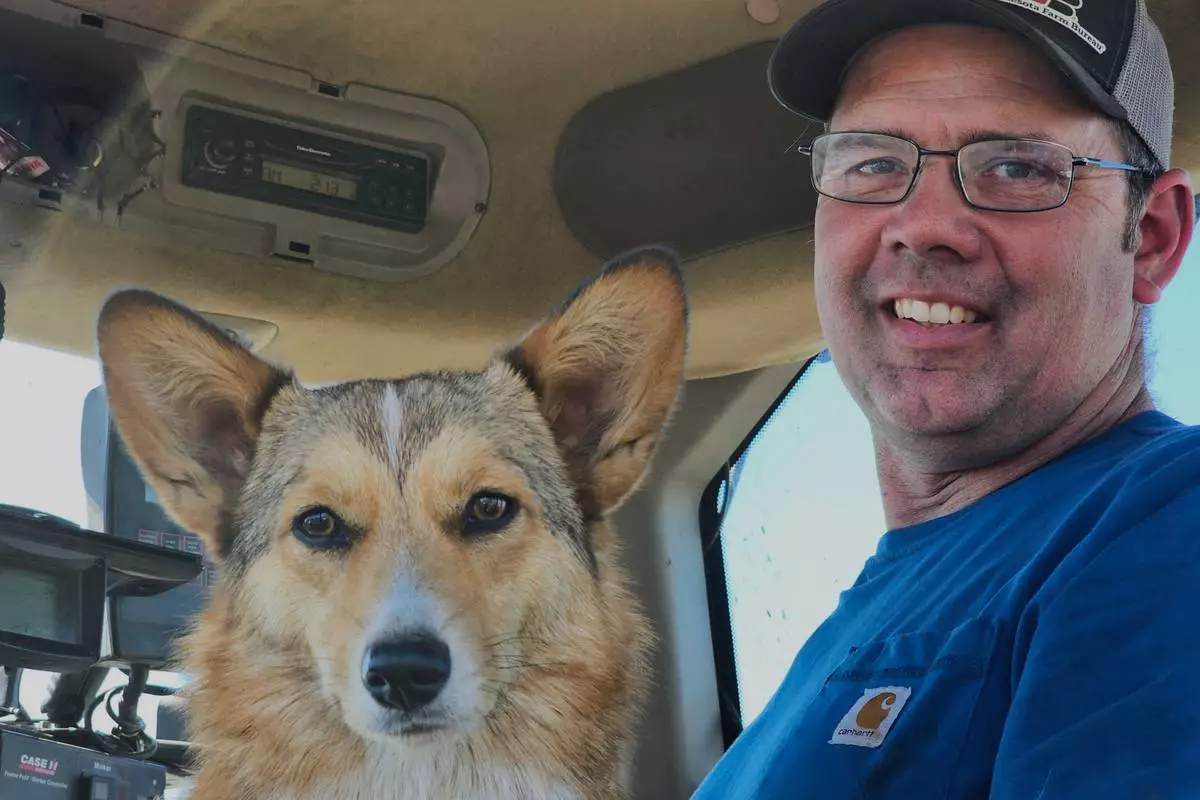
CORRECTS DATE TO MAY 8 Minnesota farmer Dan Glessing and his corgi, Georgie, are shown in his tractor as they prepare to take a break from planting soybeans on Thursday, May 8, 2025, near Waverly, Minn. (AP Photo/Steve Karnowski)
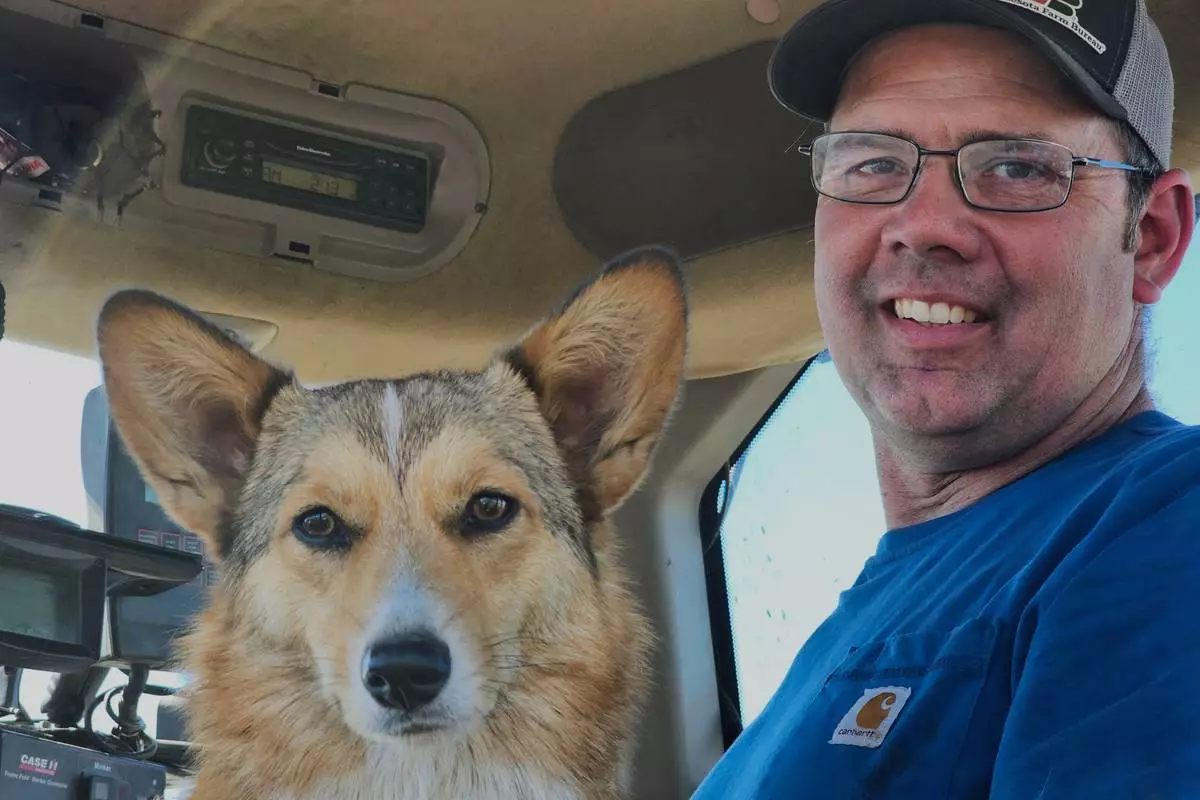
Minnesota farmer Dan Glessing and his corgi, Georgie, are shown in his tractor as they prepare to take a break from planting soybeans on Thursday, May 9, 2025, near Waverly, Minn. (AP Photo/Steve Karnowski)
U.S. President Donald Trump says Iran has proposed negotiations after his threat to strike the Islamic Republic as an ongoing crackdown on demonstrators has led to hundreds of deaths.
Trump said late Sunday that his administration was in talks to set up a meeting with Tehran, but cautioned that he may have to act first as reports mount of increasing deaths and the government continues to arrest protesters.
“The meeting is being set up, but we may have to act because of what’s happening before the meeting. But a meeting is being set up. Iran called, they want to negotiate,” Trump told reporters on Air Force One on Sunday night.
Iran did not acknowledge Trump’s comments immediately. It has previously warned the U.S. military and Israel would be “legitimate targets” if America uses force to protect demonstrators.
The U.S.-based Human Rights Activists News Agency, which has accurately reported on past unrest in Iran, gave the death toll. It relies on supporters in Iran cross checking information. It said at least 544 people have been killed so far, including 496 protesters and 48 people from the security forces. It said more than 10,600 people also have been detained over the two weeks of protests.
With the internet down in Iran and phone lines cut off, gauging the demonstrations from abroad has grown more difficult. Iran’s government has not offered overall casualty figures.
The Latest:
A witness told the AP that the streets of Tehran empty at the sunset call to prayers each night.
Part of that stems from the fear of getting caught in the crackdown. Police sent the public a text message that warned: “Given the presence of terrorist groups and armed individuals in some gatherings last night and their plans to cause death, and the firm decision to not tolerate any appeasement and to deal decisively with the rioters, families are strongly advised to take care of their youth and teenagers.”
Another text, addressed “Dear parents,” which claimed to come from the intelligence arm of the paramilitary Revolutionary Guard, also directly warned people not to take part in demonstrations.
The witness spoke to the AP on condition of anonymity due to the ongoing crackdown.
—- By Jon Gambrell in Dubai, United Arab Emirates
Iran drew tens of thousands of pro-government demonstrators to the streets Monday in a show of power after nationwide protests challenging the country’s theocracy.
Iranian state television showed images of demonstrators thronging Tehran toward Enghelab Square in the capital.
It called the demonstration an “Iranian uprising against American-Zionist terrorism,” without addressing the underlying anger in the country over the nation’s ailing economy. That sparked the protests over two weeks ago.
State television aired images of such demonstrations around the country, trying to signal it had overcome the protests, as claimed by Iranian Foreign Minister Abbas Araghchi earlier in the day.
China says it opposes the use of force in international relations and expressed hope the Iranian government and people are “able to overcome the current difficulties and maintain national stability.”
Chinese Foreign Ministry spokesperson Mao Ning said Monday that Beijing “always opposes interference in other countries’ internal affairs, maintains that the sovereignty and security of all countries should be fully protected under international law, and opposes the use or threat of use of force in international relations.”
German Chancellor Friedrich Merz condemned “in the strongest terms the violence that the leadership in Iran is directing against its own people.”
He said it was a sign of weakness rather than strength, adding that “this violence must end.”
Merz said during a visit to India that the demonstrators deserve “the greatest respect” for the courage with which “they are resisting the disproportional, brutal violence of Iranian security forces.”
He said: “I call on the Iranian leadership to protect its population rather than threatening it.”
Iran’s Foreign Ministry spokesman on Monday suggested that a channel remained open with the United States.
Esmail Baghaei made the comment during a news conference in Tehran.
“It is open and whenever needed, through that channel, the necessary messages are exchanged,” he said.
However, Baghaei said such talks needed to be “based on the acceptance of mutual interests and concerns, not a negotiation that is one-sided, unilateral and based on dictation.”
The semiofficial Fars news agency in Iran, which is close to the paramilitary Revolutionary Guard, on Monday began calling out Iranian celebrities and leaders on social media who have expressed support for the protests over the past two weeks, especially before the internet was shut down.
The threat comes as writers and other cultural leaders were targeted even before protests. The news agency highlighted specific celebrities who posted in solidarity with the protesters and scolded them for not condemning vandalism and destruction to public property or the deaths of security forces killed during clashes. The news agency accused those celebrities and leaders of inciting riots by expressing their support.
Canada said it “stands with the brave people of Iran” in a statement on social media that strongly condemned the killing of protesters during widespread protests that have rocked the country over the past two weeks.
“The Iranian regime must halt its horrific repression and intimidation and respect the human rights of its citizens,” Canada’s government said on Monday.
Iran’s foreign minister claimed Monday that “the situation has come under total control” after a bloody crackdown on nationwide protests in the country.
Abbas Araghchi offered no evidence for his claim.
Araghchi spoke to foreign diplomats in Tehran. The Qatar-funded Al Jazeera satellite news network, which has been allowed to work despite the internet being cut off in the country, carried his remarks.
Iran’s foreign minister alleged Monday that nationwide protests in his nation “turned violent and bloody to give an excuse” for U.S. President Donald Trump to intervene.
Abbas Araghchi offered no evidence for his claim, which comes after over 500 have been reported killed by activists -- the vast majority coming from demonstrators.
Araghchi spoke to foreign diplomats in Tehran. The Qatar-funded Al Jazeera satellite news network, which has been allowed to work despite the internet being cut off in the country, carried his remarks.
Iran has summoned the British ambassador over protesters twice taking down the Iranian flag at their embassy in London.
Iranian state television also said Monday that it complained about “certain terrorist organization that, under the guise of media, spread lies and promote violence and terrorism.” The United Kingdom is home to offices of the BBC’s Persian service and Iran International, both which long have been targeted by Iran.
A huge crowd of demonstrators, some waving the flag of Iran, gathered Sunday afternoon along Veteran Avenue in LA’s Westwood neighborhood to protest against the Iranian government. Police eventually issued a dispersal order, and by early evening only about a hundred protesters were still in the area, ABC7 reported.
Los Angeles is home to the largest Iranian community outside of Iran.
Los Angeles police responded Sunday after somebody drove a U-Haul box truck down a street crowded with the the demonstrators, causing protesters to scramble out of the way and then run after the speeding vehicle to try to attack the driver. A police statement said one person was hit by the truck but nobody was seriously hurt.
The driver, a man who was not identified, was detained “pending further investigation,” police said in a statement Sunday evening.
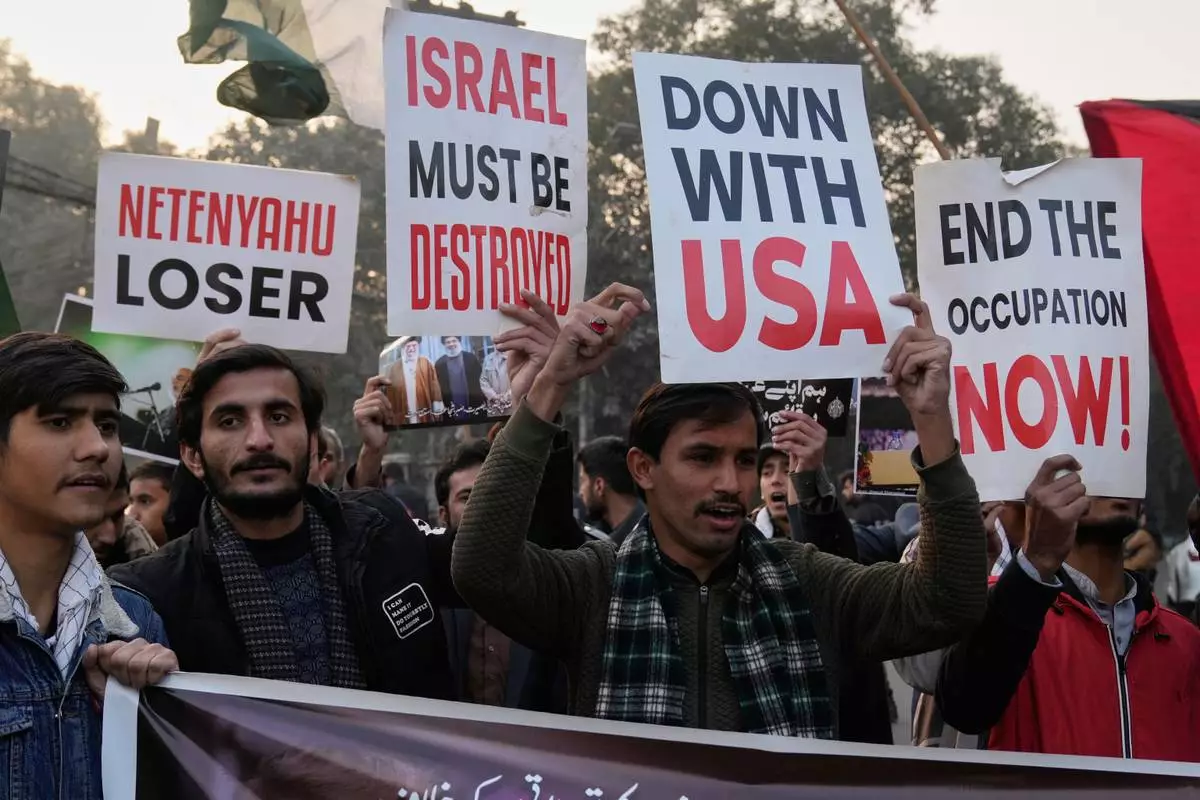
Shiite Muslims hold placards and chant slogans during a protest against the U.S. and show solidarity with Iran in Lahore, Pakistan, Sunday, Jan. 11, 2026. (AP Photo/K.M. Chaudary)
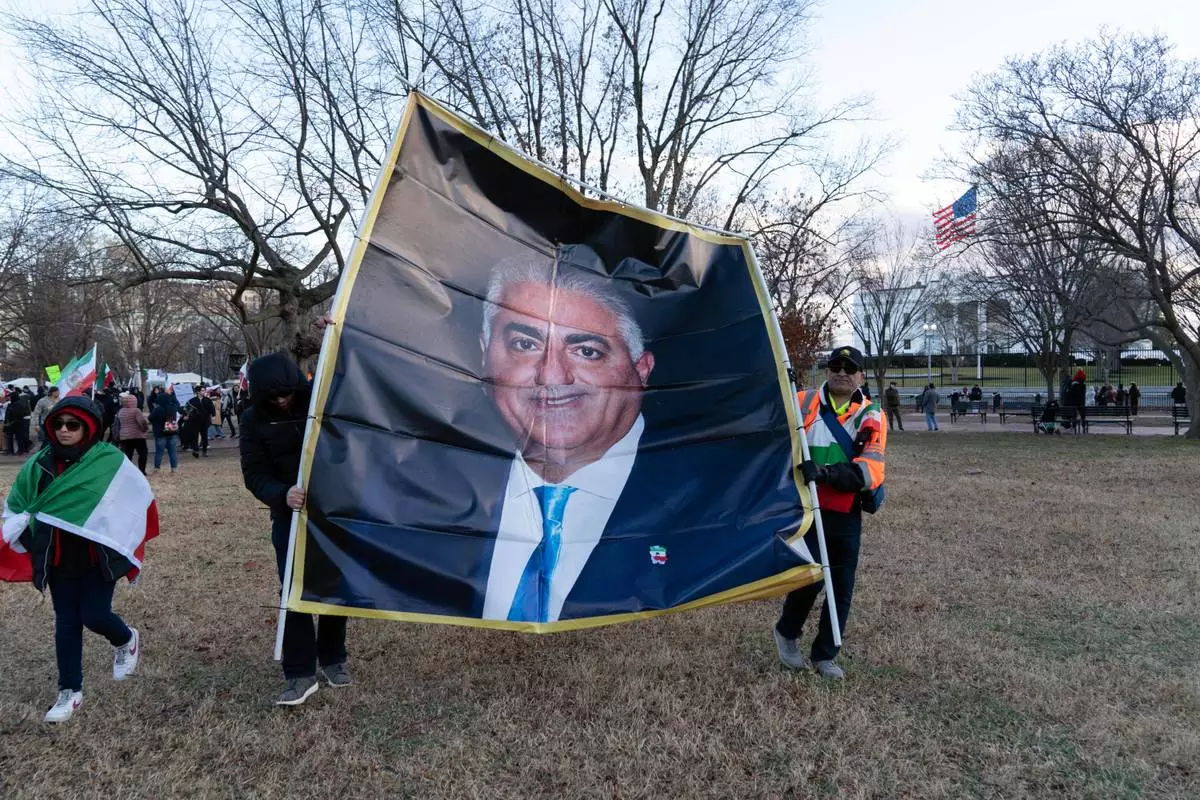
Activists carrying a photograph of Reza Pahlavi take part in a rally supporting protesters in Iran at Lafayette Park, across from the White House, in Washington, Sunday, Jan. 11, 2026. (AP Photo/Jose Luis Magana)
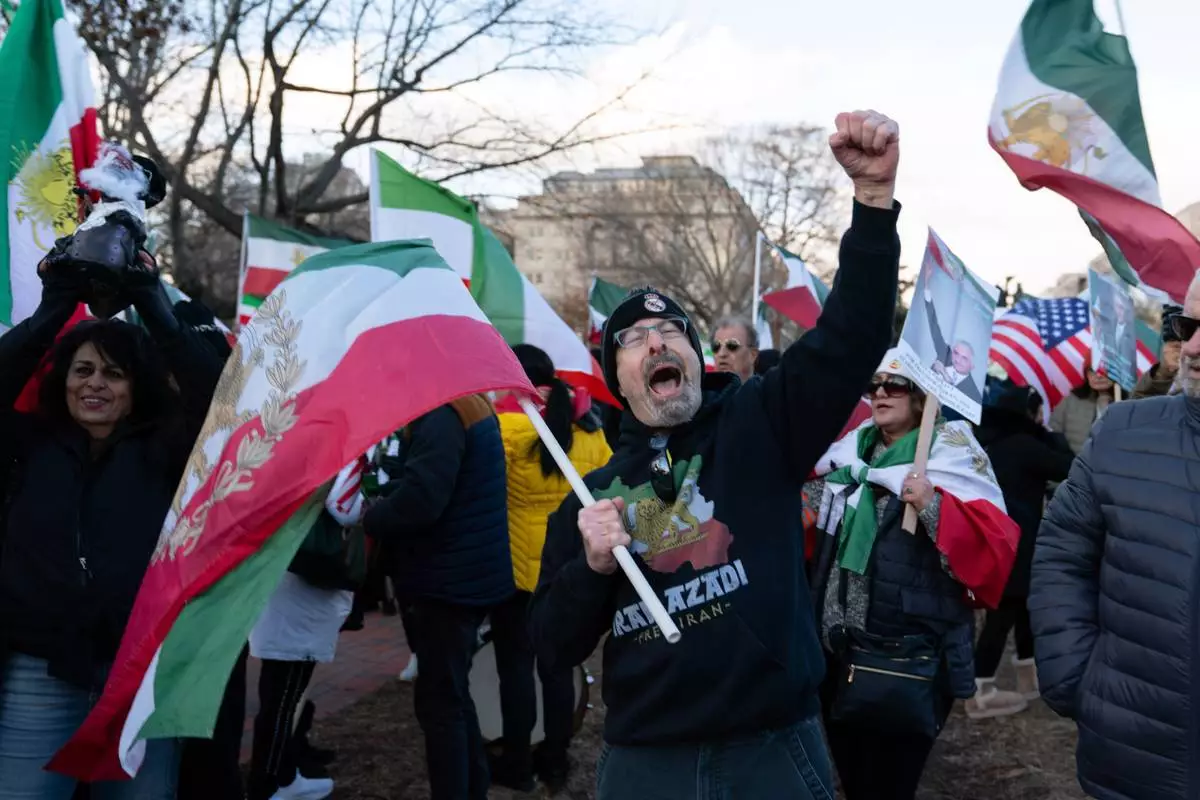
Activists take part in a rally supporting protesters in Iran at Lafayette Park, across from the White House in Washington, Sunday, Jan. 11, 2026. (AP Photo/Jose Luis Magana)
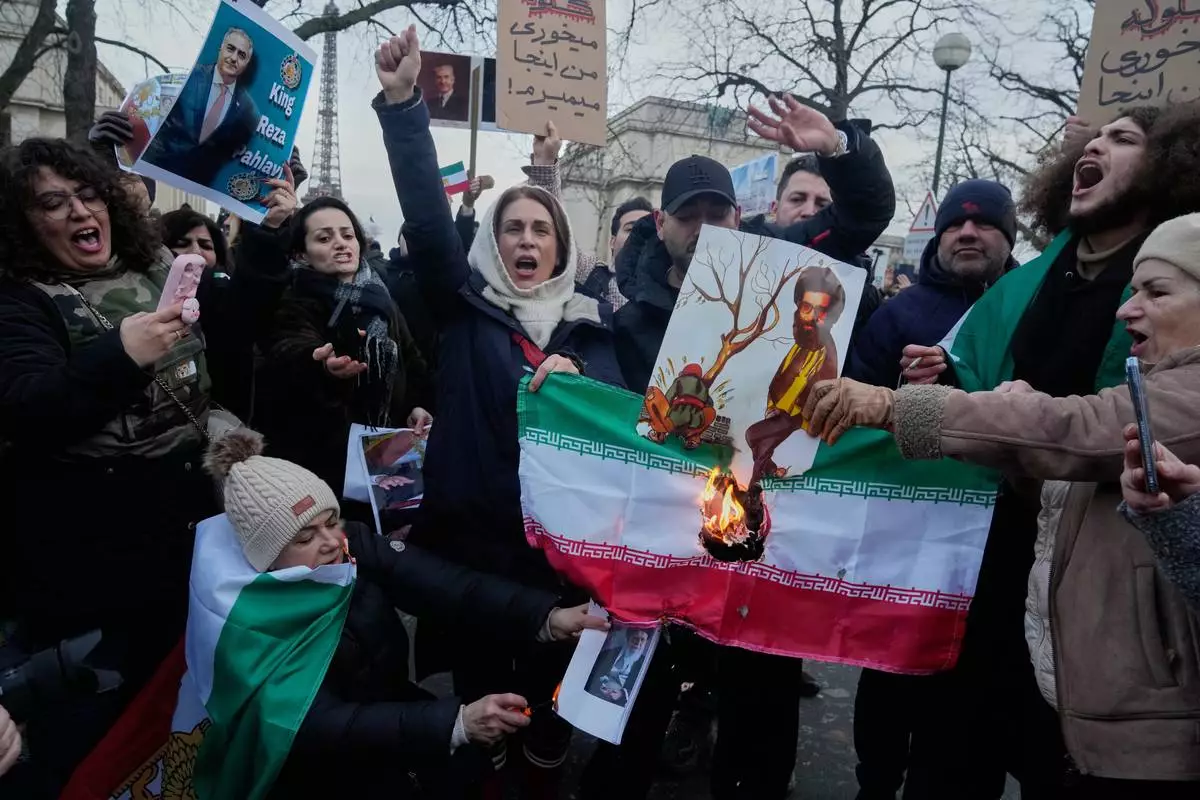
Protesters burn the Iranian national flag during a rally in support of the nationwide mass demonstrations in Iran against the government in Paris, Sunday, Jan. 11, 2026. (AP Photo/Michel Euler)