NASHVILLE, Tenn. (AP) — A lack of oxygen that incapacitated the pilot and three passengers is likely what caused a private jet to become unresponsive before flying over the nation’s capital and prompting the military to scramble fighter jets in 2023, according to a final report from the National Transportation Safety Board released on Tuesday.
The oxygen problem was likely caused by a loss of cabin pressure, according to the report. Investigators could not determine the exact reason for the pressure loss, but they noted that the Cessna Citation had a number of maintenance issues. They included no pilot-side oxygen mask and supplemental oxygen at its minimum serviceable level.
“At that level, oxygen would not have been available to the airplane occupants and passenger oxygen masks would not have deployed in the event of a loss of pressurization,” according to the report. It concluded that, “Contributing to the accident was the pilot’s and owner/operator’s decision to operate the airplane without supplemental oxygen.”
Four people died in the June 4, 2023 accident. They were pilot Jeff Hefner, 69; New York real estate broker Adina Azarian, 49; Azarian’s 2-year-old daughter Aria; and Evadnie Smith, 56, who worked as live-in nanny for Aria. Prior to the crash, Azarian, Aria and Smith were in North Carolina to visit Azarian’s adoptive parents.
Hefner stopped responding to air traffic control instructions within minutes of taking off from Elizabethton, Tennessee, at 1:13 p.m. The plane flew to New York, near its destination at Long Island’s MacArthur Airport, then turned around and flew a straight path over D.C. Fighter jets sent after it caused a loud sonic boom that was heard across the capital region as they raced to catch up. The plane then plunged almost straight down in into a mountain near Montebello, Virginia, and burst into flames at 3:23 p.m.
Fighter pilots tasked with intercepting the wayward flight said Hefner “was laying and slumped completely over into the right seat and remained motionless throughout their observations,” according to NTSB records. They did not observe any movement within the cabin area nor any shapes that resembled a person.
Once Hefner lost consciousness, the plane likely was directed along its path by autopilot “until a point at which it was no longer able to maintain control,” according to the report.
Lack of oxygen, called hypoxia, can affect people differently, but it is known to cause confusion, disorientation and diminished judgment and reactions, according to the report. A pilot would likely have between 30 seconds and 2 minutes to take corrective action. That time could be less if the depressurization is rapid.
“However, gradual depressurization can be as dangerous or more dangerous than rapid depressurization because of its potential to insidiously impair a pilot’s ability to recognize and respond to the developing emergency,” according to the report. “Cognitive impairment from hypoxia makes it harder for affected individuals to recognize their own impairment.”
The report noted that Hefner had several health issues and had been prescribed at least one medication that was potentially impairing but did not list those issues as contributing to the accident.
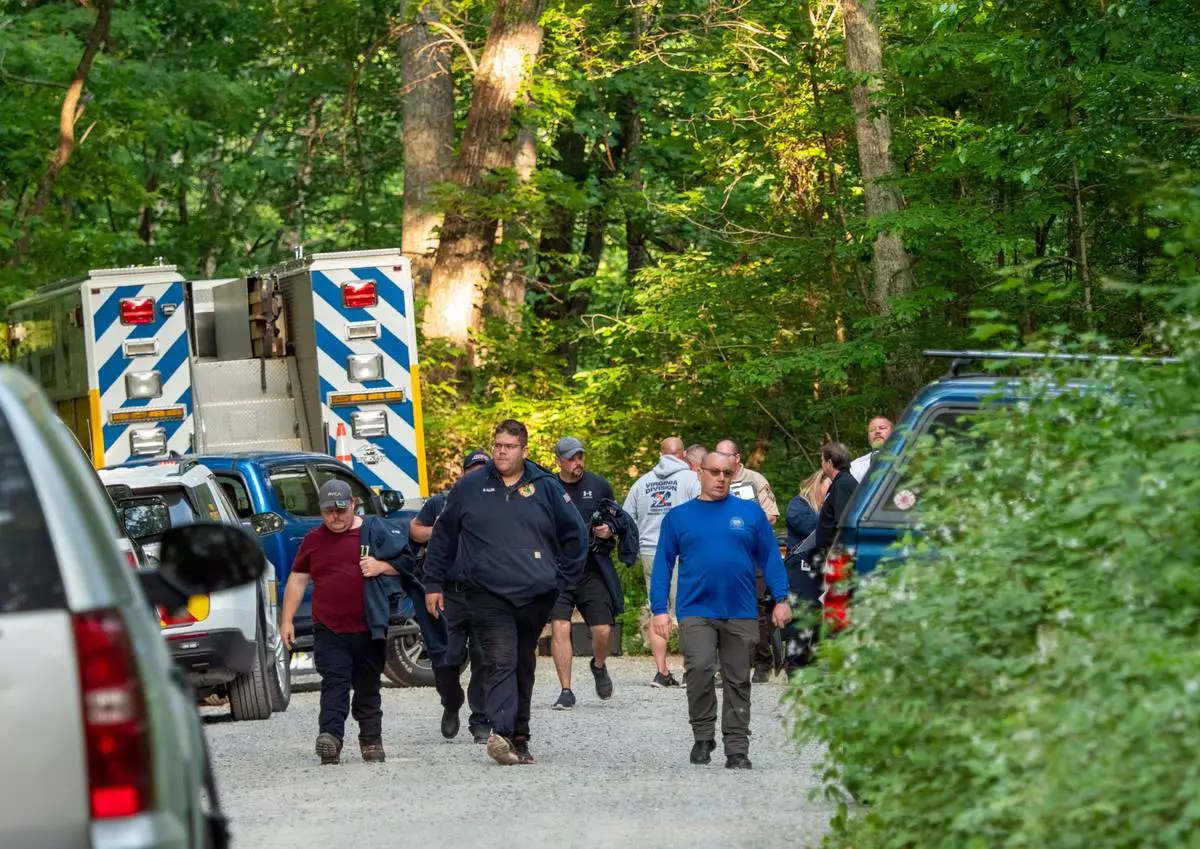
FILE - Search and rescue teams leave the command post at St. Mary's Wilderness en route to the Blue Ridge Parkway to search for the site where a Cessna Citation crashed in the mountainous terrain near Montebello, Va., June 4, 2023. (Randall K. Wolf via AP, File)
DETROIT (AP) — The Pittsburgh Steelers survived a wild finish, pushing Detroit to the brink of playoff elimination and boosting their chances of winning their division for the first time in five years.
Pittsburgh held on for 29-24 win over the Lions on Sunday when Jared Goff’s touchdown on the final play was negated by an offensive pass-interference penalty on Amon-Ra St. Brown.
“It’s been playoff-type football for us the last three weeks,” Aaron Rodgers said.
The Steelers (9-6) have won three straight after a midseason slump, surging into the AFC North lead with two games remaining.
“I’m just so appreciative of the men that I work with and the fight they displayed individually and collectively,” coach Mike Tomlin said. “Certainly weren’t perfect, a lot of adversity, some of it created by us. But they didn't blink and that’s what’s required this time of year.”
In a couple of weeks, the Lions will likely have a chance to sleep in because their season probably be over.
They almost pulled off an amazing comeback after trailing by 12 points with four-plus minutes left, but they had two touchdowns negated by penalties in the final minute.
On the last play of the game, Goff threw a fourth-down pass to St. Brown just short of the goal line. The receiver pushed off cornerback Jalen Ramsey to get free, and before the Steelers could bring St. Brown to the ground, he threw a lateral to the quarterback to set up an apparent score by Goff.
Officials huddled for a couple of minutes on the field before announcing the decision to the dismay of the crowd.
With 22 seconds left, rookie Isaac TeSlaa was called for pass interference for setting a pick that freed up St. Brown, negating Goff's 1-yard TD pass.
“That's a bad call,” Goff said.
Detroit (8-7) dropped two straight games for the first time in more than three years, ending its outside shot to win a third straight NFC North title. While the Lions haven’t been eliminated from the playoffs, they have an 8% chance of earning a spot, according to the NFL.
“We know the percentages,” said Goff, who threw two of his three touchdown passes in the fourth quarter. “We know we’re not eliminated. We know some things need to go our way.”
The running game certainly didn't go Detroit's way on Sunday.
Jaylen Warren had two 45-yard touchdown runs in the fourth quarter and finished with a career-high 143 yards for the Steelers, who had a 230-15 advantage in rushing yards.
Detroit’s defense, which allowed Pittsburgh to gain a season-high 481 yards, forced the Steelers to settle for a 37-yard field-goal try with 2:05 left, and Chris Boswell missed it.
The Lions had a fourth-and-2 from their 35 and Pittsburgh was called for pass interference and tripping on consecutive plays, moving the ball to the Steelers 35 and setting up the wild finish.
Rodgers finished 27 of 41 for 266 yards. He threw a 45-yard touchdown pass to Kenneth Gainwell to close the first half that was initially ruled incomplete, then changed to a TD after a review. Gainwell made the catch while lying on his left side and got his right arm under the ball, then popped to his feet and scampered to the end zone.
Goff was sacked by blitzing Kyle Dugger for a safety to give the Steelers a 12-10 lead in the third quarter.
Pittsburgh converted a pair of fourth downs on the ensuing drive and elected not to go for it a third time from the Lions 5, settling for a field goal and a five-point lead after a 17-play, 64-yard drive that took nearly 10 minutes.
The Steelers went ahead 3-0 when Boswell capped their first possession with a 59-yard field goal.
The Lions could have tied the game on the ensuing possession, but coach Dan Campbell went for it on fourth-and-goal from the 3 and Goff’s pass to St. Brown in the end zone was broken up by Joey Porter Jr.
Did Campbell regret that decision after seeing that a field goal in the end would have won the game?
“No,” he said without elaborating.
Steelers receiver DK Metcalf swiped at a fan leaning over the railing in the front row during the second quarter.
Metcalf and the fan, wearing a black-and-blue shirt and a blue wig, were speaking to each other before the two-time Pro Bowler threw a right hand toward the man’s face. Metcalf did not appear to make much, if any contact.
Although game officials didn't penalize Metcalf, the league will review the incident and he could face discipline.
Pittsburgh secured its 22nd straight season with at least a .500 record, breaking the NFL record it previously shared with the Dallas Cowboys, who had a 21-year run without a losing season from 1965-85. Tomlin has finished at .500 or better in each of his 19 seasons.
Steelers: CB Brandin Echols (groin) left the game in the second quarter. ... Two starters were inactive — OLB T.J. Watt (lung) and OG Isaac Seumalo (triceps) — along with reserve OLB Nick Herbig (hamstring).
Lions: C Graham Glasgow (knee) and C Trystan Colon (wrist) were inactive, giving 24-year-old Kingsley Eguakun his first start after he played in two games sparingly in September, and G Kayode Awosika (foot) missed his third straight game.
Steelers: At Cleveland next Sunday.
Lions: At Minnesota on Christmas Day.
AP NFL: https://apnews.com/hub/nfl

Detroit Lions' Jared Goff passes during the first half of an NFL football game against the Pittsburgh Steelers, Sunday, Dec. 21, 2025, in Detroit. (AP Photo/Rey Del Rio)

Pittsburgh Steelers' Aaron Rodgers passes during the first half of an NFL football game against the Detroit Lions, Sunday, Dec. 21, 2025, in Detroit. (AP Photo/Ryan Sun)
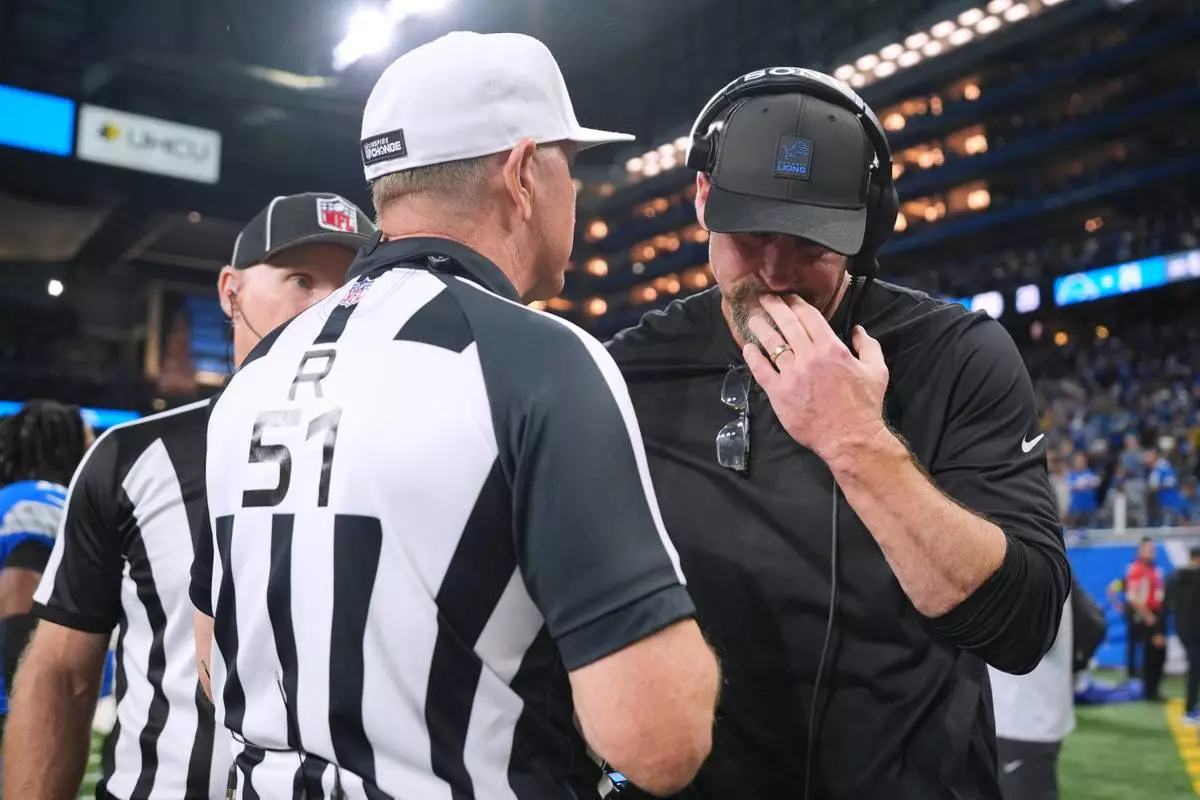
Detroit Lions head coach Dan Campbell talks with officials after the final play of an NFL football game against the Pittsburgh Steelers, Sunday, Dec. 21, 2025, in Detroit. (AP Photo/Ryan Sun)
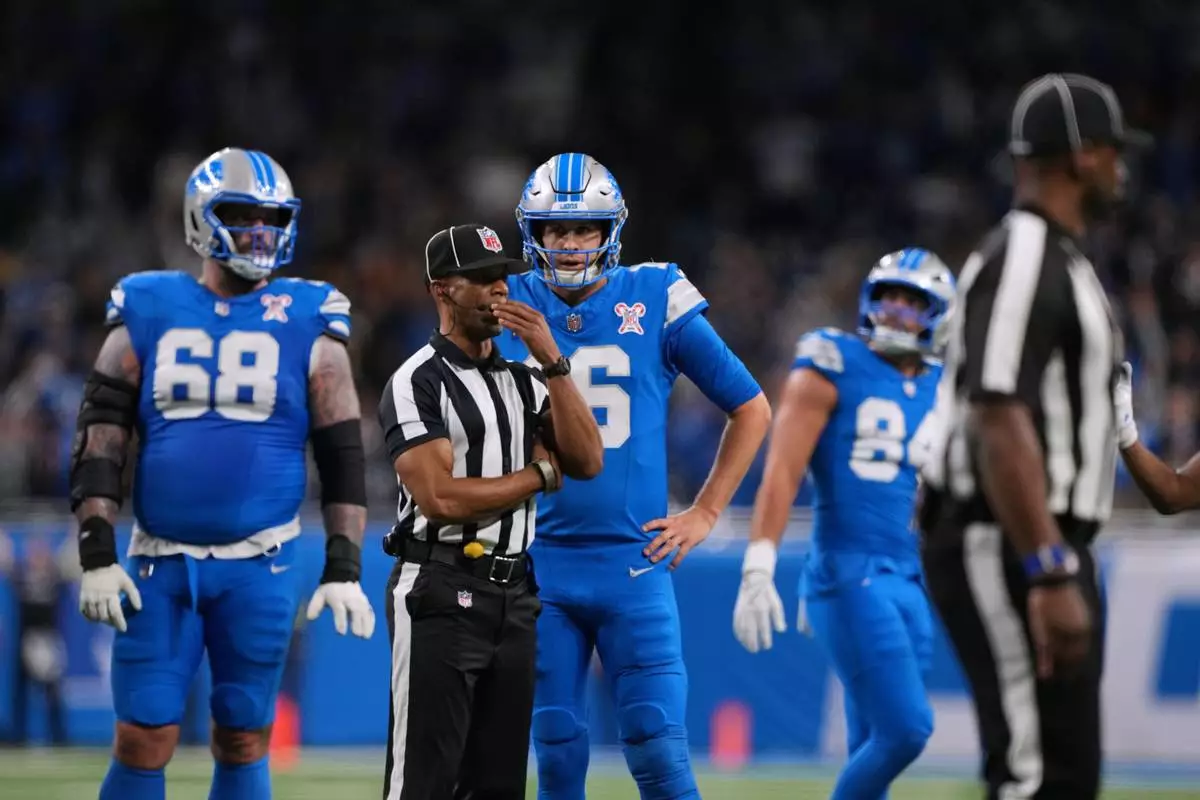
Detroit Lions' Jared Goff (16) waits for a call on the final play of an NFL football game against the Pittsburgh Steelers, Sunday, Dec. 21, 2025, in Detroit. (AP Photo/Ryan Sun)
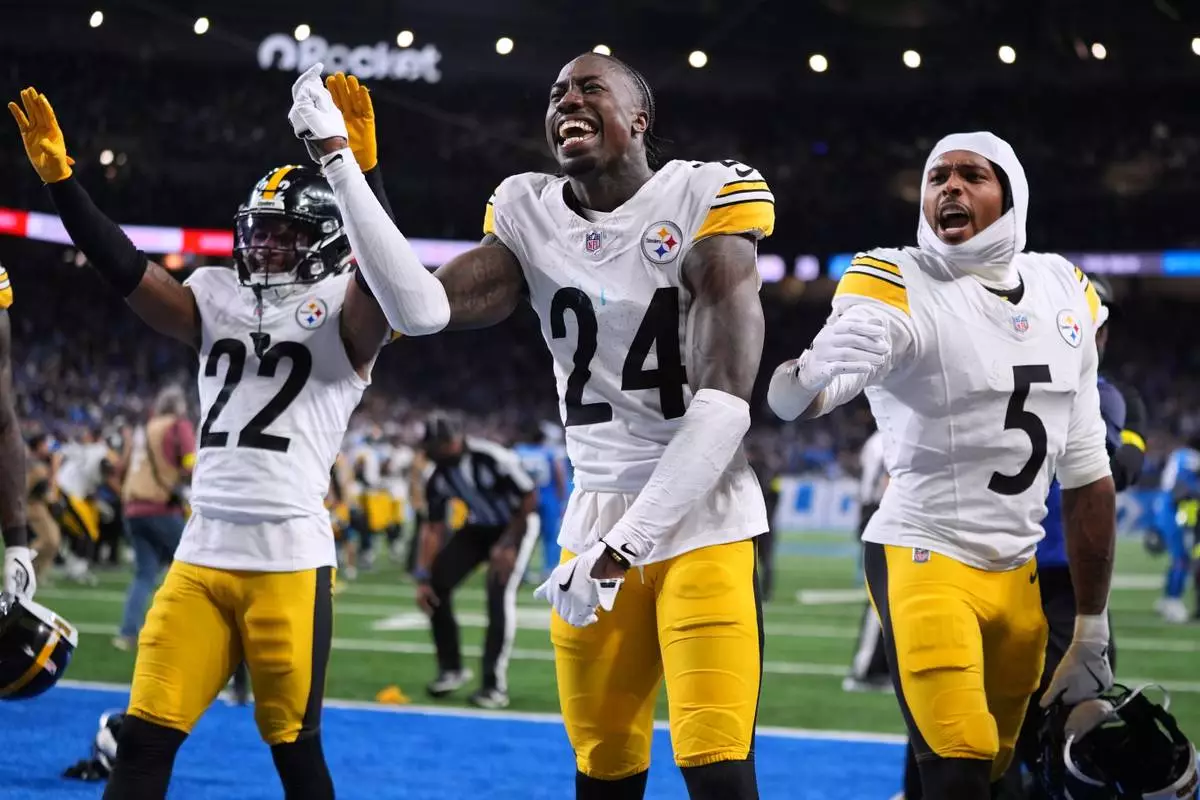
Pittsburgh Steelers' Asante Samuel Jr. (22) Joey Porter Jr. (24) and Jalen Ramsey (5) celebrate after Pittsburgh won an NFL football game against the Detroit Lions, Sunday, Dec. 21, 2025, in Detroit. (AP Photo/Ryan Sun)