Skip to Content Facebook Feature Image

Tears, trauma and a million-dollar necklace as defiant Kim Kardashian faces Paris robbery suspects

ENT

Tears, trauma and a million-dollar necklace as defiant Kim Kardashian faces Paris robbery suspects
ENT

ENT

Tears, trauma and a million-dollar necklace as defiant Kim Kardashian faces Paris robbery suspects

2025-05-15 01:48 Last Updated At:01:51

PARIS (AP) — Defiant in diamonds, Kim Kardashian appeared in a Paris courtroom Tuesday to testify in the trial over the 2016 armed robbery that upended her life. The reality star and business mogul gave emotional, at times harrowing, testimony about the night masked men tied her up at gunpoint and stole more than $6 million in jewelry.

Here’s what she revealed — and what’s still to come.

Kardashian said she was starting to doze off in bed in the early hours when she heard stomping on the stairs. She assumed it was her sister Kourtney returning from a night out. “Hello? Hello? Who is it?” she called.

Moments later, two masked men burst in. They dragged the concierge in handcuffs. They were dressed as police.

“I thought it was some sort of terrorist attack,” she said.

She grabbed her phone but froze — “I didn’t know what 911 was (in France).” She tried to call her sister and her bodyguard, but one man grabbed her hand to stop her. They threw her on the bed, bound her hands and held a gun to her back.

“I have babies,” she recalled telling the robbers. “I have to make it home. They can take everything. I just have to make it home.”

Her robe fell open — she said she was naked underneath — as one man pulled her toward him. “I was certain that was the moment that he was going to rape me,” Kardashian said.

One attacker leaned in and told her, in English, she’d be OK if she stayed quiet. He taped her mouth shut, and took her to the bathroom.

Kardashian later managed to free her hands by rubbing the tape against the bathroom sink. She hopped downstairs, ankles still bound, and found her friend and stylist, Simone Harouche. Fearing the men might return, the women climbed onto the balcony and hid in bushes. While lying there, Kardashian called her mother.

The men took a diamond ring she’d worn that night to a Givenchy show and rifled through her jewelry box. They took items including a watch her late father had given her when she graduated high school. “It wasn’t just jewelry. It was so many memories,” she said.

Investigators believe the attackers followed Kardashian’s digital breadcrumbs — images, timestamps, geotags — and exploited them with old-school criminal methods.

The robbery reshaped Kardashian’s sense of safety and freedom. “This experience really changed everything for us,” she said. “I started to get this phobia of going out.”

She often rents adjoining hotel rooms for protection and no longer stores jewelry at home, and now has up to six security guards at home.

"I can’t even sleep at night” otherwise, she said.

She also said she no longer makes social media posts in real time unless at a public event. Her Los Angeles home was robbed shortly after the Paris heist in what she believes was a copycat attack.

In a powerful courtroom moment, the chief judge read aloud a letter from one of the accused, who is too ill to testify. The letter said he had seen Kardashian’s tears on television and expressed regret. Kardashian was visibly moved.

“I’m obviously emotional,” she said in response.

“I do appreciate the letter, for sure," she added. "I forgive you for what had taken place. But it doesn’t change the emotion, the trauma, and the way my life is forever changed.”

Kardashian, who is studying to become a lawyer, added that she regularly visits prisons. “I’ve always believed in second chances,” she said.

Kardashian made a fashion statement in court, wearing a $1.5 million necklace by Samer Halimeh New York. The jeweler's press release for the necklace came out even as she was on the witness stand, a reminder that visibility remains currency, even if the rules have grown more complicated.

The choice reflected defiance and the reclaiming of the image and luxury once used against her. “Kim is Kim,” her lawyer Michael Rhodes told Entertainment Tonight outside the Palais de Justice.

Kardashian said Paris had once been a sanctuary, a place where she would walk at 3 or 4 a.m., window shopping, sometimes stopping for hot chocolate. It “always felt really safe,” she said. “It was always a magical place.”

Twelve suspects were originally charged. One has died. One was excused due to illness. The French press dubbed the group les papys braqueurs — “the grandpa robbers” — but prosecutors say they were no harmless retirees.

The defendants face charges including armed robbery, kidnapping and gang association. If convicted, they could face life in prison.

Kardashian said she was grateful for the opportunity to "tell my truth” in the packed Paris courtroom.

“This is my closure,” she said. “This is me putting this, hopefully, to rest.”

The trial is expected to conclude May 23.
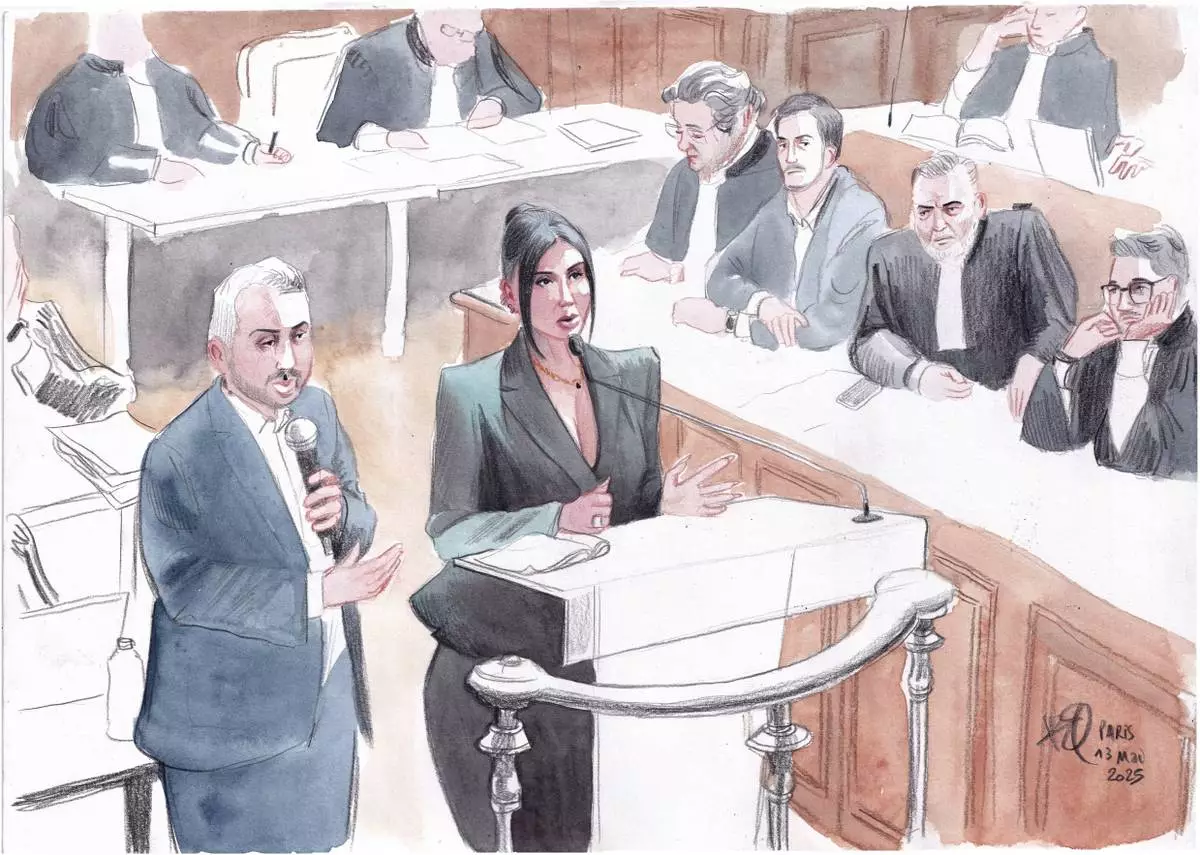
In this artist sketch, Kim Kardashian testifies regarding a robbery of millions of dollars in jewels from her Paris hotel room in 2016, in Paris, Tuesday, May 13, 2025. (AP Photo/Valentin Pasquier)

In this artist sketch, Kim Kardashian testifies regarding a robbery of millions of dollars in jewels from her Paris hotel room in 2016, in Paris, Tuesday, May 13, 2025. (AP Photo/Valentin Pasquier)

Kim Kardashian waves as she arrives to testify regarding a robbery of millions of dollars in jewels from her Paris hotel room in 2016, in Paris, Tuesday, May 13, 2025. (AP Photo/Aurelien Morissard)
Kim Kardashian waves as she arrives to testify regarding a robbery of millions of dollars in jewels from her Paris hotel room in 2016, in Paris, Tuesday, May 13, 2025. (AP Photo/Aurelien Morissard)


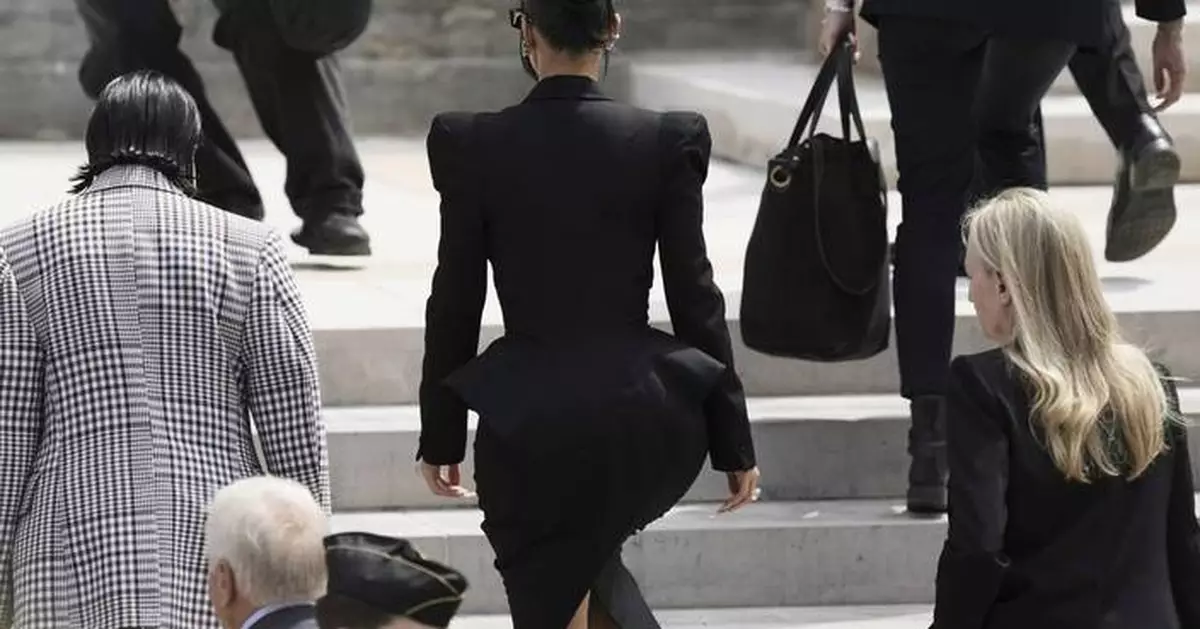
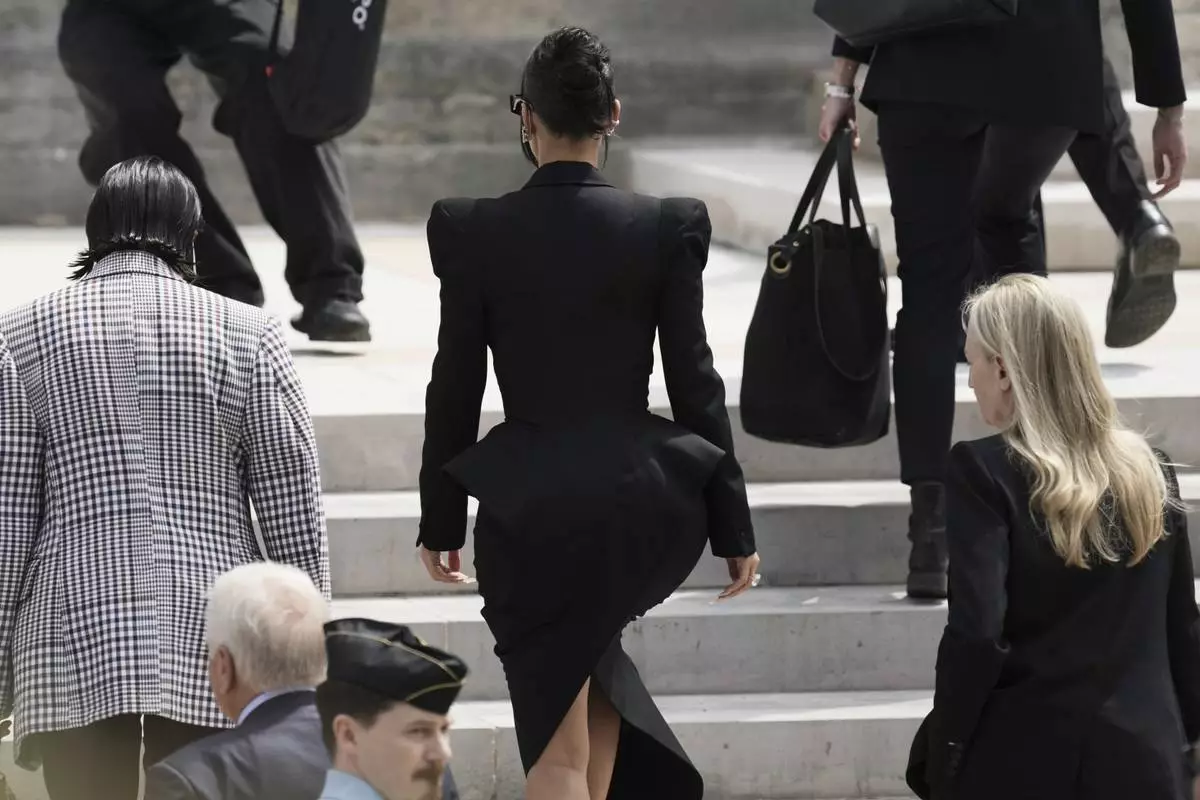
Kim Kardashian, center, walks up the steps of the palace of justice as she arrives to testify regarding a robbery of millions of dollars in jewels from her Paris hotel room in 2016, in Paris, Tuesday, May 13, 2025. (AP Photo/Aurelien Morissard)

Kim Kardashian, center, walks up the steps of the palace of justice as she arrives to testify regarding a robbery of millions of dollars in jewels from her Paris hotel room in 2016, in Paris, Tuesday, May 13, 2025. (AP Photo/Aurelien Morissard)

JERUSALEM (AP) — Over two dozen families from one of the few remaining Palestinian Bedouin villages in the central West Bank have packed up and fled their homes in recent days, saying harassment by Jewish settlers living in unauthorized outposts nearby has grown unbearable.

The village, Ras Ein el-Auja, was originally home to some 700 people from more than 100 families that have lived there for decades.

Twenty-six families already left on Thursday, scattering across the territory in search of safer ground, say rights groups. Several other families were packing up and leaving on Sunday.

“We have been suffering greatly from the settlers. Every day, they come on foot, or on tractors, or on horseback with their sheep into our homes. They enter people’s homes daily,” said Nayef Zayed, a resident, as neighbors took down sheep pens and tin structures.

Israel's military and the local settler governing body in the area did not respond to requests for comment.

Other residents pledged to stay put for the time being. That makes them some of the last Palestinians left in the area, said Sarit Michaeli, international director at B’Tselem, an Israeli rights group helping the residents.

She said that mounting settler violence has already emptied neighboring Palestinian hamlets in the dusty corridor of land stretching from Ramallah in the West to Jericho, along the Jordanian border, in the east.

The area is part of the 60% of the West Bank that has remained under full Israeli control under interim peace accords signed in the 1990s. Since the war between Israel and Hamas erupted in October 2023, over 2,000 Palestinians — at least 44 entire communities — have been expelled by settler violence in the area, B'Tselem says.

The turning point for the village came in December, when settlers put up an outpost about 50 meters (yards) from Palestinian homes on the northwestern flank of the village, said Michaeli and Sam Stein, an activist who has been living in the village for a month.

Settlers strolled easily through the village at night. Sheep and laundry went missing. International activists had to begin escorting children to school to keep them safe.

“The settlers attack us day and night, they have displaced us, they harass us in every way” said Eyad Isaac, another resident. “They intimidate the children and women.”

Michaeli said she’s witnessed settlers walk around the village at night, going into homes to film women and children and tampering with the village’s electricity.

The residents said they call the police frequently to ask for help — but it seldom arrives. Settlement expansion has been promoted by successive Israeli governments over nearly six decades. But Benjamin Netanyahu’s far-right government, which has placed settler leaders in senior positions, has made it a top priority.

That growth has been accompanied by a spike in settler violence, much of it carried out by residents of unauthorized outposts. These outposts often begin with small farms or shepherding that are used to seize land, say Palestinians and anti-settlement activists. United Nations officials warn the trend is changing the map of the West Bank, entrenching Israeli presence in the area.

Some 500,000 Israelis have settled in the West Bank since Israel captured the territory, along with east Jerusalem and the Gaza Strip, in the 1967 Mideast war. Their presence is viewed by most of the international community as illegal and a major obstacle to peace. The Palestinians seek all three areas for a future state.

For now, displaced families of the village have dispersed between other villages near the city of Jericho and near Hebron further south, said residents. Some sold their sheep and are trying to move into the cities.

Others are just dismantling their structures without knowing where to go.

"Where will we go? There’s nowhere. We’re scattered,” said Zayed, the resident, “People’s situation is bad. Very bad.”

An Israeli settler herds his flock near his outpost beside the Palestinian village of Ras Ein al-Auja in the West Bank, Sunday, Jan. 11, 2026. (AP Photo/Mahmoud Illean)

An Israeli settler herds his flock near his outpost beside the Palestinian village of Ras Ein al-Auja in the West Bank, Sunday, Jan. 11, 2026. (AP Photo/Mahmoud Illean)

A Palestinian resident of Ras Ein al-Auja village, West Bank burns trash, Sunday, Jan. 11, 2026. (AP Photo/Mahmoud Illean)

A Palestinian resident of Ras Ein al-Auja village, West Bank burns trash, Sunday, Jan. 11, 2026. (AP Photo/Mahmoud Illean)

Palestinian children play in the West Bank village of Ras Ein al-Auja, Sunday, Jan. 11, 2026. (AP Photo/Mahmoud Illean)

Palestinian children play in the West Bank village of Ras Ein al-Auja, Sunday, Jan. 11, 2026. (AP Photo/Mahmoud Illean)

Palestinian residents of Ras Ein al-Auja village, West Bank pack up their belongings and prepare to leave their homes after deciding to flee mounting settler violence, Sunday, Jan. 11, 2026. (AP Photo/Mahmoud Illean)

Palestinian residents of Ras Ein al-Auja village, West Bank pack up their belongings and prepare to leave their homes after deciding to flee mounting settler violence, Sunday, Jan. 11, 2026. (AP Photo/Mahmoud Illean)

Palestinian residents of Ras Ein al-Auja village, West Bank pack up their belongings and prepare to leave their homes after deciding to flee mounting settler violence, Sunday, Jan. 11, 2026. (AP Photo/Mahmoud Illean)

Palestinian residents of Ras Ein al-Auja village, West Bank pack up their belongings and prepare to leave their homes after deciding to flee mounting settler violence, Sunday, Jan. 11, 2026. (AP Photo/Mahmoud Illean)

Recommended Articles