OTTAWA (AP) — Mannon McMahon broke a scoreless tie at 8:42 of the third period to lift the Ottawa Charge to a 1-0 playoff victory over the Montreal Victoire on Tuesday night.
McMahon won a battle along the boards to free the puck and skated to the front of the net where she put home a Gabbie Hughes rebound to give the Charge the win and the 2-1 lead in the best-of-five Professional Women’s Hockey League semifinal series.
Click to Gallery
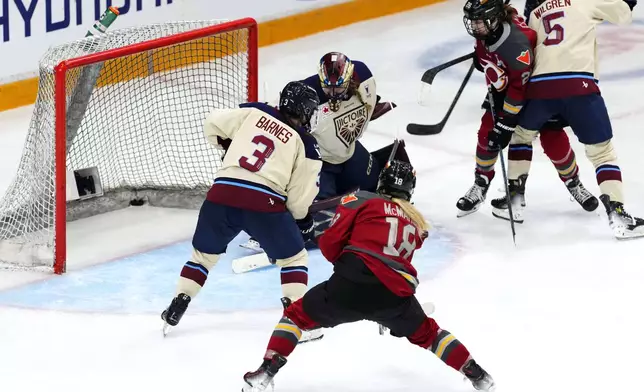
Ottawa Charge's Mannon McMahon (18) scores on Montreal Victoire goaltender Ann-Renee Desbiens (35) past Cayla Barnes (3), during third period PWHL playoff hockey action in Ottawa, Ontario, Tuesday, May 13, 2025. (Justin Tang/The Canadian Press via AP)
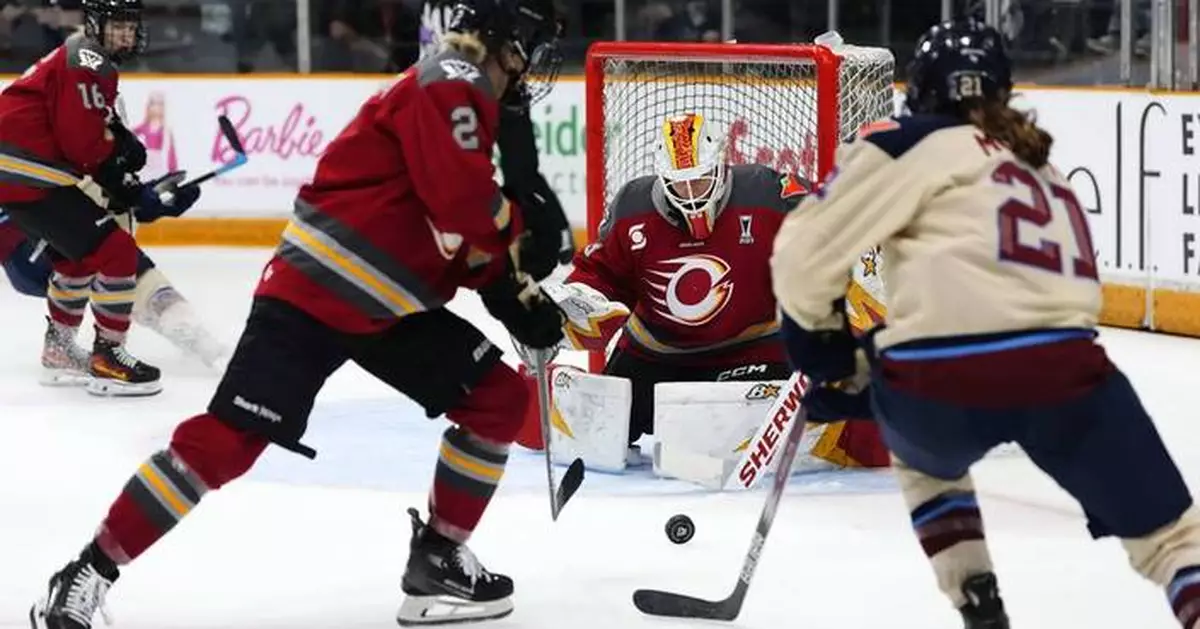
Ottawa Charge goaltender Gwyneth Philips (33) looks for the save as she is surrounded by Montreal Victoire's Abigail Boreen (24), Lina Ljungblom (25), and Maureen Murphy (21), during second period PWHL playoff hockey action in Ottawa, on Tuesday, May 13, 2025. (Justin Tang/The Canadian Press via AP)
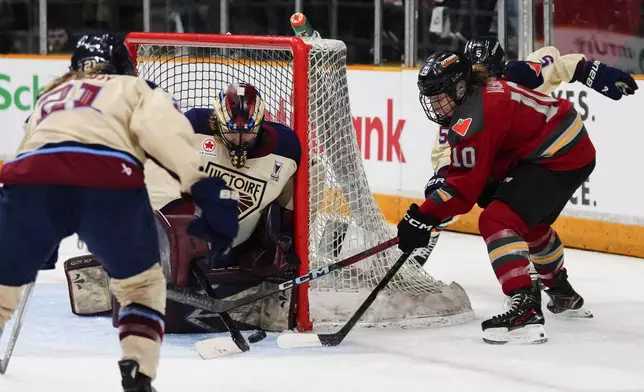
Ottawa Charge's Alexa Vasko (10) looks for a wraparound chance on Montreal Victoire goaltender Ann-Renee Desbiens (35) as Anna Wilgren (5) and Maureen Murphy (21) defend, during first period PWHL playoff hockey action in Ottawa, on Tuesday, May 13, 2025. (Justin Tang/The Canadian Press via AP)
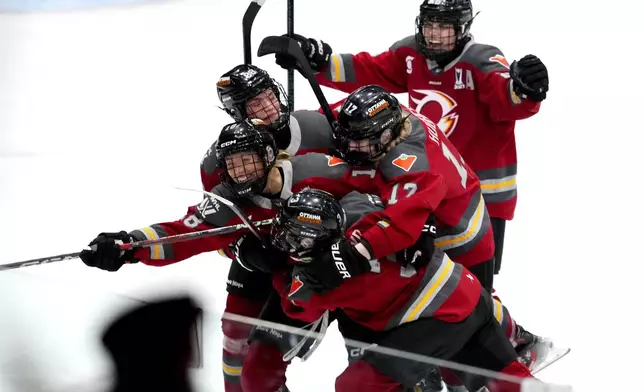
Ottawa Charge's Mannon McMahon (18) celebrates her goal against the Montreal Victoire with teammates, during third period PWHL playoff hockey action in Ottawa, Ontario, Tuesday, May 13, 2025. (Justin Tang/The Canadian Press via AP)
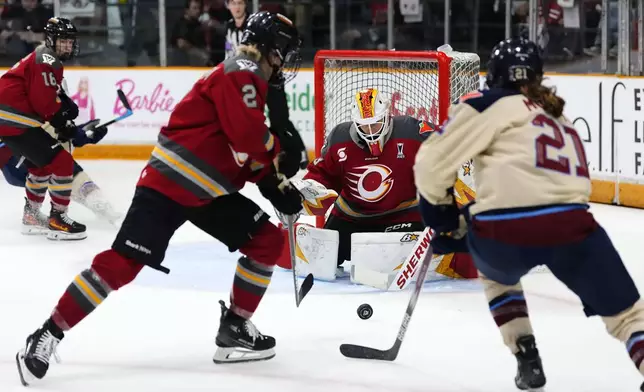
Ottawa Charge goaltender Gwyneth Philips (33) watches the puck as Aneta Tejralova (2) prepares to knock the puck away from Montreal Victoire's Maureen Murphy (21) during second period PWHL playoff hockey action in Ottawa, on Tuesday, May 13, 2025. (Justin Tang/The Canadian Press via AP)
Rookie Gwyneth Philips picked up her first playoff career shutout, stopping 26 shots.
Ottawa can punch its ticket to the PWHL championship final with a win Friday night on home ice.
Tuesday’s game marked the first home playoff game for the Charge and players acknowledged feeling a boost from the crowd.
“Stepping on to that ice today, like the crowd was going from the second the national anthem played, like, how can you not, like, be energized by that,” said McMahon. “So, we needed that (Tuesday). So, it’s huge, and to have that next game too will even be bigger.”
Finishing first overall, Montreal had the choice of its playoff opponent, and the crowd reminded them of that chanting “you picked us” at the conclusion of the game.
The Victoire, who were swept by Boston in last year’s opening round, believe they are playing well but need to generate more traffic in front of Philips.
“I think we need to take her eyes away,” said Montreal’s Erin Ambrose. “I think she is an elite goaltender … but I also think we have elite goal scorers on this team, and we’ve just got to find a way to get dirty ones at times.”
Ambrose said the team has made a point of talking about generating more traffic and it will likely be a focus of Friday’s game.
Both goaltenders picked up where they left off following Sunday’s quadruple overtime game.
A minute after McMahon scored for the Charge, an open ice hit by Laura Stacey on Ottawa’s Ashton Bell was initially ruled a major but following review was reduced to a minor for illegal body checking. Hughes took a roughing penalty coming to her teammate’s defense negating the potential power play.
A hooking penalty on Brianne Jenner sent the Victoire to the power play and Philips stood tall making a couple big saves to preserve the lead.
Montreal went 0-for-2 on the power play.
“We believe in the group that we have on the power play,” said Montreal coach Kori Cheverie. “And, you know, they have very talented players. Ottawa is playing us very aggressively high in the zone right now, so we have to find a way to get pucks to the net.”
Montreal pushed hard in the final 90 seconds but was unable to even get a shot through to challenge Philips.
“You have to learn to manage those moments, recognizing you’re probably going to see them quite a bit in playoffs,” said Charge coach Carla MacLeod. “And, you know, I think it’s an area that we continue to focus on and lean into.”
Montreal’s Ann-Renee Desbiens, who stopped 24 shots, was the difference maker for the Victoire in the opening period. Ottawa came out firing and had five shots on goal but were unable to get anything past Desbiens.
AP Women’s Hockey: https://apnews.com/hub/womens-hockey
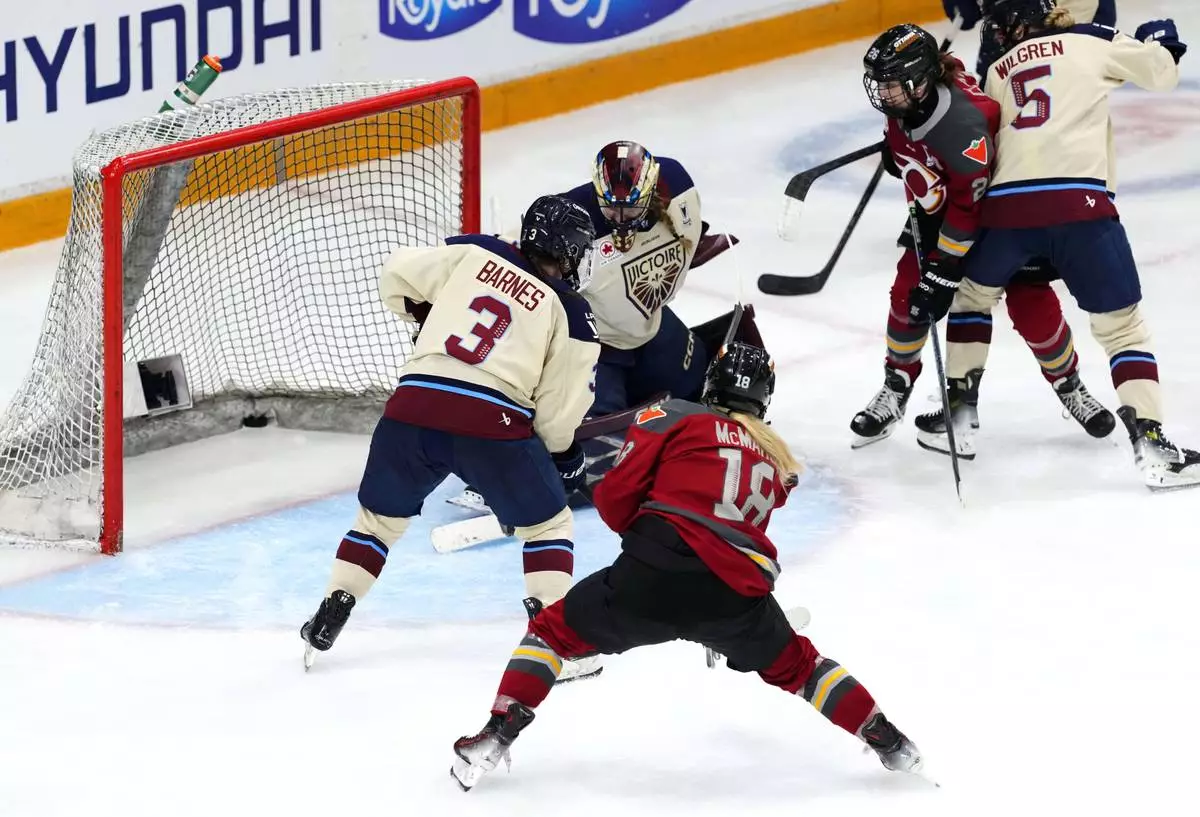
Ottawa Charge's Mannon McMahon (18) scores on Montreal Victoire goaltender Ann-Renee Desbiens (35) past Cayla Barnes (3), during third period PWHL playoff hockey action in Ottawa, Ontario, Tuesday, May 13, 2025. (Justin Tang/The Canadian Press via AP)
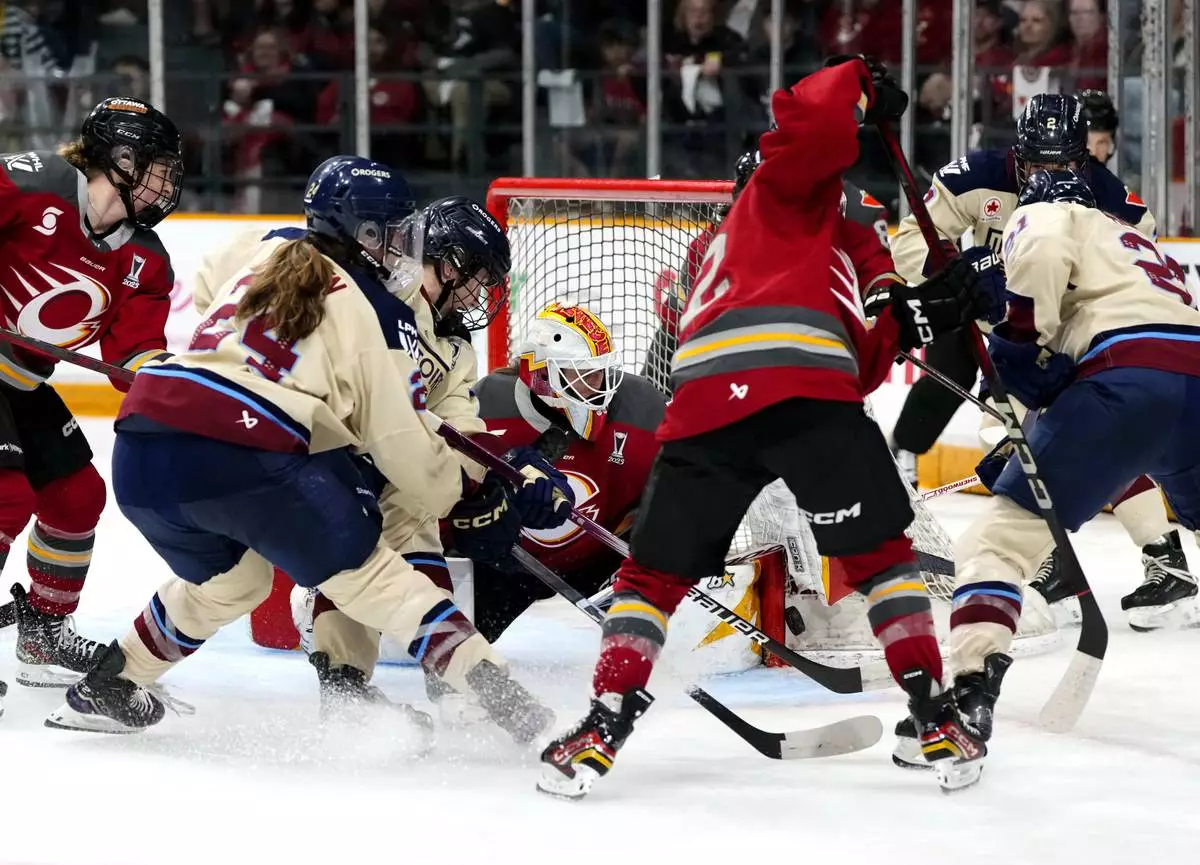
Ottawa Charge goaltender Gwyneth Philips (33) looks for the save as she is surrounded by Montreal Victoire's Abigail Boreen (24), Lina Ljungblom (25), and Maureen Murphy (21), during second period PWHL playoff hockey action in Ottawa, on Tuesday, May 13, 2025. (Justin Tang/The Canadian Press via AP)
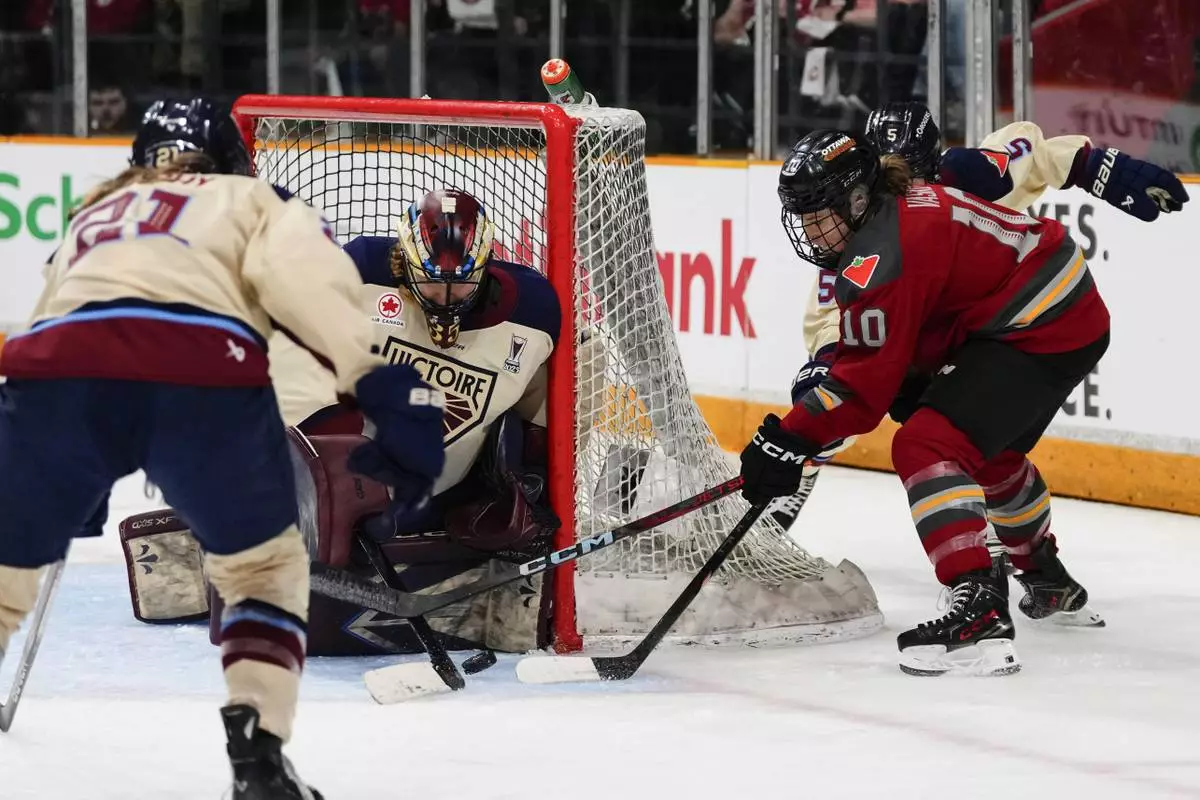
Ottawa Charge's Alexa Vasko (10) looks for a wraparound chance on Montreal Victoire goaltender Ann-Renee Desbiens (35) as Anna Wilgren (5) and Maureen Murphy (21) defend, during first period PWHL playoff hockey action in Ottawa, on Tuesday, May 13, 2025. (Justin Tang/The Canadian Press via AP)
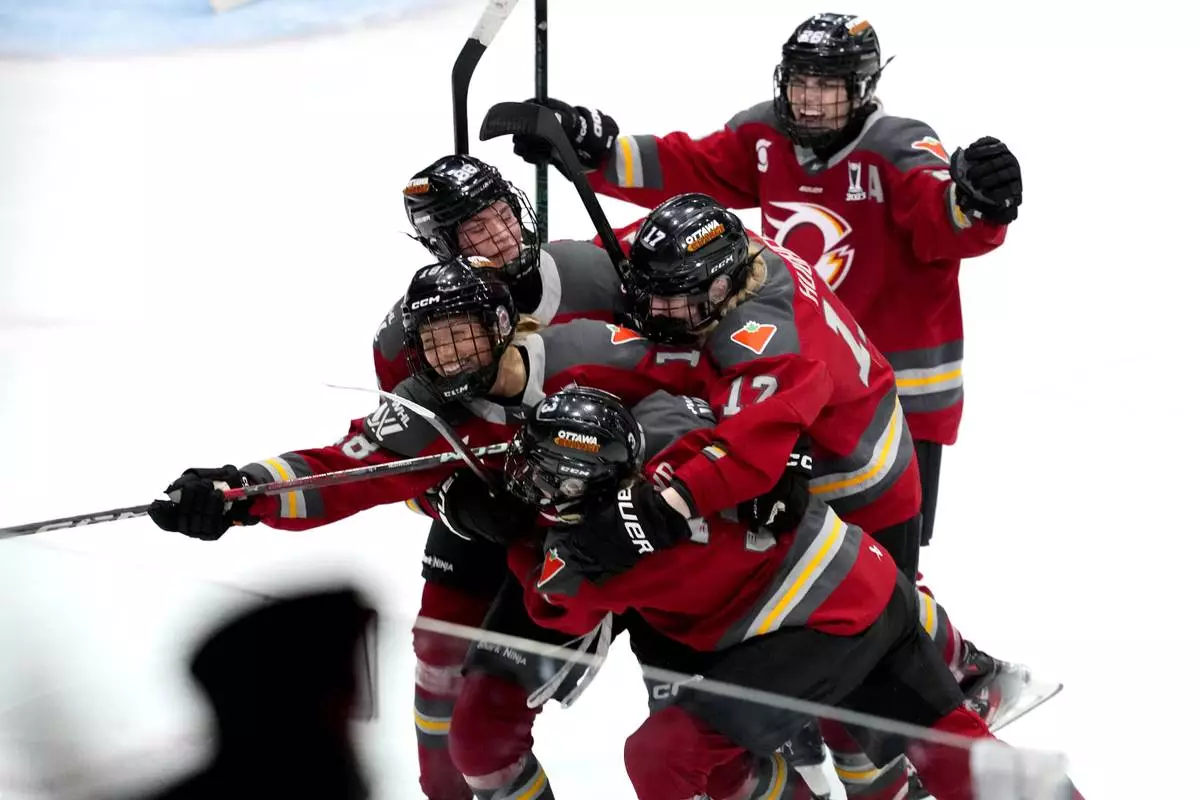
Ottawa Charge's Mannon McMahon (18) celebrates her goal against the Montreal Victoire with teammates, during third period PWHL playoff hockey action in Ottawa, Ontario, Tuesday, May 13, 2025. (Justin Tang/The Canadian Press via AP)
Ottawa Charge goaltender Gwyneth Philips (33) watches the puck as Aneta Tejralova (2) prepares to knock the puck away from Montreal Victoire's Maureen Murphy (21) during second period PWHL playoff hockey action in Ottawa, on Tuesday, May 13, 2025. (Justin Tang/The Canadian Press via AP)
RHO, Italy (AP) — No ice is colder and harder than speedskating ice. The precision it takes has meant that Olympic speedskaters have never competed for gold on a temporary indoor rink – until the 2026 Milan Cortina Winter Games.
In the pursuit of maximum glide and minimum friction, Olympic officials brought on ice master Mark Messer, a veteran of six previous Olympic speedskating tracks and the ice technician in charge of the Olympic Oval in Calgary, Canada — one of the fastest tracks in the world with over 300 records.
Messer has been putting that experience to work one thin layer of ice at a time since the end of October at the new Speed Skating Stadium, built inside adjacent trade fair halls in the city of Rho just north of Milan.
“It’s one of the biggest challenges I’ve had in icemaking,’’ Messer said during an interview less than two weeks into the process.
If Goldilocks were a speedskater, hockey ice would be medium hard, for fast puck movement and sharp turns. Figure skating ice would be softer, allowing push off for jumps and so the ice doesn’t shatter on landing. Curling ice is the softest and warmest of all, for controlled sliding.
For speedskating ice to be just right, it must be hard, cold and clean. And very, very smooth.
“The blades are so sharp, that if there is some dirt, the blade will lose the edge,’’ Messer said, and the skater will lose speed.
Speedskater Enrico Fabris, who won two Olympic golds in Turin in 2006, has traded in his skates to be deputy sports manager at the speedskating venue in Rho. For him, perfect ice means the conditions are the same for all skaters — and then if it's fast ice, so much the better.
"It's more of a pleasure to skate on this ice,'' he said.
Messer’s first Olympics were in Calgary in 1988 — the first time speedskating was held indoors. “That gave us some advantages because we didn’t have to worry about the weather, wind blowing or rain,’’ he said. Now he is upping the challenge by becoming the first ice master to build a temporary rink for the Olympics.
Before Messer arrived in Italy, workers spent weeks setting up insulation to level the floor and then a network of pipes and rubber tubes that carry glycol — an antifreeze — that is brought down to minus 7 or minus 8 degrees Celsius (17.6 to 19.4 degrees Fahrenheit) to make the ice.
Water is run through a purification system — but it can’t be too pure, or the ice that forms will be too brittle. Just the right amount of impurities “holds the ice together,’’ Messer said.
The first layers of water are applied slowly, with a spray nozzle; after the ice reaches a few centimeters it is painted white — a full day’s work — and the stripes are added to make lanes.
“The first one takes about 45 minutes. And then as soon as it freezes, we go back and do it again, and again and again. So we do it hundreds of times,’’ Messer said.
As the ice gets thicker, and is more stable, workers apply subsequent layers of water with hoses. Messer attaches his hose to hockey sticks for easier spreading.
What must absolutely be avoided is dirt, dust or frost — all of which can cause friction for the skaters, slowing them down. The goal is that when the skaters push “they can go as far as possible with the least amount of effort,’’ Messer said.
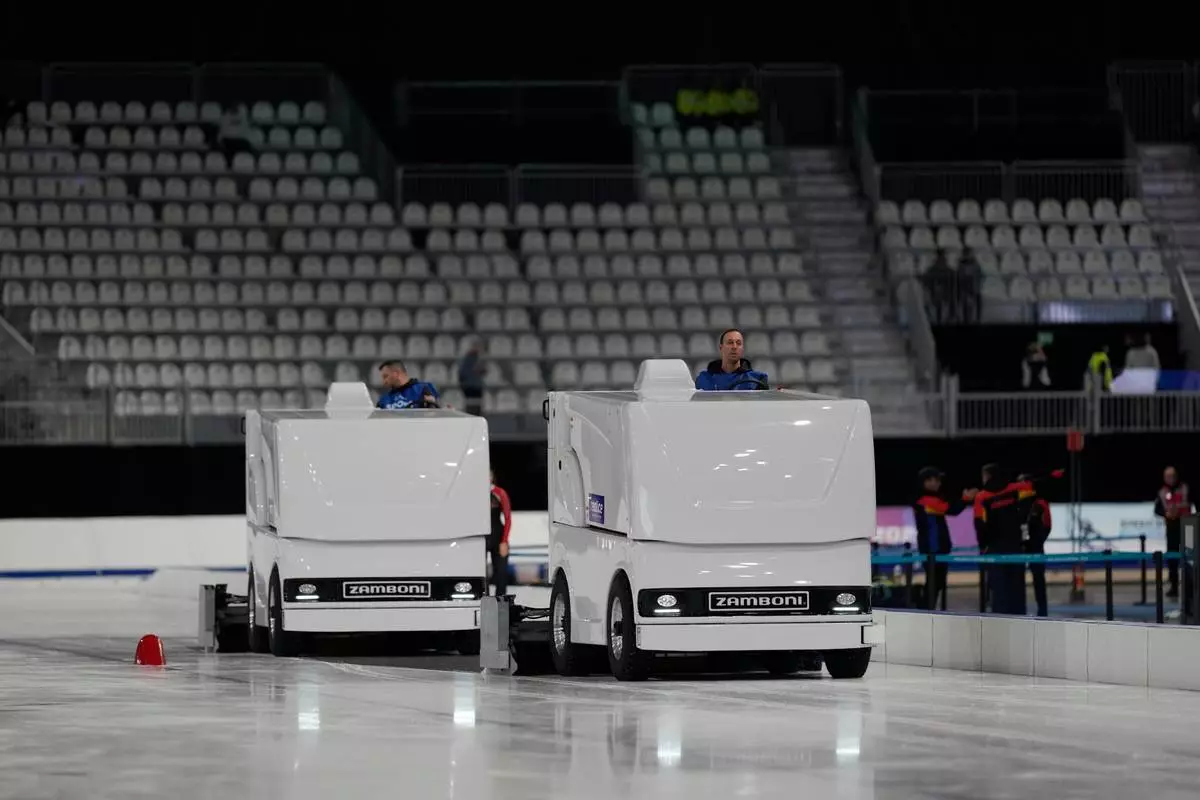
The Zamboni ice resurfacing machine plays a key role in keeping the track clean, cutting off a layer and spraying water to make a new surface.
One challenge is gauging how quickly the water from the resurfacing machine freezes in the temporary rink.
Another is getting the ice to the right thickness so that the Zamboni, weighing in at six tons, doesn’t shift the insulation, rubber tubing or ice itself.
“When you drive that out, if there’s anything moving it will move. We don’t want that,’’ Messer said.
The rink got its first big test on Nov. 29-30 during a Junior World Cup event. In a permanent rink, test events are usually held a year before the Olympics, leaving more time for adjustments. “We have a very small window to learn,’’ Messer acknowledged.
Dutch speedskater Kayo Vos, who won the men’s neo-senior 1,000 meters, said the ice was a little soft — but Messer didn’t seem too concerned.
“We went very modest to start, now we can start to change the temperatures and try to make it faster and still maintain it as a safe ice,’’ he said.
Fine-tuning the air temperature and humidity and ice temperature must be done methodically — taking into account that there will be 6,000 spectators in the venue for each event. The next real test will be on Jan. 31, when the Olympians take to the ice for their first training session.
“Eighty percent of the work is done but the hardest part is the last 20 percent, where we have to try to find the values and the way of running the equipment so all the skaters get the same conditions and all the skaters get the best conditions,’’ Messer said.
AP Winter Olympics: https://apnews.com/hub/milan-cortina-2026-winter-olympics
Serpentines are set on the ice of the stadium where speed skating discipline of the Milan Cortina 2026 Winter Olympics will take place, in Rho, outskirt of Milan, Tuesday, Nov. 11, 2025. (AP Photo/Luca Bruno)
Ice Master Mark Messer poses in the stadium where speed skating discipline of the Milan Cortina 2026 Winter Olympics will take place, in Rho, outskirt of Milan, Tuesday, Nov. 11, 2025. (AP Photo/Luca Bruno)
Workers clean the ice surface during a peed skating Junior World Cup and Olympic test event, in Rho, near Milan, Italy, Saturday, Nov. 29, 2025. (AP Photo/Luca Bruno)
Ice Master Mark Messer poses in the stadium where speed skating discipline of the Milan Cortina 2026 Winter Olympics will take place, in Rho, outskirt of Milan, Tuesday, Nov. 11, 2025. (AP Photo/Luca Bruno)