FARMINGTON HILLS, Mich.--(BUSINESS WIRE)--May 14, 2025--
Over the past several years, Humanetics has accelerated its growth by expanding both its product portfolio and its global presence. Building on this momentum, the company is introducing a new organizational structure for its Safety business unit, designed to strengthen customer support, enhance product management, and drive continuous innovation.
This press release features multimedia. View the full release here: https://www.businesswire.com/news/home/20250513400211/en/
This new structure realigns the sales regions to better support customers, introduces a dedicated product management framework to ensure Humanetics’ offerings meet customer needs, and streamlines engineering resources to enhance product development and drive continuous innovation.
Brad Baker, currently Director Sales & Marketing Americas, has been promoted to Vice President, Global Sales, reporting to Safety President Mark Westen. Brad will work with regional sales leaders to further strengthen customer satisfaction and ensure our team delivers industry-leading service.
Roderick Verschut, currently VP of Global Sales, will take on the role of Managing Director, Europe, where he will lead Humanetics Safety Europe, including mg-sensor, ATD-LabTech, and Active Safety.
All Regional Managing Directors - Roderick Verschut (Europe), Peter Wang (China), Yuji Okuda (Japan), and Pradeep Mohan (India) - will now report directly to Mark Westen, President of Safety.
Mark Westen, President of Humanetics Safety said, “Our customers are managing a lot of dynamics, so it has never been more important to remain close to them and their needs. This new structure strengthens local decision making and gives me direct contact with each region so that we can be responsive to our customers.”
In addition, Westen announced that the product development and engineering teams will be organized around the group’s four key product areas: Anthropometric Test Devices, Sensors, Testing Equipment, and Active Safety, to better support innovation and address customer needs
The Product Management group, led by Chief Technology Officer Dr. Jerry Wang, is responsible for developing new products and features, as well as collaborating with teams that integrate virtual solutions and software platforms. The Engineering team, under the leadership of Brandon Marriott, will support Product Management with dedicated, multi-disciplinary teams for each product line.
“As we enter an exciting new chapter for Humanetics Safety, our Safety, Sensors, and Digital teams are united by a shared vision to create a powerful ecosystem combining physical and virtual ATDs, integrated software, connected labs, and ADAS tools with proving ground management to deliver the most compelling and competitive products and services in the market,” said Mark Westen, President of Humanetics Safety.
About Humanetics
Our Mission: Protecting Humans in Motion
Humanetics is an Industrial technology group, and a leading provider of safety systems, crash test dummies (ATDs), simulation software (RAMSIS), CAE models, human body models, complete line of passive & active safety SW & testing solutions, precision sensors, fiber optics and laser material processing solutions. The group is organized into three divisions (Safety, Digital and Sensors) focused on precision engineering and software development that puts humans at the heart of industrial design. The group has over 1000 employees located in facilities worldwide, with our global corporate headquarters in Farmington Hills, Michigan, USA.

Caption: From left, Roderick Verschut, Brad Baker, and Dr. Jerry Wang.
NEW YORK (AP) — Reviving a campaign pledge, President Donald Trump wants a one-year, 10% cap on credit card interest rates, a move that could save Americans tens of billions of dollars but drew immediate opposition from an industry that has been in his corner.
Trump was not clear in his social media post Friday night whether a cap might take effect through executive action or legislation, though one Republican senator said he had spoken with the president and would work on a bill with his “full support.” Trump said he hoped it would be in place Jan. 20, one year after he took office.
Strong opposition is certain from Wall Street in addition to the credit card companies, which donated heavily to his 2024 campaign and have supported Trump's second-term agenda. Banks are making the argument that such a plan would most hurt poor people, at a time of economic concern, by curtailing or eliminating credit lines, driving them to high-cost alternatives like payday loans or pawnshops.
“We will no longer let the American Public be ripped off by Credit Card Companies that are charging Interest Rates of 20 to 30%,” Trump wrote on his Truth Social platform.
Researchers who studied Trump’s campaign pledge after it was first announced found that Americans would save roughly $100 billion in interest a year if credit card rates were capped at 10%. The same researchers found that while the credit card industry would take a major hit, it would still be profitable, although credit card rewards and other perks might be scaled back.
About 195 million people in the United States had credit cards in 2024 and were assessed $160 billion in interest charges, the Consumer Financial Protection Bureau says. Americans are now carrying more credit card debt than ever, to the tune of about $1.23 trillion, according to figures from the New York Federal Reserve for the third quarter last year.
Further, Americans are paying, on average, between 19.65% and 21.5% in interest on credit cards according to the Federal Reserve and other industry tracking sources. That has come down in the past year as the central bank lowered benchmark rates, but is near the highs since federal regulators started tracking credit card rates in the mid-1990s. That’s significantly higher than a decade ago, when the average credit card interest rate was roughly 12%.
The Republican administration has proved particularly friendly until now to the credit card industry.
Capital One got little resistance from the White House when it finalized its purchase and merger with Discover Financial in early 2025, a deal that created the nation’s largest credit card company. The Consumer Financial Protection Bureau, which is largely tasked with going after credit card companies for alleged wrongdoing, has been largely nonfunctional since Trump took office.
In a joint statement, the banking industry was opposed to Trump's proposal.
“If enacted, this cap would only drive consumers toward less regulated, more costly alternatives," the American Bankers Association and allied groups said.
Bank lobbyists have long argued that lowering interest rates on their credit card products would require the banks to lend less to high-risk borrowers. When Congress enacted a cap on the fee that stores pay large banks when customers use a debit card, banks responded by removing all rewards and perks from those cards. Debit card rewards only recently have trickled back into consumers' hands. For example, United Airlines now has a debit card that gives miles with purchases.
The U.S. already places interest rate caps on some financial products and for some demographics. The Military Lending Act makes it illegal to charge active-duty service members more than 36% for any financial product. The national regulator for credit unions has capped interest rates on credit union credit cards at 18%.
Credit card companies earn three streams of revenue from their products: fees charged to merchants, fees charged to customers and the interest charged on balances. The argument from some researchers and left-leaning policymakers is that the banks earn enough revenue from merchants to keep them profitable if interest rates were capped.
"A 10% credit card interest cap would save Americans $100 billion a year without causing massive account closures, as banks claim. That’s because the few large banks that dominate the credit card market are making absolutely massive profits on customers at all income levels," said Brian Shearer, director of competition and regulatory policy at the Vanderbilt Policy Accelerator, who wrote the research on the industry's impact of Trump's proposal last year.
There are some historic examples that interest rate caps do cut off the less creditworthy to financial products because banks are not able to price risk correctly. Arkansas has a strictly enforced interest rate cap of 17% and evidence points to the poor and less creditworthy being cut out of consumer credit markets in the state. Shearer's research showed that an interest rate cap of 10% would likely result in banks lending less to those with credit scores below 600.
The White House did not respond to questions about how the president seeks to cap the rate or whether he has spoken with credit card companies about the idea.
Sen. Roger Marshall, R-Kan., who said he talked with Trump on Friday night, said the effort is meant to “lower costs for American families and to reign in greedy credit card companies who have been ripping off hardworking Americans for too long."
Legislation in both the House and the Senate would do what Trump is seeking.
Sens. Bernie Sanders, I-Vt., and Josh Hawley, R-Mo., released a plan in February that would immediately cap interest rates at 10% for five years, hoping to use Trump’s campaign promise to build momentum for their measure.
Hours before Trump's post, Sanders said that the president, rather than working to cap interest rates, had taken steps to deregulate big banks that allowed them to charge much higher credit card fees.
Reps. Alexandria Ocasio-Cortez, D-N.Y., and Anna Paulina Luna, R-Fla., have proposed similar legislation. Ocasio-Cortez is a frequent political target of Trump, while Luna is a close ally of the president.
Seung Min Kim reported from West Palm Beach, Fla.
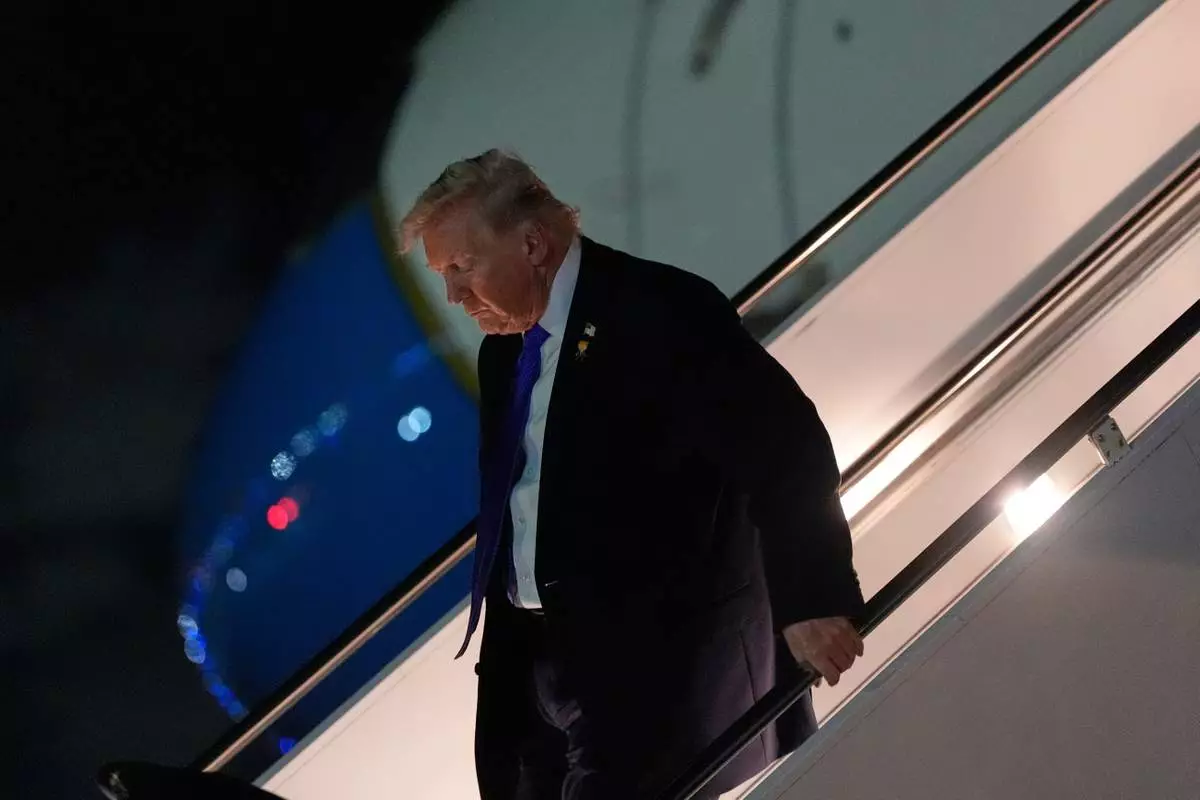
President Donald Trump arrives on Air Force One at Palm Beach International Airport, Friday, Jan. 9, 2025, in West Palm Beach, Fla. (AP Photo/Julia Demaree Nikhinson)

FILE - Visa and Mastercard credit cards are shown in Buffalo Grove, Ill., Feb. 8, 2024. (AP Photo/Nam Y. Huh, File)