Skip to Content Facebook Feature Image

Court rules in favor of The New York Times over texts between the EU chief and a pharma boss

News

Court rules in favor of The New York Times over texts between the EU chief and a pharma boss
News

News

Court rules in favor of The New York Times over texts between the EU chief and a pharma boss

2025-05-15 00:10 Last Updated At:00:21

BRUSSELS (AP) — A top European court ruled on Wednesday that the European Commission failed to provide a credible explanation for refusing The New York Times access to text messages sent between its President Ursula von der Leyen and a pharmaceutical boss during the COVID-19 pandemic.

The case highlights questions about transparency at the commission, which insists that text messages and other “ephemeral” electronic communications do not necessarily constitute documents of interest that should be saved or made public.

More Images
FILE - A Belgian Army medic brings lunch to a patient with COVID-19 at the St. Michiel Hospital in Brussels, Tuesday, Nov. 24, 2020. (AP Photo/Virginia Mayo, File)

FILE - A Belgian Army medic brings lunch to a patient with COVID-19 at the St. Michiel Hospital in Brussels, Tuesday, Nov. 24, 2020. (AP Photo/Virginia Mayo, File)

FILE - European Commission President Ursula von der Leyen, second left, speaks with Pfizer CEO Albert Bourla, center right, during an official visit to the Pfizer pharmaceutical company in Puurs, Belgium, Friday, April 23, 2021. (John Thys, Pool via AP, File)

FILE - European Commission President Ursula von der Leyen, second left, speaks with Pfizer CEO Albert Bourla, center right, during an official visit to the Pfizer pharmaceutical company in Puurs, Belgium, Friday, April 23, 2021. (John Thys, Pool via AP, File)

FILE - Syringes with the Pfizer vaccine against COVID-19 disease are ready at a new vaccination center in Paris, Thursday, May 6, 2021. (AP Photo/Michel Euler, File)
FILE - Syringes with the Pfizer vaccine against COVID-19 disease are ready at a new vaccination center in Paris, Thursday, May 6, 2021. (AP Photo/Michel Euler, File)

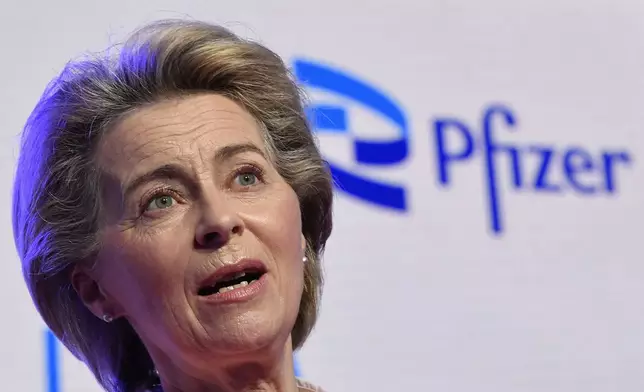
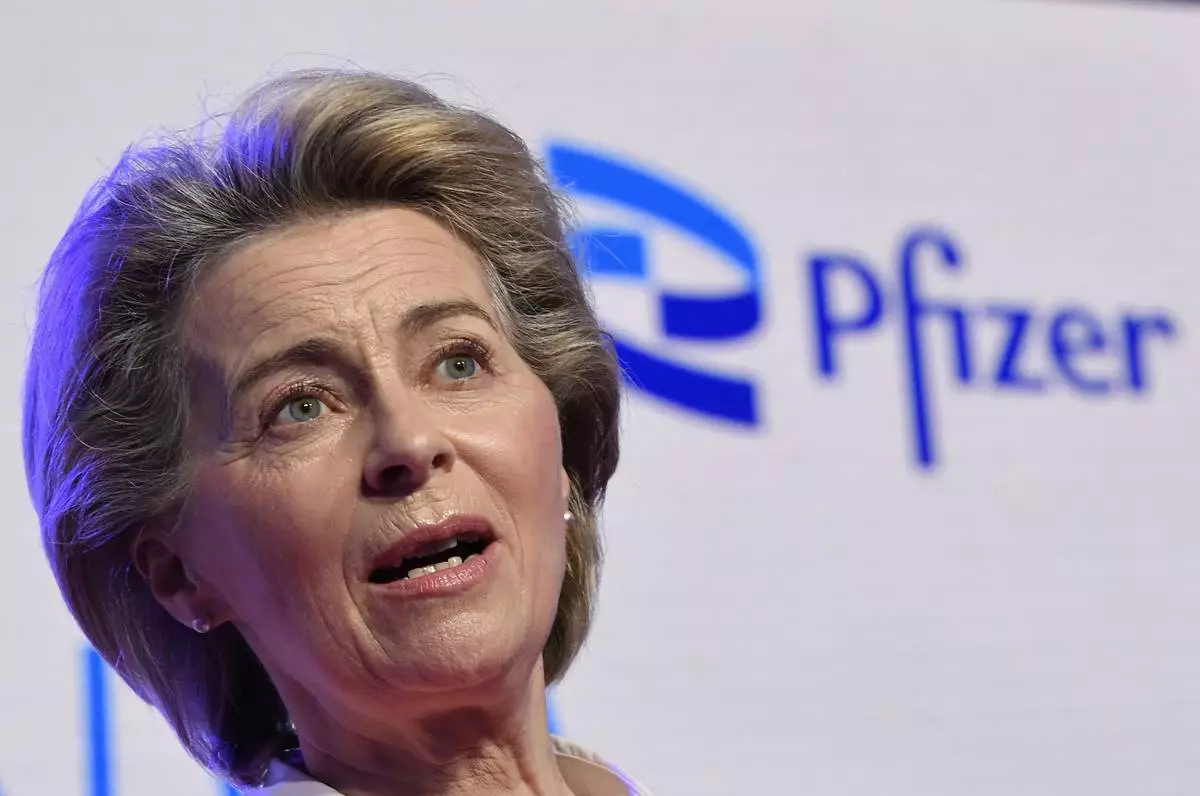
FILE - European Commission President Ursula von der Leyen makes a statement during an official visit to the Pfizer pharmaceutical company in Puurs, Belgium, Friday, April 23, 2021. (John Thys, Pool via AP, File)

FILE - European Commission President Ursula von der Leyen makes a statement during an official visit to the Pfizer pharmaceutical company in Puurs, Belgium, Friday, April 23, 2021. (John Thys, Pool via AP, File)

“Today’s decision is a victory for transparency and accountability in the European Union, and it sends a powerful message that ephemeral communications are not beyond the reach of public scrutiny,” Nicole Taylor, a spokesperson for The New York Times, said after the court annulled the commission's decision.

According to a statement from the EU’s General Court in Luxembourg, the U.S. newspaper’s lawyers “succeeded in rebutting the presumption of non-existence and of non-possession of the requested documents.”

The statement said that “the commission cannot merely state that it does not hold the requested documents but must provide credible explanations enabling the public and the court to understand why those documents cannot be found.”

It said the commission had failed to explain “in a plausible manner” why the messages did not contain important information.

It also said the commission “has not sufficiently clarified whether the requested text messages were deleted and, if so, whether the deletion was done deliberately or automatically or whether the president’s mobile phone had been replaced in the meantime.”

The commission said it would study the ruling and decide on "next steps,” which could refer to an appeal before the European Court of Justice (ECJ), the EU's top court.

It is unclear if the text messages in question still exist, and if so, who has access to them. Von der Leyen was responsible for deciding whether the texts constituted documents of value.

Transparency advocates argue that the EU’s increasingly powerful executive branch should maintain a paper trail of all its dealings and release documents when asked.

“This should serve as a catalyst for the commission to finally change its restrictive attitude to freedom of information,” said Shari Hinds, a policy officer for Transparency International, an anti-corruption group.

Païvi Leino-Sandberg, a law professor at the University of Helsinki who has a pending legal challenge before the same court about the commission’s internal documentation rules, called the news “a huge victory for transparency.”

“The commission lost so completely (in this ruling) and on every possible ground that overturning this in the ECJ seems extremely unlikely,” she said.

The New York Times said text messages were exchanged between von der Leyen and Pfizer CEO Albert Bourla as COVID-19 ravaged communities from Portugal to Finland and the EU scrambled to buy billions of vaccines.

Von der Leyen was under intense scrutiny, especially after AstraZeneca stumbled to deliver vaccine doses to the 27-nation bloc.

Amid fierce international competition for access to the vaccines, von der Leyen was praised for her leading role during the pandemic. But she also faced sharp criticism for the opacity of the negotiations to quickly gather 2.7 billion euros ($2.95 billion) to place an order for more than a billion doses.

At the same time as she was reported to be exchanging messages directly with the Pfizer boss, von der Leyen was publicly praising the company as “ a reliable partner.”

Von der Leyen was appointed to head the commission for a second five-year term last July. Critics say the 66-year-old former German defense minister dislikes having her decisions questioned, and that she centralized power at the commission’s headquarters, where she lives when in Brussels.

During her first term, von der Leyen not only led the EU’s pandemic response but also helped to rapidly wean the bloc off its dependency on Russian energy, after President Vladimir Putin used natural gas as a lever to undermine European support for Ukraine.

“It is simply untrue that the commission president does not use text messages to conduct political business,” said Daniel Freund, a lead anti-corruption EU lawmaker and a German Green Party member. ”This ruling is a clear defeat for Ursula von der Leyen and a clear rejection of her practice of concealing or hiding her text messages.”

Hungary's populist government, which licensed a contested Russian vaccine early in the pandemic and was separately later taken to court by the commission over democratic backsliding, used the ruling to take aim at von der Leyen.

In a post on social media, Foreign Minister Péter Szijjártó alleged that she “lectures us on transparency while hiding her shady Pfizer deals.” He called for the text messages to be made public and said: “Why were vaccines delayed? Why did Europe overpay? Enough with the excuses. We want answers.”

Associated Press writer Lorne Cook in Brussels contributed to this report.

FILE - A Belgian Army medic brings lunch to a patient with COVID-19 at the St. Michiel Hospital in Brussels, Tuesday, Nov. 24, 2020. (AP Photo/Virginia Mayo, File)

FILE - A Belgian Army medic brings lunch to a patient with COVID-19 at the St. Michiel Hospital in Brussels, Tuesday, Nov. 24, 2020. (AP Photo/Virginia Mayo, File)

FILE - European Commission President Ursula von der Leyen, second left, speaks with Pfizer CEO Albert Bourla, center right, during an official visit to the Pfizer pharmaceutical company in Puurs, Belgium, Friday, April 23, 2021. (John Thys, Pool via AP, File)

FILE - European Commission President Ursula von der Leyen, second left, speaks with Pfizer CEO Albert Bourla, center right, during an official visit to the Pfizer pharmaceutical company in Puurs, Belgium, Friday, April 23, 2021. (John Thys, Pool via AP, File)

FILE - Syringes with the Pfizer vaccine against COVID-19 disease are ready at a new vaccination center in Paris, Thursday, May 6, 2021. (AP Photo/Michel Euler, File)
FILE - Syringes with the Pfizer vaccine against COVID-19 disease are ready at a new vaccination center in Paris, Thursday, May 6, 2021. (AP Photo/Michel Euler, File)

FILE - European Commission President Ursula von der Leyen makes a statement during an official visit to the Pfizer pharmaceutical company in Puurs, Belgium, Friday, April 23, 2021. (John Thys, Pool via AP, File)
FILE - European Commission President Ursula von der Leyen makes a statement during an official visit to the Pfizer pharmaceutical company in Puurs, Belgium, Friday, April 23, 2021. (John Thys, Pool via AP, File)

NEW YORK (AP) — Reviving a campaign pledge, President Donald Trump wants a one-year, 10% cap on credit card interest rates, a move that could save Americans tens of billions of dollars but drew immediate opposition from an industry that has been in his corner.

Trump was not clear in his social media post Friday night whether a cap might take effect through executive action or legislation, though one Republican senator said he had spoken with the president and would work on a bill with his “full support.” Trump said he hoped it would be in place Jan. 20, one year after he took office.

Strong opposition is certain from Wall Street in addition to the credit card companies, which donated heavily to his 2024 campaign and have supported Trump's second-term agenda. Banks are making the argument that such a plan would most hurt poor people, at a time of economic concern, by curtailing or eliminating credit lines, driving them to high-cost alternatives like payday loans or pawnshops.

“We will no longer let the American Public be ripped off by Credit Card Companies that are charging Interest Rates of 20 to 30%,” Trump wrote on his Truth Social platform.

Researchers who studied Trump’s campaign pledge after it was first announced found that Americans would save roughly $100 billion in interest a year if credit card rates were capped at 10%. The same researchers found that while the credit card industry would take a major hit, it would still be profitable, although credit card rewards and other perks might be scaled back.

About 195 million people in the United States had credit cards in 2024 and were assessed $160 billion in interest charges, the Consumer Financial Protection Bureau says. Americans are now carrying more credit card debt than ever, to the tune of about $1.23 trillion, according to figures from the New York Federal Reserve for the third quarter last year.

Further, Americans are paying, on average, between 19.65% and 21.5% in interest on credit cards according to the Federal Reserve and other industry tracking sources. That has come down in the past year as the central bank lowered benchmark rates, but is near the highs since federal regulators started tracking credit card rates in the mid-1990s. That’s significantly higher than a decade ago, when the average credit card interest rate was roughly 12%.

The Republican administration has proved particularly friendly until now to the credit card industry.

Capital One got little resistance from the White House when it finalized its purchase and merger with Discover Financial in early 2025, a deal that created the nation’s largest credit card company. The Consumer Financial Protection Bureau, which is largely tasked with going after credit card companies for alleged wrongdoing, has been largely nonfunctional since Trump took office.

In a joint statement, the banking industry was opposed to Trump's proposal.

“If enacted, this cap would only drive consumers toward less regulated, more costly alternatives," the American Bankers Association and allied groups said.

Bank lobbyists have long argued that lowering interest rates on their credit card products would require the banks to lend less to high-risk borrowers. When Congress enacted a cap on the fee that stores pay large banks when customers use a debit card, banks responded by removing all rewards and perks from those cards. Debit card rewards only recently have trickled back into consumers' hands. For example, United Airlines now has a debit card that gives miles with purchases.

The U.S. already places interest rate caps on some financial products and for some demographics. The Military Lending Act makes it illegal to charge active-duty service members more than 36% for any financial product. The national regulator for credit unions has capped interest rates on credit union credit cards at 18%.

Credit card companies earn three streams of revenue from their products: fees charged to merchants, fees charged to customers and the interest charged on balances. The argument from some researchers and left-leaning policymakers is that the banks earn enough revenue from merchants to keep them profitable if interest rates were capped.

"A 10% credit card interest cap would save Americans $100 billion a year without causing massive account closures, as banks claim. That’s because the few large banks that dominate the credit card market are making absolutely massive profits on customers at all income levels," said Brian Shearer, director of competition and regulatory policy at the Vanderbilt Policy Accelerator, who wrote the research on the industry's impact of Trump's proposal last year.

There are some historic examples that interest rate caps do cut off the less creditworthy to financial products because banks are not able to price risk correctly. Arkansas has a strictly enforced interest rate cap of 17% and evidence points to the poor and less creditworthy being cut out of consumer credit markets in the state. Shearer's research showed that an interest rate cap of 10% would likely result in banks lending less to those with credit scores below 600.

The White House did not respond to questions about how the president seeks to cap the rate or whether he has spoken with credit card companies about the idea.

Sen. Roger Marshall, R-Kan., who said he talked with Trump on Friday night, said the effort is meant to “lower costs for American families and to reign in greedy credit card companies who have been ripping off hardworking Americans for too long."

Legislation in both the House and the Senate would do what Trump is seeking.

Sens. Bernie Sanders, I-Vt., and Josh Hawley, R-Mo., released a plan in February that would immediately cap interest rates at 10% for five years, hoping to use Trump’s campaign promise to build momentum for their measure.

Hours before Trump's post, Sanders said that the president, rather than working to cap interest rates, had taken steps to deregulate big banks that allowed them to charge much higher credit card fees.

Reps. Alexandria Ocasio-Cortez, D-N.Y., and Anna Paulina Luna, R-Fla., have proposed similar legislation. Ocasio-Cortez is a frequent political target of Trump, while Luna is a close ally of the president.

Seung Min Kim reported from West Palm Beach, Fla.

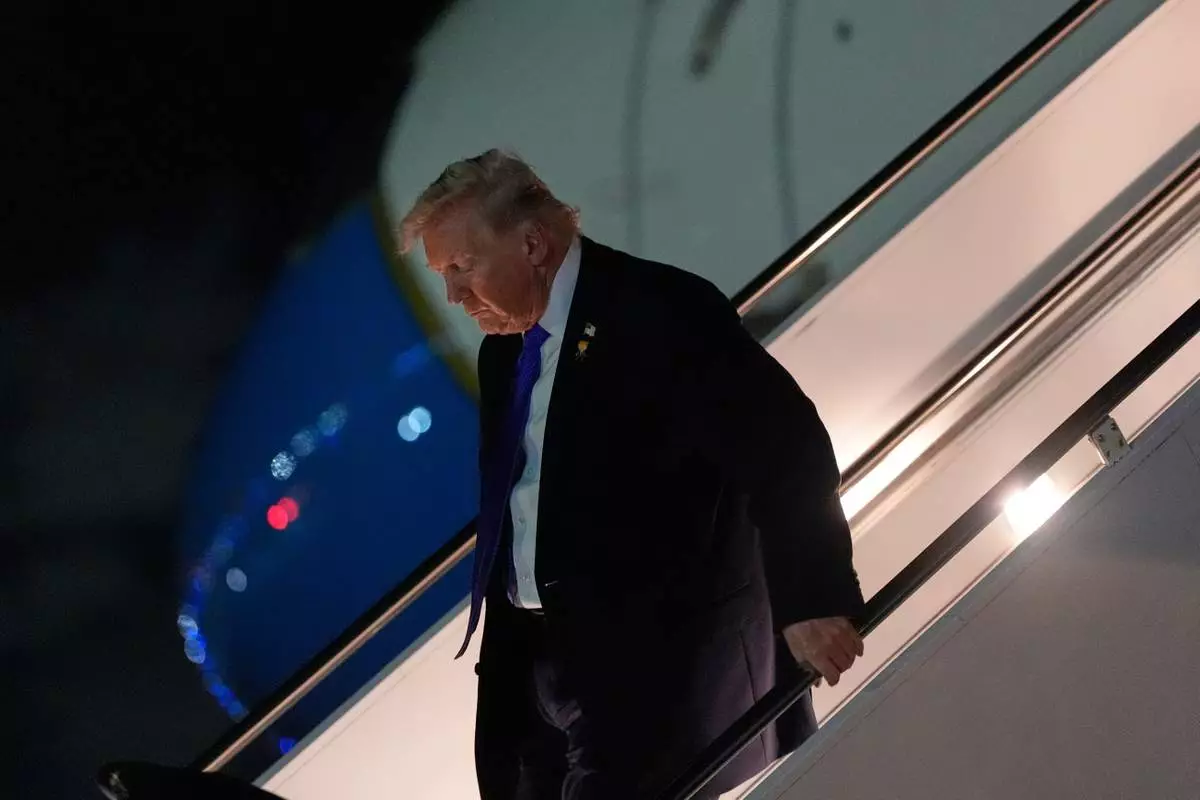
President Donald Trump arrives on Air Force One at Palm Beach International Airport, Friday, Jan. 9, 2025, in West Palm Beach, Fla. (AP Photo/Julia Demaree Nikhinson)

President Donald Trump arrives on Air Force One at Palm Beach International Airport, Friday, Jan. 9, 2025, in West Palm Beach, Fla. (AP Photo/Julia Demaree Nikhinson)

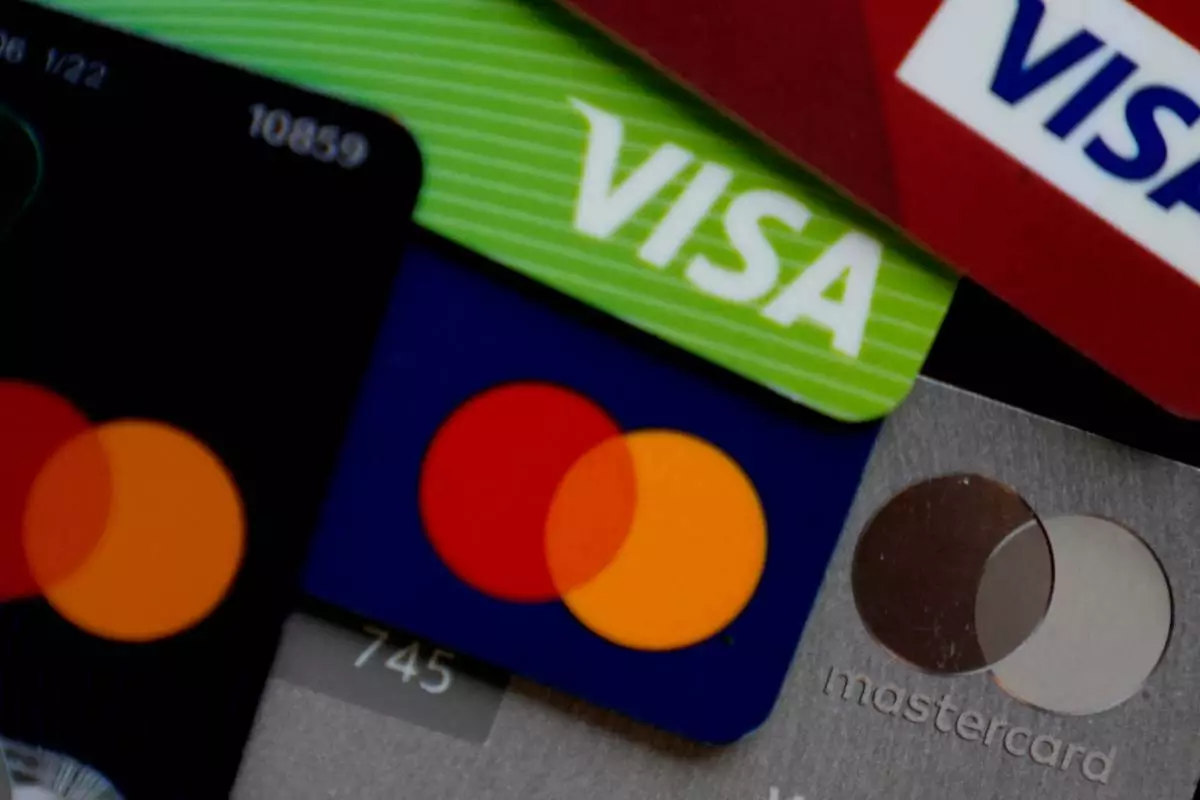
FILE - Visa and Mastercard credit cards are shown in Buffalo Grove, Ill., Feb. 8, 2024. (AP Photo/Nam Y. Huh, File)

FILE - Visa and Mastercard credit cards are shown in Buffalo Grove, Ill., Feb. 8, 2024. (AP Photo/Nam Y. Huh, File)

Recommended Articles