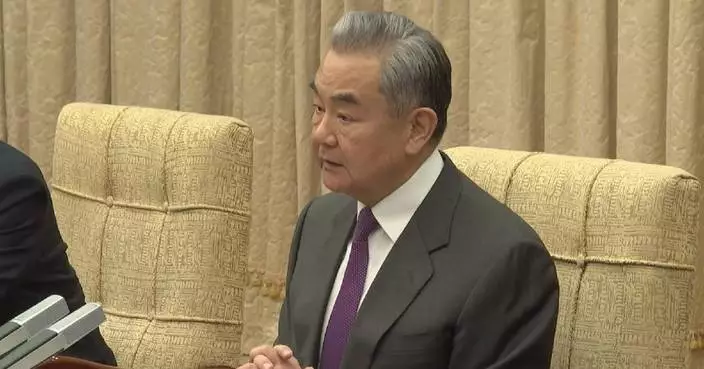
China's top political advisor Wang Huning met with Jacob Mudenda, Speaker of the National Assembly of Zimbabwe, in Beijing on Wednesday, to discuss relations between their two countries.
At the meeting, Wang, chairman of the National Committee of the Chinese People's Political Consultative Conference (CPPCC) and member of the Standing Committee of the Political Bureau of the Communist Party of China (CPC) Central Committee, recalled that last year, Chinese President Xi Jinping had in-depth friendly exchange of views with Zimbabwean President Emmerson Mnangagwa, who was in Beijing to attend the Summit of Forum on China-Africa Cooperation (FOCAC) and was paying a state visit to China, with the two leaders providing new strategic guidance for the development of China-Zimbabwe relations.
China is willing to work with Zimbabwe under the guidance of the consensus reached by the two heads of state, and take the implementation of the outcomes of FOCAC as an opportunity to enhance political mutual trust, expand pragmatic cooperation, and jointly build a high-level China-Zimbabwe community with a shared future, he said.
Wang also said that the CPPCC is willing to contribute to promoting the development of bilateral relations.
Speaking on the same occasion, Mudenda said that Zimbabwe adheres to the one-China principle and sincerely thanks China for its valuable support. He expressed the hope that the two sides will continue to strengthen exchanges at all levels, including governmental and people-to-people exchanges at various levels, and deepen cooperation in fields including energy, culture and the digital economy.
Zimbabwe's House of Assembly is willing to strengthen friendly exchanges with the CPPCC National Committee, and jointly contribute to promoting the economic and social development of the two countries, he said.
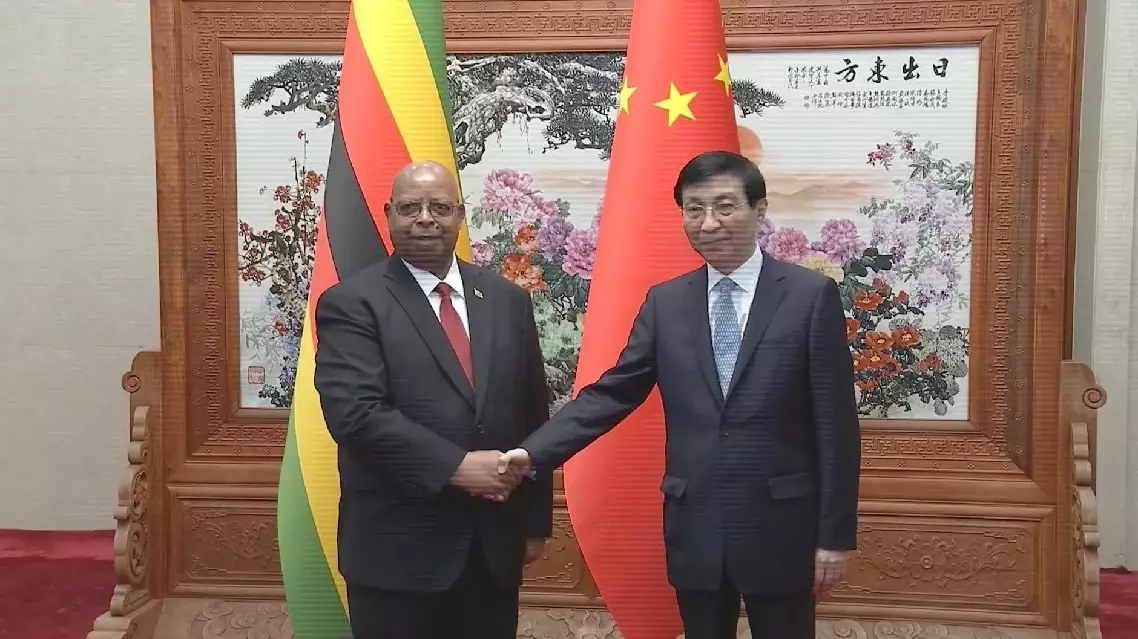
China's top political advisor meets speaker of National Assembly of Zimbabwe on relations
The U.S. military strike against Venezuela and capture of its president, Nicolas Maduro, has shocked the international community, triggering a steady stream of condemnation and serious concerns worldwide.
Brazil, Chile, Colombia, Mexico, Uruguay and Spain issued a joint statement on Sunday, expressing serious concern about and firm opposition to the U.S. unilateral military operations in Venezuela.
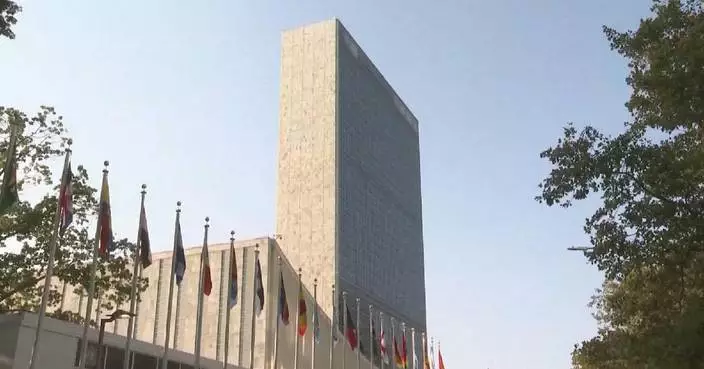
The U.S. actions contravene fundamental principles of international law, particularly the prohibition on the use or threat of force, and respect for the sovereignty and territorial integrity of States, as enshrined in the UN Charter, constituting an extremely dangerous precedent against peace and regional security, according to the statement.
In expressing profound concern and firm rejection, the six countries stressed in the statement that the situation in Venezuela must be resolved exclusively by peaceful means, and through dialogue, negotiation and respect for the will of the Venezuelan people in all its expressions, without external interference and in accordance with international law.
Only an inclusive political process, led by Venezuelans, can lead to a democratic, sustainable solution that respects human dignity, according to the statement.
Spanish Prime Minister Pedro Sanchez condemned the U.S. raid in Venezuela as a violation of international law, adding that the Spanish government always advocates and defends international law and peaceful resolution of conflicts.
Addressing a meeting of the Community of Latin American and Caribbean States (CELAC), Cuban Foreign Minister Bruno Rodriguez demanded the unconditional and immediate release of Maduro and his wife.
Noting that Latin America and the Caribbean are a zone of peace, he expressed his firm opposition to the use of force, which is an unshakable principle.
Any aggression against Venezuela shall be regarded as an attack against all CELAC member states, and nations must collectively oppose it, he stressed.
The South African government denounced the U.S. attack on Venezuela as a violation of international law, according to a statement released on Sunday.
History has repeatedly demonstrated that military invasions against sovereign states yield only instability and deepening crisis, the statement said.
South Africa calls on the UN Security Council to urgently convene a session to address this situation, according to the statement.
Serbian President Aleksandar Vucic said what happened in Venezuela demonstrates that international law and the UN Charter are losing their practical effectiveness.
U.S. military action against Venezuela marks a dangerous precedent, as similar actions could be taken against any other nations, he said.
In addition, the foreign ministries of Namibia, Singapore, Oman and Pakistan also issued statements on the same day, expressing grave concern over U.S. interference in Venezuela's internal affairs.
They emphasized the need to uphold international law and the principles of the UN Charter while respecting Venezuela's sovereignty.
They also called on all parties to exercise restraint and resolve the crisis through peaceful dialogue.
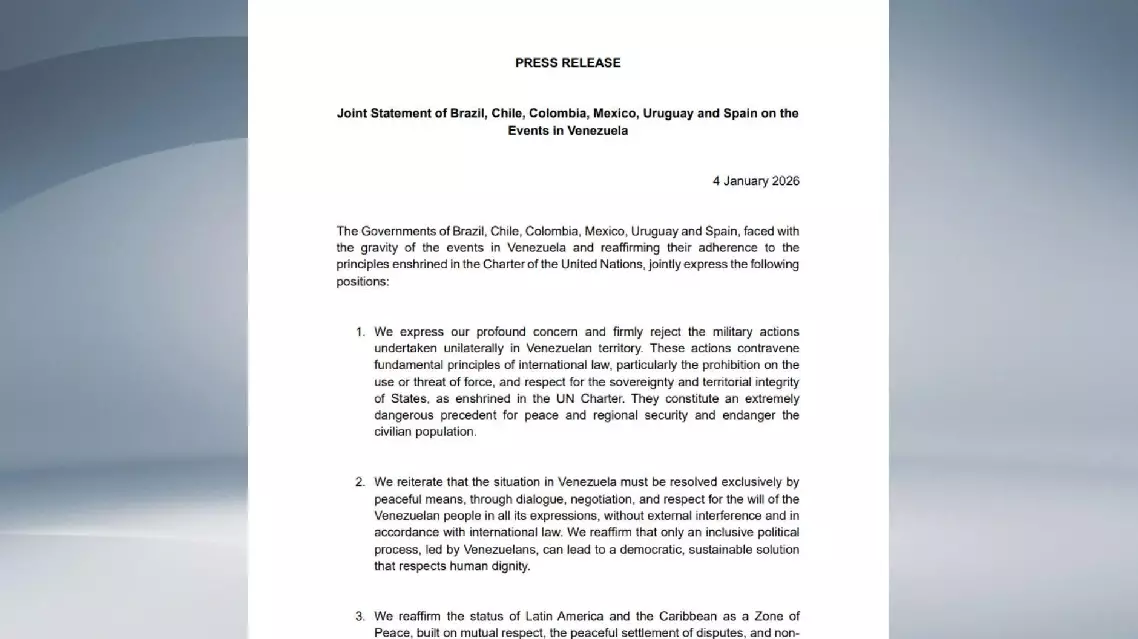
U.S. move against Venezuela sparks condemnation, concerns worldwide