Skip to Content Facebook Feature Image

Divisions emerge among House Republicans over how much to cut taxes and Medicaid in Trump's bill

ENT

Divisions emerge among House Republicans over how much to cut taxes and Medicaid in Trump's bill
ENT

ENT

Divisions emerge among House Republicans over how much to cut taxes and Medicaid in Trump's bill

2025-05-15 11:10 Last Updated At:11:20

WASHINGTON (AP) — Cheers broke out early Wednesday as Republicans on the House Ways and Means Committee signed off on the GOP tax breaks bill after a grueling round-the-clock session that pushed President Donald Trump's package past overwhelming Democratic opposition.

But there's still more work to do.

House Speaker Mike Johnson, R-La., also worked past midnight trying to resolve issues with Trump's plan. Opposition is mounting from various corners of the GOP majority as he tries to muscle the party's signature package to passage without any votes from Democrats.

On the one hand, the conservative leader of the Freedom Caucus derides the new Medicaid work requirements as a “joke” that do not go far enough at cost-cutting. Meanwhile, a handful of GOP lawmakers from New York and other high-tax states are refusing to support the measure unless changes are made to give deeper state and local tax deductions, called SALT, for their constituents back home.

"To say we have a gulf is an understatement," said Rep. Chip Roy, R-Texas, a leader of the conservative wing.

Roy said there is “a significant number of us who could not bless this product” in its current form.

Nevertheless, momentum is building toward an end-of-the-week inflection point to stitch together the sprawling package Friday at the Budget Committee. That means combining hundreds of pages of bill text covering $5 trillion in tax breaks and at least $1.5 trillion in spending reductions on Medicaid, food stamps and green energy programs to deliver Trump's second-term legislative priority.

Democrats decry the package as a give-away to the wealthy at the expense of safety net programs that millions of Americans rely on. But Johnson insists the Republican majority is on track to pass the package by Memorial Day, May 26, sending it to the Senate where Republicans are crafting their own version. With his slim majority, he can only afford a few defections from his ranks.

“We’re still on target,” Johnson said at the Capitol. “The American people are counting on us.”

Democrats also stayed up all night forcing marathon public hearings. One at the House Energy and Commerce Committee was still going more than 26 hours later before finishing Wednesday afternoon.

Later Wednesday evening, the House Agriculture Committee handling the food aid cuts wrapped up its work too, but only after the Republican chairman abruptly shut down debate on dozens of remaining amendments from Democrats.

All told, Democrats proposed hundreds of amendments trying to change the package, with dozens of votes that largely failed.

“It is a cruel, mean, rotten bill,” said Rep. Jim McGovern, D-Mass., as the Agriculture panel debated changes to the Supplemental Nutrition and Assistance Program, known as SNAP.

The nonpartisan Congressional Budget Office said at least 7.6 million fewer people would have health insurance with reductions to Medicaid, and likely more with additional changes to the Affordable Care Act.

The CBO also gave lawmakers a preliminary analysis showing that 3 million fewer people each month would participate in the SNAP food program under the changes proposed.

More than 70 million Americans rely on Medicaid for health care, and about 40 million use SNAP.

The Republicans are targeting Medicaid and SNAP for a combined $1 trillion in cuts as a way to offset the costs of the tax package, but also to achieve GOP goals of reining in the social safety net programs.

Most of the cost-savings would come from imposing stiffer work requirements for those receiving the health care and food assistance, meaning fewer people would qualify for the aid. The legislation would raise from 54 to 64 the age of able-bodied adults without dependents who would have to work to qualify for SNAP. It also would also require some parents to work to qualify for the benefits once their children are older than 7, instead of 18. Under current law, those recipients must work or participate in a work program for 80 hours a month.

The chairman of the House Energy and Commerce Committee, Rep. Brett Guthrie, R-Ky., insists the changes would “strengthen and sustain” Medicaid for the future, and are the kind of “common sense” policies Trump promised voters.

But Democrats told repeated stories of their constituents struggling to access health care. Rep. Jimmy Gomez, D-Calif., revealed his own diagnosis with Type 2 diabetes at the House Ways and Means Committee hearing and the sticker shock of health costs.

One of the most difficult issues for Johnson has been the more localized debate over state and local taxes as he works to come up with a compromise for New York, California and New Jersey lawmakers. They have rejected an offer to triple the deduction cap, now at $10,000, to $30,000 for married couples.

The speaker met with lawmakers Tuesday and talks continued into Wednesday.

Rep. Nick LaLota, R-N.Y., said it was cordial, but there was no deal. “More sizzle than steak in that meeting,” he said late Tuesday.

“The reality is you need 218 votes to pass a bill and the way this bill is currently constructed, it will not have that because it does not adequately the issue of SALT,” said Rep. Mike Lawler, R-N.Y.

The lawmakers believe they have leverage in the talks because without a deal, the $10,000 limit established under the 2017 tax bill expires at the end of the year and reverts to no cap at all.

But as Johnson and the lawmakers edge closer to a SALT deal, the conservatives are balking that their priorities must also be met.

Rep. Eric Burlison, R-Mo., said he’s a no for now, but would be working to improve the bill so that he could support it.

The conservatives argue that the tax breaks without deeper spending cuts will pile onto the deficit, and they worry that the Medicaid reductions do not go far enough in rolling back federal funds to expand the Affordable Care Act. They also want the work requirements, which don't take effect until Jan. 1, 2029, after Trump has left office, to start sooner.

"Basically Republicans are enforcing Obamacare, which is a surreal situation to me,” Burlison said.

Republicans are racing to extend Trump's tax breaks, which are set to expire later this year, while adding the new ones he campaigned on in 2024, including no taxes on tips, Social Security benefits and others.

A new analysis from the Joint Committee on Taxation shows that most tax filers would see a lower tax rates under the proposal, except those at the lowest rates, who earn less than $15,000 a year. Their average tax rate would go up.

Associated Press writers Matt Brown, Mary Clare Jalonick and Leah Askarinam contributed to this report.
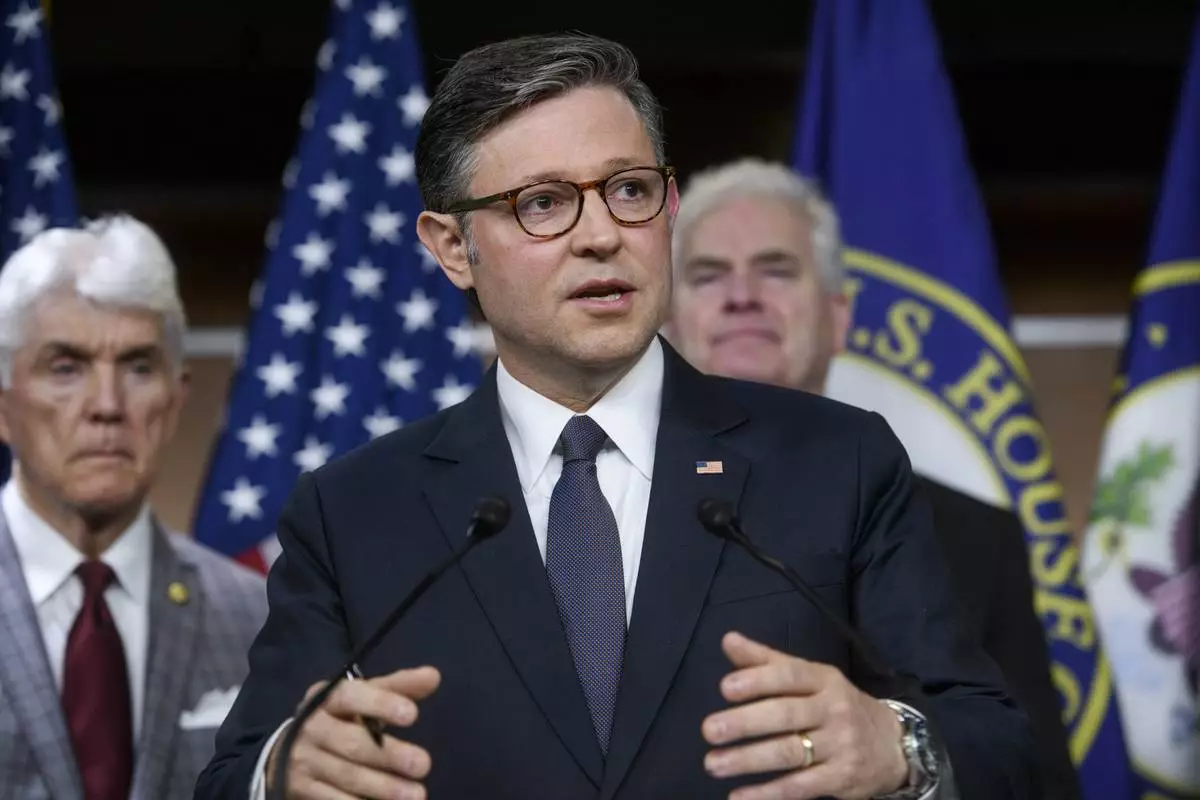
Speaker of the House Mike Johnson, R-La., speaks during a news conference at the Capitol, Tuesday, May 6, 2025, in Washington. (AP Photo/Rod Lamkey, Jr.)
Speaker of the House Mike Johnson, R-La., speaks during a news conference at the Capitol, Tuesday, May 6, 2025, in Washington. (AP Photo/Rod Lamkey, Jr.)

DUBAI, United Arab Emirates (AP) — U.S. President Donald Trump said Iran wants to negotiate with Washington after his threat to strike the Islamic Republic over its bloody crackdown on protesters, a move coming as activists said Monday the death toll in the nationwide demonstrations rose to at least 544.

Iran had no immediate reaction to the news, which came after the foreign minister of Oman — long an interlocutor between Washington and Tehran — traveled to Iran this weekend. It also remains unclear just what Iran could promise, particularly as Trump has set strict demands over its nuclear program and its ballistic missile arsenal, which Tehran insists is crucial for its national defense.

Meanwhile Monday, Iran called for pro-government demonstrators to head to the streets in support of the theocracy, a show of force after days of protests directly challenging the rule of 86-year-old Supreme Leader Ayatollah Ali Khamenei. Iranian state television aired chants from the crowd, who shouted “Death to America!” and “Death to Israel!”

Trump and his national security team have been weighing a range of potential responses against Iran including cyberattacks and direct strikes by the U.S. or Israel, according to two people familiar with internal White House discussions who were not authorized to comment publicly and spoke on condition of anonymity.

“The military is looking at it, and we’re looking at some very strong options,” Trump told reporters on Air Force One on Sunday night. Asked about Iran’s threats of retaliation, he said: “If they do that, we will hit them at levels that they’ve never been hit before.”

Trump said that his administration was in talks to set up a meeting with Tehran, but cautioned that he may have to act first as reports of the death toll in Iran mount and the government continues to arrest protesters.

“I think they’re tired of being beat up by the United States,” Trump said. “Iran wants to negotiate.”

He added: “The meeting is being set up, but we may have to act because of what’s happening before the meeting. But a meeting is being set up. Iran called, they want to negotiate.”

Iran through country's parliamentary speaker warned Sunday that the U.S. military and Israel would be “legitimate targets” if America uses force to protect demonstrators.

More than 10,600 people also have been detained over the two weeks of protests, said the U.S.-based Human Rights Activists News Agency, which has been accurate in previous unrest in recent years and gave the death toll. It relies on supporters in Iran crosschecking information. It said 496 of the dead were protesters and 48 were with security forces.

With the internet down in Iran and phone lines cut off, gauging the demonstrations from abroad has grown more difficult. The Associated Press has been unable to independently assess the toll. Iran’s government has not offered overall casualty figures.

Those abroad fear the information blackout is emboldening hard-liners within Iran’s security services to launch a bloody crackdown. Protesters flooded the streets in the country’s capital and its second-largest city on Saturday night into Sunday morning. Online videos purported to show more demonstrations Sunday night into Monday, with a Tehran official acknowledging them in state media.

In Tehran, a witness told the AP that the streets of the capital empty at the sunset call to prayers each night. By the Isha, or nighttime prayer, the streets are deserted.

Part of that stems from the fear of getting caught in the crackdown. Police sent the public a text message that warned: “Given the presence of terrorist groups and armed individuals in some gatherings last night and their plans to cause death, and the firm decision to not tolerate any appeasement and to deal decisively with the rioters, families are strongly advised to take care of their youth and teenagers.”

Another text, which claimed to come from the intelligence arm of the paramilitary Revolutionary Guard, also directly warned people not to take part in demonstrations.

“Dear parents, in view of the enemy’s plan to increase the level of naked violence and the decision to kill people, ... refrain from being on the streets and gathering in places involved in violence, and inform your children about the consequences of cooperating with terrorist mercenaries, which is an example of treason against the country,” the text warned.

The witness spoke to the AP on condition of anonymity due to the ongoing crackdown.

The demonstrations began Dec. 28 over the collapse of the Iranian rial currency, which trades at over 1.4 million to $1, as the country’s economy is squeezed by international sanctions in part levied over its nuclear program. The protests intensified and grew into calls directly challenging Iran’s theocracy.

Nikhinson reported from aboard Air Force One.

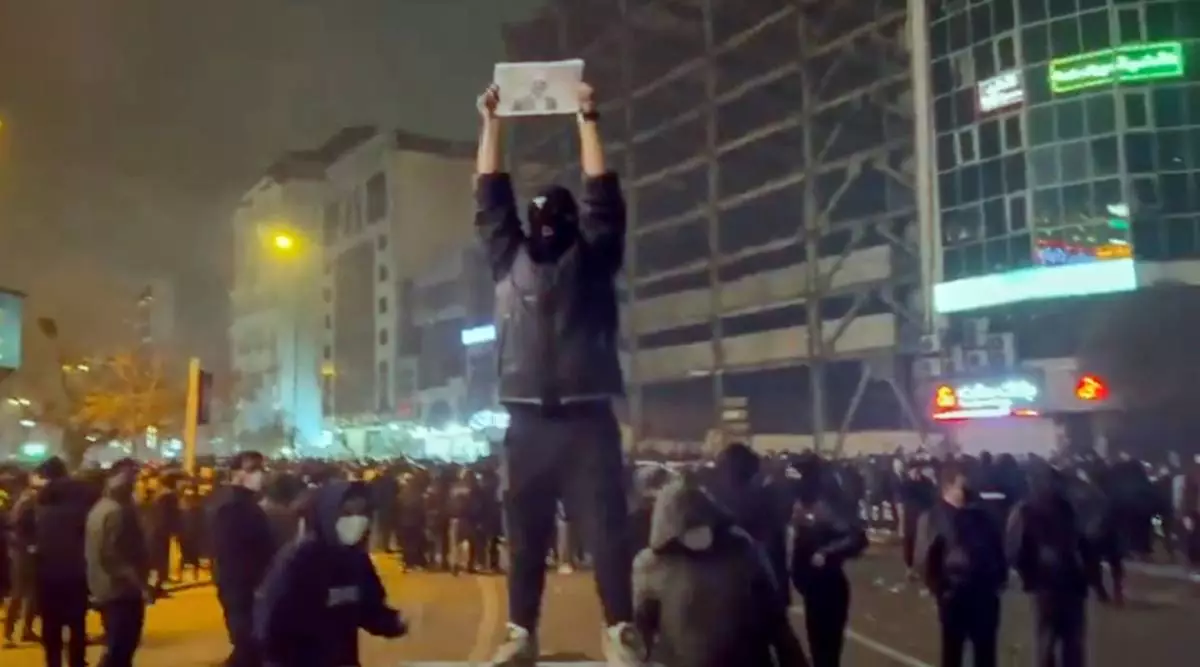
In this frame grab from video obtained by the AP outside Iran, a masked demonstrator holds a picture of Iran's Crown Prince Reza Pahlavi during a protest in Tehran, Iran, Friday, January. 9, 2026. (UGC via AP)

In this frame grab from video obtained by the AP outside Iran, a masked demonstrator holds a picture of Iran's Crown Prince Reza Pahlavi during a protest in Tehran, Iran, Friday, January. 9, 2026. (UGC via AP)

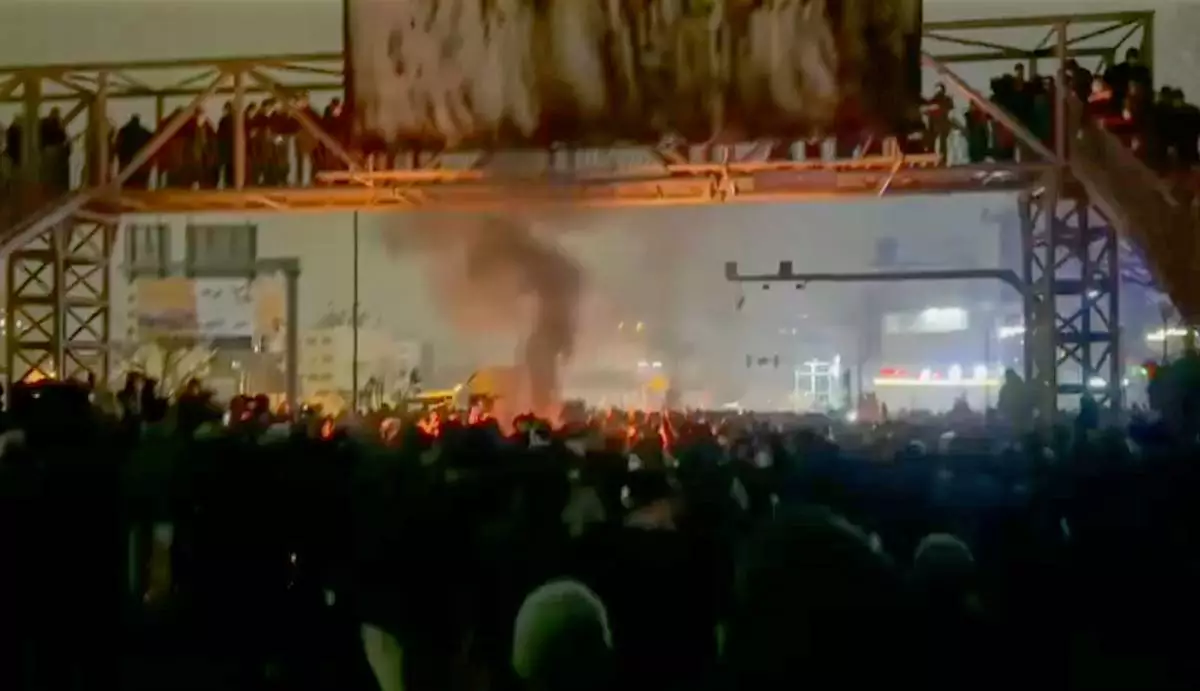
In this frame grab from footage circulating on social media from Iran shows protesters taking to the streets despite an intensifying crackdown as the Islamic Republic remains cut off from the rest of the world in Tehran, Iran, Friday, Jan. 9, 2026.(UGC via AP)

In this frame grab from footage circulating on social media from Iran shows protesters taking to the streets despite an intensifying crackdown as the Islamic Republic remains cut off from the rest of the world in Tehran, Iran, Friday, Jan. 9, 2026.(UGC via AP)

In this frame grab from footage circulating on social media from Iran showed protesters once again taking to the streets of Tehran despite an intensifying crackdown as the Islamic Republic remains cut off from the rest of the world in Tehran, Iran, Saturday Jan. 10, 2026. (UGC via AP)

In this frame grab from footage circulating on social media from Iran showed protesters once again taking to the streets of Tehran despite an intensifying crackdown as the Islamic Republic remains cut off from the rest of the world in Tehran, Iran, Saturday Jan. 10, 2026. (UGC via AP)

Recommended Articles