SAN FRANCISCO--(BUSINESS WIRE)--May 14, 2025--
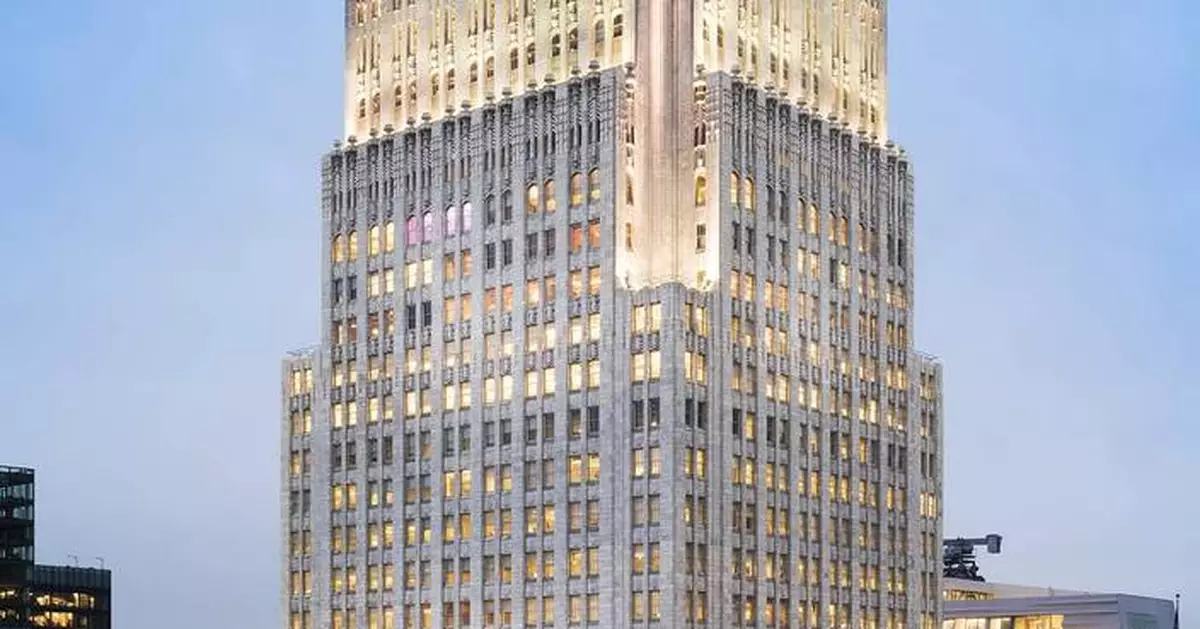
Mayor Daniel Lurie and clean energy company Intersect Power, LLC today announced the company’s new headquarters at 140 New Montgomery in downtown San Francisco, marking another step in downtown’s comeback and underscoring the city’s dominance as a global innovation hub and technology leader.
This press release features multimedia. View the full release here: https://www.businesswire.com/news/home/20250514076280/en/
To continue this dominance, Mayor Lurie has been working to accelerate downtown’s recovery and make San Francisco the best place to do business, including in clean energy and climate innovation. In February, he established a permanent San Francisco Police Department Hospitality Zone Task Force to keep downtown neighborhoods safe 365 days a year, while proposing new state legislation to support nightlife by creating more liquor licenses to encourage the opening of new bars and restaurants. Mayor Lurie has championed entertainment zones—recently signing legislation to designate a new one in the Castro District and advancing legislation to establish five more. In April, the mayor announced three new pop-ups downtown through the expansion of Vacant to Vibrant, a critical public-private partnership bringing new businesses to formerly vacant properties.
“Whether you’re a housing developer, a startup founder, or a global company—if you’ve got a vision, we want you to build it here,” said Mayor Lurie. “San Francisco is the place to be for the companies driving the future of climate innovation, and I am thrilled to welcome Intersect Power and their new headquarters to downtown San Francisco. Our administration is working every day to provide safe, clean streets downtown and create the conditions for companies big or small to thrive in our city.”
Intersect’s new headquarters marks yet another investment in San Francisco by a clean energy company. During last month’s Climate Week, which drew more than 30,000 attendees and 1,000 organizations to San Francisco, Mayor Lurie joined It’s Electric in launching the city's first curbside EV charging stations. Similarly, in April, the mayor and Redwood Materials, a lithium-ion battery recycling and production company, announced the company's new research and development facility at 100 Hooper. In March, Revel opened its first West Coast charging station in San Francisco’s Mission District.
The new headquarters will provide purpose-built opportunities for employees to gather and collaborate. The company will occupy 12,000 square feet, covering a full floor in the historic Pembroke property at 140 New Montgomery. The building has been a symbol of technology and connection from its construction 100 years ago as the headquarters of one of the country's first telecommunications companies to its role today as a hub for innovative businesses.
“As the digital landscape undergoes a profound transformation, driven by the immense potential of AI, San Francisco remains the undeniable epicenter of that progress,” said Sheldon Kimber, CEO and Founder of Intersect Power. “The city continues to be a magnet for innovators and builders at the intersection of digitization, electrification and decarbonization and Intersect Power is proud to be a part of that ecosystem.”
With San Francisco's robust venture capital funding—the Bay Area has 57% of the U.S. total —and rapidly expanding AI sector, Intersect is well-positioned to help the city's growing AI companies meet both their climate goals and energy needs.
Intersect has grown exponentially as it moves forward in building AI data centers with a “ power-first ” approach that co-locates data centers with power generation. With a combination of wind, solar, battery storage, and flexible gas generation, the company can provide the speed, scale, reliability, and cost that data center customers require.
As approximately a quarter of Intersect employees are based in the Bay Area, San Francisco has served as a main destination and meeting point for the company’s quarterly co-working team weeks, bringing together employees from across North America.
Intersect was recently recognized by TIME Magazine as a “Top GreenTech Company” on both their 2025 America’s and World’s lists, named by Fast Company as one of the World’s Most Innovative Companies of 2025, and by Forbes as one of America’s Best Startup Employers two years running.
About Intersect Power
Intersect Power is a clean energy company bringing innovative, scalable, and American-made, low-carbon solutions to its customers in global energy markets. We develop, own, and operate some of the world’s largest grid-tied clean energy resources, as well as co-located facilities for large industrial loads including data centers, e-fuels, and other energy-intensive products.
Intersect is laser-focused on the largest, most transformative clean energy projects that decarbonize the existing power grid and bring new loads to clean generation without the need for new transmission. Intersect is redefining the scope of the clean energy industry by enabling new pathways between clean electricity and the broader economy.
We have a base portfolio of 2.2 GW of operating solar PV and 2.4 GWh of battery storage in operation or construction, representing ~$4B in capital investments. We plan to break ground on an additional 4 GW of solar PV and 10 GWh of battery storage representing ~$9B of assets in 2025.
To learn more, visit www.intersectpower.com.
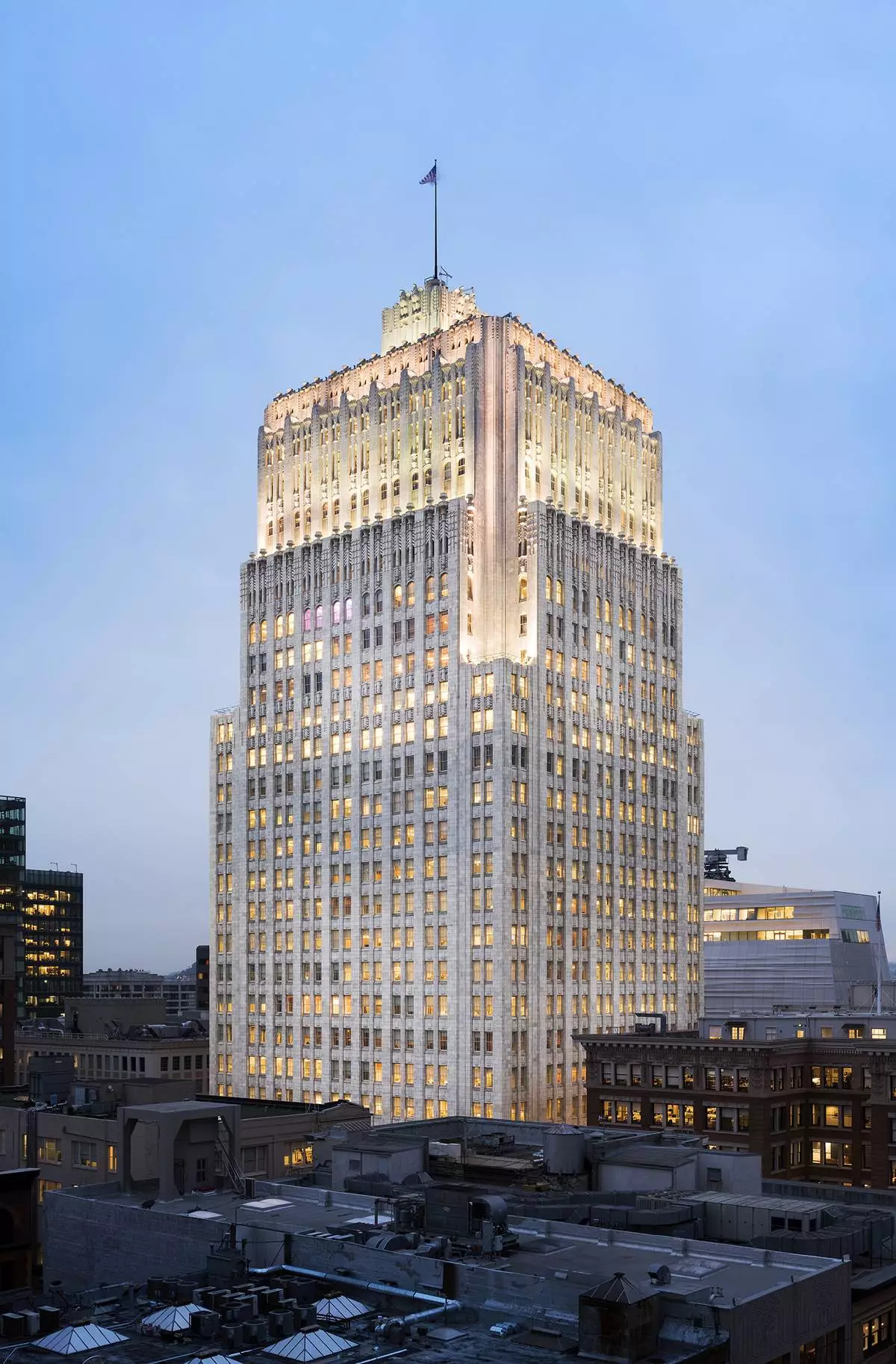
The Pembroke property at 140 New Montgomery in San Francisco, now home to Intersect's headquarters.
RHO, Italy (AP) — No ice is colder and harder than speedskating ice. The precision it takes has meant that Olympic speedskaters have never competed for gold on a temporary indoor rink – until the 2026 Milan Cortina Winter Games.
In the pursuit of maximum glide and minimum friction, Olympic officials brought on ice master Mark Messer, a veteran of six previous Olympic speedskating tracks and the ice technician in charge of the Olympic Oval in Calgary, Canada — one of the fastest tracks in the world with over 300 records.
Messer has been putting that experience to work one thin layer of ice at a time since the end of October at the new Speed Skating Stadium, built inside adjacent trade fair halls in the city of Rho just north of Milan.
“It’s one of the biggest challenges I’ve had in icemaking,’’ Messer said during an interview less than two weeks into the process.
If Goldilocks were a speedskater, hockey ice would be medium hard, for fast puck movement and sharp turns. Figure skating ice would be softer, allowing push off for jumps and so the ice doesn’t shatter on landing. Curling ice is the softest and warmest of all, for controlled sliding.
For speedskating ice to be just right, it must be hard, cold and clean. And very, very smooth.
“The blades are so sharp, that if there is some dirt, the blade will lose the edge,’’ Messer said, and the skater will lose speed.
Speedskater Enrico Fabris, who won two Olympic golds in Turin in 2006, has traded in his skates to be deputy sports manager at the speedskating venue in Rho. For him, perfect ice means the conditions are the same for all skaters — and then if it's fast ice, so much the better.
"It's more of a pleasure to skate on this ice,'' he said.
Messer’s first Olympics were in Calgary in 1988 — the first time speedskating was held indoors. “That gave us some advantages because we didn’t have to worry about the weather, wind blowing or rain,’’ he said. Now he is upping the challenge by becoming the first ice master to build a temporary rink for the Olympics.
Before Messer arrived in Italy, workers spent weeks setting up insulation to level the floor and then a network of pipes and rubber tubes that carry glycol — an antifreeze — that is brought down to minus 7 or minus 8 degrees Celsius (17.6 to 19.4 degrees Fahrenheit) to make the ice.
Water is run through a purification system — but it can’t be too pure, or the ice that forms will be too brittle. Just the right amount of impurities “holds the ice together,’’ Messer said.
The first layers of water are applied slowly, with a spray nozzle; after the ice reaches a few centimeters it is painted white — a full day’s work — and the stripes are added to make lanes.
“The first one takes about 45 minutes. And then as soon as it freezes, we go back and do it again, and again and again. So we do it hundreds of times,’’ Messer said.
As the ice gets thicker, and is more stable, workers apply subsequent layers of water with hoses. Messer attaches his hose to hockey sticks for easier spreading.
What must absolutely be avoided is dirt, dust or frost — all of which can cause friction for the skaters, slowing them down. The goal is that when the skaters push “they can go as far as possible with the least amount of effort,’’ Messer said.
The Zamboni ice resurfacing machine plays a key role in keeping the track clean, cutting off a layer and spraying water to make a new surface.
One challenge is gauging how quickly the water from the resurfacing machine freezes in the temporary rink.
Another is getting the ice to the right thickness so that the Zamboni, weighing in at six tons, doesn’t shift the insulation, rubber tubing or ice itself.
“When you drive that out, if there’s anything moving it will move. We don’t want that,’’ Messer said.
The rink got its first big test on Nov. 29-30 during a Junior World Cup event. In a permanent rink, test events are usually held a year before the Olympics, leaving more time for adjustments. “We have a very small window to learn,’’ Messer acknowledged.
Dutch speedskater Kayo Vos, who won the men’s neo-senior 1,000 meters, said the ice was a little soft — but Messer didn’t seem too concerned.
“We went very modest to start, now we can start to change the temperatures and try to make it faster and still maintain it as a safe ice,’’ he said.
Fine-tuning the air temperature and humidity and ice temperature must be done methodically — taking into account that there will be 6,000 spectators in the venue for each event. The next real test will be on Jan. 31, when the Olympians take to the ice for their first training session.
“Eighty percent of the work is done but the hardest part is the last 20 percent, where we have to try to find the values and the way of running the equipment so all the skaters get the same conditions and all the skaters get the best conditions,’’ Messer said.
AP Winter Olympics: https://apnews.com/hub/milan-cortina-2026-winter-olympics

Serpentines are set on the ice of the stadium where speed skating discipline of the Milan Cortina 2026 Winter Olympics will take place, in Rho, outskirt of Milan, Tuesday, Nov. 11, 2025. (AP Photo/Luca Bruno)

Ice Master Mark Messer poses in the stadium where speed skating discipline of the Milan Cortina 2026 Winter Olympics will take place, in Rho, outskirt of Milan, Tuesday, Nov. 11, 2025. (AP Photo/Luca Bruno)
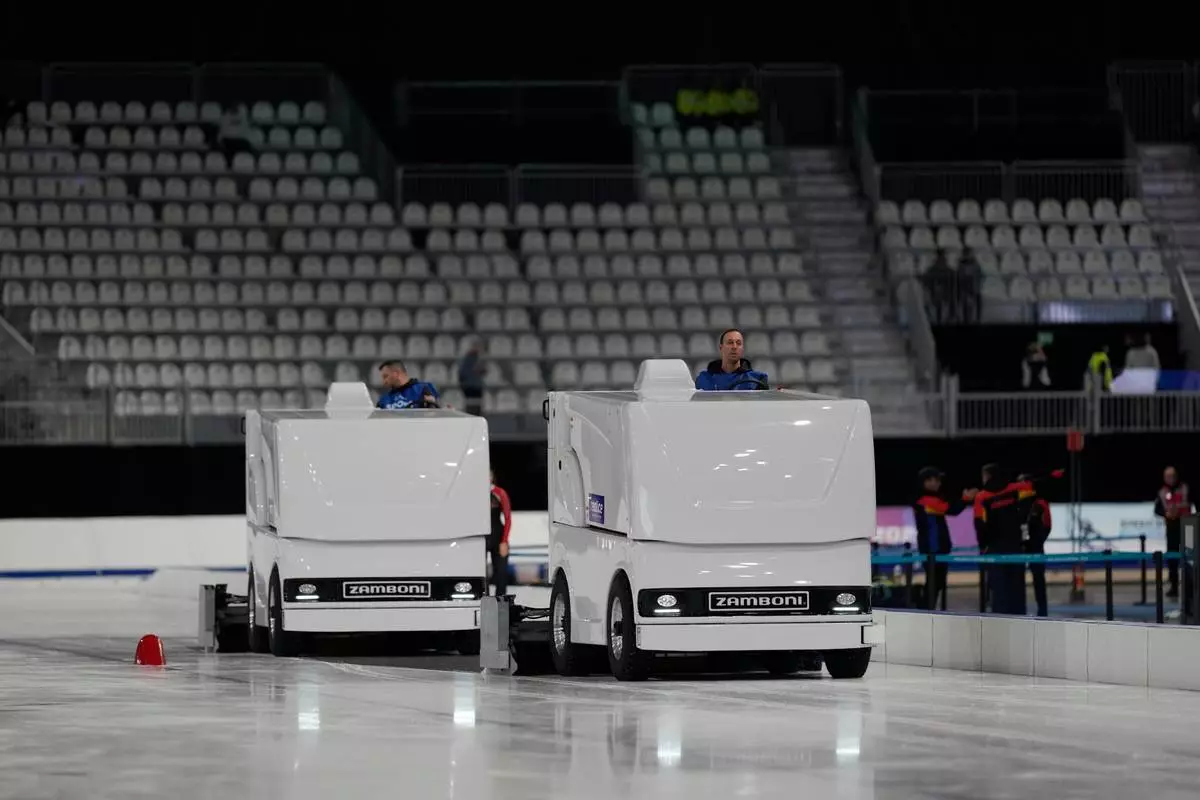
Workers clean the ice surface during a peed skating Junior World Cup and Olympic test event, in Rho, near Milan, Italy, Saturday, Nov. 29, 2025. (AP Photo/Luca Bruno)

Ice Master Mark Messer poses in the stadium where speed skating discipline of the Milan Cortina 2026 Winter Olympics will take place, in Rho, outskirt of Milan, Tuesday, Nov. 11, 2025. (AP Photo/Luca Bruno)

Ice Master Mark Messer poses in the stadium where speed skating discipline of the Milan Cortina 2026 Winter Olympics will take place, in Rho, outskirt of Milan, Tuesday, Nov. 11, 2025. (AP Photo/Luca Bruno)