The first monologue Daniel Dae Kim ever performed was by David Henry Hwang.
He had to do one for his college summer program at the National Theater Institute in Connecticut. Kim chose a scene from “FOB," Hwang's play about the assimilation struggles of a Chinese American. So, it's fitting that 35 years later Hwang — the first Asian American to win the Tony Award for best play — would be the one to bring Kim into the Tony spotlight.
Known for TV series such as “Lost” and “Hawaii Five-0,” Kim, 56, is the first Asian nominee in the category of best leading actor in a play in the Tonys’ 78-year history for his work in a Broadway revival of Hwang’s “Yellow Face.”
“I can imagine a lot of things, but I did not imagine this scenario with David,” Kim said. “That I would be in a play with him, that we would both be nominated for Tony Awards and we would be able to call each other friends.”
In the semi-autobiographical show, which ran last fall at the Roundabout Theatre Company, Kim played a satirical version of Hwang. The show also scored nods for best play revival and best performance by a featured actor in a play for first-time nominee Francis Jue, an original 2007 cast member.
You could not have scripted a better ending for a play that was written in response to the musical “Miss Saigon” casting white actors as Asian characters.
Kim's performance was filmed in November and PBS will broadcast “Yellow Face” on Friday. The Tonys, airing on CBS on June 8, also will put a spotlight on the play.
This groundbreaking nomination seems like the perfect karmic reward for Kim, who has spent years advocating for greater Asian representation. At the pandemic's height, the Korean American actor was a constant media presence speaking out against anti-Asian hate. He also jump-started a campaign for veteran actor James Hong, then 91, to get a Hollywood star.
He woke up to the news of his nomination after people were able to get around his phone's “do not disturb” mode. His competition includes George Clooney and Cole Escola.
“It’d be a huge surprise if I won, but I will say that even getting the nomination is a win especially when you put it in the context of our community and what this means for Asian Americans,” said Kim, whose previous Broadway credits include “The King and I.”
He admits it's surprising and “a little sad” that no other Asian actor has been in this category. There’s still never been an Asian nominee for best lead actress in a play.
“Of course, the barrier we really want to break is to actually have someone win, and hopefully that happens sooner rather than later, whether it’s me or not.”
Kim is one of seven Asian acting nominees this year. Only three acting trophy winners have been Asian. One was Lea Salonga for “Miss Saigon” and another was Ruthie Ann Miles for “The King and I.” Coincidentally, the first was BD Wong for best featured actor in Hwang's Tony-winning play, “M. Butterfly.” Hwang takes special pride in helping actors break glass ceilings.
“I get to feel like, ‘Oh, maybe I’m actually able to make a difference’ and change the culture in the way that my little-kid-self would have loved but would not have thought possible," said Hwang, who now has his fourth career Tony nomination. He was last nominated 22 years ago.
For a long time, Hwang felt the only way to get a play with Asian characters made was to set it outside America because "Broadway audiences are not interested in Asian Americans.”
Historically, productions with Asian ensembles have been musicals set in “the exotic lands of Asia,” such as “The King and I," said Esther Kim Lee, a theater studies professor at Duke University and author of “The Theatre of David Henry Hwang." “Flower Drum Song,” set in San Francisco, was an exception but the songs and book were by Richard Rodgers and Oscar Hammerstein II. Hwang actually revised the book in 2002.
“It's 2025. We finally see an actual Asian American play with an Asian American lead,” Lee said. “You can have ‘The King and I’ and have great actors and they may get Tony Awards, but it’s really not about Asian Americans. That this has happened with ‘Yellow Face’ is just incredible.”
The show's two-month run brought the Roundabout a 50% increase in first-time audience members — “a powerful statement," Kim said.
“One of the nicest compliments I would hear after the show when I would go to the stage door is, ‘This is the first Broadway show I’ve ever seen,’" Kim said. “That meant a lot to me because bringing Asian Americans into the theater is important and bringing younger people into the theater is important just for the health of theater in general.”
Besides discussing whitewash casting, “Yellow Face” examines the pain of the main character's immigrant father. The role is based on Hwang's father's experience being wrongly accused of laundering money for China. With the current anti-immigrant and anti-DEI climate, the show's airing on PBS feels especially vital to Hwang.
“Whenever there’s a conflict between America and any Asian country, Asian Americans are the first to get targeted,” Hwang said.
PBS is also where in 2020 the five-episode history docuseries “Asian Americans" aired for Asian American Pacific Islander Heritage Month. Kim was a narrator and remains “unequivocally proud" of the project.
Five years after the rise of anti-Asian hate crimes, Kim sees “Yellow Face” simply making it to Broadway as a victory.
“I don’t want to get preachy, but I will say that the goal with spotlighting and elevating people of color is not to threaten the establishment,” Kim said. “The goal was really to say everyone can contribute to our society. Everyone can be a positive force for change.”
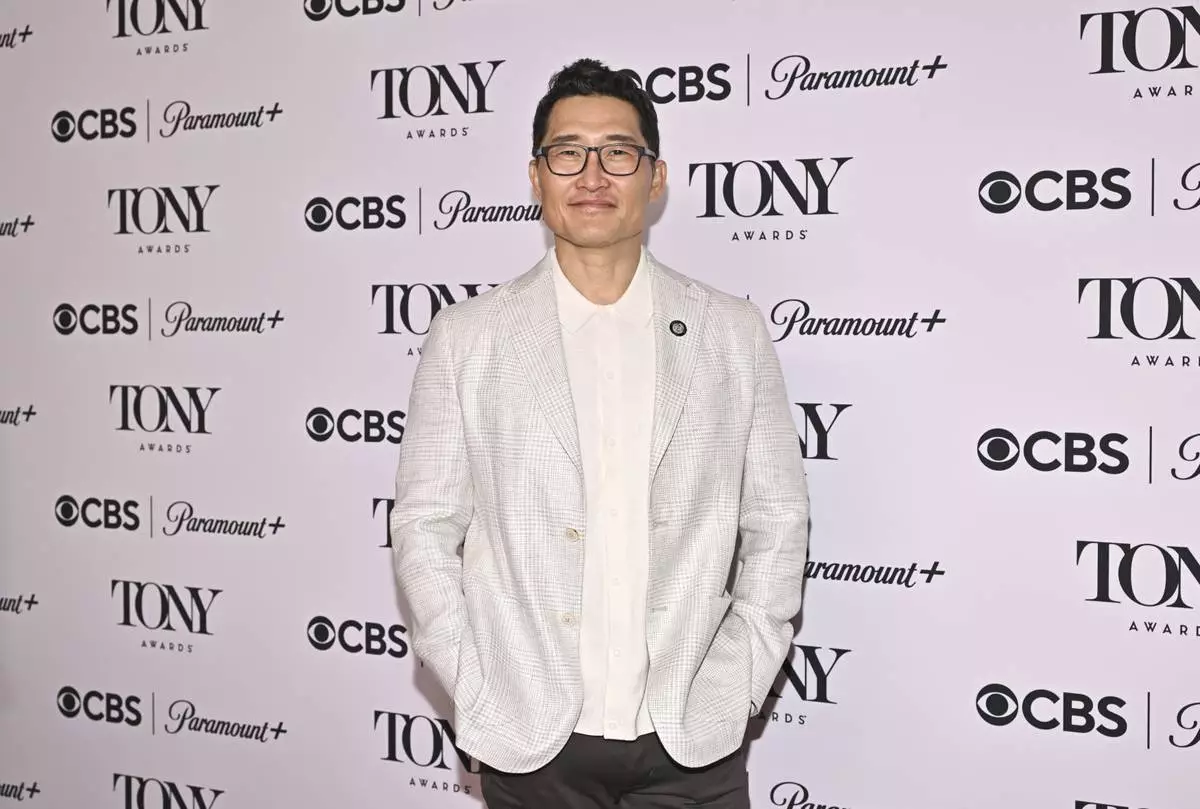
Nominee Daniel Dae Kim from "Yellow Face" attends the 78th Annual Tony Awards Meet the Nominees press event at the Sofitel New York on Thursday, May 8, 2025, in New York. (Photo by Evan Agostini/Invision/AP)