Skip to Content Facebook Feature Image

Trump's Mideast trip splashes out on deals and diplomacy but is quiet on human rights

News

Trump's Mideast trip splashes out on deals and diplomacy but is quiet on human rights
News

News

Trump's Mideast trip splashes out on deals and diplomacy but is quiet on human rights

2025-05-16 15:01 Last Updated At:15:11

WASHINGTON (AP) — Saudi royalty and American billionaires were in the front row for a speech in Riyadh where President Donald Trump condemned what he called past U.S. interference in the wealthy Gulf states.

Gone were the days when American officials would fly to the Middle East to give "you lectures on how to live, and how to govern your own affairs,” Trump said at a Saudi investment forum this week.

More Images
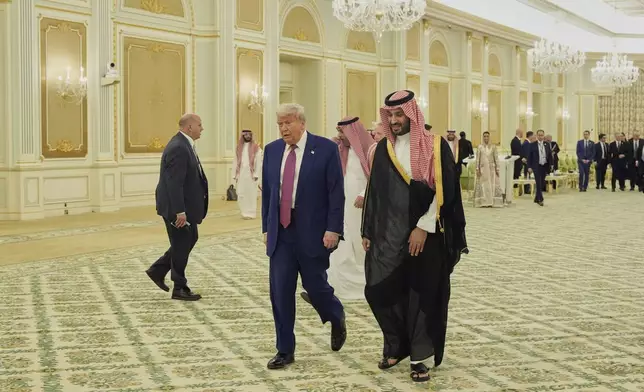
President Donald Trump and Saudi Crown Prince Mohammed bin Salman walk for a signing ceremony at the Royal Palace in Riyadh, Saudi Arabia, Tuesday, May 13, 2025. (AP Photo/Alex Brandon)
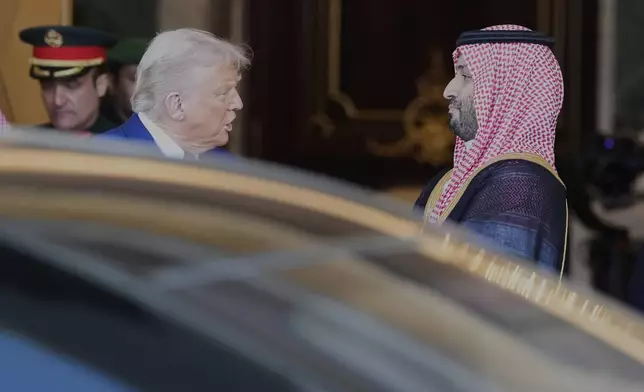
President Donald Trump and Saudi Crown Prince Mohammed bin Salman walk for a signing ceremony at the Royal Palace in Riyadh, Saudi Arabia, Tuesday, May 13, 2025. (AP Photo/Alex Brandon)

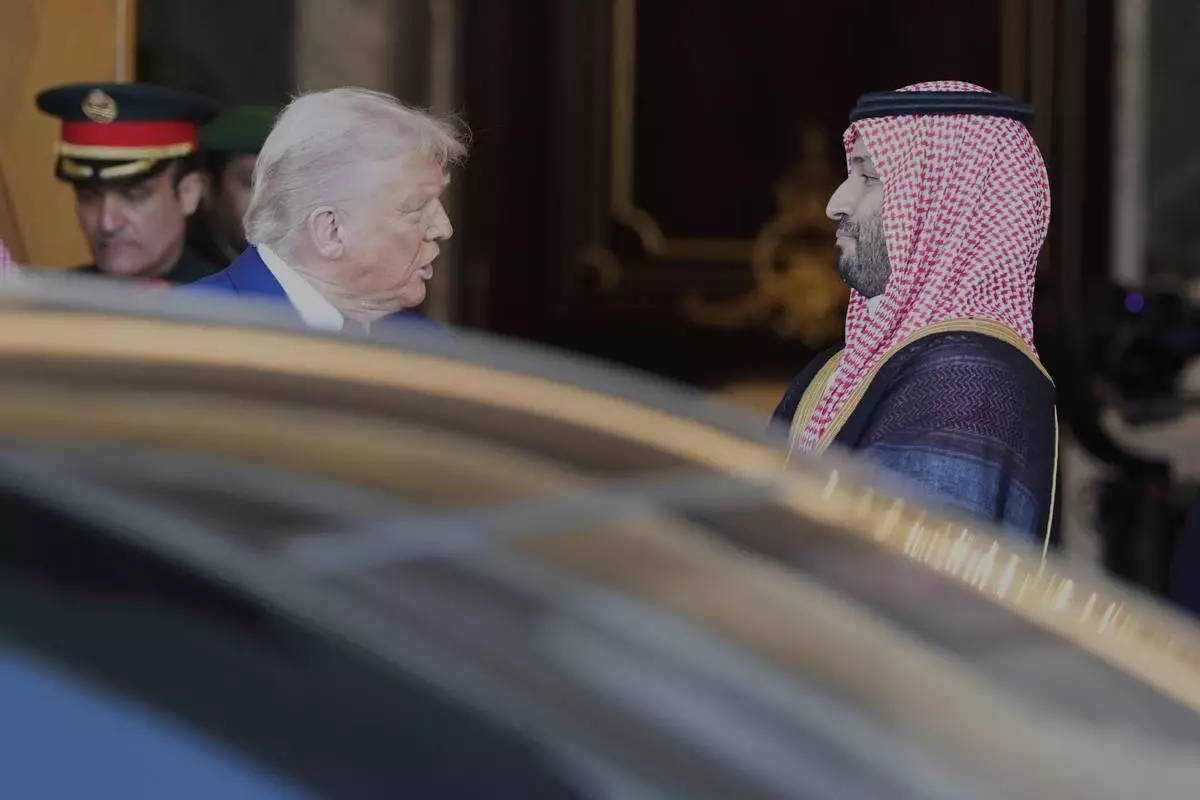
President Donald Trump speaks with Saudi Crown Prince Mohammed bin Salman as he leaves the Royal Palace after a signing ceremony with Saudi Crown Prince Mohammed bin Salman in Riyadh, Saudi Arabia, Tuesday, May 13, 2025. (AP Photo/Alex Brandon)
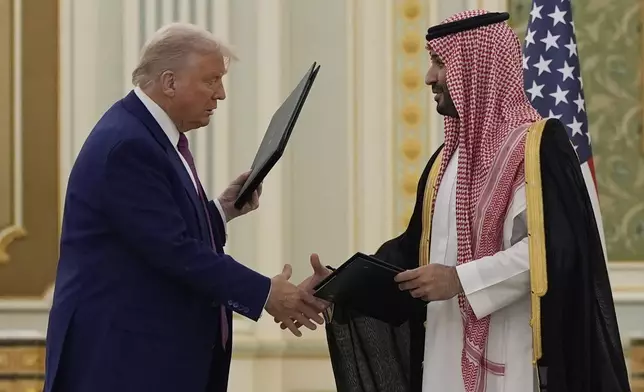
President Donald Trump speaks with Saudi Crown Prince Mohammed bin Salman as he leaves the Royal Palace after a signing ceremony with Saudi Crown Prince Mohammed bin Salman in Riyadh, Saudi Arabia, Tuesday, May 13, 2025. (AP Photo/Alex Brandon)

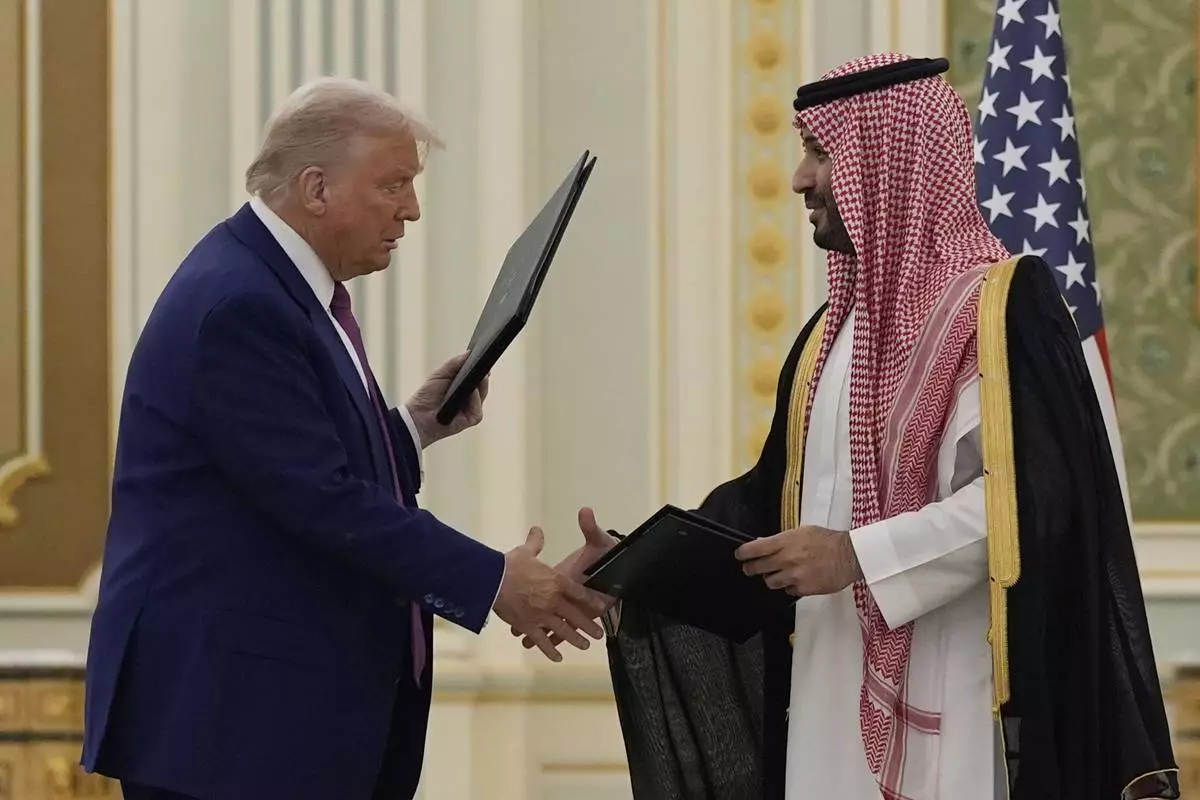
President Donald Trump and Saudi Crown Prince Mohammed bin Salman shake hands after exchanging documents during a signing ceremony at the Royal Palace in Riyadh, Saudi Arabia, Tuesday, May 13, 2025. (AP Photo/Alex Brandon)
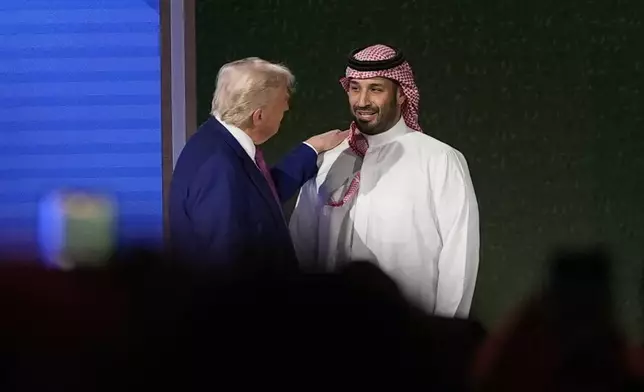
President Donald Trump and Saudi Crown Prince Mohammed bin Salman shake hands after exchanging documents during a signing ceremony at the Royal Palace in Riyadh, Saudi Arabia, Tuesday, May 13, 2025. (AP Photo/Alex Brandon)

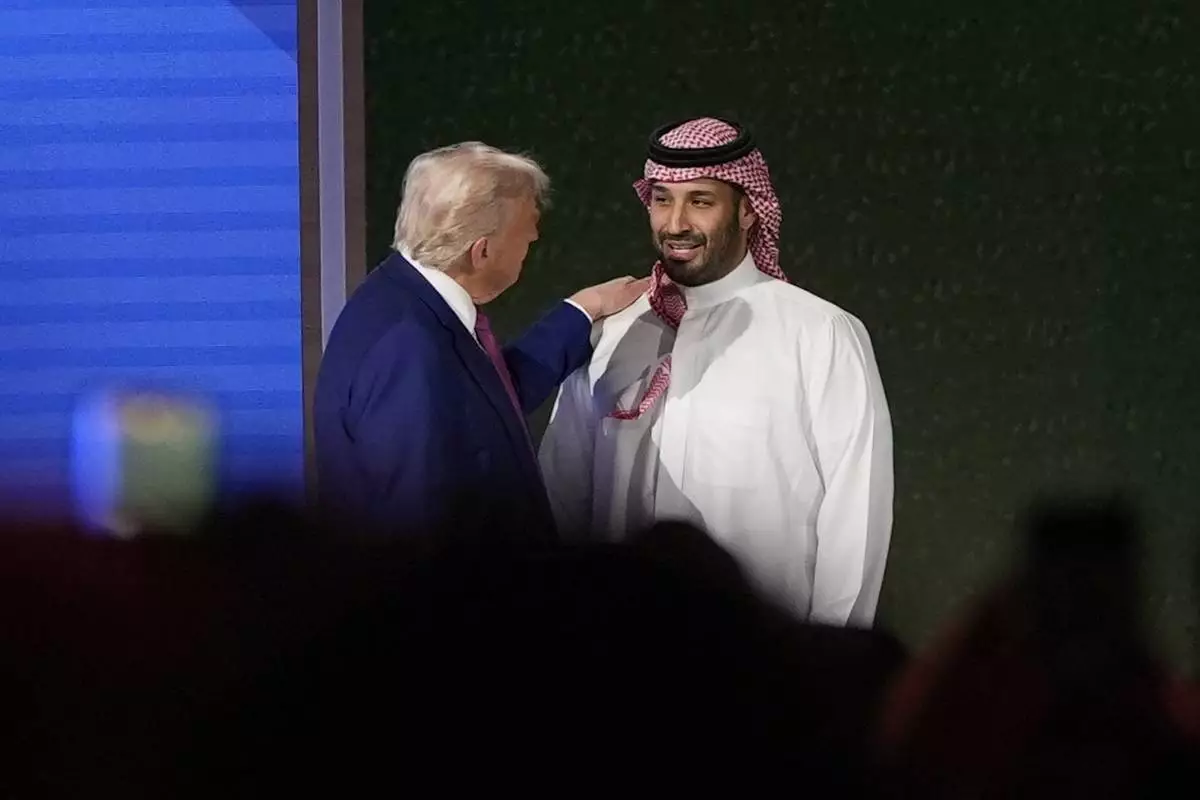
President Donald Trump shakes hands with Saudi Crown Prince Mohammed bin Salman after his speech at the King Abdulaziz International Conference Center in Riyadh, Saudi Arabia, Tuesday, May 13, 2025. (AP Photo/Alex Brandon)
President Donald Trump shakes hands with Saudi Crown Prince Mohammed bin Salman after his speech at the King Abdulaziz International Conference Center in Riyadh, Saudi Arabia, Tuesday, May 13, 2025. (AP Photo/Alex Brandon)

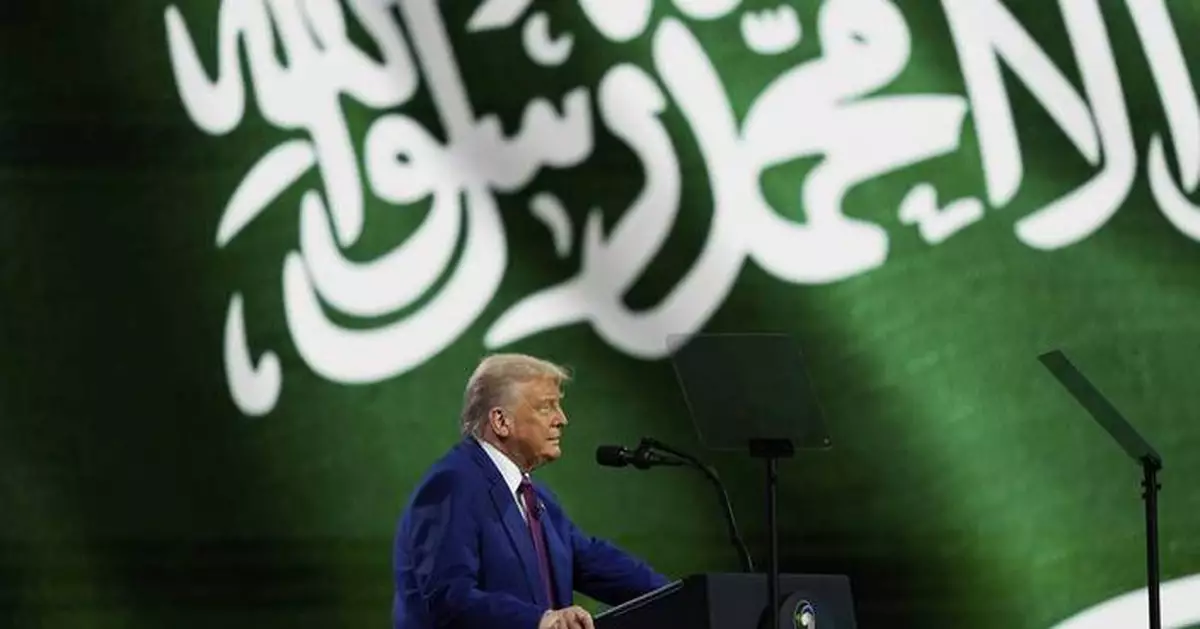
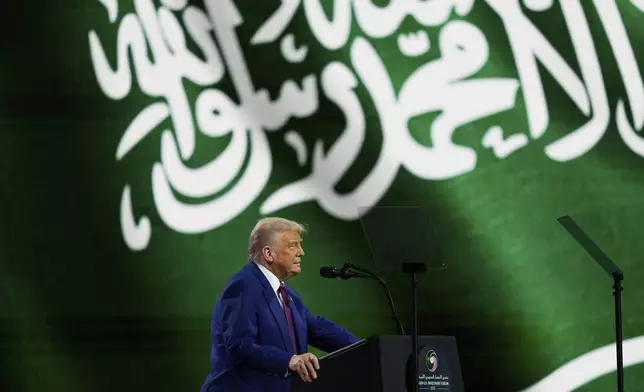
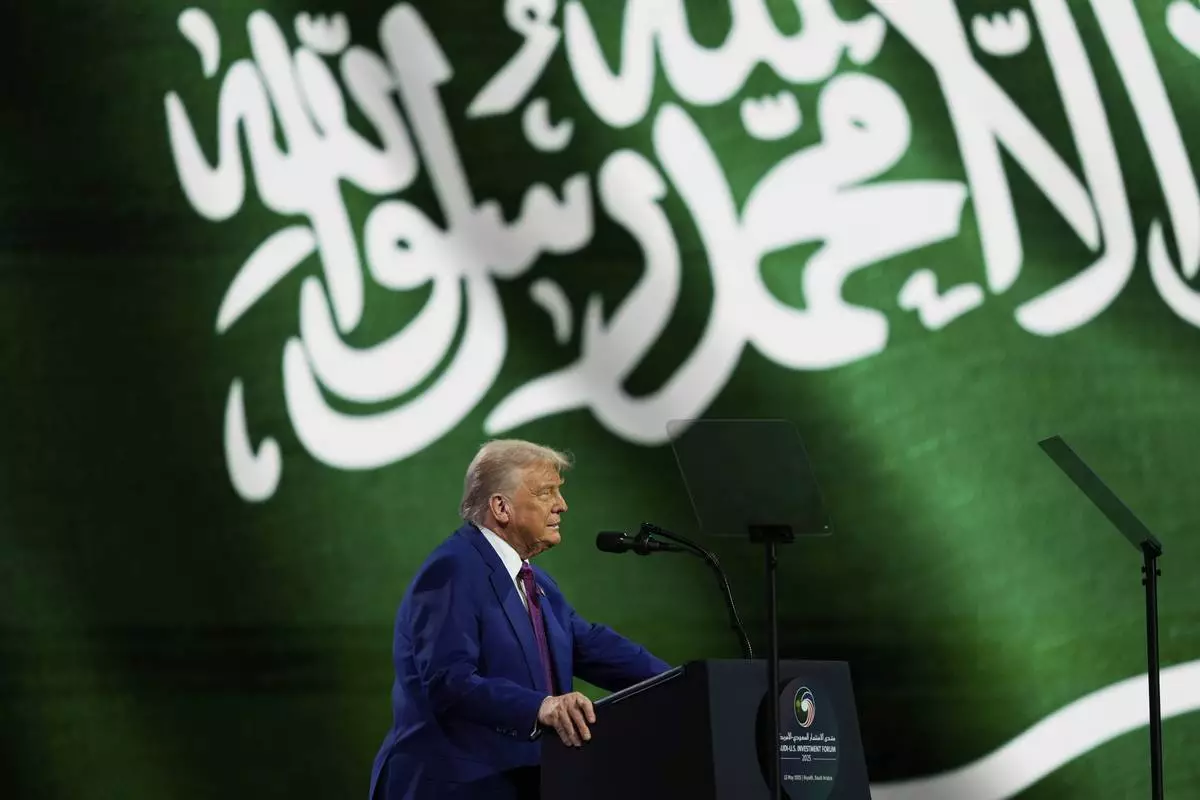
President Donald Trump speaks at the Saudi-U.S. Investment Forum at the King Abdulaziz International Conference Center in Riyadh, Saudi Arabia, Tuesday, May 13, 2025. (AP Photo/Alex Brandon)

President Donald Trump speaks at the Saudi-U.S. Investment Forum at the King Abdulaziz International Conference Center in Riyadh, Saudi Arabia, Tuesday, May 13, 2025. (AP Photo/Alex Brandon)

No one in the audience sat closer, or listened more intently, than Saudi Arabia's crown prince, Mohammed bin Salman.

Ordinary Arabs listened, too, including Saudi journalists, rights advocates, businesspeople, writers and others who had fled the kingdom. Their fear: Trump's words underlined a message that the United States was pulling back from its longtime role as an imperfect, sporadic but powerful advocate for human rights around the world.

“It was painful to see,” said Abdullah Alaoudh, whose 68-year-old father, a Saudi cleric with a wide following, was among hundreds of royals, civil society figures, rights advocates and others jailed by Prince Mohammed in the first years of his rise to de facto ruler.

Saudi Arabia has since freed many of those people in what groups say is the crown prince's improved human rights record following past international criticism and isolation. But Abdullah's father, Salman Alaoudh, is among the many still behind bars.

Trump was speaking directly to the prince — “the person who tortured my father, who has banned my family” from leaving the kingdom, said Abdullah, who advocates for detained and imprisoned people in Saudi Arabia from the United States.

The Saudi embassy did not immediately respond to messages seeking comment.

A White House spokeswoman, Anna Kelly, said Trump's speech “celebrated the ever-growing partnership between the United States and Saudi Arabia” and a Middle East working toward peace. Kelly did not respond to a question about whether the president had raised human rights issues with Gulf leaders.

A State Department spokesman, Tommy Pigott, called Trump's discussions with Gulf leaders private.

Trump's first major trip of his second term — also including Qatar and the United Arab Emirates — drew far less attention to human rights than is typical for U.S. visits to autocratic countries with spotty records on free speech, fair trials and other rights.

Human rights groups posted concerns about the Gulf countries, but some refrained from more vocal objections. Saudi exiles in the U.S. also skipped the usual pointed comments on social media. And the administration faced few of the typical questions on whether a visiting president had used the trip to press for the release of detained Americans or imprisoned activists.

That's partly due to human rights improvements in Saudi Arabia, groups say. But the silence also reflects what some organizations call a worsening human rights picture in the United States.

Ibrahim Almadi, a Florida man seeking U.S. help getting his father home from Saudi Arabia, said he tried in vain to score a commitment from a Republican lawmaker or other official to urge Trump to raise his father's cause. His now 75-year-old Saudi American father, Saad Almadi, had been jailed over critical tweets about the Saudi government and now is under an exit ban from the country.

“It is a love relationship between Trump and MBS,” the son said. One mention of the case to Trump, then one comment by Trump to the Saudi crown prince, and “I will have my father back."

Some Saudis who fled to the U.S. say they are pulling back from social media and any public criticism of Saudi officials, fearing the same detentions and deportations faced by some immigrants and pro-Palestinian protesters under the Trump administration.

Democracy in the Arab World Now — the nonprofit founded by Jamal Khashoggi, the U.S.-based journalist killed at the Saudi Consulate in Istanbul — is advising Arabs with unsettled immigration status in the U.S. to “be cautious when they travel, to be thoughtful about what they say,” executive director Sarah Leah Whitson said.

The U.S. intelligence community said the crown prince oversaw the 2018 plot, while he has denied any involvement. The killing of Khashoggi, who used his Washington Post column to urge Prince Mohammed to institute reforms, led then-President Joe Biden to pledge to make Saudi royals into pariahs.

But soaring U.S. gasoline prices in 2022 spurred Biden to visit the oil-exporting giant, where he had an awkward fist bump with the prince.

In his second term, Trump has tightened his embrace of Prince Mohammed and other wealthy Gulf leaders, seeking big investments in the U.S., while Trump’s elder sons are developing major real estate projects in the region.

Burned by the condemnation and initial isolation over Khashoggi, Prince Mohammed has quietly released some of those imprisoned for seeking women's right to drive, for critical tweets, for publicly proposing Saudi policy changes and more. The prince also has liberalized legal and social conditions for women, part of a campaign to attract business and diversify Saudi Arabia's economy.

But many others remain in prison. Thousands, including Almadi, face exit bans, rights groups say.

Those organizations cite another reason that activists are staying quieter than usual during the trip: the United States’ own human rights reputation.

Besides deportations, Whitson pointed to U.S. military support to Israel during its 19-month offensive against Hamas in Gaza, which has killed thousands of civilians. The Trump administration says it's trying to secure a ceasefire.

Americans faulting another country’s abuses now “just doesn’t pass the laugh test,” Whitson said. “The United States does not have the moral standing, the legal standing, the credibility to be chastising another country at this moment in time.”
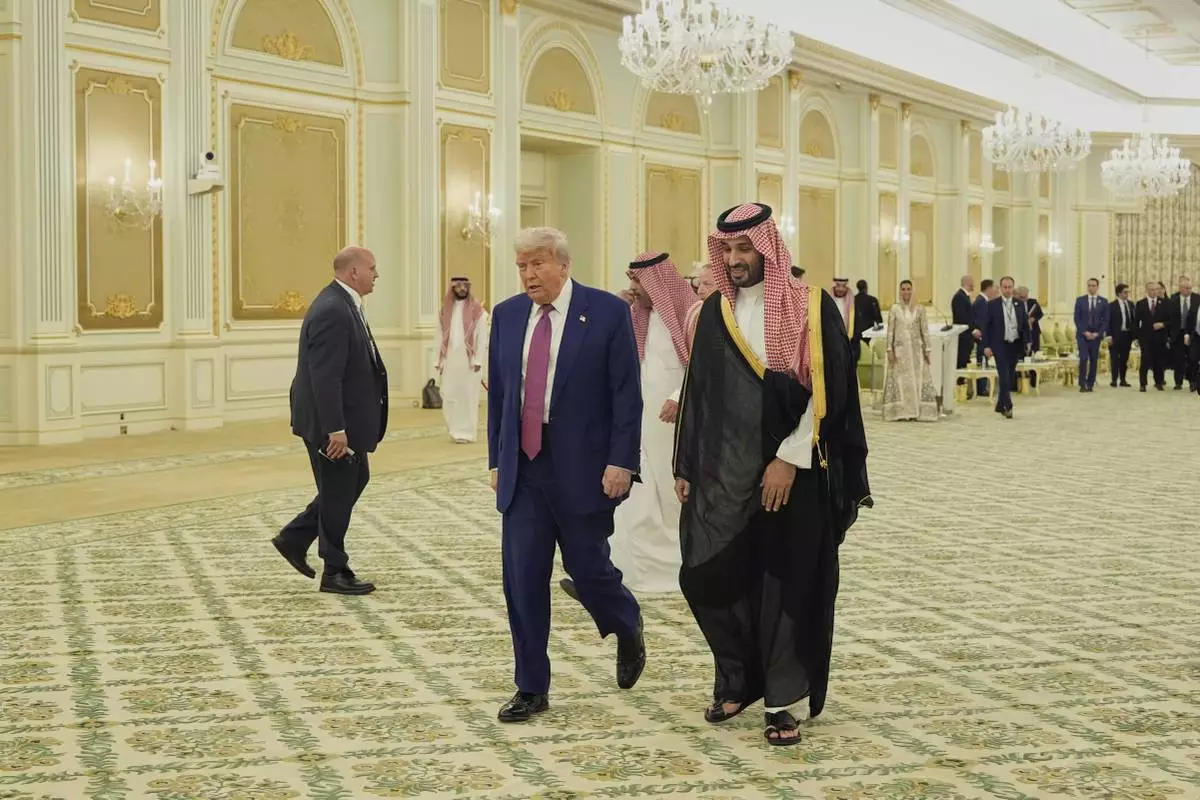
President Donald Trump and Saudi Crown Prince Mohammed bin Salman walk for a signing ceremony at the Royal Palace in Riyadh, Saudi Arabia, Tuesday, May 13, 2025. (AP Photo/Alex Brandon)
President Donald Trump and Saudi Crown Prince Mohammed bin Salman walk for a signing ceremony at the Royal Palace in Riyadh, Saudi Arabia, Tuesday, May 13, 2025. (AP Photo/Alex Brandon)

President Donald Trump speaks with Saudi Crown Prince Mohammed bin Salman as he leaves the Royal Palace after a signing ceremony with Saudi Crown Prince Mohammed bin Salman in Riyadh, Saudi Arabia, Tuesday, May 13, 2025. (AP Photo/Alex Brandon)
President Donald Trump speaks with Saudi Crown Prince Mohammed bin Salman as he leaves the Royal Palace after a signing ceremony with Saudi Crown Prince Mohammed bin Salman in Riyadh, Saudi Arabia, Tuesday, May 13, 2025. (AP Photo/Alex Brandon)

President Donald Trump and Saudi Crown Prince Mohammed bin Salman shake hands after exchanging documents during a signing ceremony at the Royal Palace in Riyadh, Saudi Arabia, Tuesday, May 13, 2025. (AP Photo/Alex Brandon)
President Donald Trump and Saudi Crown Prince Mohammed bin Salman shake hands after exchanging documents during a signing ceremony at the Royal Palace in Riyadh, Saudi Arabia, Tuesday, May 13, 2025. (AP Photo/Alex Brandon)

President Donald Trump shakes hands with Saudi Crown Prince Mohammed bin Salman after his speech at the King Abdulaziz International Conference Center in Riyadh, Saudi Arabia, Tuesday, May 13, 2025. (AP Photo/Alex Brandon)
President Donald Trump shakes hands with Saudi Crown Prince Mohammed bin Salman after his speech at the King Abdulaziz International Conference Center in Riyadh, Saudi Arabia, Tuesday, May 13, 2025. (AP Photo/Alex Brandon)
President Donald Trump speaks at the Saudi-U.S. Investment Forum at the King Abdulaziz International Conference Center in Riyadh, Saudi Arabia, Tuesday, May 13, 2025. (AP Photo/Alex Brandon)
President Donald Trump speaks at the Saudi-U.S. Investment Forum at the King Abdulaziz International Conference Center in Riyadh, Saudi Arabia, Tuesday, May 13, 2025. (AP Photo/Alex Brandon)
DUBAI, United Arab Emirates (AP) — U.S. President Donald Trump said Iran wants to negotiate with Washington after his threat to strike the Islamic Republic over its bloody crackdown on protesters, a move coming as activists said Monday the death toll in the nationwide demonstrations rose to at least 544.

Iran had no immediate reaction to the news, which came after the foreign minister of Oman — long an interlocutor between Washington and Tehran — traveled to Iran this weekend. It also remains unclear just what Iran could promise, particularly as Trump has set strict demands over its nuclear program and its ballistic missile arsenal, which Tehran insists is crucial for its national defense.

Meanwhile Monday, Iran called for pro-government demonstrators to head to the streets in support of the theocracy, a show of force after days of protests directly challenging the rule of 86-year-old Supreme Leader Ayatollah Ali Khamenei. Iranian state television aired chants from the crowd, who shouted “Death to America!” and “Death to Israel!”

Trump and his national security team have been weighing a range of potential responses against Iran including cyberattacks and direct strikes by the U.S. or Israel, according to two people familiar with internal White House discussions who were not authorized to comment publicly and spoke on condition of anonymity.

“The military is looking at it, and we’re looking at some very strong options,” Trump told reporters on Air Force One on Sunday night. Asked about Iran’s threats of retaliation, he said: “If they do that, we will hit them at levels that they’ve never been hit before.”

Trump said that his administration was in talks to set up a meeting with Tehran, but cautioned that he may have to act first as reports of the death toll in Iran mount and the government continues to arrest protesters.

“I think they’re tired of being beat up by the United States,” Trump said. “Iran wants to negotiate.”

He added: “The meeting is being set up, but we may have to act because of what’s happening before the meeting. But a meeting is being set up. Iran called, they want to negotiate.”

Iran through country's parliamentary speaker warned Sunday that the U.S. military and Israel would be “legitimate targets” if America uses force to protect demonstrators.

More than 10,600 people also have been detained over the two weeks of protests, said the U.S.-based Human Rights Activists News Agency, which has been accurate in previous unrest in recent years and gave the death toll. It relies on supporters in Iran crosschecking information. It said 496 of the dead were protesters and 48 were with security forces.

With the internet down in Iran and phone lines cut off, gauging the demonstrations from abroad has grown more difficult. The Associated Press has been unable to independently assess the toll. Iran’s government has not offered overall casualty figures.

Those abroad fear the information blackout is emboldening hard-liners within Iran’s security services to launch a bloody crackdown. Protesters flooded the streets in the country’s capital and its second-largest city on Saturday night into Sunday morning. Online videos purported to show more demonstrations Sunday night into Monday, with a Tehran official acknowledging them in state media.

In Tehran, a witness told the AP that the streets of the capital empty at the sunset call to prayers each night. By the Isha, or nighttime prayer, the streets are deserted.

Part of that stems from the fear of getting caught in the crackdown. Police sent the public a text message that warned: “Given the presence of terrorist groups and armed individuals in some gatherings last night and their plans to cause death, and the firm decision to not tolerate any appeasement and to deal decisively with the rioters, families are strongly advised to take care of their youth and teenagers.”

Another text, which claimed to come from the intelligence arm of the paramilitary Revolutionary Guard, also directly warned people not to take part in demonstrations.

“Dear parents, in view of the enemy’s plan to increase the level of naked violence and the decision to kill people, ... refrain from being on the streets and gathering in places involved in violence, and inform your children about the consequences of cooperating with terrorist mercenaries, which is an example of treason against the country,” the text warned.

The witness spoke to the AP on condition of anonymity due to the ongoing crackdown.

The demonstrations began Dec. 28 over the collapse of the Iranian rial currency, which trades at over 1.4 million to $1, as the country’s economy is squeezed by international sanctions in part levied over its nuclear program. The protests intensified and grew into calls directly challenging Iran’s theocracy.

Nikhinson reported from aboard Air Force One.

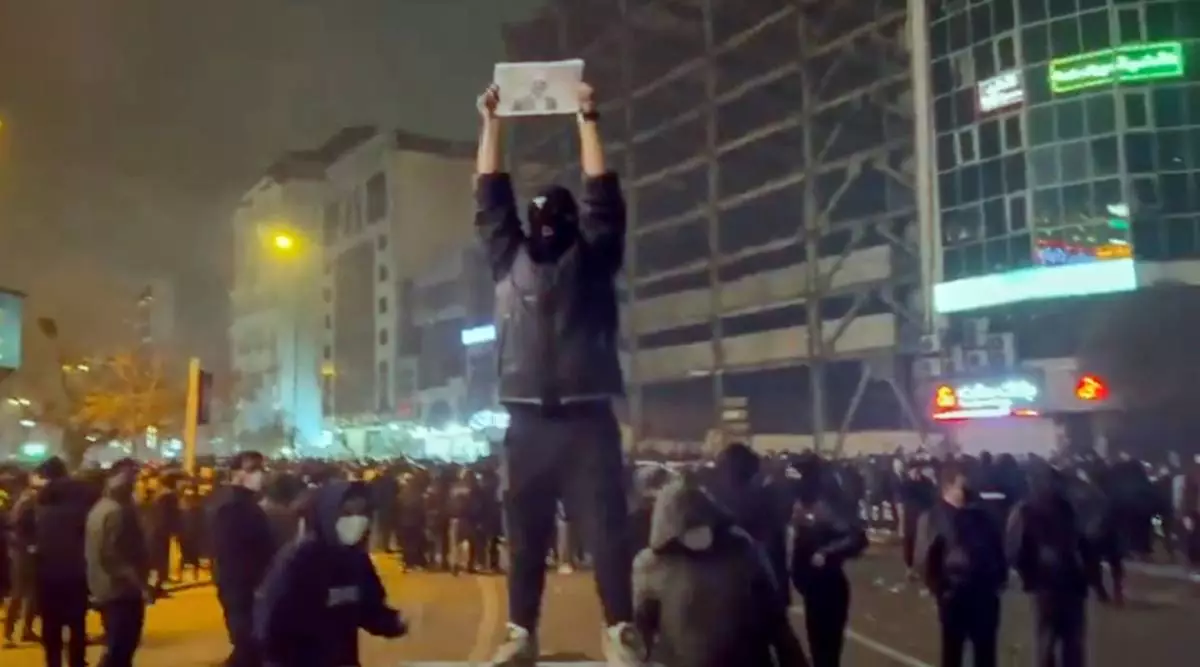
In this frame grab from video obtained by the AP outside Iran, a masked demonstrator holds a picture of Iran's Crown Prince Reza Pahlavi during a protest in Tehran, Iran, Friday, January. 9, 2026. (UGC via AP)

In this frame grab from video obtained by the AP outside Iran, a masked demonstrator holds a picture of Iran's Crown Prince Reza Pahlavi during a protest in Tehran, Iran, Friday, January. 9, 2026. (UGC via AP)

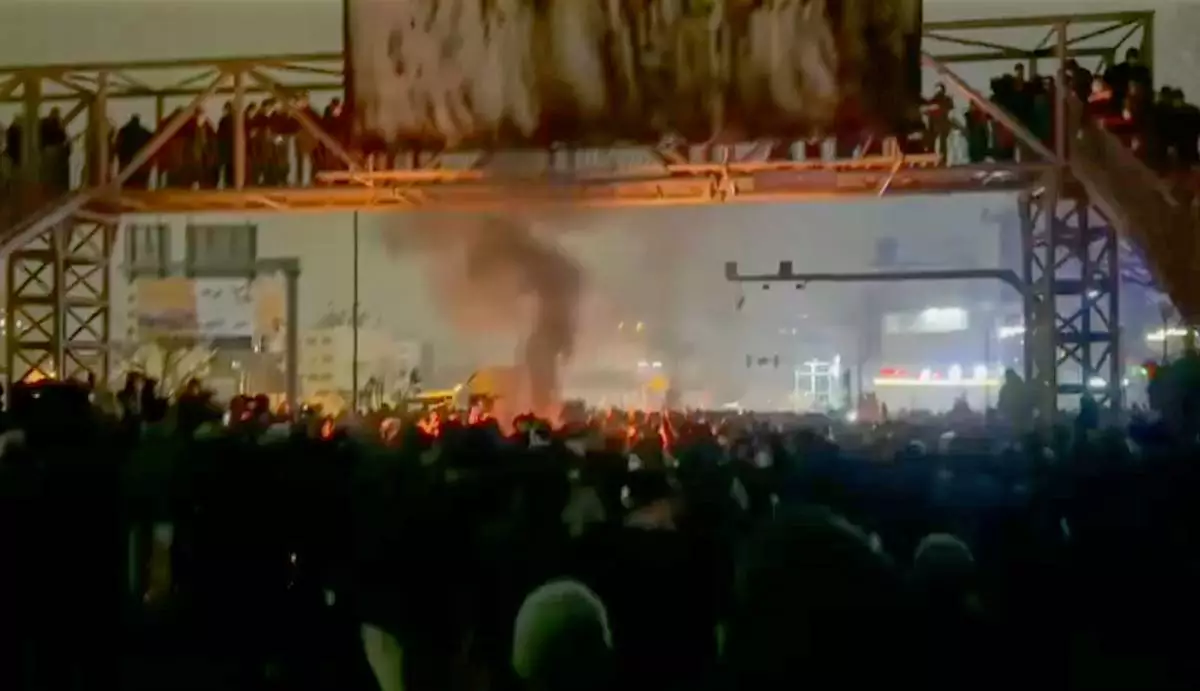
In this frame grab from footage circulating on social media from Iran shows protesters taking to the streets despite an intensifying crackdown as the Islamic Republic remains cut off from the rest of the world in Tehran, Iran, Friday, Jan. 9, 2026.(UGC via AP)

In this frame grab from footage circulating on social media from Iran shows protesters taking to the streets despite an intensifying crackdown as the Islamic Republic remains cut off from the rest of the world in Tehran, Iran, Friday, Jan. 9, 2026.(UGC via AP)

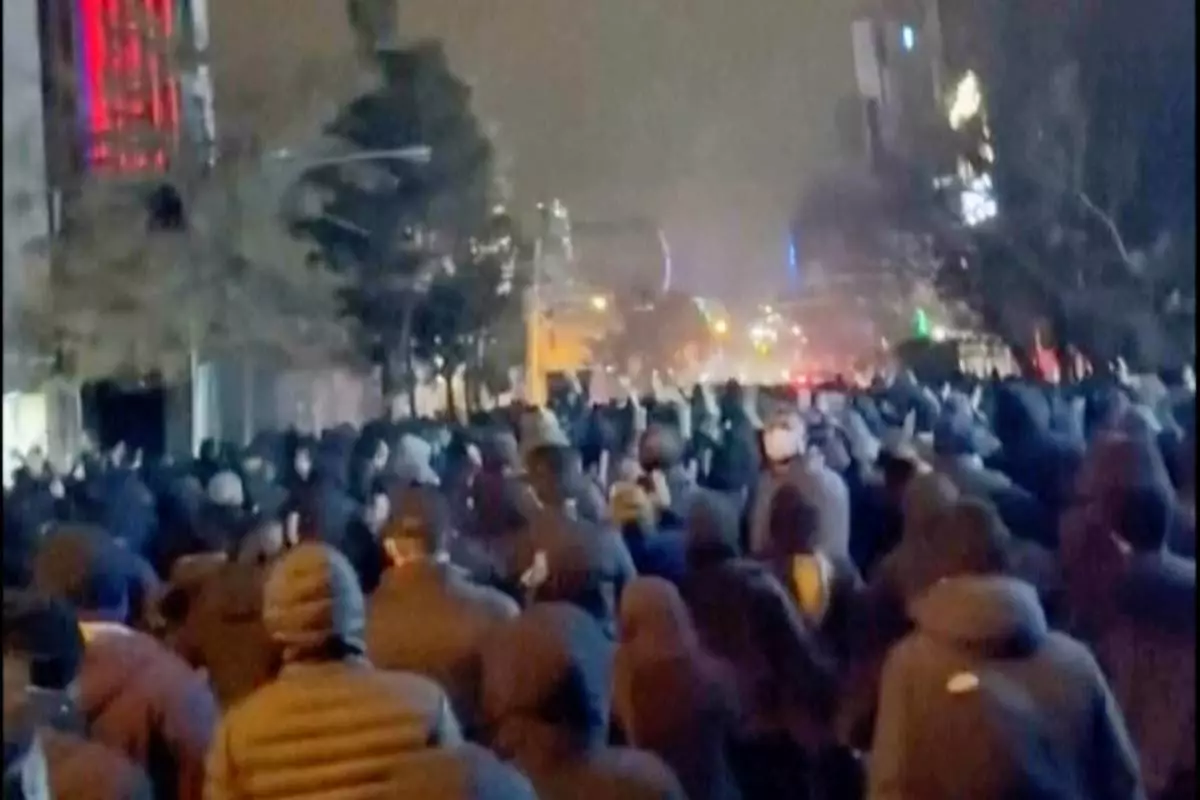
In this frame grab from footage circulating on social media from Iran showed protesters once again taking to the streets of Tehran despite an intensifying crackdown as the Islamic Republic remains cut off from the rest of the world in Tehran, Iran, Saturday Jan. 10, 2026. (UGC via AP)

In this frame grab from footage circulating on social media from Iran showed protesters once again taking to the streets of Tehran despite an intensifying crackdown as the Islamic Republic remains cut off from the rest of the world in Tehran, Iran, Saturday Jan. 10, 2026. (UGC via AP)

Recommended Articles