Speech by FS at Family Education and Legacy Forum 2025
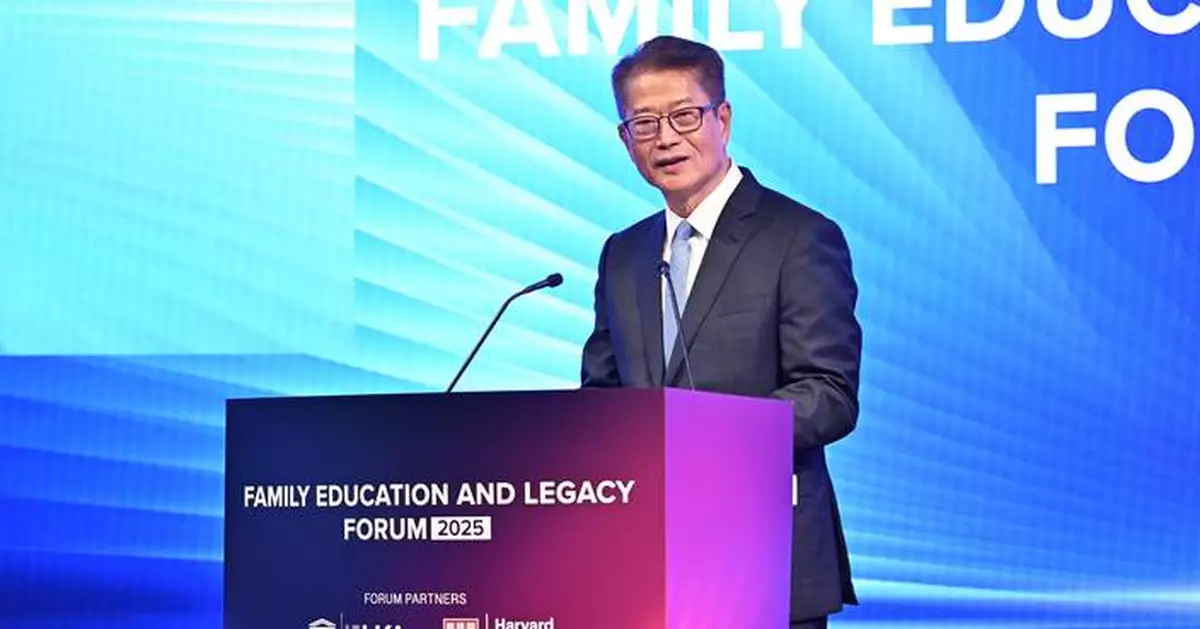
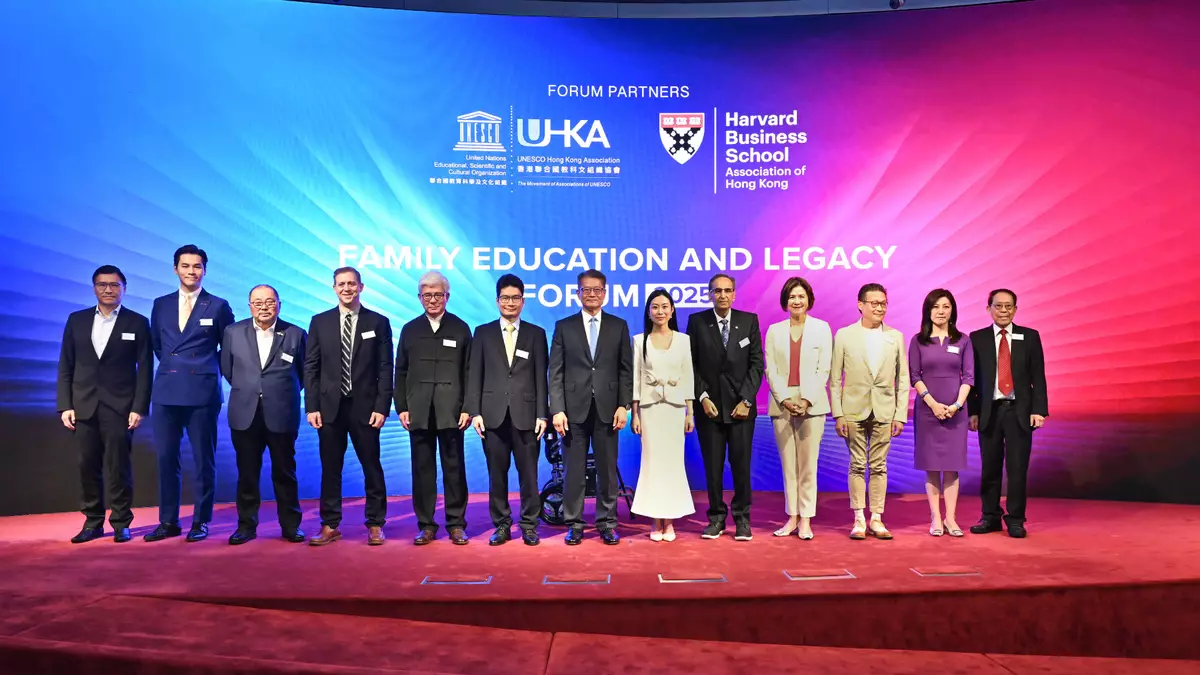
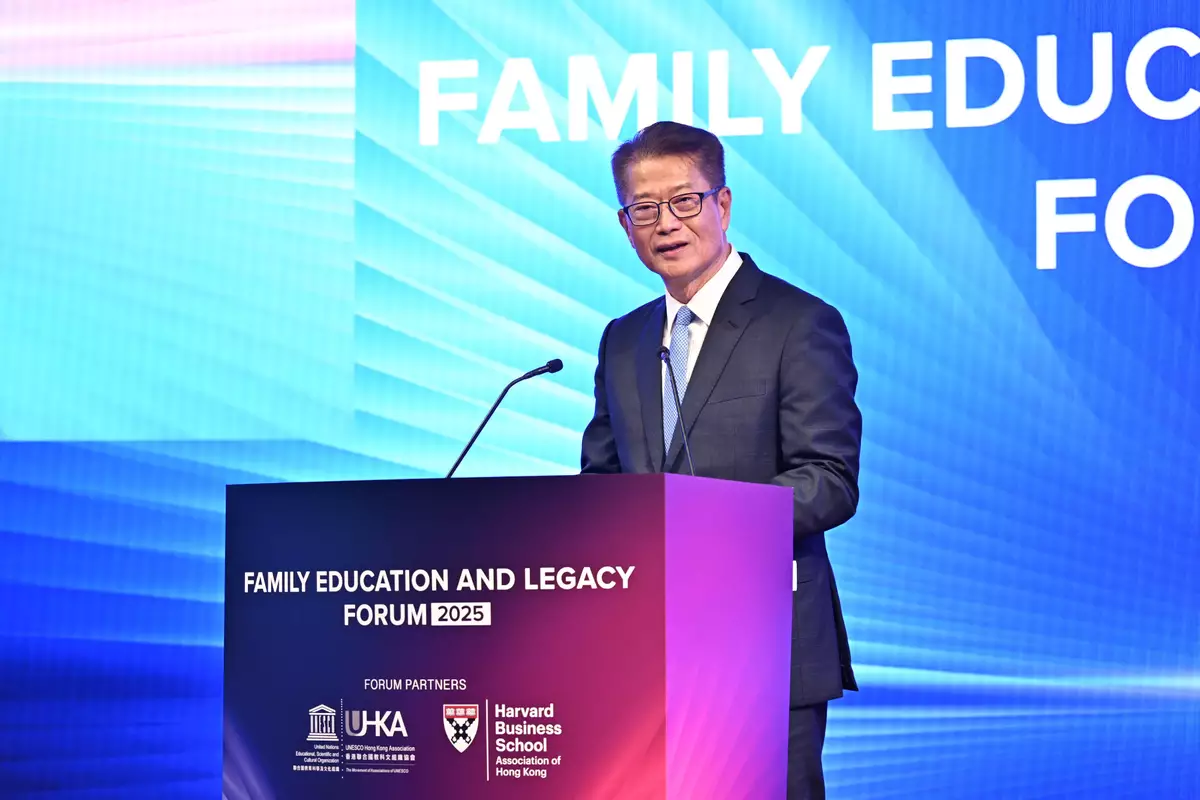
Following is the speech by the Financial Secretary, Mr Paul Chan, at Family Education and Legacy Forum 2025 today (May 17):
Yanice (Chair of the Organising Committee of Family Education and Legacy Forum 2025, Ms Yanice Mak), Enoch (Vice President of the United Nations Educational, Scientific and Cultural Organization Hong Kong Association, Professor Enoch Young), Joseph (the Under Secretary for Financial Services and the Treasury, Mr Joseph Chan), distinguished guests, ladies and gentlemen,
Good afternoon. It is a great pleasure to join you all at the Family Education and Legacy Forum 2025.
Today, we bring together family business leaders, academics and thought leaders to explore a topic that is both timely and timeless: sustainable family wealth succession. It is a subject that goes well beyond financial continuity. It encompasses values, responsibility and intergenerational purpose.
Let me begin by extending a very warm welcome to Dr Josh Baron from Harvard Business School. Your presence here adds intellectual strength to the dialogue. And if I may take the opportunity of this occasion, held at a time when the world is facing protectionism and unilateralism unseen for decades, to highlight a few Chinese values that I believe are highly relevant when navigating the uncertainties of our time, that is our emphasis on harmony, consensus building, shared progress and common prosperity.
Coming back to the Forum today. The lineup of speakers is indeed impressive. I am sure their insights will be enlightening and inspiring, providing useful advice for family businesses and their owners in a world that is undergoing rapid transformation.
Allow me to share a few personal reflections as morsel to your ensuing discussions. As some of you may know, before entering public service in 2012, I worked in the private sector and had the privilege of attending Harvard Business School’s Owner/President Management Programme. These reflections come from my years of knowledge of and experience in both the public and private sectors.
The first point is about financial sustainability.
Family businesses often start with great success by their founders. Yet it is indeed not uncommon for second or third-generation owners to have vastly different ideas or aspirations than those of their parents. While pursuing one’s dreams and being open to new opportunities, one must manage their risk exposure, in particular liquidity and leverage level.
The second point is about recognising the mega trends and the associated opportunities and risks. In my view, a few forces will define the coming decade.
First, geopolitics. We must recognise that strategic competition among major powers will likely persist. The days of seamless globalisation are giving way to geo-economic fragmentation, marked by tariffs, technology barriers and polarisation of international politics.
Going forward, three regional blocs may emerge: first, the Asia-Pacific; second, India, the Middle East and Europe; and third, the Americas. Within a region, there will be more collaboration and partnership; but between regional blocs, competition will be more intense. For family business owners, this means recalibrating strategies, managing risks across jurisdictions, and identifying new regional opportunities.
Second, artificial intelligence (AI). AI is already transforming the way we work and do business. The "AI+ era" is unstoppable. AI is deeply integrated across sectors, from manufacturing, logistics and city management to hospitality, games and household appliances.
To embrace it is not only about resources and investments, but more importantly, a shift in mindset.
Third, green transformation. Around the world – with only a few exceptions – green is high on the agenda of consumers, investors and governments.
Family businesses will need to respond to higher demands on sustainability. But more than that, I believe family capital can and should play a catalytic role in this transformation, by scaling up green solutions and supporting systemic change.
The third point is about creating a legacy. Knowing many family business leaders in person, I understand you do care about the collective good of our community and the world. But my point is not exactly philanthropy, but the well-being of the people, which must be embedded as a core value of businesses.
Consider the stories of the Six Little Dragons of Hangzhou like DeepSeek and Unitree Robotics. While people often focus on their technological prowess, I believe the success of these companies is also driven by the aspiration, deep in their hearts, that innovation should be affordable, accessible and inclusive.
There are similar examples here in Hong Kong. For instance, a surgical robot company born out of the Chinese University of Hong Kong is producing affordable surgical robots for broad applications in Hong Kong, the Mainland and overseas, benefiting thousands of patients with limited means. On the other hand, several fintech firms are exporting innovative financial solutions to Southeast Asia, making credit and financial services more accessible to underserved communities. The founders of these companies, whom I know personally, share the same vision of inclusiveness.
These examples remind us that legacy is not only about what we build, but also who we build it for.
Ladies and gentlemen, I cannot better conclude by making one final point: the most valuable inheritance we can pass on is not wealth, but wisdom. Let us not forget the importance of providing the best education for our next generation, an education that nurtures compassion, resilience, cross-cultural understanding and a strong sense of global citizenship. One that equips our children not only with knowledge, but with the moral compass and courage to face uncertainty, uphold values and lead with purpose.
My sincere thanks to the UNESCO Hong Kong Association and the Harvard Business School Association of Hong Kong for convening this meaningful exchange. I look with anticipation to the wisdom and impactful initiatives that will emerge from today’s dialogue. I wish you all the best of health and business in the time ahead. Thank you very much.
Speech by FS at Family Education and Legacy Forum 2025 Source: HKSAR Government Press Releases
Speech by FS at Family Education and Legacy Forum 2025 Source: HKSAR Government Press Releases