Skip to Content Facebook Feature Image

Colombian president on win-win BRI cooperation with China

China

China

China

Colombian president on win-win BRI cooperation with China

2025-05-17 15:06 Last Updated At:05-18 00:37

Colombian President Gustavo Petro spoke highly of the China-proposed Belt and Road Initiative (BRI) and elaborated on the potential of deepened cooperation with China in green development and commodities trade in an interview with China Media Group (CMG) in Beijing on Wednesday.

Petro, who attended the China-CELAC (Community of Latin American and Caribbean States) Forum in Beijing, said that he believes the core principle of the BRI is mutual benefit and win-win cooperation.

"If one takes the time to carefully study the cooperation framework of the plan (Belt and Road Initiative), it becomes clear that its core principle is mutual benefit and win-win cooperation. It's a sharp contrast to Latin America's traditional trade model with the United States. I think we have to get to the point. Colombia, like any other country in the world, has the right to freely choose our partners, where we relate to whomever we want," he said.

This year marks the 45th anniversary of the establishment of China-Colombia diplomatic relations. Petro met with President Xi Jinping on Wednesday, and the two heads of state witnessed the signing of a cooperation plan between the two governments on jointly building the Silk Road Economic Belt and the 21st-Century Maritime Silk Road, marking Colombia's formal accession to the BRI.

During the interview, the Colombian president praised China's progress in green development, and called for expanded bilateral cooperation in that field and beyond.

"When it comes to decarbonization, Colombia has the potential to lead. Colombia has abundant sunlight across most of the country, which means that any farmhouse, community or village can install solar panels without government assistance and generate their own electricity. In doing so, they can break free from monopolistic control and take energy into their own hands. China has made major progress in this field and holds a competitive edge in the global market," said Petro, adding that Colombia hopes to begin manufacturing solar panels domestically.

"Colombia is a paradise blessed with exceptional geography. Our capital, Bogota, sits at 2,600 meters above sea level and enjoys a cool, pleasant climate. The Caribbean coast, on the other hand, has a classic tropical climate and produces coconuts and other tropical crops in abundance. This environmental diversity has nurtured a wealth of flowers and species, and it opens up vast opportunities for China and Colombia to cooperate in agriculture and ecological industries. I hope this can pave the way for expanded commodities trade between our countries," he said.
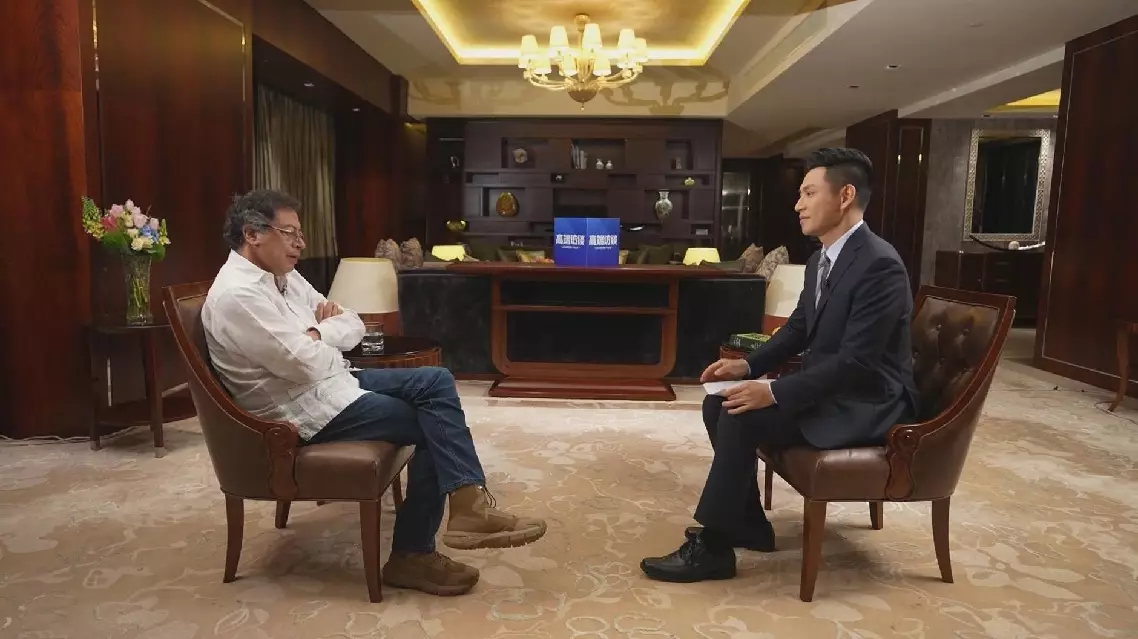
Colombian president on win-win BRI cooperation with China

Colombian president on win-win BRI cooperation with China
Colombian president on win-win BRI cooperation with China
Colombian president on win-win BRI cooperation with China
The Iranian government is focusing on public concerns and maintaining stable supplies of essential goods amid recent protests, Iranian President Masoud Pezeshkian said in a televised interview on Sunday.

In the city of Karaj, northwest of the capital Tehran, daily life has largely continued as normal. A video filmed by a local resident on Sunday shows food stores open and grocery shelves fully stocked.

"This is the block near my home, and there are some food stores here. Daily life continues here. Last night we did not see many protests in Karaj. Right now the city is very safe. This is a grocery store close to my home. All the food is available; nothing is in shortage. Here are noodles and different types of beans. Here are dairy products, cheese, and yogurt. I also checked other grocery stores and didn't see any shortages. Everything is available," said local resident Ali Reza.

Iranian officials have described recent disturbances as acts orchestrated by the "enemy," including some carried out by well-trained and armed "terrorists." The incidents have caused casualties among security personnel and civilians, as well as property damage.

The Secretary of Iran's Supreme National Security Council Ali Larijani has directed authorities to severely punish the "terrorists."

Meanwhile, Iran's police chief Ahmad-Reza Radan said on Sunday that the police had raised alert levels and arrested several leaders of the troublemakers during the operations on Saturday.

President Pezeshkian noted in the interview that the normal demands of the Iranian people are reasonable and justified, but they must realize that triggering riots and carrying out terrorist acts are the enemy's attempts to undermine the country. He urged the public to remain vigilant.

Also on Sunday, Iranian Parliament Speaker Mohammad Baqer Qalibaf warned that Tehran would regard U.S. and Israeli bases and facilities in the Middle East as "legitimate targets" if Washington takes military action against Iran. His remarks followed media reports saying U.S. President Donald Trump is "seriously considering authorizing a strike" against Iran.

Iranian state media reported that at least 109 members of Iran's security forces have been killed in clashes since the protests began 14 days ago. Meanwhile, human rights groups based outside the country said the number of protesters killed has exceeded 200, though the figure could not be independently verified.

The protests initially erupted over a sharp depreciation of the rial and sweeping subsidy reforms. Iranian authorities have blamed the unrest on foreign-linked agents and sanctions imposed by the United States.

Iranian president says government focusing on ensuring supplies amid protests

Iranian president says government focusing on ensuring supplies amid protests

Recommended Articles