Hollywood’s awards season is underway with the 83rd Golden Globe Awards, happening now.
Comedian Nikki Glaser returns for a second year to host the ceremony at the Beverly Hilton in Beverly Hills, California. It’s a Champagne-soaked party featuring some of the biggest names in film and television, even if the awards won’t exactly forecast the Oscars.
“One Battle After Another” topped the list of nominations with nine, closely followed by “Sentimental Value” with eight. “Wicked: For Good” was snubbed for best picture and best director. Others left out include Joe Rogan (for the new podcast category ), Sydney Sweeney and Gwyneth Paltrow, leaving room for plenty of surprise inclusions. See the full list of nominees.
The Globes is being broadcast on CBS and is available to stream through Paramount+.
The Latest:
The Globes bill itself as a giant party — and what’s a party without nourishment and libations? (It is quite literally 5 p.m. somewhere — in Beverly Hills.) Chef Nobu Matsuhisa is helming the menu for the third year in a row. Here’s what guests will get inside the ballroom:
DINNER: A selection of highlights from the chef’s eponymous restaurants — yellowtail jalapeno, a caviar cup, lobster salad with a spicy lemon dressing, different types of nigiri and, of course, miso black cod.
DESSERT: White chocolate mousse, pistachio sponge and ceremonial matcha cake accompanied by a “Golden Nobu” coin, per a press release.
DRINKS: Taking its boozy reputation seriously, the Globes have designated an official Champagne: Moët & Chandon. Guests will have two choices — Moët Impérial and Moët Rosé Impérial — described as “perfectly paired” with Matsuhisa’s menu. They also have an official water, supplied by Saratoga Spring Water.
If the stars’ individually plated meals sound good to you, the Globes is touting a to-go package from Nobu locations in New York and LA. The promotion ends today and will run you $125. (They’re also running an $83 in-house, themed lobster special. Gold leaf is involved.)
Warner Bros. Discovery might be facing a sale that’s left the entertainment industry fraught with anxiety, but its awards season hopes are off to a good start.
It ranks second behind independent label Neon in total motion picture nominations. HBO Max, its subsidiary, trails only Netflix in total television/podcast nominations.
Here’s how the three companies — Warner Bros., Netflix and Paramount — at the heart of Hollywood’s latest studio consolidation battle compare tonight:
MOTION PICTURE
TELEVISION/PODCAST
Kylie Jenner has been spotted inside the ballroom. Like last year, she didn’t walk the red carpet alongside her nominated date, Timothée Chalamet.
Mexican actor Diego Luna said that while the Star Wars prequel series “Andor” contains references to the past, it’s useful for the present.
“As an actor, as a filmmaker, I get involved in projects that matter to me, that say things I believe need to be said,” he said. “‘Andor’ was one of those.”
Luna is nominated for best male actor in a drama.
Hudson, who is nominated for best female actor in a musical/comedy, finds that many of this year’s films — including her own, “Song Sung Blue” — are about dreamers. She reflected on her own childhood experience of locking herself in her bedroom, talking in the mirror and pretending to play different characters.
“I think people need that right now,” Hudson said. “So many things have become so cynical. And we are our own narrator to our life.”
Some of the entertainment industry’s biggest players are competing for much more than a statuette this awards season. Tonight, they’re doing it on one company’s home turf.
The elephant in the ballroom is sure to be the dueling bids for Warner Bros. Discovery, which is behind some of this year’s leading contenders with films “Sinners” and “One Battle After Another” as well as TV hit “The White Lotus.”
Netflix and Paramount have each made offers for the storied Hollywood studio. But Warner Bros. this week again rejected Paramount’s $77.9 billion hostile takeover of the entire company, urging shareholders to back its $72 billion deal with Netflix for its streaming and studio business.
Whether Paramount gains ownership over its rival’s extensive content library remains to be seen. But, at the least, company executives will have cinephiles’ eyeballs tonight: The Golden Globes are televised live on Paramount-owned CBS.
Per the Globes themselves, 27. They range from rising actors like Chase Infiniti, nominated for “One Battle After Another,” to longstanding entertainers like Bill Maher, nominated for his comedy special.
The other new nominees: Aimee Lou Wood, Ashley Walters, Britt Lower, Carrie Coon, Charlie Hunnam, Dwayne Johnson, Erin Doherty, Eva Victor, Inga Ibsdotter Lilleaas, Jacob Elordi, Jessie Buckley, Kevin Hart, Kumail Nanjiani, Lee Byung-Hun, Michael B. Jordan, Owen Cooper, Paul Mescal, Rashida Jones, Renate Reinsve, Rhea Seehorn, Stephen Graham, Tessa Thompson, Teyana Taylor, Tramell Tillman and Walton Goggins.
Noah Wyle says watchers of “The Pitt” are right to be concerned that his character Dr. Robby doesn’t wear a helmet as he rides his motorcycle to the ER on the Season 2 premiere.
“There’s nothing arbitrary about the way we do the show, everything’s pretty specific, and that was a very specific decision that we made to have him riding with the helmet on his backpack but not on his head, telling everybody he wears one but we all know that he isn’t,” Wyle said.
Then he added this bit of intrigue: “That calls into question just about everything he says and does all season and what we can believe.”
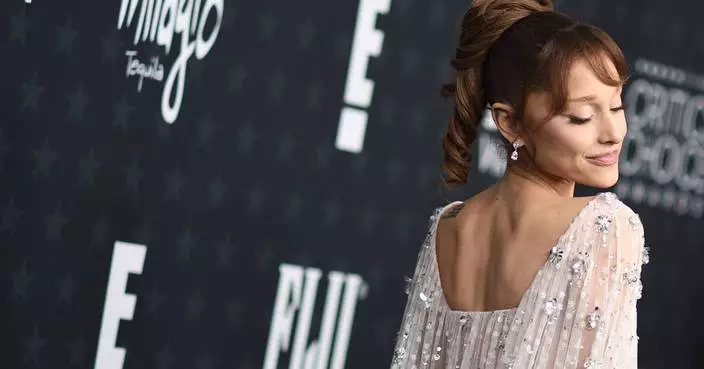
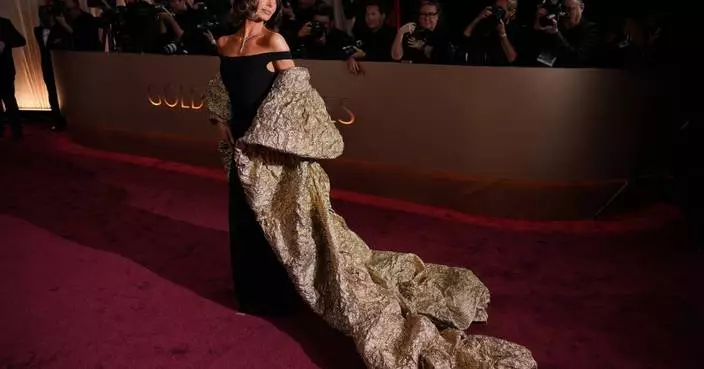
Ariana Grande’s Glinda pink took the night off. With her signature ponytail high, the “Wicked: For Good” nominee walked the carpet in black. Granted, it was black in a Glinda-worthy ball gown silhouette.
The “Before Sunrise” director has two films nominated for best musical/comedy film: “Blue Moon,” which follows legendary lyricist Lorenz Hart on the opening night of his longtime collaborator Richard Rodgers’ new hit musical, and “Nouvelle Vague,” an ode to French New Wave that dramatizes the making of Jean-Luc Godard’s “Breathless.”
Richard Linklater described the movies as “bookends” about “two really unique artists at really crucial moments in their lives.”
“One’s kind of an enthusiastic, passionate, exuberant beginning of a career and one’s kind of a sad end to a career,” he told AP.
And, speaking of artists at crucial moments in their lives, none other than Glen Powell surprised the “Hit Man” director mid-interview to say “there is no happier place for me than a Richard Linklater set.”
Nobu Matsuhisa is the official chef for the Golden Globes for the third year straight.
Last year, speaking ahead of the release of the documentary “Nobu,” he revealed his advice to young people faced with adversity: ”Don’t give up. Just don’t forget about the ambitions, passions and go step by step.”
▶ Read more from the chef’s interview
Victor, who directed, wrote and starred in “Sorry Baby,” is looking forward to the next project.
“This is so busy and so loud and so intense,” Victor said on the red carpet. “I think writers are kind of in need of quiet and space and time and not any noise. I look forward to, after all the celebrating, going back into my little hole and dreaming.”
Victor is nominated for best female actor in a drama motion picture.
The kernels of the film were planted in the Iranian director’s head during his time as a political prisoner, though he said his experience paled in comparison to others'.
“I did not go through anything in particular, any particular hardship, compared to my fellow prisoners,” Jafar Panahi said through a translator.
Hundreds of Iranians have been killed as the government attempts to squash protests demanding a regime change.
The dissident Iranian director is one of today’s most renowned international filmmakers. But unlike others, Jafar Panahi is facing a yearlong prison sentence and two-year travel ban for “propaganda activities” against the Iranian government.
It’s not his first time; he’s been jailed for his work before in Tehran’s infamous Evin Prison, and was banned from making movies in Iran until 2023.
But he made films anyway, and his time in the prison system inspired his latest film, “It Was Just an Accident,” which has already snagged awards, including Cannes’ prized Palme d’Or.
The film is nominated for four Golden Globe awards: best drama, director, screenplay and foreign-language film.
The ballroom is open and “Sinners” stars Li Jun Li and Jayme Lawson arrived together early at the “Sinners” table and were quickly served some Nobu.
The evening’s host, Nikki Glaser, began her likely multi-change fashion marathon in Zuhair Murad. Her satin, blush-pink gown was strapless with a draped corset bodice and a sweetheart neckline. The look had a voluminous skirt and hails from the Zuhair Murad Resort ready-to-wear collection.
Traditionally, hosts change clothes often. Last year, Glaser changed at least seven times.
The idea for the pins began with a late-night text exchange earlier this week between Nelini Stamp, with the group Working Families Power, and Jess Morales Rocketto, the executive director of a Latino advocacy group called Maremoto.
“There is a longstanding tradition of people who create art taking a stand for justice in moments,” Stamp said. “We’re going to continue that tradition.”
The two organizers began calling up the celebrities and influencers they knew, who in turn brought their campaign to the more prominent figures in their circles.
Allies of their movement have been attending the “fancy events” that take place in the days leading up to the Golden Globes, according to Stamp. They’re passing out the pins at parties and distributing them to neighbors who will be attending the ceremony.
▶Read more about the anti-ICE pins
After filming “Marty Supreme,” Kevin O’Leary says he would like to star in the next James Bond movie.
“I want to be the bad guy in Bond,” he said. “Nobody can do it the way I can. And I want Bond to be a woman this time.”
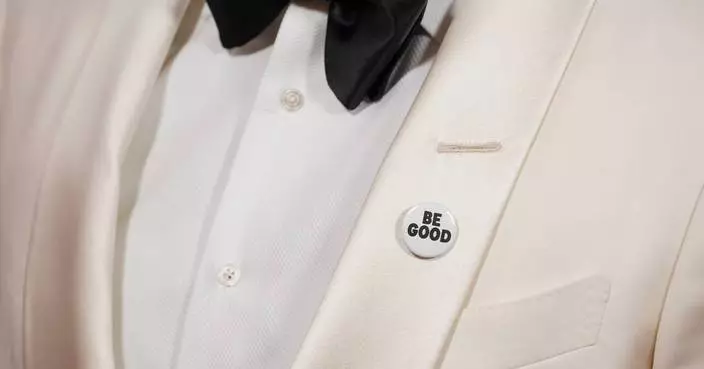
Mark Ruffalo is wearing a pin saying “BE GOOD” on the red carpet.
The emblem, part of the #BeGood campaign, references the fatal shooting of Renee Good by an immigration officer in Minneapolis last week. According to a news release, the pins also pay tribute to Keith Porter, who was fatally shot in Los Angeles by an off-duty ICE officer on New Year’s Eve.
The campaign was organized by a group of entertainment industry professionals with support from groups Working Families Power and Maremoto.
Wagner Moura, a best actor nominee for Brazil’s “The Secret Agent” says speaking out about politics is risky for an entertainer, but feels like a necessity.
“In order to do that you have to be very aware that sometimes you have to pay the price, but I’m willing to,” he said. “I’m a very political person, I think politically, I like to make political films. ‘The Secret Agent’ is one of those.”
“It would be weird for me to work as a political artist and then shy away from saying what I think,” he said.
“I’m getting a lot of direct messages from vampires,” he said. “Finally, a film where the vampire is respected.”
In the film, O’Leary portrays a successful businessman who described himself as a vampire born in the 17th century. The strikingly absurd quote is a memorable moment in the film.
Wunmi Mosaku of “Sinners” wore stunning bright yellow to announce news of her pregnancy. She cradled her bump as she made her way up the stairs. In a Vogue essay, she celebrates her pregnancy and her Nigerian culture, explaining that in Yoruba, “we say Iya ni Wúrà.” It means “mother is golden.” When she saw sketches of her custom yellow Matthew Reisman gown, “I knew it was the right dress and the right moment.”
Mosaku is Nigerian British with an American husband who stays out of the spotlight.
Actor Delroy Lindo didn’t have much time to rehearse the three-page monologue before filming. But the magic came out while shooting the scene.
“As we filmed, the more conversant one became with the moment,” he said. “It was one of those situations that became more and more full, and the fact that it lands on you, as the audience, spiritually, is beautiful for me to hear.”
The film has a slew of nominations, including best drama motion picture, best director and best screenplay.
Kevin O’Leary, the businessman-turned-TV personality who starred as Milton Rockwell in “Marty Supreme,” said the role was written with him in mind.
O’Leary recalled director Josh Safdie saying to him: “We wrote this part, Milton Rockwell, he’s a real a-hole, and I think you’re the guy.”
After reading the script, O’Leary agreed. “I really felt that I’m that guy,” he said.
Presenter Priyanka Chopra Jonas and Jonas Brothers member Nick Jonas posed for cameras not long after celebrating their seventh wedding anniversary. She was dressed in a midnight blue tiered gown with a waist sash. He picked a traditional black tux.
Jonas shared a photo on Instagram Dec. 1 of Chopra in a red bikini with the words: “7 years married to my dream girl.”
A massive construction project across from the main driveway of the Beverly Hilton hotel has upended the Golden Globes.
Instead of walking down the red-carpeted driveway and into the lobby, the starry attendees are stepping onto an oxblood carpet, which is fully enclosed for the first time and set up along Wilshire Boulevard, which is shut down for the awards.
There are stairs to contend with as A-listers make their way, including what’s being called the golden ascent, a staircase designed to mimic a film reel as it unspools.
If they survive the gauntlet, the celebs will find a meal from tony Nobu, a celebrity haunt known for its Japanese-Peruvian fusion cuisine, waiting on their plates in the International Ballroom. It’s practically comfort food for Kylie Jenner, whose family are regulars at the Malibu location.
The construction causing all the changes is a $10 billion mixed-use development featuring two luxury residential towers, a hotel, shopping and restaurants. For years, that property was a giant hole after a department store was shuttered and torn down.
Brittany Snow says she has mixed feelings about the arc of her character, Sophie O’Neil, on “The Hunting Wives.”
She says they are about to start shooting the fifth episode of Season 2 of the Netflix show.
“I wish that Sophie made better choices,” Snow said. “But we love to watch her make bad choices.”
She added, “I love playing a character like that. I can’t tell you that she’s the most altruistic human, but what fun would that be?”
That grand, Met Gala-esque staircase was only for the stars. The non-famous entered through another, ground level entrance.
“Don’t worry,” a staffer told a disappointed guest. “There’s a place to get your photo at the end too.”
Park Chan-wook, director of “No Other Choice” said he originally wrote the film for an American audience. Only recently did he decide to develop the piece as a Korean film, he said.
“I think, in turn, it improved the movie and the screenplay, because before then, we weren’t able to incorporate the AI technology element into the movie,” he said through a translator, while wearing Saint Laurent.
Park’s film is nominated for best motion picture for a musical or comedy. It is also nominated for best non-English motion picture.
Kaouther Ben Hania, director of “The Voice of Hind Rajab,” said the reception of her film has restored her faith in art.
“Many people told me, ‘This movie changed me,’” she said. “People in the beginning are afraid to watch it, but once they see the voice and hear the voice of Hind Rajab, this movie affects them and changes them.”
The movie includes an audio recording of the 5-year-old Palestinian girl Hind Rajab before she was killed by Israeli forces in 2024. It’s nominated for best non-English motion picture.
“Sinners” director Ryan Coogler said he’s “married to cinema, and this movie felt like I was renewing my vows.” Chase Infiniti woke up to a dead phone the morning she was nominated for “One Battle After Another.”
Maggie O’Farrell, author of “Hamnet” and co-nominated for the adaptation’s screenplay, says the film “feels not like my child, more like a kind of niece or nephew.” And for “Sentimental Value” director Joachim Trier, it was time for some Champagne.
▶ Read more reactions
University of California and Simi Valley police and bomb-sniffing dogs of no obvious, immediate affiliation were on hand to help monitor vehicles dropping off guests, involving a labyrinthine route that might befuddle even the most seasoned Angeleno, accessible only to those traveling east.
The Golden Globes has also chosen a harrowing staircase climb for its celebrity guests, flanked by photographers on both sides. The setup is not unlike the daunting Grand Staircase for the Met Gala.
The presenters announced Thursday feature a mix of Hollywood A-listers like George Clooney, Julia Roberts and Queen Latifah, along with rising stars like the leads from “Heated Rivalry,” Connor Storrie and Hudson Williams.
Additional presenters include: Amanda Seyfried, Ana de Armas, Ayo Edebiri, Charli xcx, Chris Pine, Colman Domingo, Dakota Fanning, Dave Franco, Diane Lane, Hailee Steinfeld, Jason Bateman, Jennifer Garner, Joe Keery, Judd Apatow, Justin Hartley, Kathryn Hahn, Keegan-Michael Key, Kevin Bacon, Kevin Hart, Kyra Sedgwick, Lalisa Manobal (Lisa from Blackpink), Luke Grimes, Macaulay Culkin, Marlon Wayans, Melissa McCarthy, Mila Kunis, Miley Cyrus, Minnie Driver, Orlando Bloom, Pamela Anderson, Priyanka Chopra Jonas, Regina Hall, Sean Hayes, Snoop Dogg, Wanda Sykes, Will Arnett and Zoë Kravitz.
The Globes usually want a party, not politics. But that might be hard in the award show’s first ceremony during President Donald Trump’s second term.
The fatal shooting of 37-year-old mother Renee Good in Minneapolis by U.S. Immigration and Customs Enforcement may be on the minds of many attendees. The night’s frontrunner, “One Battle After Another,” notably opens with a raid on an ICE detention facility.
While the Globes’ TV drama and comedy categories have massive overlap with last year’s Emmys, the limited series group is full of new blood.
Recent buzzy series " All Her Fault," “The Beast in Me” and “The Girlfriend” have all been nominated for best limited series and the honor of probably losing to “Adolescence.”
Compared to the crazy-convoluted Emmys calendar, the Golden Globes TV eligibility window is as simple as the singular soul on “Pluribus.”
If most of a show aired the previous year, it’s eligible. That’s it.
The big nominees are still nearly all reruns though. Everything in the best drama series category was up for best drama at September’s Emmys, including the winner “The Pitt.”
“Pluribus” is the only invader in the group, and has a good chance of getting the Globes to conform to its will. “Heated Rivalry” didn’t make the team.
Last year, the Golden Globes largely avoided conversations surrounding President Donald Trump’s politics. That may not be the case this time around.
Since Trump reclaimed the White House, the president’s name has been added to the exterior of the John F. Kennedy Center for the Performing Arts building. Numerous artists have canceled appearances at the center, and ticket sales and attendance have fallen, and viewership for December’s broadcast of the Kennedy Center Honors program was down by about 35% compared to the year before.
Meanwhile, Trump also said he would slap a 100% tax on movies made outside the United States, though no such tariffs have yet to be levied.
And the awards event will also be taking place in California, one of the states central to political redistricting ahead of U.S. midterms this year.
This year’s voting body is made up of nearly 400 journalists and film critics from around the world, who cover the entertainment industry for international audiences.
The ceremony was originally presented by the Hollywood Foreign Press Association. After a series of scandals, Dick Clark Productions and Eldridge Industries acquired the rights to the show in 2023. The voting body has expanded to include more racial, ethnic and gender diversity since then.
Any foreign entertainment journalist working for an internationally based media outlet can apply to be a voter.
The Golden Globes this year introduced the best podcast category, and the nominees represent a mix of news and celebrity conversations all the while avoiding political controversy. Up for the inaugural award:
The nominations seemingly avoided controversy by passing on popular conservative-leaning podcasts from the shortlist, such as “The Joe Rogan Experience,” which topped all major podcast platforms in 2025, and “The Megyn Kelly Show,” “The Tucker Carlson Show,” “The Ben Shapiro Show” and Candace Owens’ “Candace.”
Also axed from the nominees: the left-leaning “Pod Save America,” and popular true-crime podcasts “Morbid” and “Rotten Mango.”
Warner Bros. might be on the cusp of being sold, but it stands to dominate Sunday’s Globes. The studio is behind the odds-on favorite “One Battle After Another,” the most likely drama winner, “Sinners,” and the most nominated series, “The White Lotus.”
Warner Bros. Discovery has agreed to be acquired by Netflix in a deal with $82.7 million. The only studio with more nominations than Warner Bros.’ 31? Netflix, with 35.
FILMS
1. “One Battle After Another”: 9
2. “Sentimental Value”: 8
3. “Sinners”: 7
4. “Hamnet”: 6
5. “Frankenstein” and “Wicked: For Good”: 5 each
TELEVISION
1. “The White Lotus”: 6
2. “Adolescence”: 5
3: “Only Murders in the Building” and “Severance”: 4 each
5. “The Bear,” “The Beast in Me,” “Black Mirror,” “Hacks,” “Nobody Wants This,” and “The Studio: 3 each
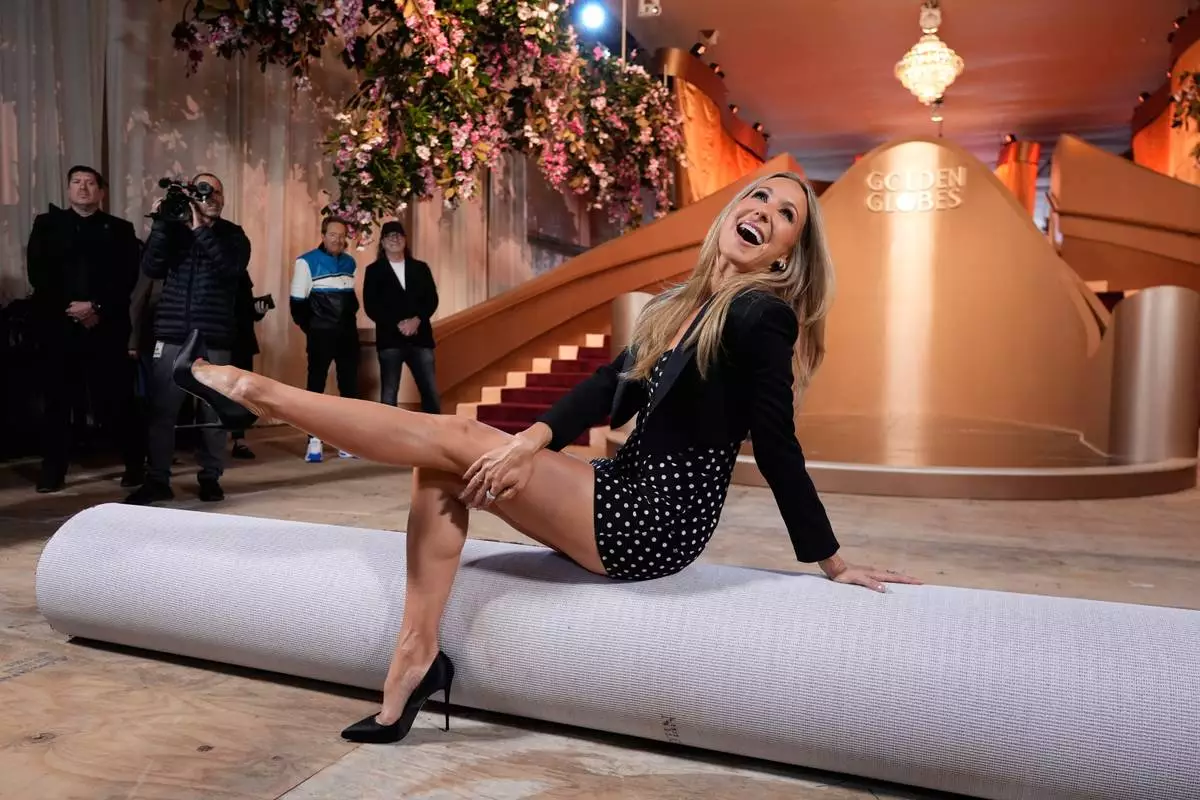
Nikki Glaser rolls out the red carpet during the 83rd Golden Globes press preview on Thursday, Jan. 8, 2026, at the Beverly Hilton in Beverly Hills, Calif. (AP Photo/Chris Pizzello)
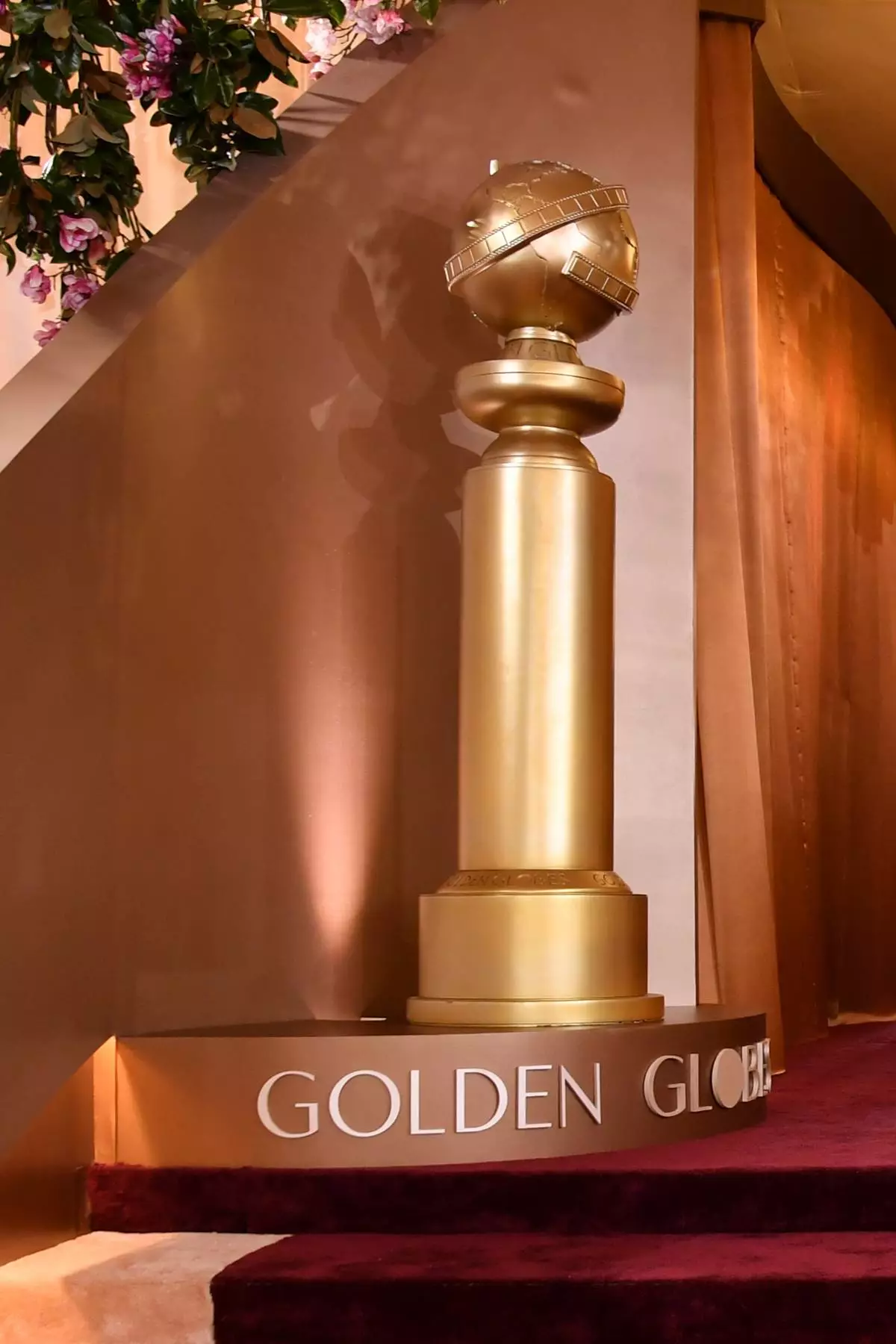
General view of atmosphere at the 83rd Golden Globes on Sunday, Jan. 11, 2026, at the Beverly Hilton in Beverly Hills, Calif. (Photo by Richard Shotwell/Invision/AP)
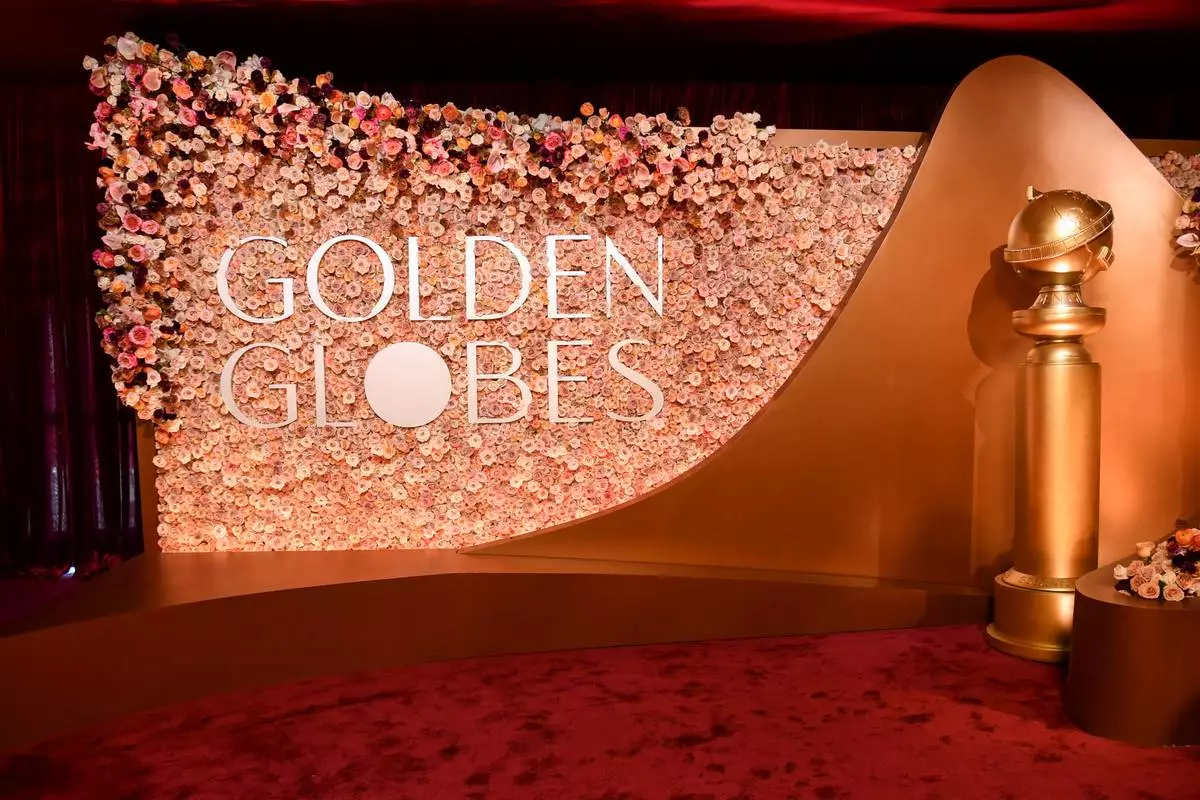
A general atmosphere at the 83rd Golden Globes on Sunday, Jan. 11, 2026, at the Beverly Hilton in Beverly Hills, Calif. (Photo by Richard Shotwell/Invision/AP)