Companies in the Yangtze River Delta, one of China's most economically vibrant and innovative regions, are driving the development of new energy vehicles (NEVs).
The Yangtze River Delta region, which takes up only 4 percent of China's landmass, contributes about 25 percent of its total GDP and one-third of its foreign trade and investment. The region encompasses the provinces of Jiangsu, Zhejiang, Anhui, and Shanghai Municipality.
Founded in 2014, Hesai Technology is a global leader in automotive LiDAR systems based in Shanghai. At present, it supplies about one-third of all automotive LiDAR systems used around the world. LiDAR, which stands for Light Detection and Ranging, helps autonomous driving systems to navigate roads safely.
A LiDAR device emits millions of light pulses every second and creates 3D maps based on the light pulses reflected back from nearby objects. By measuring how long it takes for each pulse to come back, the LiDAR device calculates distances and will automatically trigger the brakes if it detects that something is too close.
In heavy rain or fog, normal cameras may struggle to see clearly and computers might fail to recognize unusually shaped objects, but a LiDAR device helps to keep things safer under such circumstances, according to industry insiders.
"LiDAR is not to replace cameras. Camera can solve many problems, but camera is very reliable on external lights. A LiDAR is like a seat belt, having better LiDAR and more LiDAR will save lives," said Andrew Fan, chief financial officer of Hesai Technology.
Valuing the unique advantages of the Yangtze River Delta, the company's research, development and production are all concentrated in the region, according to Fan.
"Yangtze River Delta has its own unique competitiveness in terms of client bases, supply chains, human resources and, more importantly, the business environment here," Fan said.
Taicang is a small city neighboring Shanghai in Jiangsu Province which has been home to German auto parts giant Schaeffler for 30 years.
"Here in Taicang, we achieved what we call the 'three 100s'. Within 100 kilometers, we can source most of our raw materials. Within 100 minutes, we can reach to most of our customers. And we have over 100 suppliers located nearby," said Xi Pengchong, director of Taicang Campus Schaeffler (China) Co., Ltd.
The Yangtze River Delta has over 17,300 kilometers of expressways and more than 14,600 kilometers of railways, connecting almost every city and county in the region. Through this network, both Schaeffler and Hesai's products can quickly reach one of their main customers 150 kilometers away, said Zeekr Group, a Chinese EV rising star founded in 2021.
Located in Ningbo City of east China's Zhejiang Province, Zeekr's main manufacturing plant covers an area over 133 hectares and can produce up to 300,000 cars a year.
"This kind of ecosystem helps us save time. It used to take over 10 days to make a car but now it can be done as little as two days from order to delivery," said Zhao Chunlin, vice president of Zeekr Group.
At present, 75 percent of the company's component suppliers are located within a four-hour drive.
"The shorter the transport distances are, the less the inventory volumes are. This helps us to lower the logistic costs," said Zhao.
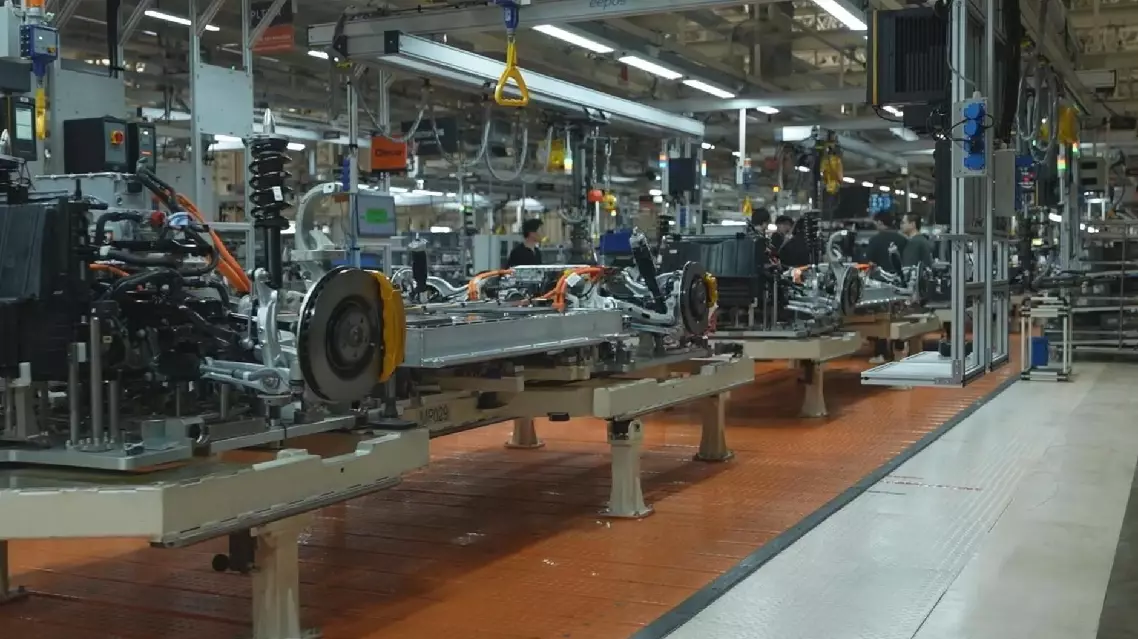
Yangtze River Delta companies drive NEV development