China's major commercial banks on Tuesday announced reductions in deposit interest rates, the first cuts this year.
The one-year fixed-term deposit interest rate was lowered by 15 basis points to 0.95 percent, announced by the Industrial and Commercial Bank of China, the Bank of China, the China Construction Bank, the Agricultural Bank of China, and the China Merchants Bank.
After the adjustment, the rates for fixed-term deposits now stand at 1.05 percent for two years, 1.25 percent for three years, and 1.3 percent for five years.
At the Postal Savings Bank of China, the six-month and one-year fixed-term deposit interest rates have been adjusted to 0.86 percent and 0.98 percent, respectively. Interest rates for other maturities remain consistent with those offered by the five aforementioned banks.
This move follows two rounds of deposit rate cuts in July and October last year.
Also on Tuesday, China cut market-based benchmark lending rates, with the one-year loan prime rate (LPR) down to 3 percent from the previous reading of 3.1 percent. The over-five-year LPR, on which many lenders base their mortgage rates, was lowered to 3.5 percent from 3.6 percent.
Earlier this month, China implemented its first policy rate cut of the year, lowering the seven-day reverse repo rate from 1.5 percent to 1.4 percent.
"The downward trend of the LPR is an important signal for implementing a moderately accommodative monetary policy. It helps maintain ample liquidity, guides the decline in social financing costs, and supports the stimulation of new credit demand, stabilize loan supply, and unleash investment and consumption potential. In addition, lower loan interest rates will contribute to enhancing debt sustainability, thereby further stabilizing market expectations," said Zhang Jun, chief economist at China Galaxy Securities.
Since the reform of the LPR mechanism in 2019, greater room has been created for the market-driven decline of loan interest rates, pushing them to historically low levels. In April, the weighted average interest rate for newly issued corporate loans stood at approximately 3.2 percent -- about 50 basis points lower than that in the same period of last year. Meanwhile, the weighted average interest rate for new housing loans to individual buyers was around 3.1 percent, marking a year-on-year decline of roughly 55 basis points.
"As the pricing of a large number of loans for both residents and enterprises is directly linked to the LPR, the resulting savings on interest payments create room for enterprises to maintain stable operations and for residents to expand consumption. At the same time, the combined effects of lower loan interest rates and the use of structural monetary policy tools have further improved the interest rate regulation framework and enhanced the transmission mechanism of monetary policy," said Zhang Wenlang, chief macro analyst in the Research Department of China International Capital Corporation Limited (CICC).
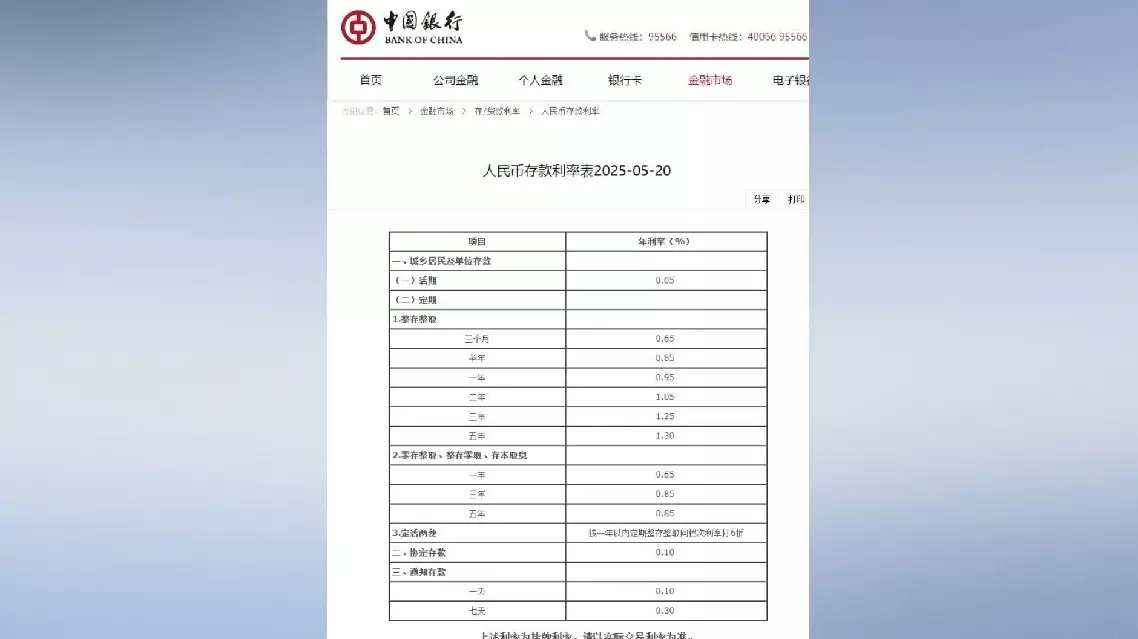
China's major lenders lower deposit interest rates