WASHINGTON (AP) — Secretary of State Marco Rubio and Democratic senators sparred Tuesday over the Trump administration’s foreign policies, ranging from Ukraine and Russia to the Middle East, Latin America, the slashing of the U.S. foreign assistance budget and refugee admissions.
Rubio defended the administration’s decisions to his former colleagues during a Senate Foreign Relations Committee hearing, his first since being confirmed on President Donald Trump’s Inauguration Day.
He said “America is back” and claimed four months of foreign-policy achievements, even as many of them remain frustratingly inconclusive. Among them are the resumption of nuclear talks with Iran, efforts to bring Russia and Ukraine into peace talks and efforts to end the war in Gaza between Israel and Hamas.
America's top diplomat praised agreements with El Salvador and other Latin American countries to accept migrant deportees, saying “secure borders, safe communities and zero tolerance for criminal cartels are once again the guiding principles of our foreign policy.”
He also rejected assertions that massive cuts to his department’s budget would hurt America’s standing abroad. Instead, he said the cuts would actually improve the U.S. reputation internationally.
Committee Chairman Jim Risch opened the hearing with praise for Trump's changes and spending cuts and welcomed what he called the administration’s promising nuclear talks with Iran.
Risch also noted what he jokingly called “modest disagreement” with Democratic lawmakers, who used Tuesday’s hearing to confront Rubio about Trump administration moves.
Ranking Democratic member Jeanne Shaheen argued that the Trump administration has “eviscerated six decades of foreign-policy investments” and given China openings around the world.
“I urge you to stand up to the extremists of the administration,” the New Hampshire senator said.
Other Democrats excoriated the administration for its suspension of the refugee admissions program, particularly while allowing white Afrikaners from South Africa to enter the country.
Some Republicans also warned about drastic foreign assistance cuts, including former Senate leader Mitch McConnell and Susan Collins. They expressed concern that the U.S. is being outmaneuvered by its rivals internationally after the elimination of thousands of aid programs.
“The basic functions that soft power provides are extremely important,” McConnell told Rubio at a second hearing later in the day before the Senate Appropriations Committee. “You get a whole lot of friends for not much money.”
Rubio told the Appropriations Committee that the Trump administration is encouraging but not threatening Israel to resume humanitarian aid shipments into Gaza.
He said the U.S. is not following the lead of several European countries that have imposed sanctions or warned of actions against Israel amid the dearth of assistance reaching vulnerable Palestinians. However, he said U.S. officials have stressed in discussions with the Israelis that aid is urgently needed for civilians in Gaza who are suffering during Israel’s military operation against Hamas.
“We’re not prepared to respond the way these countries have,” but the U.S. has engaged with Israel in the last few days about “the need to resume humanitarian aid,” Rubio said. “We anticipate that those flows will increase over the next few days and weeks — it’s important that that be achieved.”
And Rubio acknowledged that the administration was approaching foreign governments about taking mass numbers of civilians from Gaza but insisted that any Palestinians leaving would be “voluntary.”
“There’s no deportation,” Rubio said. “We’ve asked countries preliminarily whether they will be open to accepting people not as a permanent solution, but as a bridge to reconstruction” in Gaza.
Sen. Jeff Merkley, D-Ore., condemned it as a “strategy of forced migration.”
Also on the Middle East, Rubio said the administration has pushed ahead with attempts to broker a ceasefire in Gaza and promote stability in Syria.
He stressed the importance of U.S. engagement with Syria, saying that otherwise, he fears the interim government there could be weeks or months away from a “potential collapse and a full-scale civil war of epic proportions.”
Rubio’s comments addressed Trump’s pledge to lift sanctions burdening Syria’s new transitional government, which is led by a former militant chief who led the overthrow of the country’s longtime oppressive leader, Bashar Assad, late last year. The U.S. sanctions were imposed under Assad.
In two particularly contentious exchanges, Kaine and Van Hollen demanded answers on the decision to suspend overall refugee admissions but to exempt Afrikaners based on what they called “specious” claims that they have been subjected to massive discrimination by the South African government. Rubio gave no ground.
In one tense exchange, Kaine pressed Rubio to say whether there should be a different refugee policy based on skin color.
“I'm not the one arguing that,” Rubio said. “Apparently, you are, because you don't like the fact they're white.”
“The United States has a right to pick and choose who we allow into the United States,” he said. “If there is a subset of people that are easier to vet, who we have a better understanding of who they are and what they’re going to do when they come here, they’re going to receive preference.”
He added: “There are a lot of sad stories around the world, millions and millions of people around the world. It’s heartbreaking, but we cannot assume millions and millions of people around the world. No country can.”
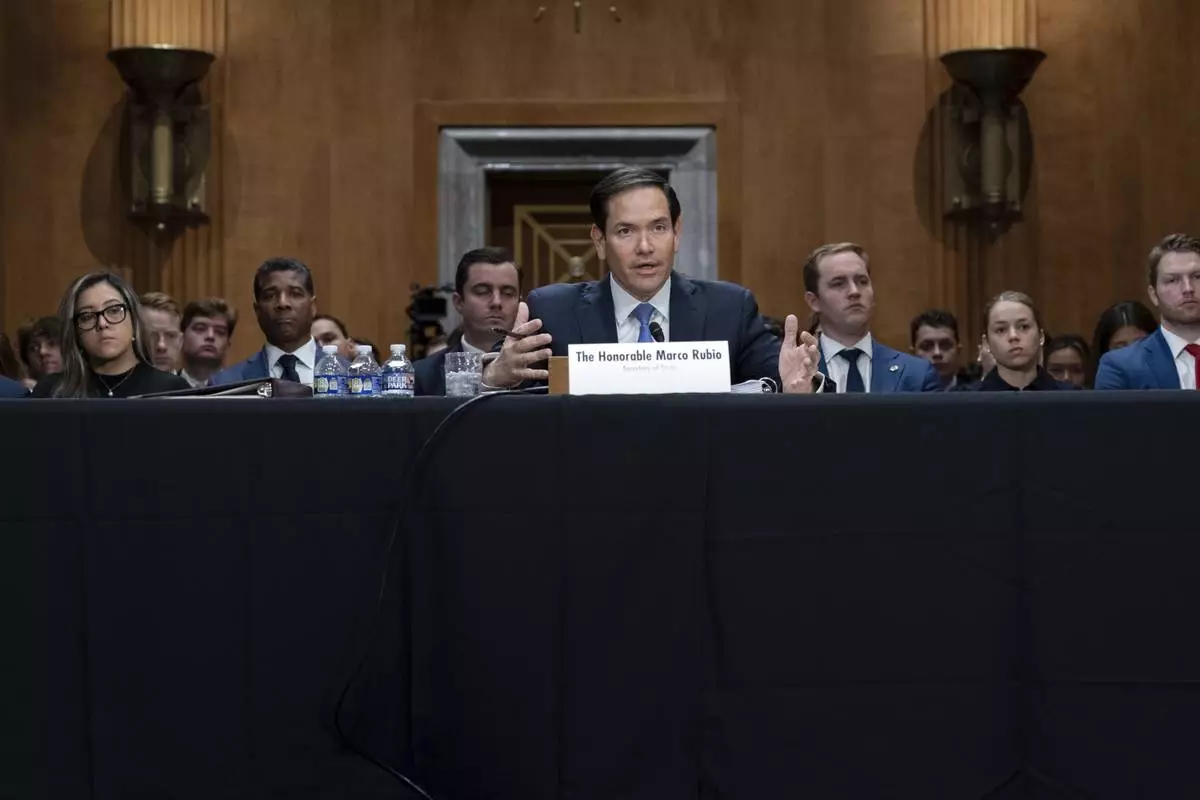
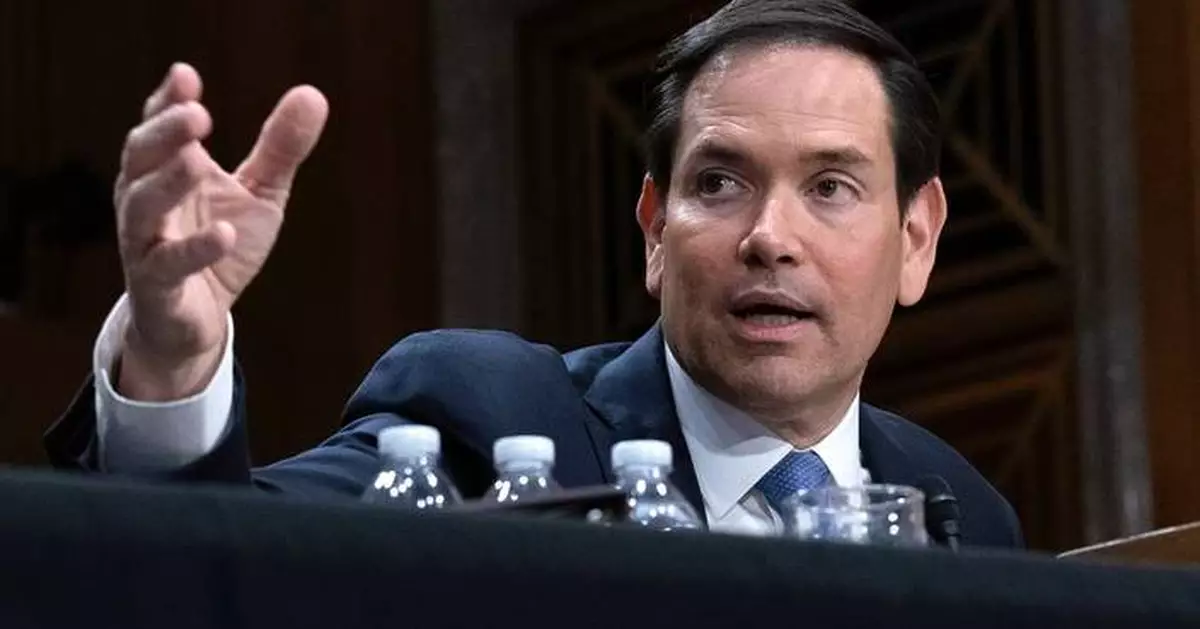
Secretary of State Marco Rubio testifies before the Senate Committee on Foreign Relations hearing to examine the President's proposed budget request for fiscal year 2026 for the Department of State on Capitol Hill in Washington, Tuesday, May 20, 2025. (AP Photo/Jose Luis Magana)
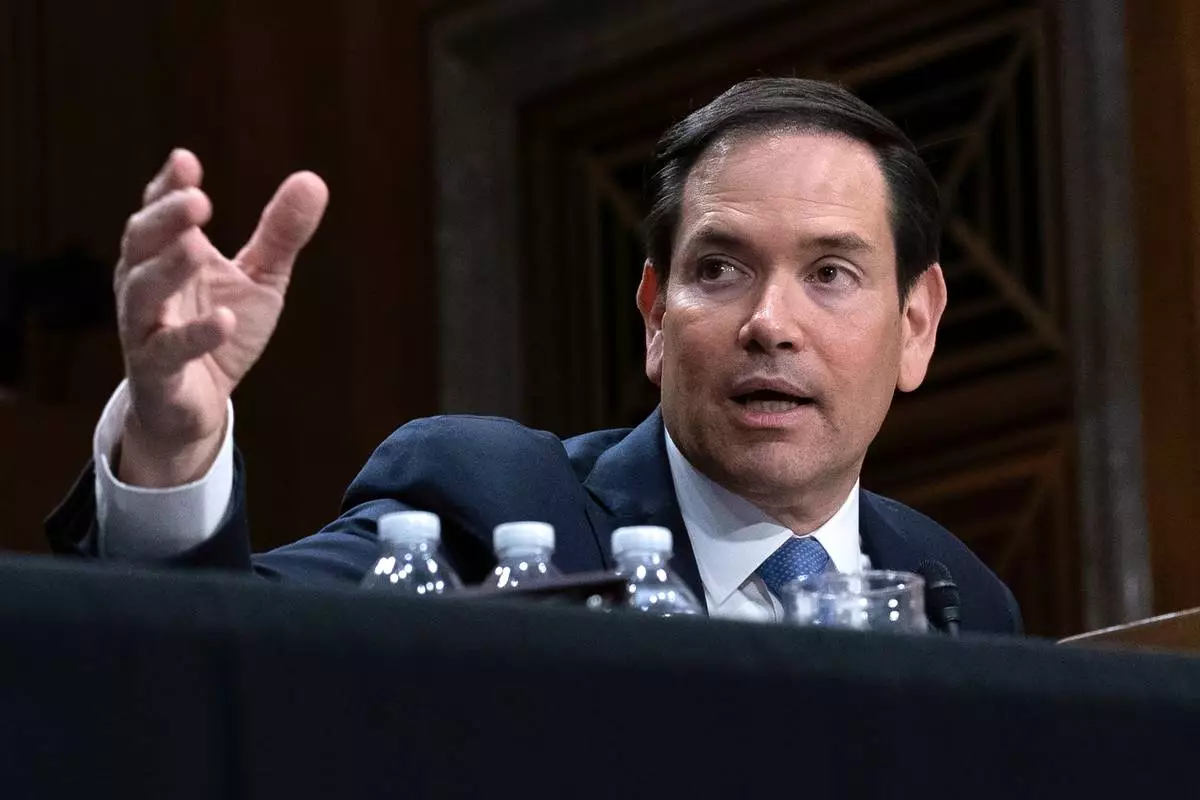
Secretary of State Marco Rubio testifies before the Senate Committee on Foreign Relations hearing to examine the President's proposed budget request for fiscal year 2026 for the Department of State on Capitol Hill in Washington, Tuesday, May 20, 2025. (AP Photo/Jose Luis Magana)
WASHINGTON (AP) — A day after the audacious U.S. military operation in Venezuela, President Donald Trump on Sunday renewed his calls for an American takeover of the Danish territory of Greenland for the sake of U.S. security interests, while his top diplomat declared the communist government in Cuba is “in a lot of trouble.”
The comments from Trump and Secretary of State Marco Rubio after the ouster of Venezuela's Nicolás Maduro underscore that the U.S. administration is serious about taking a more expansive role in the Western Hemisphere.
With thinly veiled threats, Trump is rattling hemispheric friends and foes alike, spurring a pointed question around the globe: Who's next?
“It’s so strategic right now. Greenland is covered with Russian and Chinese ships all over the place," Trump told reporters as he flew back to Washington from his home in Florida. "We need Greenland from the standpoint of national security, and Denmark is not going to be able to do it.”
Asked during an interview with The Atlantic earlier on Sunday what the U.S.-military action in Venezuela could portend for Greenland, Trump replied: “They are going to have to view it themselves. I really don’t know.”
Trump, in his administration's National Security Strategy published last month, laid out restoring “American preeminence in the Western Hemisphere” as a central guidepost for his second go-around in the White House.
Trump has also pointed to the 19th century Monroe Doctrine, which rejects European colonialism, as well as the Roosevelt Corollary — a justification invoked by the U.S. in supporting Panama’s secession from Colombia, which helped secure the Panama Canal Zone for the U.S. — as he's made his case for an assertive approach to American neighbors and beyond.
Trump has even quipped that some now refer to the fifth U.S. president's foundational document as the “Don-roe Doctrine.”
Saturday's dead-of-night operation by U.S. forces in Caracas and Trump’s comments on Sunday heightened concerns in Denmark, which has jurisdiction over the vast mineral-rich island of Greenland.
Danish Prime Minister Mette Frederiksen in a statement that Trump has "no right to annex" the territory. She also reminded Trump that Denmark already provides the United States, a fellow member of NATO, broad access to Greenland through existing security agreements.
“I would therefore strongly urge the U.S. to stop threatening a historically close ally and another country and people who have made it very clear that they are not for sale,” Frederiksen said.
Denmark on Sunday also signed onto a European Union statement underscoring that “the right of the Venezuelan people to determine their future must be respected” as Trump has vowed to “run” Venezuela and pressed the acting president, Delcy Rodriguez, to get in line.
Trump on Sunday mocked Denmark’s efforts at boosting Greenland’s national security posture, saying the Danes have added “one more dog sled” to the Arctic territory’s arsenal.
Greenlanders and Danes were further rankled by a social media post following the raid by a former Trump administration official turned podcaster, Katie Miller. The post shows an illustrated map of Greenland in the colors of the Stars and Stripes accompanied by the caption: “SOON."
“And yes, we expect full respect for the territorial integrity of the Kingdom of Denmark,” Amb. Jesper Møller Sørensen, Denmark's chief envoy to Washington, said in a post responding to Miller, who is married to Trump's influential deputy chief of staff Stephen Miller.
During his presidential transition and in the early months of his return to the White House, Trump repeatedly called for U.S. jurisdiction over Greenland, and has pointedly not ruled out military force to take control of the mineral-rich, strategically located Arctic island that belongs to an ally.
The issue had largely drifted out of the headlines in recent months. Then Trump put the spotlight back on Greenland less than two weeks ago when he said he would appoint Republican Gov. Jeff Landry as his special envoy to Greenland.
The Louisiana governor said in his volunteer position he would help Trump “make Greenland a part of the U.S.”
Meanwhile, concern simmered in Cuba, one of Venezuela’s most important allies and trading partners, as Rubio issued a new stern warning to the Cuban government. U.S.-Cuba relations have been hostile since the 1959 Cuban revolution.
Rubio, in an appearance on NBC's “Meet the Press,” said Cuban officials were with Maduro in Venezuela ahead of his capture.
“It was Cubans that guarded Maduro,” Rubio said. “He was not guarded by Venezuelan bodyguards. He had Cuban bodyguards.” The secretary of state added that Cuban bodyguards were also in charge of “internal intelligence” in Maduro’s government, including “who spies on who inside, to make sure there are no traitors.”
Trump said that “a lot” of Cuban guards tasked with protecting Maduro were killed in the operation. The Cuban government said in a statement read on state television on Sunday evening that 32 officers were killed in the U.S. military operation.
Trump also said that the Cuban economy, battered by years of a U.S. embargo, is in tatters and will slide further now with the ouster of Maduro, who provided the Caribbean island subsidized oil.
“It's going down,” Trump said of Cuba. “It's going down for the count.”
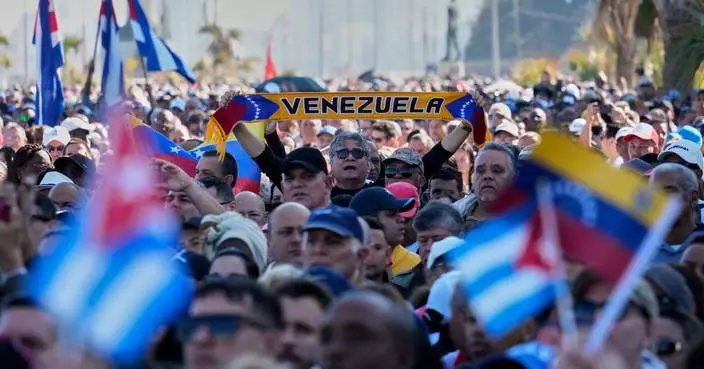
Cuban authorities called a rally in support of Venezuela’s government and railed against the U.S. military operation, writing in a statement: “All the nations of the region must remain alert, because the threat hangs over all of us.”
Rubio, a former Florida senator and son of Cuban immigrants, has long maintained Cuba is a dictatorship repressing its people.
“This is the Western Hemisphere. This is where we live — and we’re not going to allow the Western Hemisphere to be a base of operation for adversaries, competitors, and rivals of the United States," Rubio said.
Cubans like 55-year-old biochemical laboratory worker Bárbara Rodríguez were following developments in Venezuela. She said she worried about what she described as an “aggression against a sovereign state.”
“It can happen in any country, it can happen right here. We have always been in the crosshairs,” Rodríguez said.
AP writers Andrea Rodriguez in Havana, Cuba, and Darlene Superville traveling aboard Air Force One contributed reporting.
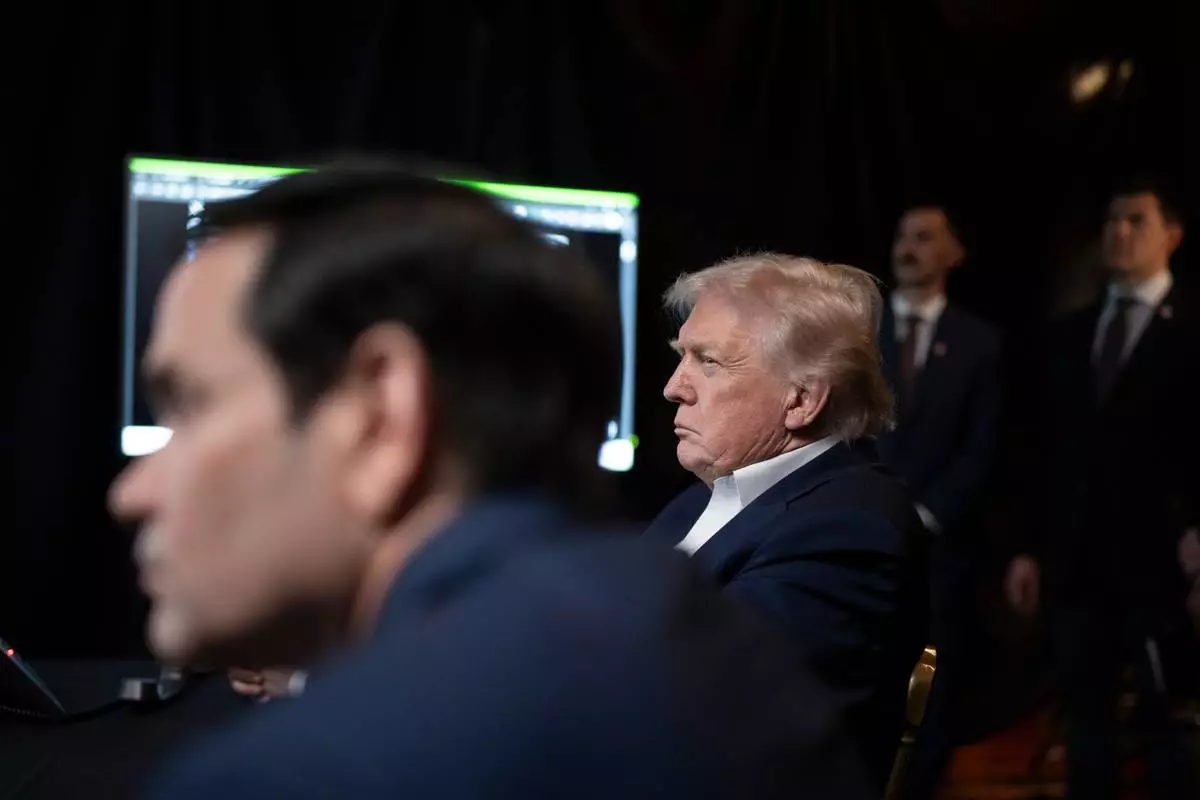
In this photo released by the White House, President Donald Trump monitors U.S. military operations in Venezuela, with Secretary of State Marco Rubio at Mar-a-Lago in Palm Beach, Fla., Saturday, Jan. 3, 2026. (Molly Riley/The White House via AP)