LONDON--(BUSINESS WIRE)--May 20, 2025--
New research from Omdia reveals that Netflix maintains its leading position in South Korea’s subscription-based online video market, accounting for 31% of the total subscriber base. However, major domestic platforms collectively represent a larger 40% share, led by Tving (16%), Coupang Play (13%) and Wavve (11%).
This press release features multimedia. View the full release here: https://www.businesswire.com/news/home/20250519923488/en/
The performance of local platforms reflects their strong cultural alignment and strategic presence within South Korea’s streaming ecosystem. With K-dramas continuing to play a significant role in the global content market, platforms such as Tving are expected to expand their content libraries to strengthen competitiveness both domestically and internationally.
As part of this broader strategy, CJ ENM, Tving’s primary shareholder, has outlined plans for global expansion, targeting 15 million global subscribers by 2027. To support this ambition, CJ ENM has committed an additional KRW150 billion ($106 million) for content investment in 2025, on top of the KRW 1 trillion (approximately $706 million) budget announced last year. The company also plans to collaborate with studios in the US, Japan, and Southeast Asia, which are the key markets for its global expansion. Tving’s international roll out is signaling a potential shift in its distribution approach that could influence competitive dynamics across global streaming markets.
Kia Ling Teoh, Senior Analyst at Omdia, commented: “These are notable developments for the local video business. A potential game-changer could develop from the ongoing merger discussions between Tving and Wavve. If the deal proceeds, it could result in the formation of South Korea’s largest domestic streaming service, severely narrowing the gap with Netflix and further reshaping the competitive landscape.”
Coupang Play, operated by South Korea’s e-commerce firm Coupang, is currently the third-largest streaming platform in the country. The service is available exclusively to subscribers of Coupang’s premium Wow membership program. While its original content library remains smaller than Tving, Coupang Play has expanded its offering through securing major sports broadcasting rights, and through strategic content partnerships with Hollywood studios including Paramount and Warner Bros. Discovery. These agreements provide exclusive access to popular international titles from Paramount+, HBO, Max, and Warner Bros., differentiating Coupang Play from competitors that focus more heavily on domestic originals.
Jun Wen Woo, Senior Analyst at Omdia, added: “As the market continues to evolve, both global and local platforms are adapting their content and platform strategies to meet changing consumer expectations. While Netflix leads in terms of individual subscriber share, the collective momentum of domestic platforms, driven by strong local content, strategic investment, and platform innovation, positions them as key players in the future of South Korea’s streaming ecosystem and increasingly, the global market.”
ABOUT OMDIA
Omdia, part of Informa TechTarget, Inc. (Nasdaq: TTGT), is a technology research and advisory group. Our deep knowledge of tech markets combined with our actionable insights empower organizations to make smart growth decisions.

South Korea: Subscription online video market share by operators' subscription base 2025, (%)
RHO, Italy (AP) — No ice is colder and harder than speedskating ice. The precision it takes has meant that Olympic speedskaters have never competed for gold on a temporary indoor rink – until the 2026 Milan Cortina Winter Games.
In the pursuit of maximum glide and minimum friction, Olympic officials brought on ice master Mark Messer, a veteran of six previous Olympic speedskating tracks and the ice technician in charge of the Olympic Oval in Calgary, Canada — one of the fastest tracks in the world with over 300 records.
Messer has been putting that experience to work one thin layer of ice at a time since the end of October at the new Speed Skating Stadium, built inside adjacent trade fair halls in the city of Rho just north of Milan.
“It’s one of the biggest challenges I’ve had in icemaking,’’ Messer said during an interview less than two weeks into the process.
If Goldilocks were a speedskater, hockey ice would be medium hard, for fast puck movement and sharp turns. Figure skating ice would be softer, allowing push off for jumps and so the ice doesn’t shatter on landing. Curling ice is the softest and warmest of all, for controlled sliding.
For speedskating ice to be just right, it must be hard, cold and clean. And very, very smooth.
“The blades are so sharp, that if there is some dirt, the blade will lose the edge,’’ Messer said, and the skater will lose speed.
Speedskater Enrico Fabris, who won two Olympic golds in Turin in 2006, has traded in his skates to be deputy sports manager at the speedskating venue in Rho. For him, perfect ice means the conditions are the same for all skaters — and then if it's fast ice, so much the better.
"It's more of a pleasure to skate on this ice,'' he said.
Messer’s first Olympics were in Calgary in 1988 — the first time speedskating was held indoors. “That gave us some advantages because we didn’t have to worry about the weather, wind blowing or rain,’’ he said. Now he is upping the challenge by becoming the first ice master to build a temporary rink for the Olympics.
Before Messer arrived in Italy, workers spent weeks setting up insulation to level the floor and then a network of pipes and rubber tubes that carry glycol — an antifreeze — that is brought down to minus 7 or minus 8 degrees Celsius (17.6 to 19.4 degrees Fahrenheit) to make the ice.
Water is run through a purification system — but it can’t be too pure, or the ice that forms will be too brittle. Just the right amount of impurities “holds the ice together,’’ Messer said.
The first layers of water are applied slowly, with a spray nozzle; after the ice reaches a few centimeters it is painted white — a full day’s work — and the stripes are added to make lanes.
“The first one takes about 45 minutes. And then as soon as it freezes, we go back and do it again, and again and again. So we do it hundreds of times,’’ Messer said.
As the ice gets thicker, and is more stable, workers apply subsequent layers of water with hoses. Messer attaches his hose to hockey sticks for easier spreading.
What must absolutely be avoided is dirt, dust or frost — all of which can cause friction for the skaters, slowing them down. The goal is that when the skaters push “they can go as far as possible with the least amount of effort,’’ Messer said.
The Zamboni ice resurfacing machine plays a key role in keeping the track clean, cutting off a layer and spraying water to make a new surface.
One challenge is gauging how quickly the water from the resurfacing machine freezes in the temporary rink.
Another is getting the ice to the right thickness so that the Zamboni, weighing in at six tons, doesn’t shift the insulation, rubber tubing or ice itself.
“When you drive that out, if there’s anything moving it will move. We don’t want that,’’ Messer said.
The rink got its first big test on Nov. 29-30 during a Junior World Cup event. In a permanent rink, test events are usually held a year before the Olympics, leaving more time for adjustments. “We have a very small window to learn,’’ Messer acknowledged.
Dutch speedskater Kayo Vos, who won the men’s neo-senior 1,000 meters, said the ice was a little soft — but Messer didn’t seem too concerned.
“We went very modest to start, now we can start to change the temperatures and try to make it faster and still maintain it as a safe ice,’’ he said.
Fine-tuning the air temperature and humidity and ice temperature must be done methodically — taking into account that there will be 6,000 spectators in the venue for each event. The next real test will be on Jan. 31, when the Olympians take to the ice for their first training session.
“Eighty percent of the work is done but the hardest part is the last 20 percent, where we have to try to find the values and the way of running the equipment so all the skaters get the same conditions and all the skaters get the best conditions,’’ Messer said.
AP Winter Olympics: https://apnews.com/hub/milan-cortina-2026-winter-olympics

Serpentines are set on the ice of the stadium where speed skating discipline of the Milan Cortina 2026 Winter Olympics will take place, in Rho, outskirt of Milan, Tuesday, Nov. 11, 2025. (AP Photo/Luca Bruno)

Ice Master Mark Messer poses in the stadium where speed skating discipline of the Milan Cortina 2026 Winter Olympics will take place, in Rho, outskirt of Milan, Tuesday, Nov. 11, 2025. (AP Photo/Luca Bruno)
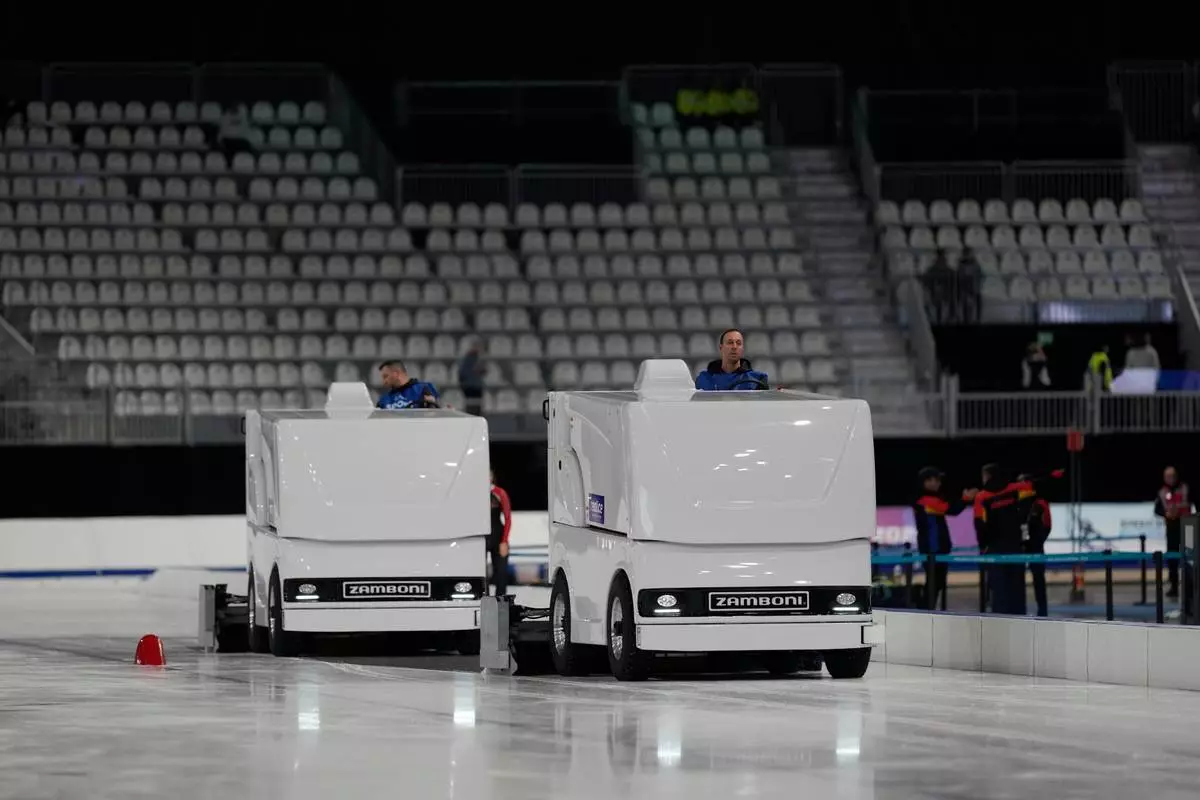
Workers clean the ice surface during a peed skating Junior World Cup and Olympic test event, in Rho, near Milan, Italy, Saturday, Nov. 29, 2025. (AP Photo/Luca Bruno)

Ice Master Mark Messer poses in the stadium where speed skating discipline of the Milan Cortina 2026 Winter Olympics will take place, in Rho, outskirt of Milan, Tuesday, Nov. 11, 2025. (AP Photo/Luca Bruno)

Ice Master Mark Messer poses in the stadium where speed skating discipline of the Milan Cortina 2026 Winter Olympics will take place, in Rho, outskirt of Milan, Tuesday, Nov. 11, 2025. (AP Photo/Luca Bruno)