SACRAMENTO, Calif. (AP) — Congress may stop California from implementing its first-in-the nation rule banning the sale of new gas-powered cars by 2035.
A Senate vote expected as soon as this week could end the nation's most aggressive effort to transition toward electric vehicles as President Donald Trump's administration doubles down on fossil fuels.
California makes up roughly 11% of the U.S. car market, giving it significant power to shape purchasing trends. Vehicles are one of the largest sources of planet-warming emissions.
The Republican-controlled Congress is targeting three California waivers that set stricter emissions rules than the federal government. The House voted to block them several weeks ago, and Senate Majority Leader John Thune said his chamber would take up a similar effort this week, even though the Senate Parliamentarian and the U.S. Government Accountability Office say California’s policies are not subject to the review mechanism used by the House.
Thune said California's “are an improper expansion of a limited Clean Air Act authority and would endanger consumers, our economy, and our nation’s energy supply.”
California Gov. Gavin Newsom and state air regulators say what lawmakers are doing is illegal and they will likely sue if the measure advances.
Here's what to know:
The Environmental Protection Agency has let the state adopt stricter emissions standards for decades, and other states can sign on to those rules.
California has some of the nation's worst air pollution, and the waivers date back to efforts in the 1960s and 1970s to fight smog in Los Angeles.
Trump rescinded California’s ability to enforce its standards during his first term, but President Joe Biden’s administration restored it in 2022.
Newsom, a Democrat, announced plans in 2020 to ban the sale of new gas-powered cars by 2035. State air regulators formalized the rules in 2022, and the federal government allowed them to move forward last year.
The rule requires automakers to sell an increasing number of zero-emission cars, pickup trucks and SUVs over the next decade. Electric vehicles would have to make up 43% of new sales by 2027, 68% by 2030 and 100% by 2035. People would still be able to buy used gas-powered cars, plug-in hybrids or hydrogen-powered vehicles.
California passed another rule in 2020 to phase out the sale of medium- and heavy-duty diesel vehicles, including box trucks, semitrailers and large pickups. Depending on class, zero-emission trucks will have to make up 40% to 75% of sales by 2035. The Biden administration approved that policy in 2023.
The third regulation targeted by Congress would reduce smog-forming emissions from trucks. The rule revamped a testing program to ensure heavy-duty vehicles comply with emissions standards and set stricter standards to limit pollution from nitrogen oxides and particulate matter, which pose public health risks.
New York, Colorado and New Mexico are among the states that announced plans to follow all three of the policies.
Several automakers, including Honda, Ford and Volkswagen, signed deals with California to follow some of the state's tailpipe emission standards. But the companies have not committed to complying with the 2035 mandate on gas-powered cars if it gets blocked and did not respond to requests for comment on the Senate's upcoming vote.
The National Automobile Dealers Association urged the Senate to pass the measure.
“Banning gas and hybrid cars is a national issue that should be decided by Congress, not an unelected state agency," Mike Stanton, the group's president and CEO, wrote in a letter.
The Safe Roads Coalition, which represents towing and truck companies, said the medium- and heavy-duty truck rule is unfeasible and should be blocked.
“While transitioning combustion engines to electric is well-intended, unworkable regulations threaten roadside services for millions of American motorists,” said Josh Lovelace, the group's national director.
Thune, the Senate majority leader, said the nation's grid can't handle California's plans. It is a concern shared by other critics, who point to California's struggle several summers ago to maintain consistent power during a heat wave.
“Our already shaky electric grid would quickly face huge new burdens from a surge in electric vehicles,” he said in a statement announcing the vote.
Newsom's administration argues the state is on its way to building out an electric grid and charging infrastructure that can support many more electric vehicles. Broadly, California has a goal of net-zero greenhouse gas emissions across the economy by 2045.
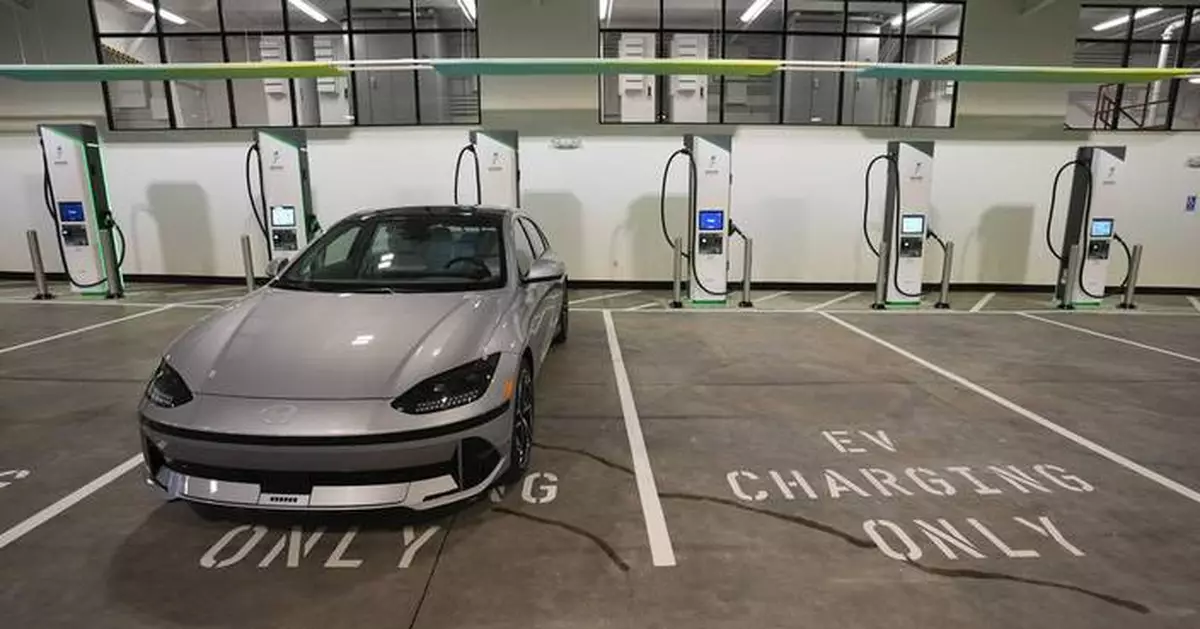
But the state remains far short of what is eventually needed. California has about 84,000 public electric vehicle chargers in the state but needs 1.2 million by 2030 to support the EV transition, according to the California Energy Commission. The Trump administration directed states earlier this year to stop spending money approved under Biden to help build electric vehicle charges across the U.S. More than a dozen states are suing the federal government over the effort.
Newsom has also recently touted the state's growing battery storage capacity. Neither the commission nor the California Air Resources Board responded to questions about how much the state's electric grid must grow to support the power demand expected from the state's transition. But the state has said it needs at least four times more wind and solar power to meet 2045 energy demands and that the grid must grow at an “unprecedented rate.”
Timothy Johnson, a professor of energy and the environment at Duke University, said most regions of the U.S. can generate enough power or add enough to meet EV charging demand, but local power lines and transformers could be overloaded.
Eleven other states, plus Washington, D.C., have adopted California's plan to phase out new gas-powered cars, according to the air board. Several more have adopted the state's previous zero-emission vehicle standards.
But some of those states are already backing away.
Republican Vermont Gov. Phil Scott last week paused enforcement of electric vehicle sales targets that follow California's, saying the pace wasn't realistic. In Delaware, Democratic Gov. Matt Meyer has said he wants to rescind the state's EV mandate. Other states still appear to be moving ahead.
Associated Press writers Mary Clare Jalonick, Matthew Daly and Alexa St. John in Washington; Bruce Shipkowski in Toms River, New Jersey; Steve Karnowski in Minneapolis; Claire Rush in Portland, Oregon; and Susan Haigh in Hartford, Connecticut, contributed.
Austin is a corps member for The Associated Press/Report for America Statehouse News Initiative. Report for America is a nonprofit national service program that places journalists in local newsrooms to report on undercovered issues. Follow Austin on X: @sophieadanna
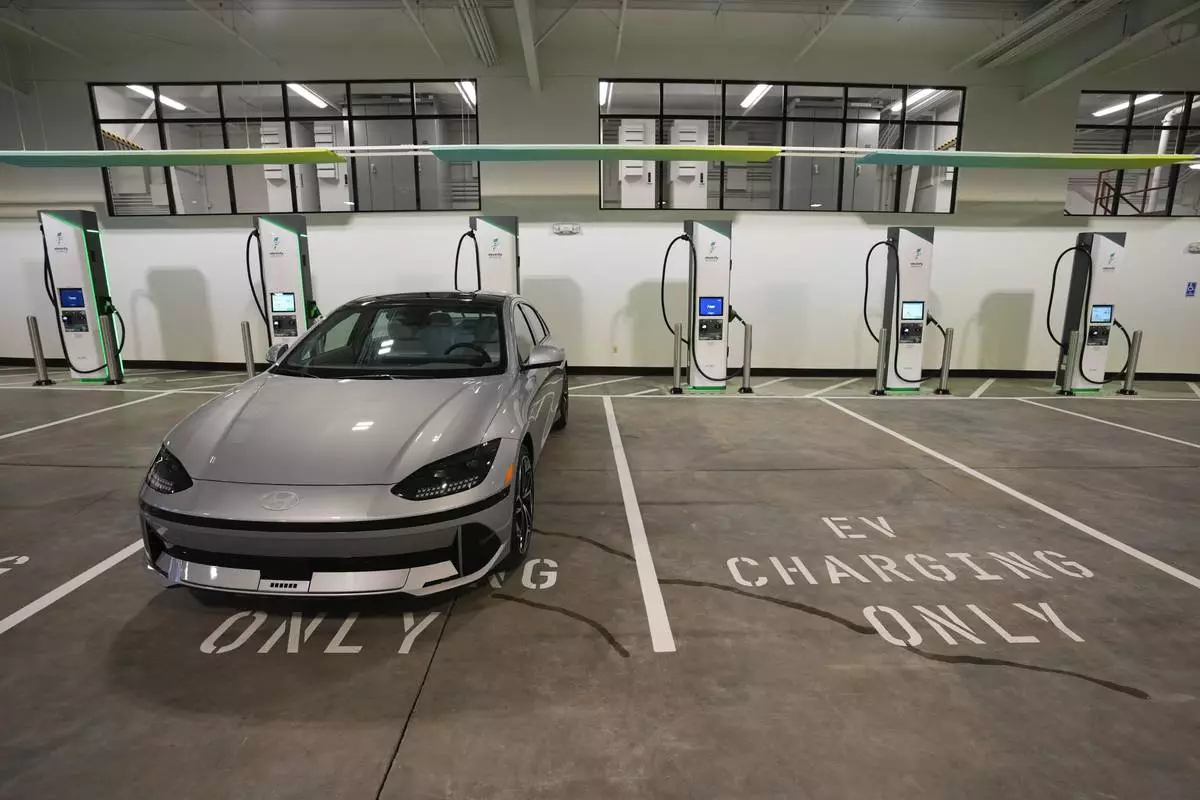
FILE - Charging bays are seen at the new Electrify America indoor electric vehicle charging station in San Francisco, Wednesday, Feb. 7, 2024. (AP Photo/Eric Risberg, File)
SEOUL, South Korea (AP) — North Korea on Thursday displayed apparent progress in the construction of a nuclear-powered submarine, with state media photos showing a largely completed hull, as leader Kim Jong Un condemned rival South Korea’s push to acquire the technology.
North Korea’s official Korean Central News Agency said Kim visited a shipyard to inspect the construction of what the North describes as an 8,700-ton-class nuclear-propelled submarine, which the leader has called a crucial step in the modernization and nuclear armament of North Korea’s navy. The North has indicated it plans to arm the submarine with nuclear weapons, calling it a “strategic guided missile submarine” or a “strategic nuclear attack submarine.”
During the visit, Kim described South Korea’s efforts to acquire its own nuclear-powered submarine, which have been backed by U.S. President Donald Trump, as an “offensive act” that severely violates the North’s security and maritime sovereignty.
He said that the South Korean plan further underscores the need to advance and nuclear-arm North Korea’s navy, and claimed that the completion of his nuclear-powered submarine would be an “epoch-making” change in strengthening its nuclear war deterrent against what he called enemy threats.
The agency did not specify when Kim visited the shipyard but released photos showing him inspecting a huge, burgundy-colored vessel, coated with what appears to be anti-corrosion paint, under construction inside an assembly hall with senior officials and his daughter. It was the first time North Korean state media had released images of the submarine since March, when they mostly showed the lower sections of the vessel.
It was not immediately clear how close North Korea is to completing the vessel. But because submarines are typically built from the inside out, the release of what appears to be a largely completed hull suggests that many core components, including the engine and possibly the reactor, are already in place, said Moon Keun-sik, a submarine expert at Seoul’s Hanyang University.
“Showing the entire vessel now seems to indicate that most of the equipment has already been installed and it is just about ready to be launched into the water,” said Moon, a former submarine officer in the South Korean navy, who believes the North Korean submarine could possibly be tested at sea within months.
A nuclear-powered submarine was one item on a long wish list of sophisticated weaponry that Kim announced during a major political conference in 2021 to cope with what he called growing U.S.-led military threats. Other weapons were solid-fueled intercontinental ballistic missiles, hypersonic weapons, spy satellites and multi-warhead missiles.
North Korea has conducted a series of tests to develop some of those systems and recently unveiled a new naval destroyer, which Kim hailed as a major step toward expanding the operational range and preemptive strike capabilities of the country’s nuclear forces.
If North Korea obtains a submarine capable of operating stealthily for extended periods and launching missiles from underwater, it would be a worrying development for its neighbors, as such launches would be difficult to detect in advance. But there have been questions about whether North Korea, a heavily sanctioned and impoverished country, could get resources and technology to build nuclear-powered submarines.
Some experts say North Korea’s recent alignment with Russia — including sending thousands of troops and military equipment to support President Vladimir Putin’s war in Ukraine — may have helped it to receive crucial technologies in return.
While some analysts suspect North Korea may have sought a reactor from Russia, possibly from a retired Russian submarine, Moon said it's more likely that North Korea designed its own reactor, while possibly receiving some technological assistance from Russia.
During a summit with Trump in November, South Korean President Lee Jae Myung called for U.S. support for South Korea’s efforts to acquire nuclear-powered submarines, while reaffirming a commitment to increase defense spending to ease the burden on the United States.
Trump later said that the United States is open to sharing closely held technology to allow South Korea to build a nuclear-powered submarine, but it’s not immediately clear where and when the vessel would be built and how Seoul would get the nuclear fuel and reactor technology required.
In a separate report, KCNA said Kim on Wednesday supervised a test of a new, long-range anti-air missile that was fired toward its eastern sea. South Korea’s Defense Ministry didn’t immediately comment on the launch.
Tensions on the Korean Peninsula have worsened in recent years as Kim accelerated his military nuclear program and deepened alignment with Moscow following Russia’s invasion of Ukraine. His government has repeatedly dismissed calls by Washington and Seoul to revive negotiations aimed at winding down his nuclear and missile programs, which derailed in 2019 following a collapsed summit with Trump during the American president’s first term.

In this photo provided by the North Korean government, a test of a long-range anti-air missile is launched towards its eastern sea, as seen from an undisclosed location in North Korea, Wednesday, Dec. 24, 2025. Independent journalists were not given access to cover the event depicted in this image distributed by the North Korean government. The content of this image is as provided and cannot be independently verified. Korean language watermark on image as provided by source reads: "KCNA" which is the abbreviation for Korean Central News Agency. (Korean Central News Agency/Korea News Service via AP)
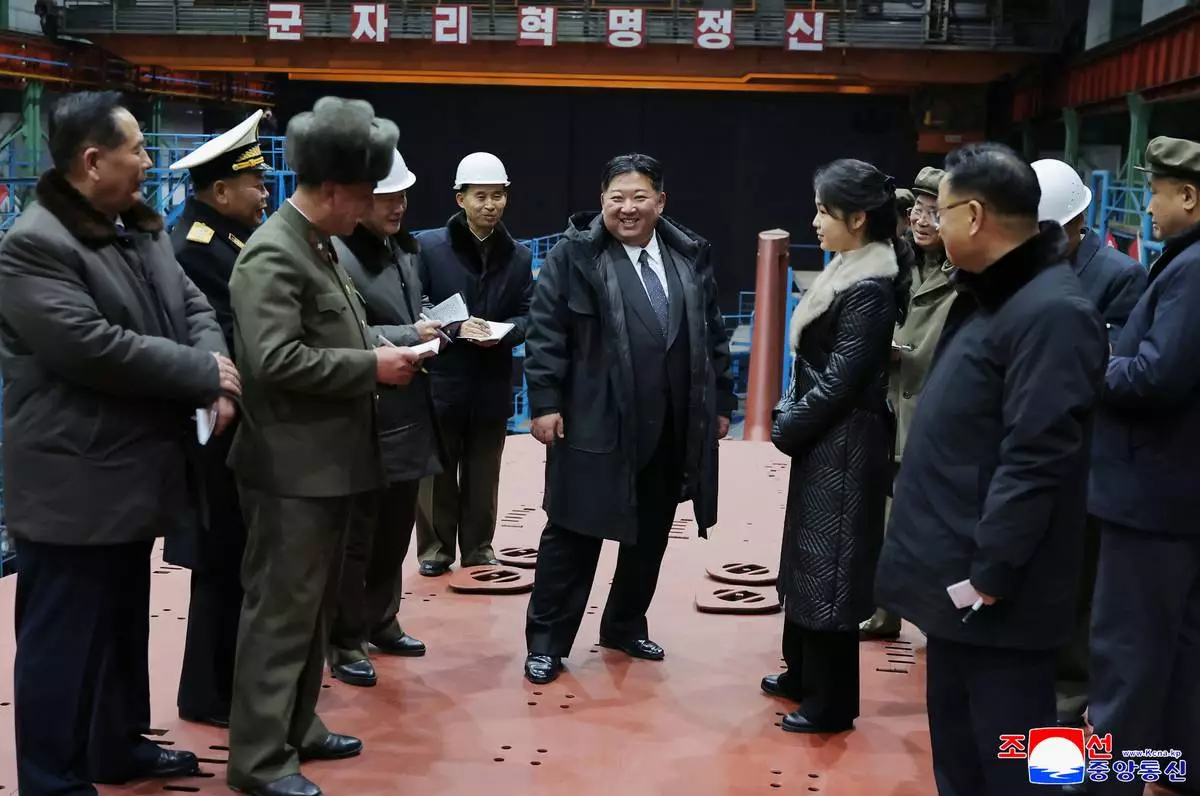
In this undated photo provided Thursday, Dec. 25, 2025, by the North Korean government, its leader Kim Jong Un, with his daughter, inspects a nuclear-powered submarine under construction at an undisclosed location in North Korea. Independent journalists were not given access to cover the event depicted in this image distributed by the North Korean government. The content of this image is as provided and cannot be independently verified. Korean language watermark on image as provided by source reads: "KCNA" which is the abbreviation for Korean Central News Agency. (Korean Central News Agency/Korea News Service via AP)

In this undated photo provided Thursday, Dec. 25, 2025, by the North Korean government, its leader Kim Jong Un, third left, visits a shipyard as he inspects a nuclear-powered submarine under construction at an undisclosed location in North Korea. Independent journalists were not given access to cover the event depicted in this image distributed by the North Korean government. The content of this image is as provided and cannot be independently verified. Korean language watermark on image as provided by source reads: "KCNA" which is the abbreviation for Korean Central News Agency. (Korean Central News Agency/Korea News Service via AP)

In this undated photo provided Thursday, Dec. 25, 2025, by the North Korean government, its leader Kim Jong Un inspects a nuclear-powered submarine under construction at an undisclosed location in North Korea. Independent journalists were not given access to cover the event depicted in this image distributed by the North Korean government. The content of this image is as provided and cannot be independently verified. Korean language watermark on image as provided by source reads: "KCNA" which is the abbreviation for Korean Central News Agency. (Korean Central News Agency/Korea News Service via AP)

In this undated photo provided Thursday, Dec. 25, 2025, by the North Korean government, its leader Kim Jong Un inspects a nuclear-powered submarine under construction at an undisclosed location in North Korea. Independent journalists were not given access to cover the event depicted in this image distributed by the North Korean government. The content of this image is as provided and cannot be independently verified. Korean language watermark on image as provided by source reads: "KCNA" which is the abbreviation for Korean Central News Agency. (Korean Central News Agency/Korea News Service via AP)