NEW YORK (AP) — U.S. stocks are drifting in tentative trading following a rocky week so far because of worries coming out of the bond market about the U.S. government’s soaring debt. The S&P 500 was down 0.1% in early trading Thursday. The Dow Jones Industrial Average was down 99 points, and the Nasdaq composite was up 0.1%. Treasury yields were also holding a bit steadier in the bond market, but only after oscillating earlier in the morning after the House of Representatives approved a bill that would cut taxes and could add trillions of dollars to the U.S. debt.
THIS IS A BREAKING NEWS UPDATE. AP’s earlier story follows below.
Click to Gallery
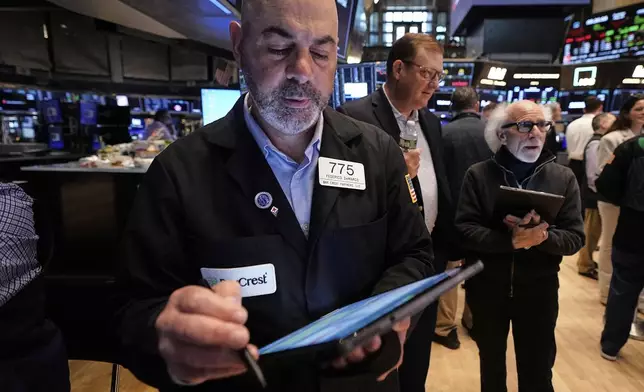
Traders Fred Demarco, left, and Peter Tuchman, right, work on the floor of the New York Stock Exchange, Tuesday, May 20, 2025. (AP Photo/Richard Drew)

Meagen Eisenberg, second from right, Chief Marketing Officer of Samsara, gavels trading closed at the New York Stock Exchange, Tuesday, May 20, 2025. (AP Photo/Richard Drew)

Currency traders watch monitors near a screen showing the Korea Composite Stock Price Index (KOSPI), top left, and the foreign exchange rate between U.S. dollar and South Korean won, top center, at the foreign exchange dealing room of the KEB Hana Bank headquarters in Seoul, South Korea, Thursday, May 22, 2025. (AP Photo/Ahn Young-joon)

A currency trader passes by a screen showing the Korea Composite Stock Price Index (KOSPI), top left, and the foreign exchange rate between U.S. dollar and South Korean won, top center, at the foreign exchange dealing room of the KEB Hana Bank headquarters in Seoul, South Korea, Thursday, May 22, 2025. (AP Photo/Ahn Young-joon)

Currency traders work near a screen showing the Korea Composite Stock Price Index (KOSPI) and the foreign exchange rate between U.S. dollar and South Korean won, right, at the foreign exchange dealing room of the KEB Hana Bank headquarters in Seoul, South Korea, Thursday, May 22, 2025. (AP Photo/Ahn Young-joon)
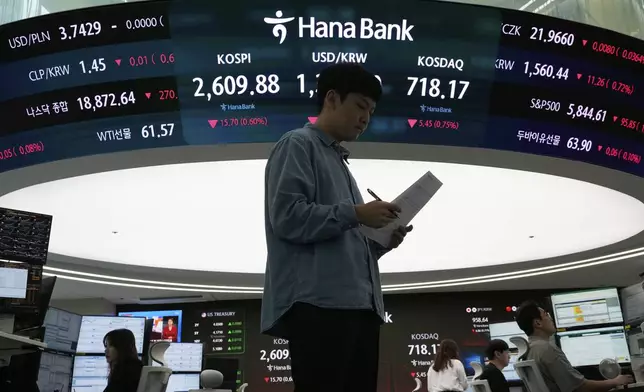
A currency trader works near a screen showing the Korea Composite Stock Price Index (KOSPI), top center left, and the foreign exchange rate between U.S. dollar and South Korean won, top center, at the foreign exchange dealing room of the KEB Hana Bank headquarters in Seoul, South Korea, Thursday, May 22, 2025. (AP Photo/Ahn Young-joon)
Bond yields inched higher and Wall Street flipped from small gains to losses before the opening bell Thursday after rising U.S. debt sank markets on the previous day.
Futures for the Dow Jones Industrial Average fell 0.5% in premarket trading, while futures for the S&P 500 and Nasdaq each slid 0.3%.
U.S. markets are also reacting to the passage early in the House on Thursday of the Republicans' multitrillion-dollar spending bill, which aims to extend some $4.5 trillion in tax breaks from President Donald Trump’s first term in 2017 while adding others. The bill, which has stiffer requirements for Medicaid and other programs, is expected to undergo some changes when it gets to the Senate for a vote.
The legislation also includes a speedier rollback of production tax credits for clean electricity projects, which sent shares of solar companies tumbling. First Solar slid more than 7%, while Sunrun lost nearly one-third of its value. Energy technology company Enphase Energy fell 15%.
Health care stocks were also falling early Thursday after the Centers for Medicare & Medicaid Services said it was immediately expanding its auditing of Medicare Advantage plans. UnitedHealth Group fell 3.5% and Humana was down 4.8%.
U.S. markets are coming off significant losses from a day earlier over concerns about the cost of the bill and the U.S.'s already mounting debt. The nonpartisan Congressional Budget Office said the tax provisions would increase federal deficits by $3.8 trillion over the decade.
Treasury yields ticked up on Thursday after spiking the day before when the U.S. government released the results for its latest auction of 20-year bonds. Such bonds help to pay government bills and the auction had to offer a yield of more than 5% to attract enough buyers.
The yield on the 10-year was at 4.62% early Thursday, up from 4.51% two days ago, a significant move in the bond market.
Rising yields for U.S. Treasury bonds are a canary in the coal mine, Stephen Innes of SPI Asset Management said in a commentary.
“The U.S. still has the biggest markets, the deepest liquidity, and the dollar’s inertia working in its favor. But even inertia can’t outrun compound interest and structural deficits forever,” he wrote.
The declining U.S. dollar weighed on Asian regional markets, according to some analysts, because some Asian nations have significant holdings in dollars. It also affects Asian exporters, such as Japanese automakers and electronics companies, by reducing the value of their overseas earnings when they are converted into yen.
In currency trading, the U.S. dollar fell to 143.35 Japanese yen from 143.68 yen. It had been trading at 150 yen levels a year ago. The euro slid to $1.1312.
Japan's benchmark Nikkei 225 shed 0.8% to finish at 36,985.87.
Hong Kong’s Hang Seng lost 1.2% to 23,544.31, while the Shanghai Composite edged down 0.2% to 3,380.19.
Australia's S&P/ASX 200 slipped 0.5% to 8,348.70. South Korea's Kospi dropped 1.2% to 2,593.67.
In Europe at midday, France’s CAC 40 slipped 1.1%, while Germany’s DAX declined 1%. Britain’s FTSE 100 fell 0.8%.
The price of oil fell on media reports that OPEC+ was considering another production increase. Benchmark U.S. crude lost 94 cents to $60.63 a barrel. Brent crude, the international standard, fell 99 cents to $63.92 a barrel.
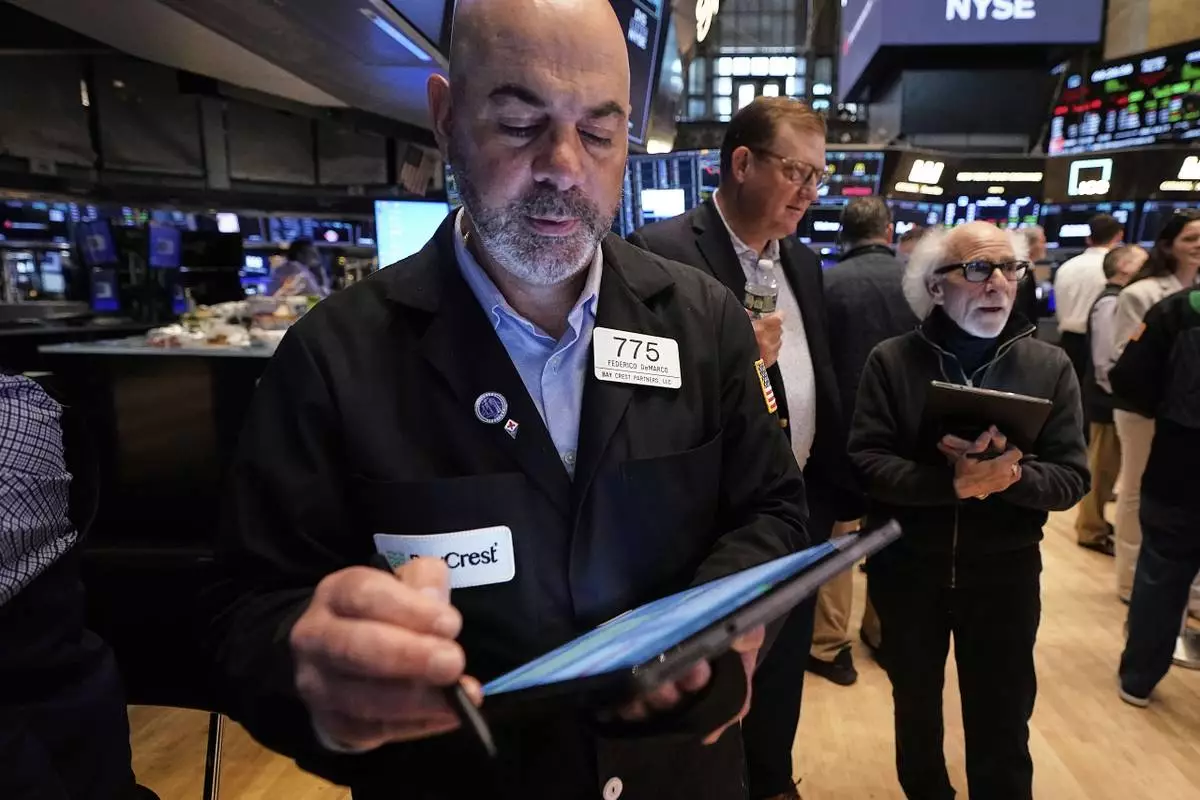
Traders Fred Demarco, left, and Peter Tuchman, right, work on the floor of the New York Stock Exchange, Tuesday, May 20, 2025. (AP Photo/Richard Drew)

Meagen Eisenberg, second from right, Chief Marketing Officer of Samsara, gavels trading closed at the New York Stock Exchange, Tuesday, May 20, 2025. (AP Photo/Richard Drew)

Currency traders watch monitors near a screen showing the Korea Composite Stock Price Index (KOSPI), top left, and the foreign exchange rate between U.S. dollar and South Korean won, top center, at the foreign exchange dealing room of the KEB Hana Bank headquarters in Seoul, South Korea, Thursday, May 22, 2025. (AP Photo/Ahn Young-joon)

A currency trader passes by a screen showing the Korea Composite Stock Price Index (KOSPI), top left, and the foreign exchange rate between U.S. dollar and South Korean won, top center, at the foreign exchange dealing room of the KEB Hana Bank headquarters in Seoul, South Korea, Thursday, May 22, 2025. (AP Photo/Ahn Young-joon)

Currency traders work near a screen showing the Korea Composite Stock Price Index (KOSPI) and the foreign exchange rate between U.S. dollar and South Korean won, right, at the foreign exchange dealing room of the KEB Hana Bank headquarters in Seoul, South Korea, Thursday, May 22, 2025. (AP Photo/Ahn Young-joon)

A currency trader works near a screen showing the Korea Composite Stock Price Index (KOSPI), top center left, and the foreign exchange rate between U.S. dollar and South Korean won, top center, at the foreign exchange dealing room of the KEB Hana Bank headquarters in Seoul, South Korea, Thursday, May 22, 2025. (AP Photo/Ahn Young-joon)