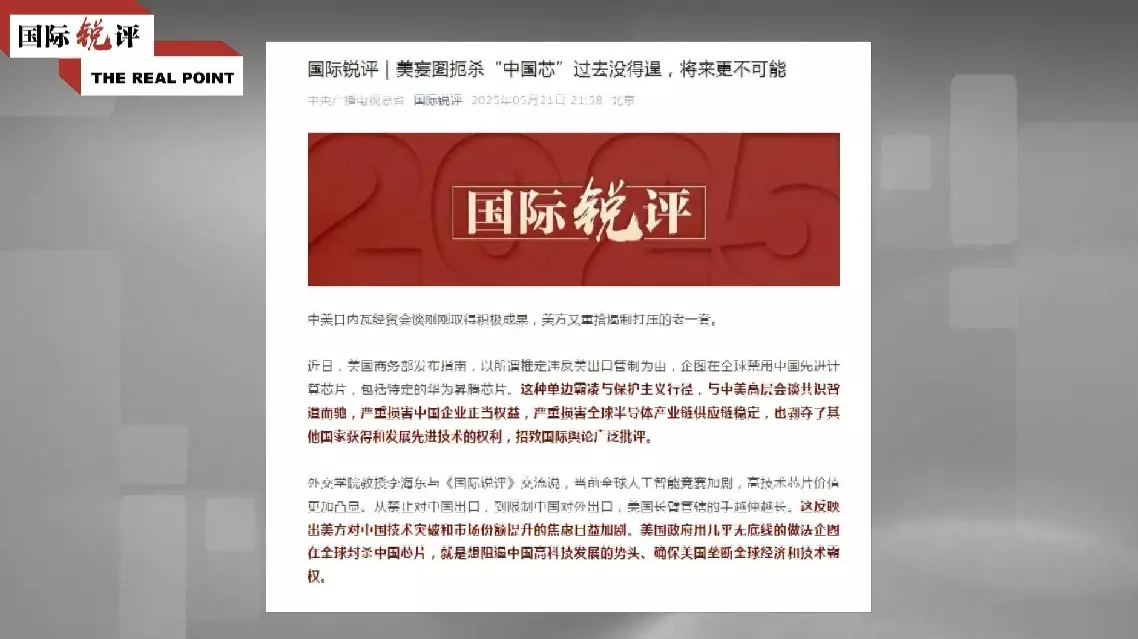
A Chinese language media commentary points out the U.S. attempt to strangle China's chip industry failed in the past and is bound to fail in the future.
An edited translation of the commentary published on Wednesday by the Chinese language media outlet The Real Point is as follows:
Despite the recent outcomes of the China-U.S. economic and trade meeting in Geneva, the U.S. has once again resorted to its old tactics of suppression and containment against China.
The U.S. Department of Commerce recently issued new guidelines, claiming that certain Chinese advanced computing chips - including Huawei's Ascend chips - are presumed to violate U.S. export controls, and attempting to impose a global ban on them. This unilateral bullying and protectionist behavior contradicts the consensus reached during China-U.S. high-level meeting. It severely undermines the legitimate rights of Chinese companies, destabilizes the global semiconductor supply chain, and deprives other countries of the right to access and develop advanced technologies, prompting widespread international criticism.
During an interview, Li Haidong, a professor at China Foreign Affairs University, said that global competition in artificial intelligence is intensifying, making high-tech chips even more critical. By moving from banning exports to China to restricting China's exports, the U.S. is extending its long-arm jurisdiction. This reflects the growing concern in the U.S. over China's technological advancements and its rising market share. The U.S. government's virtually unlimited tactics to block Chinese chips globally aim to curb China's high-tech progress and preserve U.S. monopoly over global economic and technological power.
The U.S. adopts a "develop for itself, prevent others from advancing" strategy, which runs counter to the current global trend of collaborative technological progress. In this context, chip manufacturing is a prime example of a globalized industry. According to industry experts, making a single chip requires collaboration among at least seven countries and 39 companies, involving over 50 industries and thousands of processes. The U.S. government's repeated mistakes, such as export controls, have been based on a zero-sum mindset, and disrupted and distorted the global semiconductor supply chain. This not only increases costs, hinders innovation, and harms U.S. companies and consumers but also damages the broader global technological landscape.
Renowned scholar and Columbia University professor Jeffrey Sachs pointed out that countries should strengthen cooperation in advanced technologies rather than divide the world into "friends" and "enemies." The U.S. government has turned what should be shared technological benefits into bargaining chips in a zero-sum game, severing global collaboration and destabilizing the global supply chain. Jensen Huang, CEO of U.S. tech giant Nvidia, recently said that the Chinese market is vital for Nvidia and that the U.S. export ban on chips to China is "deeply painful." The New York Times also reported that the U.S. government’s actions are undermining the pillars of U.S. strength and innovation.
Protectionism cannot protect competitiveness, and this is a fundamental truth in human economic development. As the world's leading technological and economic power, the U.S. often champions "free competition" and "market economy." However, in reality, U.S. decision-makers cling to a "you lose, I win" zero-sum mentality and lack the courage to approach competition rationally. The U.S. claims it wants to keep the U.S. "at the forefront of AI innovation." Yet, instead of improving the investment environment, retaining and attracting talent, and ramping up research and development, it attempts to sabotage others' progress. This approach will not accelerate the U.S. progress. On the contrary, it will weaken its global competitiveness and accelerate the decline of U.S. hegemony. The facts have already proven that China's progress and development are unstoppable, regardless of the extent of containment or blockade imposed.
In recent years, China has made significant breakthroughs in frontier technologies, from quantum technology to emerging AI innovations such as DeepSeek, to the booming humanoid robotics industry. In 2024, China's total research and development expenditure exceeded 3.6 trillion yuan (496.32 billion U.S. dollars), ranking second in the world. The number of researchers has ranked first globally for 11 consecutive years. The National Innovation Index Report 2024 also shows that China has ranked the 10th globally, improving by 10 places since 2012 -- the fastest progress of any country in over a decade.
In the chip sector, certain U.S. individuals hoped to use it to suppress China's progress through export controls, but the result has been the opposite. Data shows that in 2024, China's integrated circuit exports reached 159.55 billion U.S. dollars, marking a 17.4 percent year-on-year increase and setting a new record. The export volume reached 298.13 billion units, an 11.7-percent rise. This suggests that China's influence in the global semiconductor industry is steadily growing.
The U.S. should immediately correct the wrongdoing, adhere to international trade rules, and respect other countries' right to technological development. China is open to resolving differences through dialog with the U.S., but will firmly reject any form of unilateral bullying. The "small yard, high fence" and the "iron curtain of sci-technology" failed to constrain China's development in the past, and they certainly will not in the future.
US attempt to strangle China's chips is doomed from start: commentary