Skip to Content Facebook Feature Image

Gaza's main hospital is overwhelmed with children in pain from malnutrition

News

Gaza's main hospital is overwhelmed with children in pain from malnutrition
News

News

Gaza's main hospital is overwhelmed with children in pain from malnutrition

2025-05-23 08:27 Last Updated At:08:31

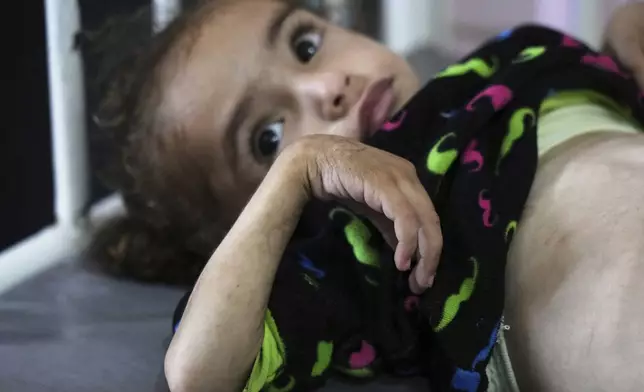
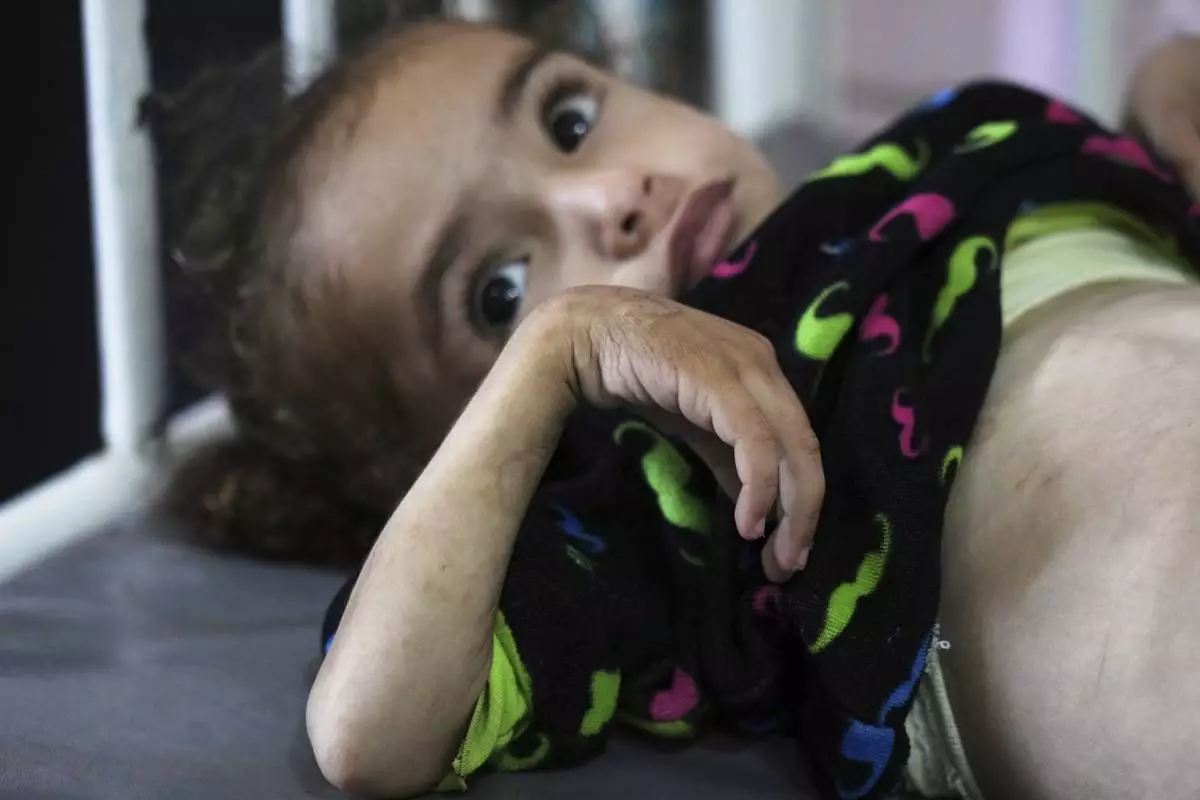
KHAN YOUNIS, Gaza Strip (AP) — Grabbing her daughter's feeble arm, Asmaa al-Arja pulls a shirt over the 2-year-old's protruding ribs and swollen belly. The child lies on a hospital bed, heaving, then wails uncontrollably, throwing her arms around her own shoulders as if to console herself.

This isn't the first time Mayar has been in a Gaza hospital battling malnutrition, yet this 17-day stint is the longest. She has celiac disease, an autoimmune disorder that means she can't eat gluten and requires special food. But there's little left for her to eat in the embattled enclave after 19 months of war and Israel's punishing blockade, and she can't digest what's available.

More Images
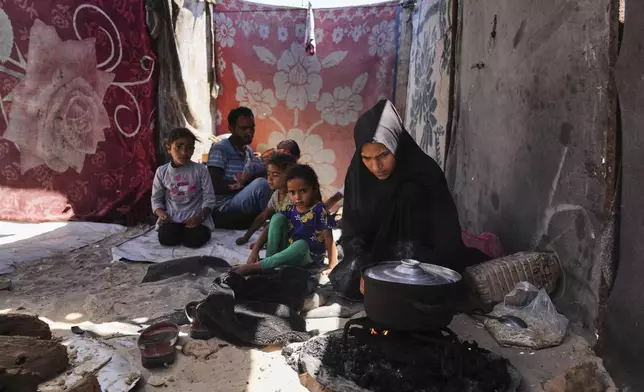
Nouf Al-Arja, 30, who suffers from malnutrition, cooks for her family inside their tent in a camp for displaced Palestinians in Muwasi, Khan Younis, Gaza, Wednesday, May 21, 2025. (AP Photo/Abdel Kareem Hana)
Nouf Al-Arja, 30, who suffers from malnutrition, cooks for her family inside their tent in a camp for displaced Palestinians in Muwasi, Khan Younis, Gaza, Wednesday, May 21, 2025. (AP Photo/Abdel Kareem Hana)

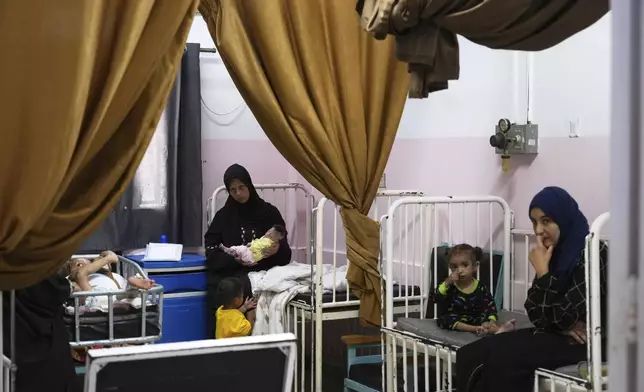
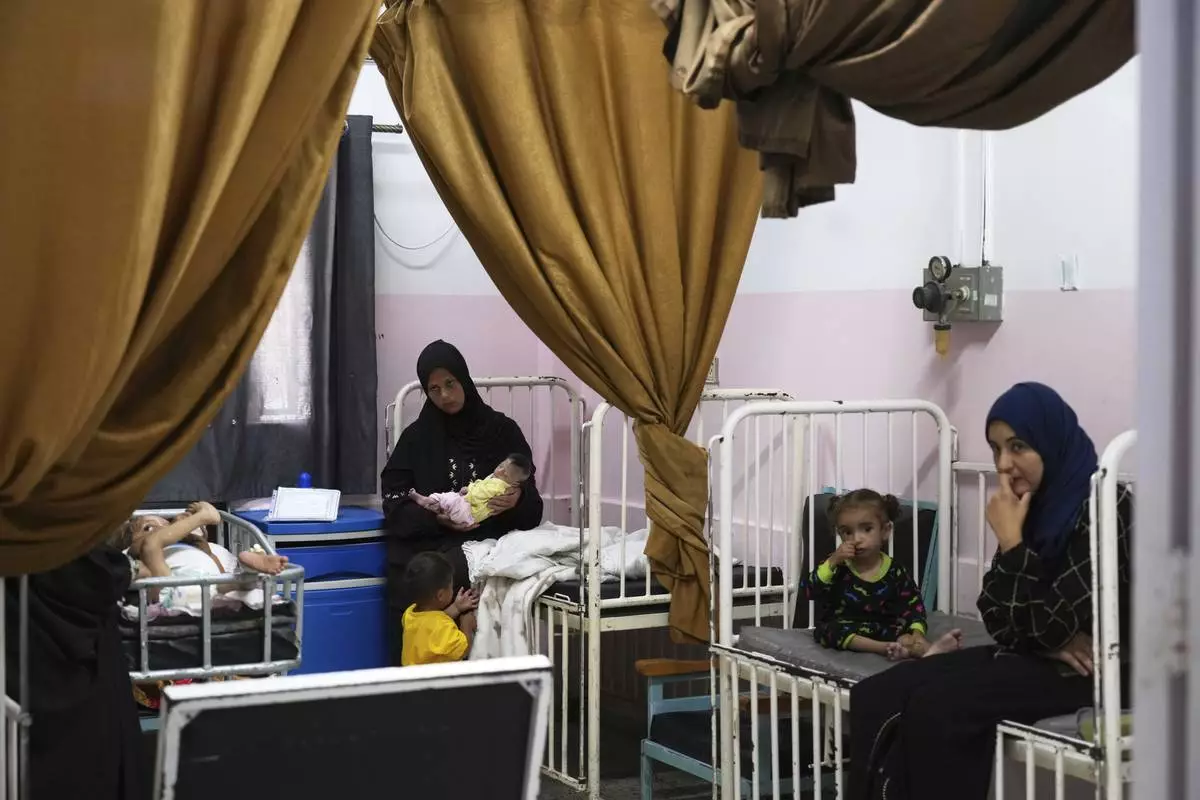
Mayar Al-Arja, 2, right, and 5-month-old Yousef Al-Najjar, both suffering from malnutrition, are cared for by their mothers in a clinic in Nasser Hospital, Khan Younis, Gaza, on Wednesday, May 21, 2025. (AP Photo/Abdel Kareem Hana)
Mayar Al-Arja, 2, right, and 5-month-old Yousef Al-Najjar, both suffering from malnutrition, are cared for by their mothers in a clinic in Nasser Hospital, Khan Younis, Gaza, on Wednesday, May 21, 2025. (AP Photo/Abdel Kareem Hana)

Mayar Al-Arja, 2, who suffers from malnutrition, lies on a bed in a clinic in Nasser hospital, Khan Younis, Gaza, Wednesday, May 21, 2025. (AP Photo/Abdel Kareem Hana)

Mayar Al-Arja, 2, who suffers from malnutrition, lies on a bed in a clinic in Nasser hospital, Khan Younis, Gaza, Wednesday, May 21, 2025. (AP Photo/Abdel Kareem Hana)
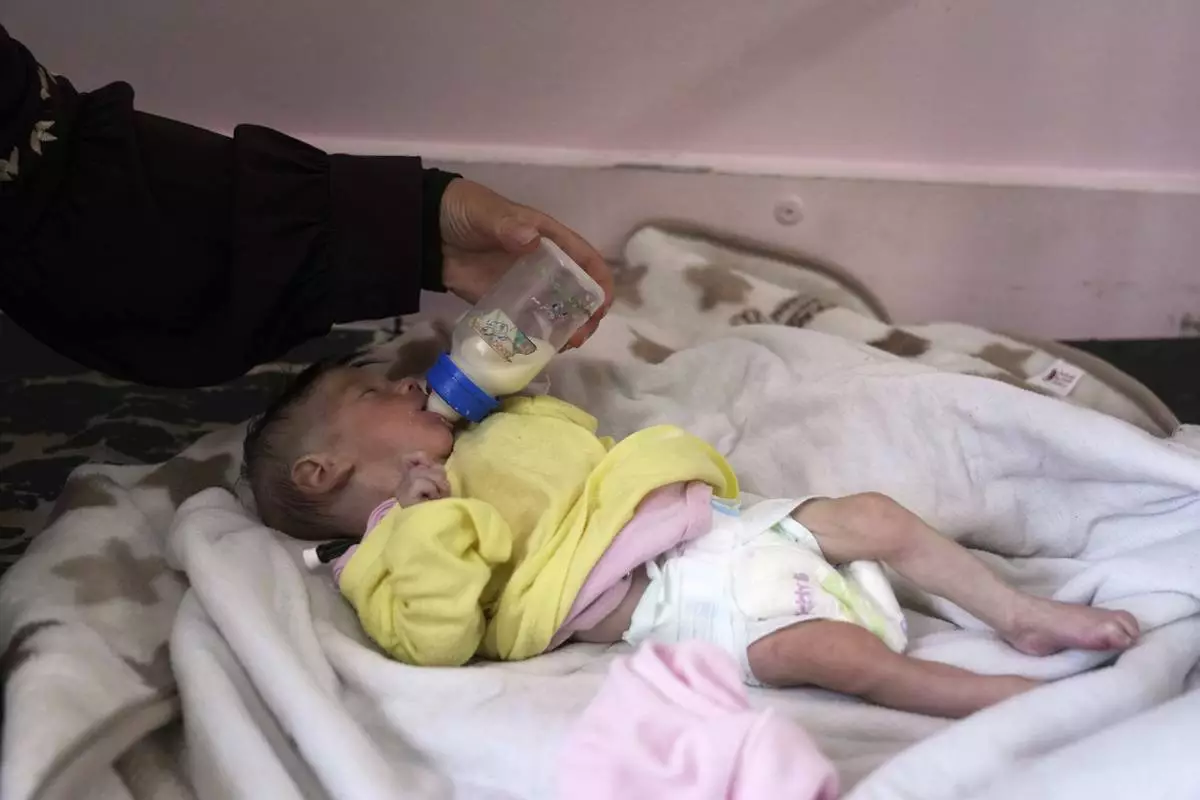
Najia Al-Najjar feeds her 5-month-old baby, Yousef, who suffers from malnutrition, at a clinic in Nasser hospital, Khan Younis, Gaza, Wednesday, May 21, 2025. (AP Photo/Abdel Kareem Hana)

Najia Al-Najjar feeds her 5-month-old baby, Yousef, who suffers from malnutrition, at a clinic in Nasser hospital, Khan Younis, Gaza, Wednesday, May 21, 2025. (AP Photo/Abdel Kareem Hana)

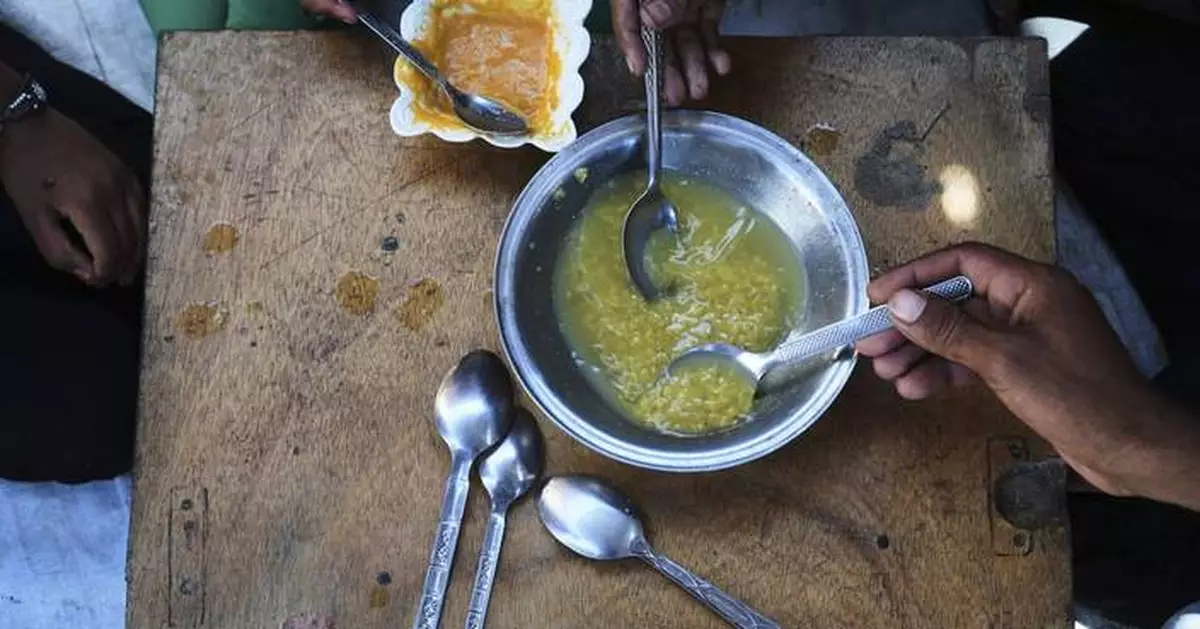
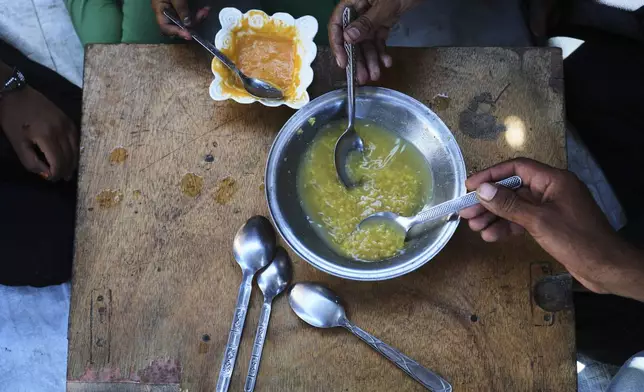
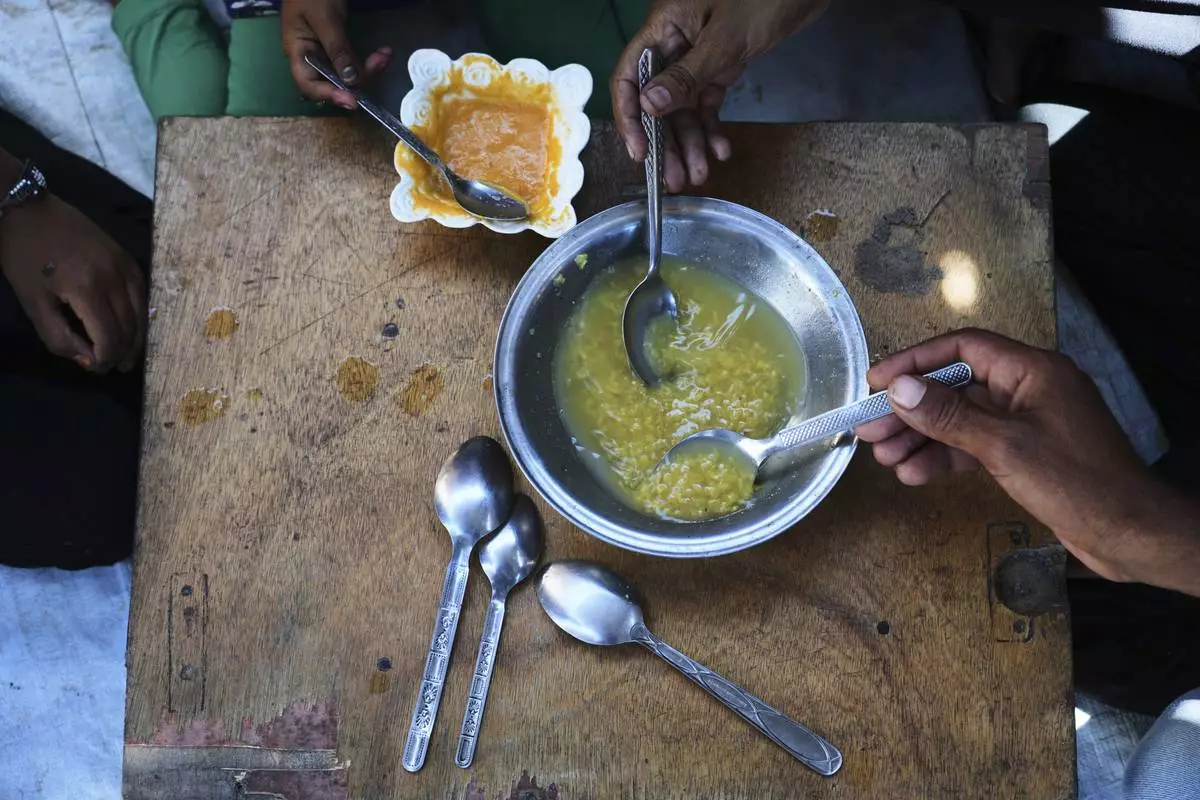
The Al-Arja family eats lentil soup inside their tent in a camp for displaced Palestinians in Muwasi, Khan Younis, Gaza, Wednesday, May 21, 2025. (AP Photo/Abdel Kareem Hana)

The Al-Arja family eats lentil soup inside their tent in a camp for displaced Palestinians in Muwasi, Khan Younis, Gaza, Wednesday, May 21, 2025. (AP Photo/Abdel Kareem Hana)

“She needs diapers, soy milk and she needs special food. This is not available because of border closures. If it's available, it is expensive, I can’t afford it,” her mother said as she sat next to Mayar at Nasser Hospital in Khan Younis.

Mayar is among the more than 9,000 children who have been treated for malnutrition this year, according to the U.N. children’s agency, and food security experts say tens of thousands of cases are expected in the coming year.

Experts also warn the territory could plunge into famine if Israel doesn’t stop its military campaign and fully lift its blockade — but the World Health Organization said last week that people are already starving.

“Everywhere you look, people are hungry. ... They point their fingers to their mouths showing that (they) need something to eat,” said Nestor Owomuhangi, the representative of the United Nations Population Fund for the Palestinian territories. “The worst has already arrived in Gaza.”

For more than two months, Israel has banned all food, medicine and other goods from entering the territory that is home to some 2 million Palestinians, as it carries out waves of airstrikes and ground operations. Palestinians in Gaza rely almost entirely on outside aid to survive because Israel's offensive has destroyed almost all the territory's food production capabilities.

After weeks of insisting Gaza had enough food, Israel relented in the face of international pressure and began allowing dozens of humanitarian trucks into the territory this week — including some carrying baby food.

“Children are already dying from malnutrition and there are more babies in Gaza now who will be in mortal danger if they don’t get fast access to the nutrition supplies needed to save their lives,” said Tess Ingram of the U.N. children’s agency.

But U.N. agencies say the amount is woefully insufficient, compared to around 600 trucks a day that entered during a recent ceasefire and that are necessary to meet basic needs. And they have struggled to retrieve the aid and distribute it, blaming complicated Israeli military procedures and the breakdown of law and order inside the territory.

On Wednesday, a U.N. official said more than a dozen trucks arrived at warehouses in central Gaza. The official spoke on condition of anonymity because they were not authorized to talk to the press. That appeared to be the first aid to actually reach a distribution point since the blockade was lifted.

Israel accuses Hamas of siphoning off aid, without providing evidence, and plans to roll out a new aid distribution system within days. U.N. agencies and aid groups say the new system would fall far short of mounting needs, force much of the population to flee again in order to be closer to distribution sites, and violate humanitarian principles by forcing people to move to receive the aid rather than delivering it based on need to where people live.

On top of not being able to find or afford the food that Mayar needs, her mother said chronic diarrhea linked to celiac disease has kept the child in and out of hospital all year. The toddler — whose two pigtails are brittle, a sign of malnutrition — weighs 7 kilograms (15 pounds), according to doctors. That's about half what healthy girl her age should.

But it’s getting harder to help her as supplies like baby formula are disappearing, say health staff.

Hospitals are hanging by a thread, dealing with mass casualties from Israeli strikes. Packed hospital feeding centers are overwhelmed with patients.

“We have nothing at Nasser Hospital," said Dr. Ahmed al-Farrah, who said his emergency center for malnourished children is at full capacity. Supplies are running out, people are living off scraps, and the situation is catastrophic for babies and pregnant women, he said.

In the feeding center of the hospital, malnourished mothers console their hungry children — some so frail their spines jut out of their skin, their legs swollen from lack food.

The Integrated Food Security Phase Classification, a leading international authority on the severity of hunger crises, has warned that there could be some 71,000 cases of malnourished children between now and March. In addition, nearly 17,000 pregnant and breastfeeding women will need treatment for acute malnutrition in the coming months.

Mai Namleh and her 18-month-old son, who live in a tent, are both malnourished. She wanted to wean him off of breastmilk because she barely has any, but she has so little else to give him.

She gives him heavily watered-down formula to ration it, and sometimes offers him starch to quiet his hunger screams. “I try to pass it for milk to stop him screaming,” she said of the formula.

An aid group gave her around 30 packets of nutritional supplements, but they ran out in two days as she shared them with family and friends, she said.

In another tent, Nouf al-Arja says she paid a fortune for a hard-to-find kilogram (about 2 pounds) of red lentils. The family cooks it with a lot of water so it lasts, unsure what they will eat next. The mother of four has lost 23 kilograms (50 pounds) and struggles to focus, saying she constantly feels dizzy.

Both she and her 3-year-old daughter are malnourished, doctors said. She's worried her baby boy, born four months earlier and massively underweight, will suffer the same fate as she struggles to breastfeed.

“I keep looking for (infant food) .... so I can feed him. There is nothing," she said.

El Deeb reported from Beirut and Mednick from Tel Aviv, Israel.

Follow AP’s war coverage at https://apnews.com/hub/israel-hamas-war
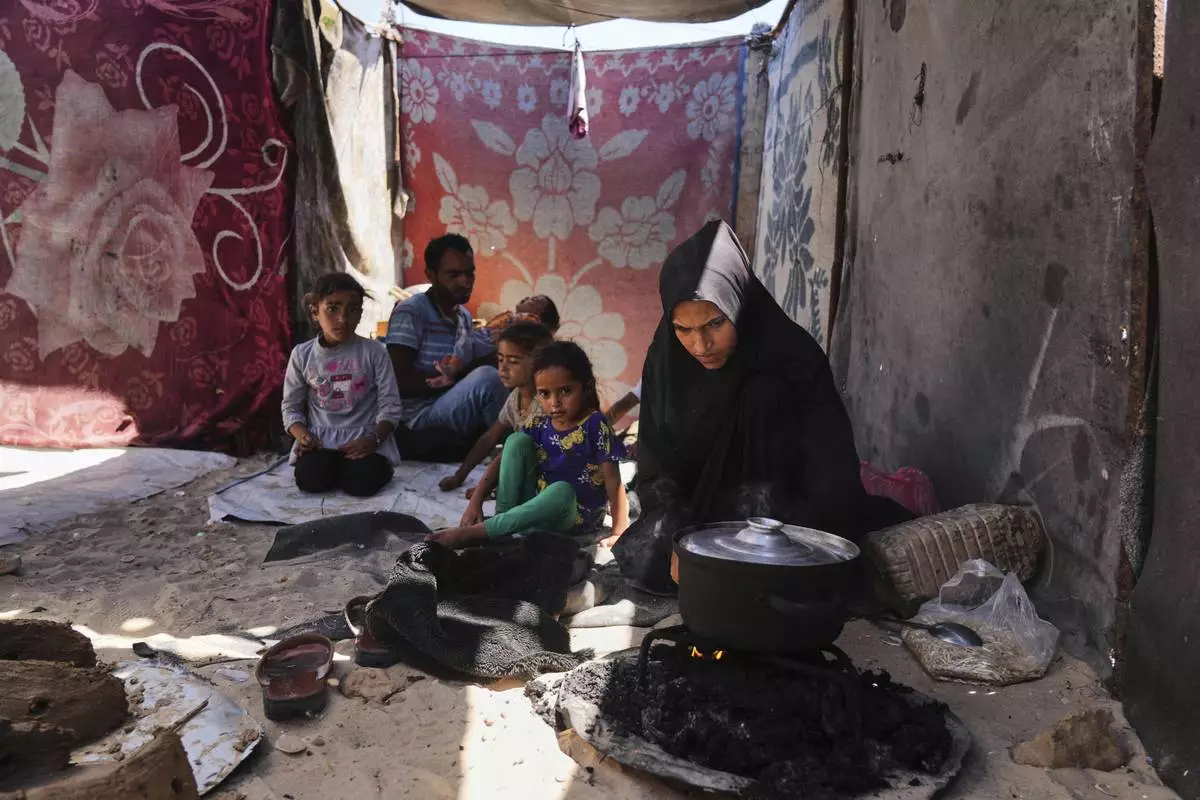
Nouf Al-Arja, 30, who suffers from malnutrition, cooks for her family inside their tent in a camp for displaced Palestinians in Muwasi, Khan Younis, Gaza, Wednesday, May 21, 2025. (AP Photo/Abdel Kareem Hana)
Nouf Al-Arja, 30, who suffers from malnutrition, cooks for her family inside their tent in a camp for displaced Palestinians in Muwasi, Khan Younis, Gaza, Wednesday, May 21, 2025. (AP Photo/Abdel Kareem Hana)

Mayar Al-Arja, 2, right, and 5-month-old Yousef Al-Najjar, both suffering from malnutrition, are cared for by their mothers in a clinic in Nasser Hospital, Khan Younis, Gaza, on Wednesday, May 21, 2025. (AP Photo/Abdel Kareem Hana)
Mayar Al-Arja, 2, right, and 5-month-old Yousef Al-Najjar, both suffering from malnutrition, are cared for by their mothers in a clinic in Nasser Hospital, Khan Younis, Gaza, on Wednesday, May 21, 2025. (AP Photo/Abdel Kareem Hana)

Mayar Al-Arja, 2, who suffers from malnutrition, lies on a bed in a clinic in Nasser hospital, Khan Younis, Gaza, Wednesday, May 21, 2025. (AP Photo/Abdel Kareem Hana)
Mayar Al-Arja, 2, who suffers from malnutrition, lies on a bed in a clinic in Nasser hospital, Khan Younis, Gaza, Wednesday, May 21, 2025. (AP Photo/Abdel Kareem Hana)
Najia Al-Najjar feeds her 5-month-old baby, Yousef, who suffers from malnutrition, at a clinic in Nasser hospital, Khan Younis, Gaza, Wednesday, May 21, 2025. (AP Photo/Abdel Kareem Hana)

Najia Al-Najjar feeds her 5-month-old baby, Yousef, who suffers from malnutrition, at a clinic in Nasser hospital, Khan Younis, Gaza, Wednesday, May 21, 2025. (AP Photo/Abdel Kareem Hana)

The Al-Arja family eats lentil soup inside their tent in a camp for displaced Palestinians in Muwasi, Khan Younis, Gaza, Wednesday, May 21, 2025. (AP Photo/Abdel Kareem Hana)
The Al-Arja family eats lentil soup inside their tent in a camp for displaced Palestinians in Muwasi, Khan Younis, Gaza, Wednesday, May 21, 2025. (AP Photo/Abdel Kareem Hana)
DUBAI, United Arab Emirates (AP) — U.S. President Donald Trump said Iran wants to negotiate with Washington after his threat to strike the Islamic Republic over its bloody crackdown on protesters, a move coming as activists said Monday the death toll in the nationwide demonstrations rose to at least 544.

Iran had no immediate reaction to the news, which came after the foreign minister of Oman — long an interlocutor between Washington and Tehran — traveled to Iran this weekend. It also remains unclear just what Iran could promise, particularly as Trump has set strict demands over its nuclear program and its ballistic missile arsenal, which Tehran insists is crucial for its national defense.

Meanwhile Monday, Iran called for pro-government demonstrators to head to the streets in support of the theocracy, a show of force after days of protests directly challenging the rule of 86-year-old Supreme Leader Ayatollah Ali Khamenei. Iranian state television aired chants from the crowd, who shouted “Death to America!” and “Death to Israel!”

Trump and his national security team have been weighing a range of potential responses against Iran including cyberattacks and direct strikes by the U.S. or Israel, according to two people familiar with internal White House discussions who were not authorized to comment publicly and spoke on condition of anonymity.

“The military is looking at it, and we’re looking at some very strong options,” Trump told reporters on Air Force One on Sunday night. Asked about Iran’s threats of retaliation, he said: “If they do that, we will hit them at levels that they’ve never been hit before.”

Trump said that his administration was in talks to set up a meeting with Tehran, but cautioned that he may have to act first as reports of the death toll in Iran mount and the government continues to arrest protesters.

“I think they’re tired of being beat up by the United States,” Trump said. “Iran wants to negotiate.”

He added: “The meeting is being set up, but we may have to act because of what’s happening before the meeting. But a meeting is being set up. Iran called, they want to negotiate.”

Iran through country's parliamentary speaker warned Sunday that the U.S. military and Israel would be “legitimate targets” if America uses force to protect demonstrators.

More than 10,600 people also have been detained over the two weeks of protests, said the U.S.-based Human Rights Activists News Agency, which has been accurate in previous unrest in recent years and gave the death toll. It relies on supporters in Iran crosschecking information. It said 496 of the dead were protesters and 48 were with security forces.

With the internet down in Iran and phone lines cut off, gauging the demonstrations from abroad has grown more difficult. The Associated Press has been unable to independently assess the toll. Iran’s government has not offered overall casualty figures.

Those abroad fear the information blackout is emboldening hard-liners within Iran’s security services to launch a bloody crackdown. Protesters flooded the streets in the country’s capital and its second-largest city on Saturday night into Sunday morning. Online videos purported to show more demonstrations Sunday night into Monday, with a Tehran official acknowledging them in state media.

In Tehran, a witness told the AP that the streets of the capital empty at the sunset call to prayers each night. By the Isha, or nighttime prayer, the streets are deserted.

Part of that stems from the fear of getting caught in the crackdown. Police sent the public a text message that warned: “Given the presence of terrorist groups and armed individuals in some gatherings last night and their plans to cause death, and the firm decision to not tolerate any appeasement and to deal decisively with the rioters, families are strongly advised to take care of their youth and teenagers.”

Another text, which claimed to come from the intelligence arm of the paramilitary Revolutionary Guard, also directly warned people not to take part in demonstrations.

“Dear parents, in view of the enemy’s plan to increase the level of naked violence and the decision to kill people, ... refrain from being on the streets and gathering in places involved in violence, and inform your children about the consequences of cooperating with terrorist mercenaries, which is an example of treason against the country,” the text warned.

The witness spoke to the AP on condition of anonymity due to the ongoing crackdown.

The demonstrations began Dec. 28 over the collapse of the Iranian rial currency, which trades at over 1.4 million to $1, as the country’s economy is squeezed by international sanctions in part levied over its nuclear program. The protests intensified and grew into calls directly challenging Iran’s theocracy.

Nikhinson reported from aboard Air Force One.

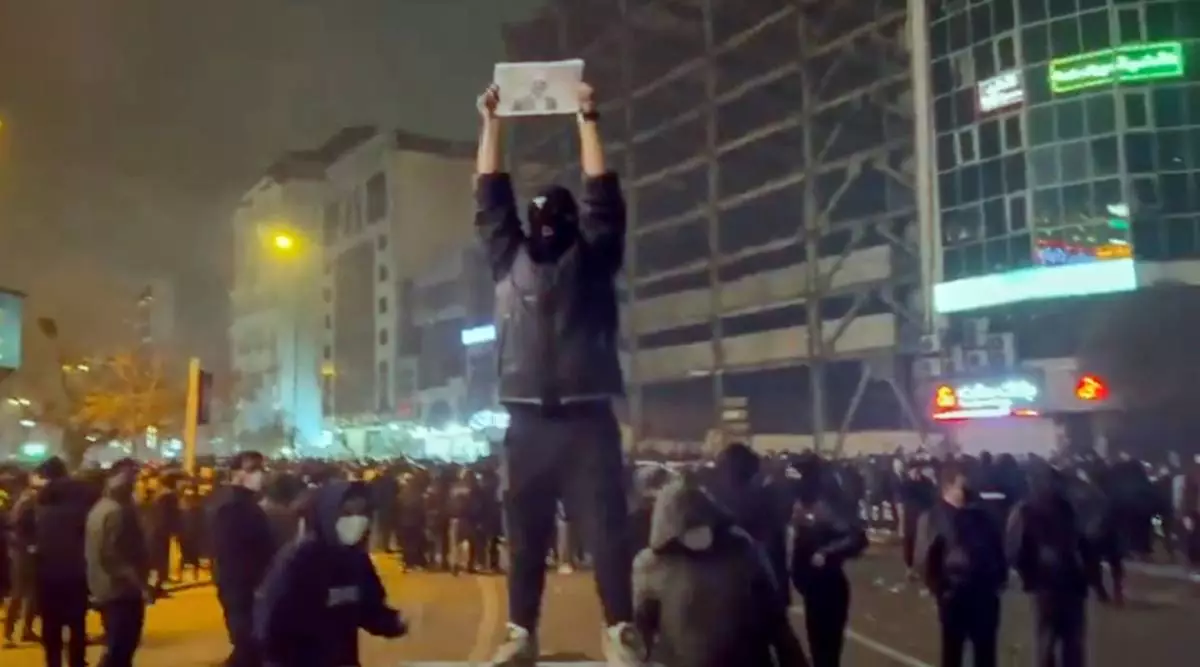
In this frame grab from video obtained by the AP outside Iran, a masked demonstrator holds a picture of Iran's Crown Prince Reza Pahlavi during a protest in Tehran, Iran, Friday, January. 9, 2026. (UGC via AP)

In this frame grab from video obtained by the AP outside Iran, a masked demonstrator holds a picture of Iran's Crown Prince Reza Pahlavi during a protest in Tehran, Iran, Friday, January. 9, 2026. (UGC via AP)

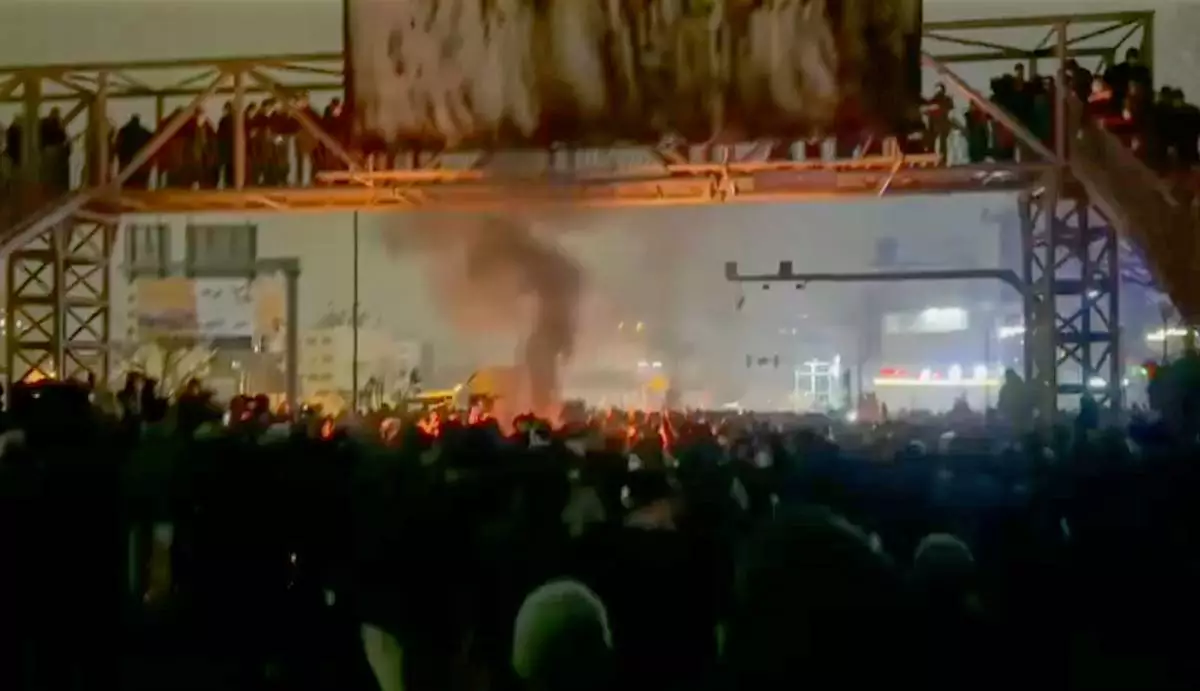
In this frame grab from footage circulating on social media from Iran shows protesters taking to the streets despite an intensifying crackdown as the Islamic Republic remains cut off from the rest of the world in Tehran, Iran, Friday, Jan. 9, 2026.(UGC via AP)

In this frame grab from footage circulating on social media from Iran shows protesters taking to the streets despite an intensifying crackdown as the Islamic Republic remains cut off from the rest of the world in Tehran, Iran, Friday, Jan. 9, 2026.(UGC via AP)

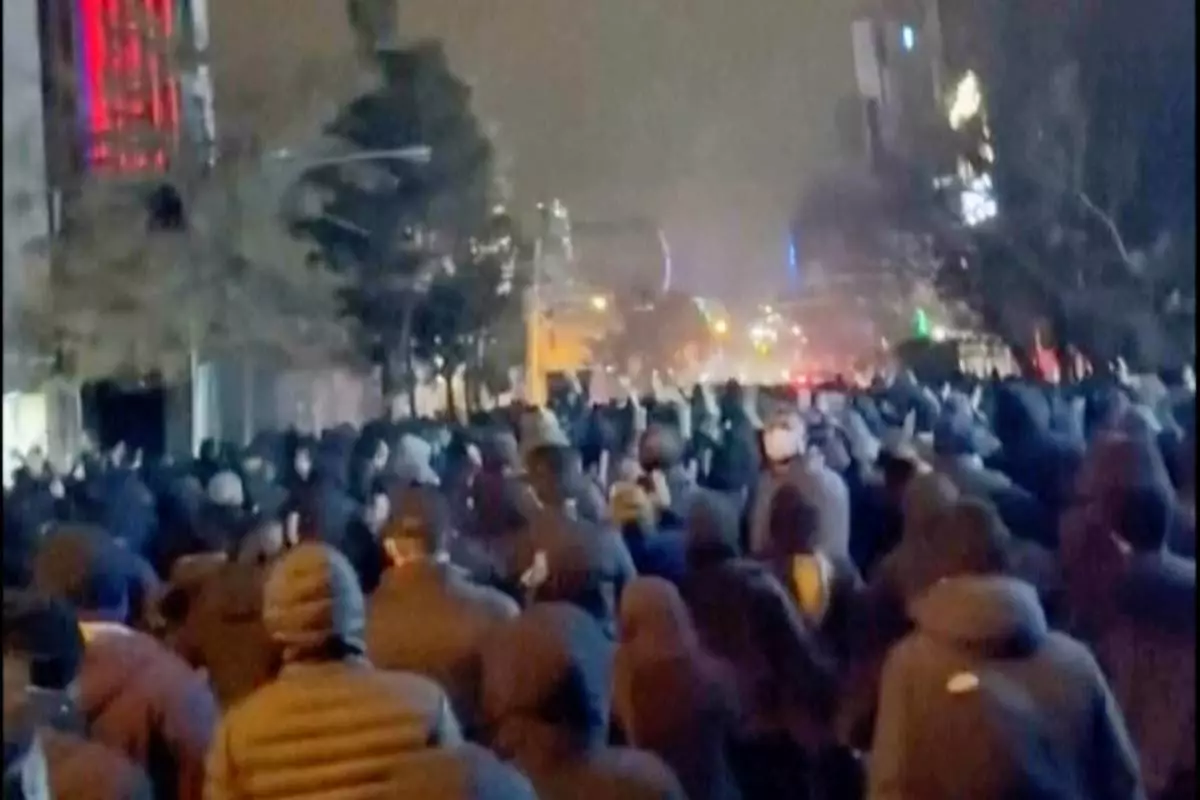
In this frame grab from footage circulating on social media from Iran showed protesters once again taking to the streets of Tehran despite an intensifying crackdown as the Islamic Republic remains cut off from the rest of the world in Tehran, Iran, Saturday Jan. 10, 2026. (UGC via AP)

In this frame grab from footage circulating on social media from Iran showed protesters once again taking to the streets of Tehran despite an intensifying crackdown as the Islamic Republic remains cut off from the rest of the world in Tehran, Iran, Saturday Jan. 10, 2026. (UGC via AP)

Recommended Articles