The Deqing Freshwater Pearl Mussels Composite Fishery System in east China’s Zhejiang Province was officially recognized by the United Nations Food and Agriculture Organization (FAO) as Globally Important Agricultural Heritage Systems (GIAHS) on Monday.
Deqing, recognized by the Expert Committee on China's Important Agricultural Cultural Heritage under the Ministry of Agriculture and Rural Affairs, is the earliest-recorded area for freshwater pearl farming. As early as the Southern Song Dynasty (1127-1279), it achieved artificial freshwater pearl cultivation.
In the late 1970s, Deqing began the systematic research on the origin of freshwater pearl farming. After more than 30 years of literature research and field surveys, it produced a series of results like "Proof of the Origin of Large-scale Cultivation of Artificial Pearls in Ancient China".
The Deqing Pearl System is a testament to the harmonious symbiosis of nature and human ingenuity. Xiaoshanyang on Fuxi Street is the system's main protected area, where fish glide and mussels nestle in clear waters.
Based in the principle of mutualism between fish and mussels, and rooted in the local technique of attached pearl farming, it has evolved into a complex web of aquatic life. It encompasses mussels, fish, plankton, benthic organisms, and aquatic plants.
In June 2017, the system was officially recognized as China's Important Agricultural Cultural Heritage by the Ministry of Agriculture and Rural Affairs. In September of the same year, Deqing launched the application for GIAHS. In 2019, it entered the GIAHS Preparatory List. In April this year, FAO experts conducted an on-site assessment in Deqing and finally confirmed its inclusion.
FAO experts said the system is a model of combining agricultural wisdom with modern conservation methods to reflect the enduring vitality of Chinese agricultural civilization.
"I was very impressed to see how the indigenous knowledge is still there for more than 2,000 years ago, regarding the fishery and the pearl mussels techniques that are originally from here. I was also impressed to see how the integration of the use of the diversity and the germplasm is implemented [at] the site. The germplasm or gene bank is not only for the site but for the China as a whole to improve and to protect this very crucial and very precious germplasm. And the more important thing also, to see the industry sector involved in this protection and using the sustainable manner, the natural sources that you have [at] the site," said Aicha Bammoun, a FAO expert.
"I am impressed by all the elements of the system, the traditional fish production, the pearl mussels. We need to keep our planet for the future, so we want to preserve the plan for today, but also for the future, because we had to think about the next generation. So, in that sense that's a challenge is to have a productive system which provides means of livelihood to the local community, to live well at the present, but at the same time to keep the base for the future. And I think that Deqing is doing a great effort for that," Jose Maria Garcia Alvarez-Coque, another FAO expert continued.
In recent years, Deqing has been promoting the "pearl+" industry-chain integration model. Mainly worn for decoration, pearls are now used in the beauty, healthcare, and cultural tourism industries, following an "industry and academic research tourism" model.
So far, Deqing's deep-processing industry generates an annual output of over 7 billion yuan (about 971 million U.S. dollars), accounting for about one-tenth of the national total and provides employment for nearly 20,000 people.
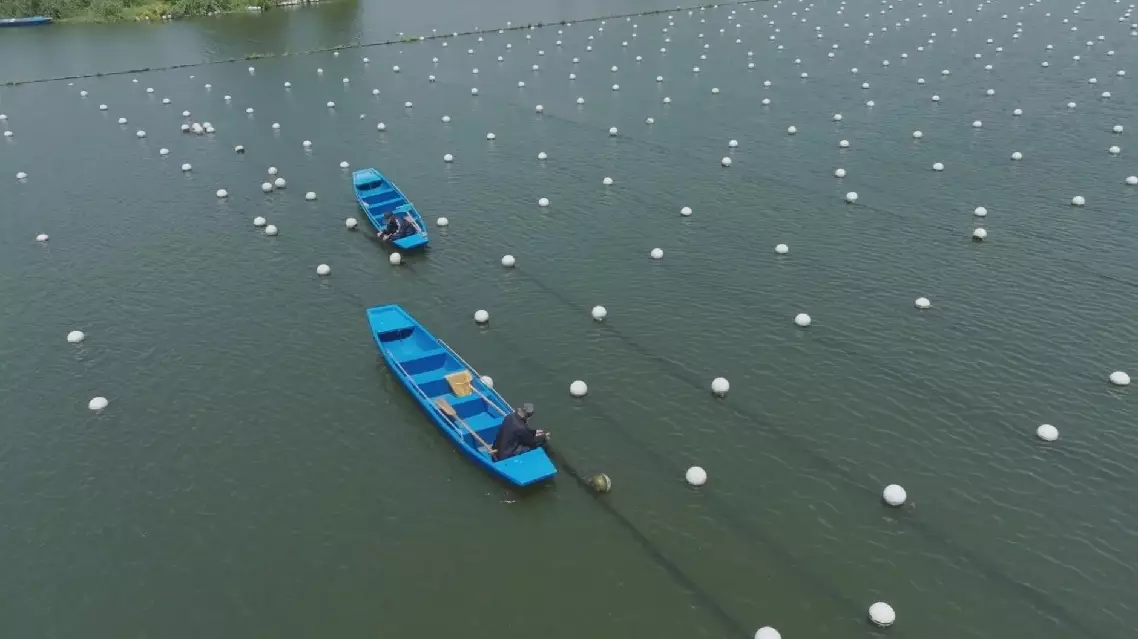
Deqing's freshwater pearl farming system gains global recognition