Sales of previously occupied U.S. homes fell in April, as elevated mortgage rates and rising prices discouraged prospective homebuyers during what’s traditionally the busiest time of the year for the housing market.
Existing home sales dropped 0.5% last month, from March, to a seasonally adjusted annual rate of 4 million units, the National Association of Realtors said Thursday. The sales decline marks the slowest sales pace for the month of April going back to 2009 in the wake of the U.S. housing crisis. March’s sales pace was also the slowest for that month going back to 2009.
Sales fell 2% compared with April last year. The latest home sales fell slightly short of the 4.10 million pace economists were expecting, according to FactSet.
Home prices increased on an annual basis for the 22nd consecutive month, although at the slowest rate since July 2023. The national median sales price rose 1.8% in April from a year earlier to $414,000, an all-time high for the month of April.
“The affordability condition is clearly hurting the market, particularly higher mortgage rates,” said Lawrence Yun, NAR’s chief economist.
For the past three years, sales of previously occupied U.S. homes have been at about 75% of what they were before the pandemic. The market slump began in early 2022, when mortgage rates began to climb from pandemic-era lows. Homes sales fell last year to their lowest level in nearly 30 years.
The average rate on a 30-year mortgage has remained relatively close to its high so far this year of just above 7%, which it set in mid-January, according to mortgage buyer Freddie Mac. The average rate’s low point so far was five weeks ago, when it briefly dropped to 6.62%. This week, it averaged 6.86%, its highest level since mid-February.
Homes purchased last month likely went under contract in March and April, when the average rate on a 30-year mortgage ranged from 6.62% to 6.83%.
High mortgage rates, which can add hundreds of dollars a month in costs for borrowers, have frozen out many would-be homebuyers struggling to find a home they can afford.
Homeownership is out of reach for many Americans after years of surging home prices. The median U.S. home sales price has jumped 53% over the past six years.
Home shoppers who can afford to buy at current mortgage rates are benefiting from more homes on the market when compared with recent years.
There were 1.45 million unsold homes at the end of last month, a 9% increase from March, and 20.8% higher than April last year, NAR said. That's the most homes on the market since September 2020, but it's still well below the roughly 2 million homes for sale that was typical before the pandemic.
The latest unsold inventory snapshot translates to a 4.4-month supply at the current sales pace, up from a 3.5-month pace at the end of April last year. Traditionally, a 5- to 6-month supply is considered a balanced market between buyers and sellers.
One reason the inventory of homes for sale has been rising is that properties are taking longer to sell. Homes typically remained on the market for 29 days last month before selling, up from 26 days in April last year, NAR said.
The wider selection of homes on the market likely helped boost sales among first-time homebuyers. They accounted for 34% of sales last month, the highest level since July 2020, but that is still down from the historical norm of 40%.
Home shoppers who can afford to sidestep mortgage rates and pay all cash for a home accounted for 25% of sales last month, down from 28% a year earlier. Investors, who account for many all-cash purchases, made up 15% of homes sold last month, down from 16% a year earlier, NAR said.

FILE - A sale sign stands outside a home on the market Thursday, Oct. 17, 2024, in the east Washington Park neighborhood of Denver. (AP Photo/David Zalubowski, File)
NEW YORK (AP) — Thousands of nurses in three hospital systems in New York City went on strike Monday after negotiations through the weekend failed to yield breakthroughs in their contract disputes.
The strike was taking place at The Mount Sinai Hospital and two of its satellite campuses, with picket lines forming. The other affected hospitals are NewYork-Presbyterian and Montefiore Medical Center in the Bronx.
About 15,000 nurses are involved in the strike, according to New York State Nurses Association.
“After months of bargaining, management refused to make meaningful progress on core issues that nurses have been fighting for: safe staffing for patients, healthcare benefits for nurses, and workplace violence protections,” the union said in a statement issued Monday. “Management at the richest hospitals in New York City are threatening to discontinue or radically cut nurses’ health benefits.”
The strike, which comes during a severe flu season, could potentially force the hospitals to transfer patients, cancel procedures or divert ambulances. It could also put a strain on city hospitals not involved in the contract dispute, as patients avoid the medical centers hit by the strike.
The hospitals involved have been hiring temporary nurses to try and fill the labor gap during the walkout, and said in a statement during negotiations that they would “do whatever is necessary to minimize disruptions.” Montefiore posted a message assuring patients that appointments would be kept.
“NYSNA’s leaders continue to double down on their $3.6 billion in reckless demands, including nearly 40% wage increases, and their troubling proposals like demanding that a nurse not be terminated if found to be compromised by drugs or alcohol while on the job," Montefiore spokesperson Joe Solmonese said Monday after the strike had started. "We remain resolute in our commitment to providing safe and seamless care, regardless of how long the strike may last.”
New York-Presbyterian accused the union of staging a strike to “create disruption,” but said in a statement that it has taken steps to ensure patients receive the care they need.
"We’re ready to keep negotiating a fair and reasonable contract that reflects our respect for our nurses and the critical role they play, and also recognizes the challenging realities of today’s healthcare environment,” the statement said.
The work stoppage is occurring at multiple hospitals simultaneously, but each medical center is negotiating with the union independently. Several other hospitals across the city and in its suburbs reached deals in recent days to avert a possible strike.
The nurses’ demands vary by hospital, but the major issues include staffing levels and workplace safety. The union says hospitals have given nurses unmanageable workloads.
Nurses also want better security measures in the workplace, citing incidents like a an incident last week, when a man with a sharp object barricaded himself in a Brooklyn hospital room and was then killed by police.
The union also wants limitations on hospitals’ use of artificial intelligence.
The nonprofit hospitals involved in the negotiations say they’ve been working to improve staffing levels, but say the union’s demands overall are too costly.
Nurses voted to authorize the strike last month.
Both New York Gov. Kathy Hochul and Mayor Zohran Mamdani had expressed concern about the possibility of the strike. As the strike deadline neared, Mamdani urged both sides to keep negotiating and reach a deal that “both honors our nurses and keeps our hospitals open.”
“Our nurses kept this city alive through its hardest moments. Their value is not negotiable,” Mamdani said.
State Attorney General Letitia James voiced similar support, saying "nurses put their lives on the line every day to keep New Yorkers healthy. They should never be forced to choose between their own safety, their patients’ well-being, and a fair contract.”
The last major nursing strike in the city was only three years ago, in 2023. That work stoppage, at Mount Sinai and Montefiore, was short, lasting three days. It resulted in a deal raising pay 19% over three years at those hospitals.
It also led to promised staffing improvements, though the union and hospitals now disagree about how much progress has been made, or whether the hospitals are retreating from staffing guarantees.
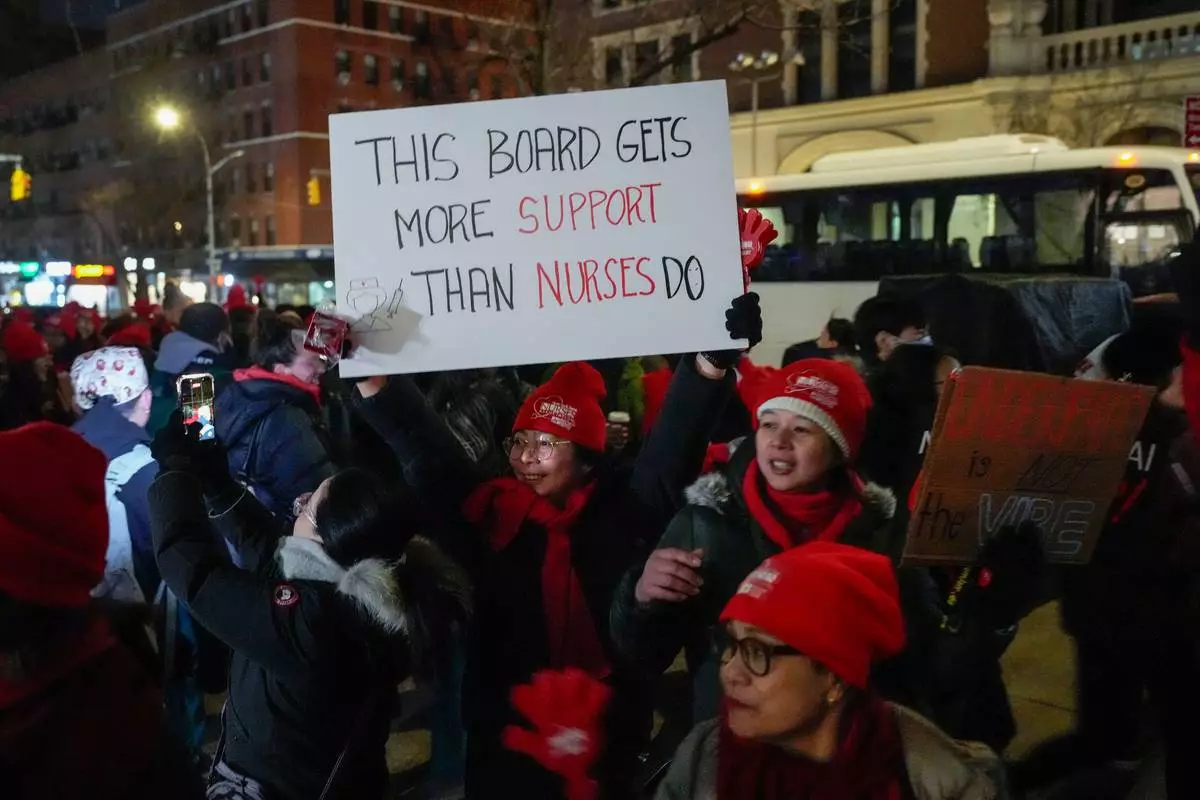
Nurses strike outside Mount Sinai West Hospital, Monday, Jan. 12, 2026, in New York. (AP Photo/Yuki Iwamura)
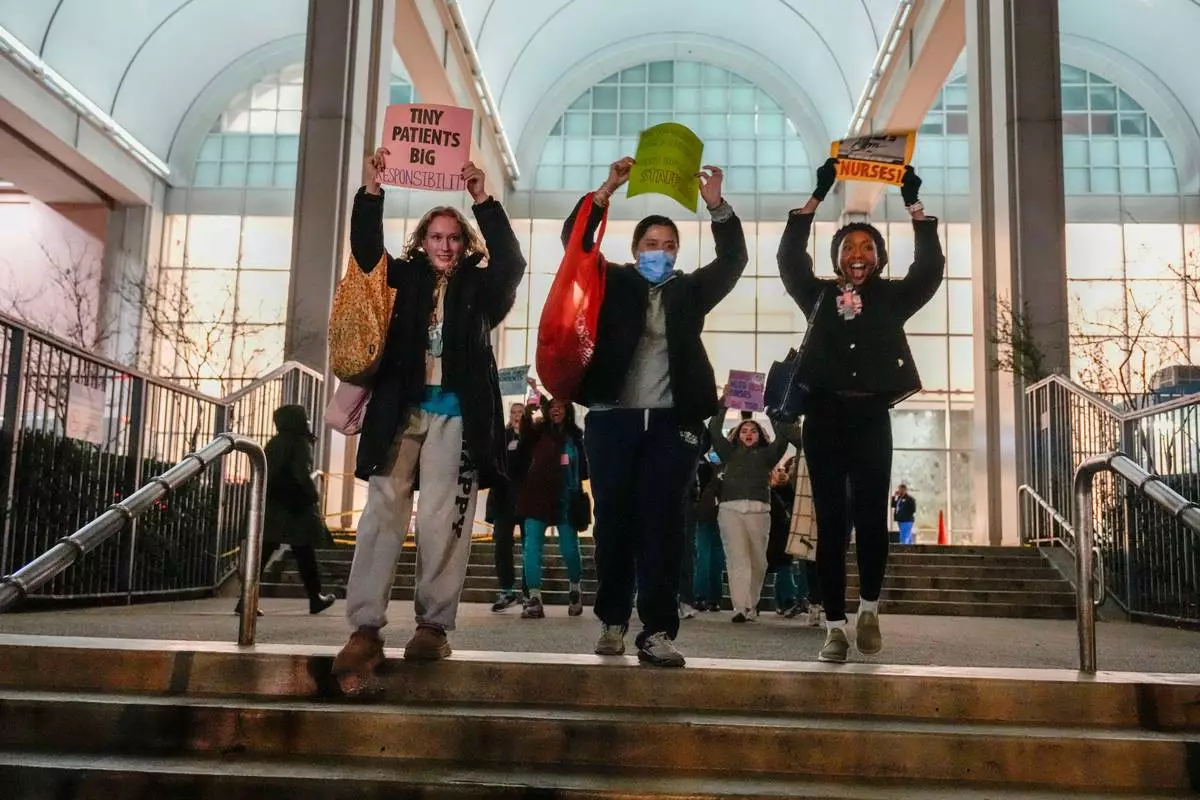
Nurses strike outside Mount Sinai West Hospital, Monday, Jan. 12, 2026, in New York. (AP Photo/Yuki Iwamura)
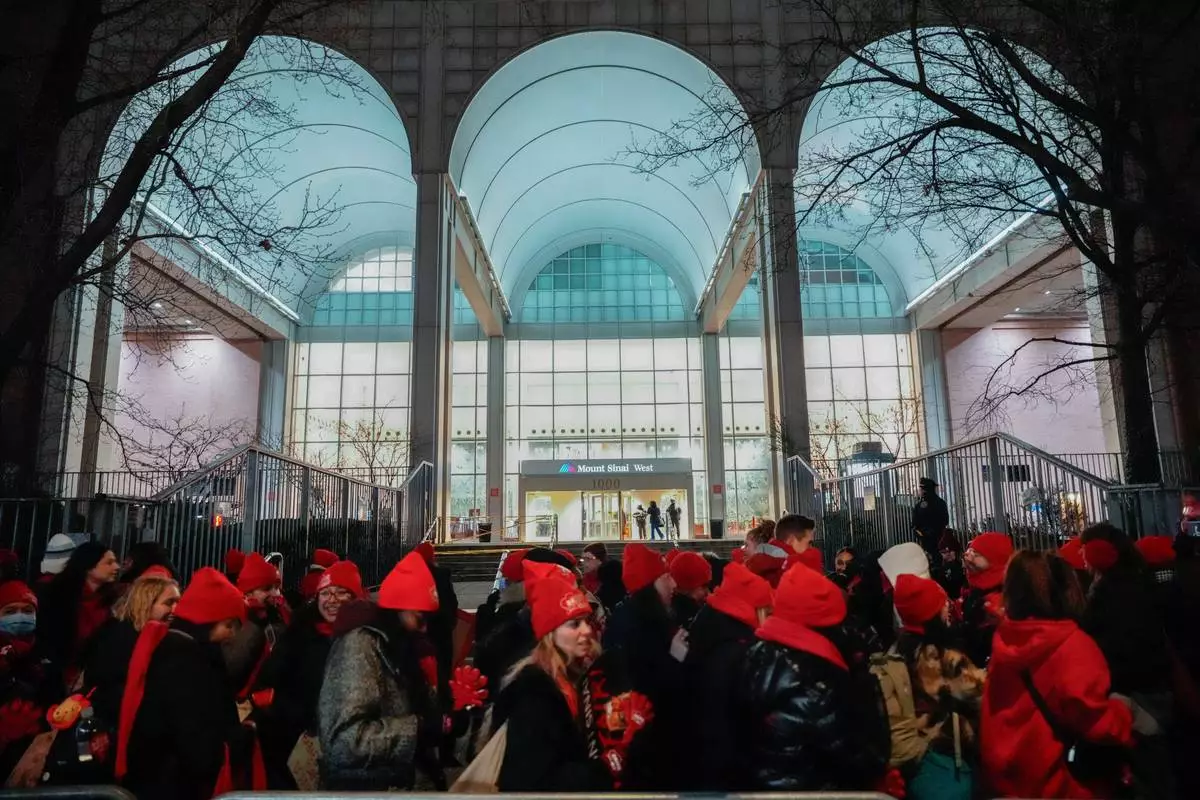
Nurses strike outside Mount Sinai West Hospital, Monday, Jan. 12, 2026, in New York. (AP Photo/Yuki Iwamura)
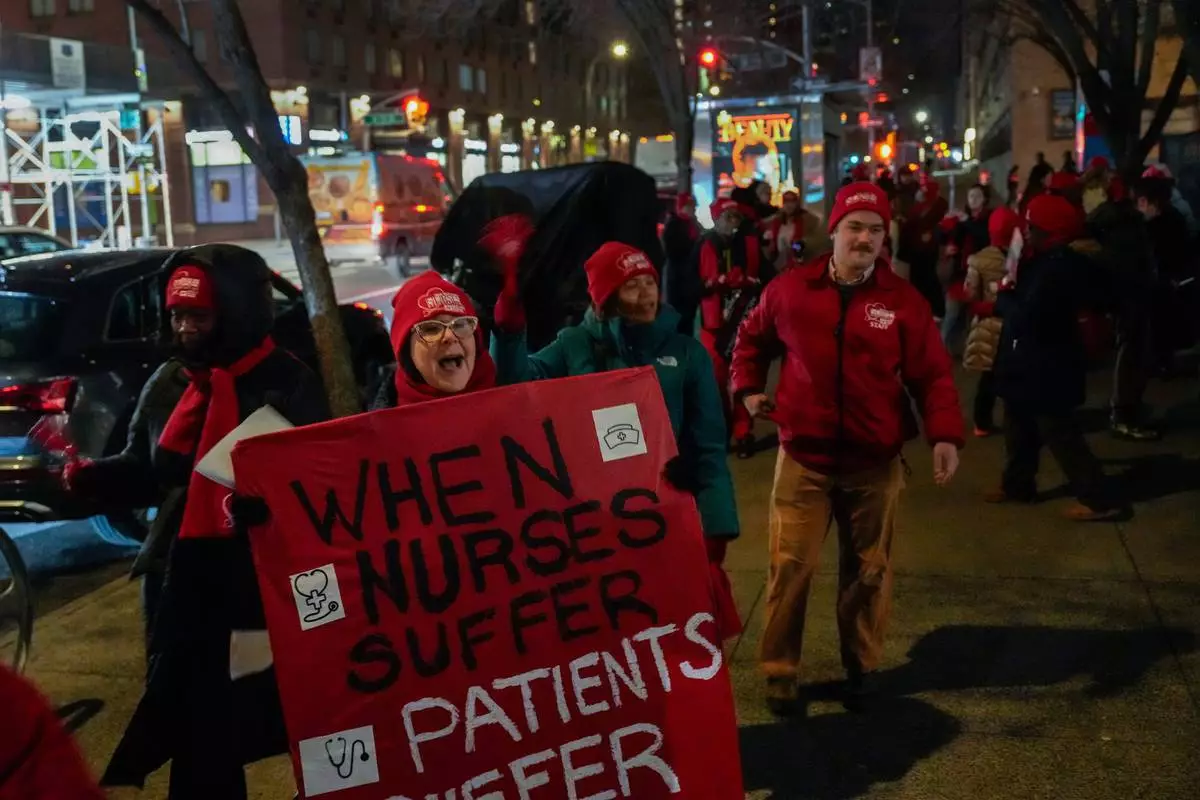
Nurses strike outside Mount Sinai West Hospital, Monday, Jan. 12, 2026, in New York. (AP Photo/Yuki Iwamura)

FILE - A medical worker transports a patient at Mount Sinai Hospital, April 1, 2020, in New York. (AP Photo/Mary Altaffer, File)