WASHINGTON (AP) — The Trump administration says making cents doesn't make sense anymore.
The U.S. Mint has made its final order of penny blanks and plans to stop producing the coin when those run out, a Treasury Department official confirmed Thursday. This move comes as the cost of making pennies has increased markedly, by upward of 20% in 2024, according to the Treasury.
By stopping the penny's production, the Treasury expects an immediate annual savings of $56 million in reduced material costs, according to the official, who was not authorized to discuss the matter publicly and spoke on condition of anonymity to preview the news.
In February, President Donald Trump announced that he had ordered his administration to cease production of the 1-cent coin.
“For far too long the United States has minted pennies which literally cost us more than 2 cents. This is so wasteful!” Trump wrote at that time in a post on his Truth Social site. “I have instructed my Secretary of the US Treasury to stop producing new pennies.”
There are about 114 billion pennies currently in circulation in the United States — that's $1.14 billion — but they are greatly underutilized, the Treasury says. The penny was one of the first coins made by the U.S. Mint after its establishment in 1792.
The nation's treasury secretary has the authority to mint and issue coins “in amounts the secretary decides are necessary to meet the needs of the United States.”
Advocates for ditching the penny cite its high production cost — almost 4 cents per penny now, according to the U.S. Mint — and limited utility. Fans of the penny cite its usefulness in charity drives and relative bargain in production costs compared with the nickel, which costs almost 14 cents to mint.
The Wall Street Journal first reported the news.
Pennies are the most popular coin made by the U.S. Mint, which reported making 3.2 billion of them last year. That’s more than half of all the new coins it made last year.
Congress, which dictates currency specifications such as the size and metal content of coins, could make Trump’s order permanent through law. But past congressional efforts to ditch the penny have failed.
Two bipartisan bills to kill the penny permanently were introduced this year.
Sens. Mike Lee, R-Utah, and Jeff Merkley, D-Ore., introduced the Make Sense Not Cents Act this month. In April, Reps. Lisa McClain, R-Mich., and Robert Garcia, D-Calif., along with Sens. Cynthia Lummis, R-Wyo., and Kirsten Gillibrand, D-N.Y., introduced the Common Cents Act.
Jay Zagorsky, professor of markets, public policy, and law at Boston University, said that while he supports the move to end penny production, Congress must include language in any proposed legislation to require rounding up in pricing, which will eliminate the demand for pennies.
Zagorsky, who recently published a book called “The Power of Cash: Why Using Paper Money is Good for You and Society,” said otherwise simply ditching the penny will only increase demand for nickels, which are even more expensive, at 14 cents to produce.
“If we suddenly have to produce a lot of nickels — and we lose more money on producing every nickel — eliminating the penny doesn't make any sense.”
Mark Weller, executive director of the Americans for Common Cents group — which conducts research and provides information to Congress and the Executive Branch on the value and benefits of the penny — says “there has been an evolution over the past six months that inevitably the production of the penny will be halted.”
His group advocates for the U.S. to find ways to reduce the cost of producing the nickel, especially since it will be more in demand once the penny is totally eliminated from circulation.
“It's incumbent on Treasury to come up with a cheaper way to make the nickel,” Weller said. “Let's make sure we're making our coins as least expensively as possible and maintaining the option to use cash in transactions.”
__
Suderman reported from Richmond, Virginia.

FILE - Freshly-made pennies sit in a bin at the U.S. Mint in Denver on Aug. 15, 2007. (AP Photo/David Zalubowski, File)
Glenn Hall, a Hockey Hall of Famer whose ironman streak of 502 starts as a goaltender remains an NHL record, has died. He was 94.
Nicknamed “Mr. Goalie,” Hall worked to stop pucks at a time when players at his position were bare-faced, before masks of any kind became commonplace. He did it as well as just about anyone of his generation, which stretched from the days of the Original Six into the expansion era.
A spokesperson for the Chicago Blackhawks confirmed the team received word of Hall’s death from his family. A league historian in touch with Hall’s son, Pat, said Hall died at a hospital in Stony Plain, Alberta, on Wednesday.
Hall backstopped Chicago to the Stanley Cup in 1961 and won the Conn Smythe Trophy as most valuable player of the playoffs in 1968 with St. Louis when the Blues reached the final before losing to Montreal. He was the second of just six Conn Smythe winners from a team that did not hoist the Cup.
His run of more than 500 games in net is one of the most untouchable records in sports, given how the position has changed in the decades since. Second in history is Alec Connell with 257 from 1924-30.
“Glenn was sturdy, dependable and a spectacular talent in net,” Commissioner Gary Bettman said. “That record, set from 1955-56 to 1962-63, still stands, probably always will, and is almost unfathomable — especially when you consider he did it all without a mask.”
Counting the postseason, Hall started 552 games in a row.
Hall won the Calder Trophy as rookie of the year in 1956 when playing for the Detroit Red Wings. After two seasons, he was sent to the Black Hawks along with legendary forward Ted Lindsay.
Hall earned two of his three Vezina Trophy honors as the league's top goalie with Chicago, in 1963 and '67. The Blues took him in the expansion draft when the NHL doubled from six teams to 12, and he helped them reach the final in each of their first three years of existence, while winning the Vezina again at age 37.
Hall was in net when Boston's Bobby Orr scored in overtime to win the Cup for the Bruins in 1970, a goal that's among the most famous in hockey history because of the flying through the air celebration that followed. He played one more season with St. Louis before retiring in 1971.
“His influence extended far beyond the crease," Blues chairman Tom Stillman said. “From the very beginning, he brought credibility, excellence, and heart to a new team and a new NHL market.”
A native of Humboldt, Saskatchewan, Hall was a seven-time first-team NHL All-Star who had 407 wins and 84 shutouts in 906 regular-season games. He was inducted into the Hall of Fame in 1975, and his No. 1 was retired by Chicago in 1988.
Hall was chosen as one of the top 100 players in the league's first 100 years.
Blackhawks chairman and CEO Danny Wirtz called Hall an innovator and “one of the greatest and most influential goaltenders in the history of our sport and a cornerstone of our franchise.”
“We are grateful for his extraordinary contributions to hockey and to our club, and we will honor his memory today and always,” Wirtz said.
The Blackhawks paid tribute to Hall and former coach and general manager Bob Pulford with a moment of silence before Wednesday night’s game against St. Louis. Pulford died Monday.
A Hall highlight video was shown on the center-ice videoboard. The lights were turned off for the moment of silence, except for a spotlight on the No. 1 banner for Hall that hangs in the rafters at the United Center.
Fellow Hall of Famer Martin Brodeur, the league's all-time leader in wins with 691 and games played with 1,266, posted a photo of the last time he saw Hall along with a remembrance of him.
“Glenn Hall was a legend, and I was a big fan of his,” Brodeur said on social media. “He set the standard for every goaltender who followed. His toughness and consistency defined what it meant to play.”
AP Sports Writer Jay Cohen in Chicago contributed.
AP NHL: https://apnews.com/hub/nhl
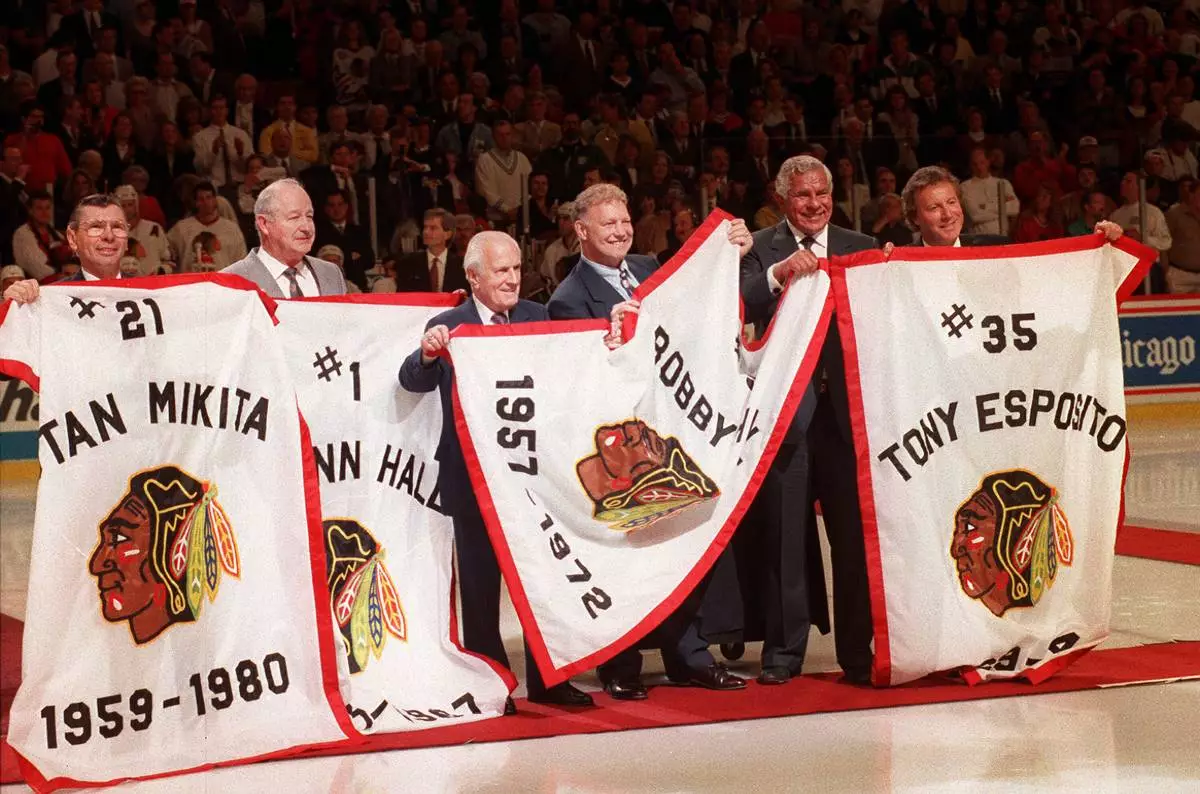
FILE - Glenn Hall, second from left, stands with fellow former Chicago Blackhawks players Stan Mikita, former general manager Tommy Ivan, Bobby Hull, Bill Wirtz and Tony Esposito during a pre-game ceremony at the Chicago Stadium in Chicago, Ill., April 14, 1994. (AP Photo/Fred Jewell, File)
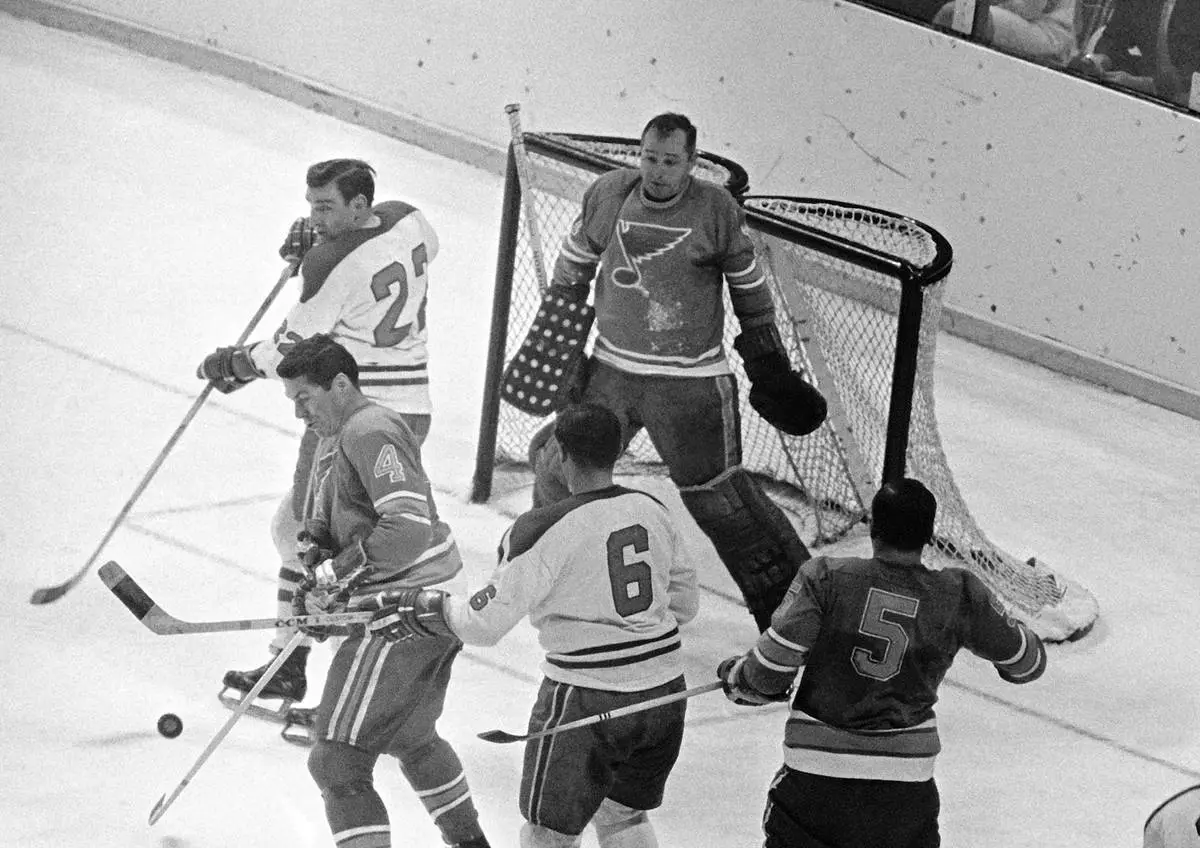
FILE - St. Louis Blues goalie Glenn Hall, top right, is pinned to his net waiting to make a save on a Montreal Canadians shot as Blues' Noel Picard (4) tries to block the puck while Canadiens' John Ferguson (22) and Ralph Backstorm wait for a rebound in the third period of their NHL hockey Stanley Cup game, May 5, 1968. (AP Photo/Fred Waters, File)