Skip to Content Facebook Feature Image

The bond market is shaking Wall Street again, this time because of worries about tax cuts

Business

The bond market is shaking Wall Street again, this time because of worries about tax cuts
Business

Business

The bond market is shaking Wall Street again, this time because of worries about tax cuts

2025-05-23 03:11 Last Updated At:03:21

NEW YORK (AP) — Wall Street’s quiet corner is making noise again.

While the bond market is typically seen as slower moving, it can pack a heavy punch when it’s alarmed. And right now, it’s getting worried about how much more Washington is preparing to pile onto its spiraling mountain of debt because of its desire to cut taxes.

The House of Representatives approved a bill of tax breaks early Thursday that could add trillions of dollars to the federal government’s debt, and it’s heading to the Senate next. Worries about the U.S. debt have sent yields jumping in the bond market, which in turn has shaken the stock market. The S&P 500 is potentially heading toward its worst week in seven.

In the past, angry reactions from the bond market have been so strong that they've forced governments to backtrack on policies and even led to the ouster of some political leaders. To be sure, many veteran investors say it would be overblown or at least premature to say “bond-market vigilantes” are rounding up this time around, because yields have not jumped high enough to indicate a crisis. But the higher yields will nevertheless have wide-reaching effects.

“I wouldn't look at this from an apocalyptical dynamic, but there are real ramifications," said Nate Thooft, a senior portfolio manager at Manulife Investment Management. “Look at mortgage rates.”

Here's a look at what's going on:

The centerpiece of the U.S. bond market is the 10-year Treasury, and its yield has climbed to 4.54% from 4.43% at the end of last week and just 4.01% early last month. That's a notable move for the bond market, which measures things in hundredths of percentage points.

That yield shows roughly how much in interest the U.S. government needs to pay investors to get them to lend it cash for 10 years. Washington needs that cash because it consistently spends more than it takes in through tax revenue. And when bond investors are more wary of lending to the U.S. government, yields for Treasurys rise.

The moves have been sharpest for the longest-term bonds. The yield on a 30-year Treasury has topped 5% and is getting close to where it was before the 2008 financial crisis wiped out interest rates.

Bond investors hate inflation because it means the future payments that bonds will give them won't be able to buy as much stuff.

Worries are rising about the potential for higher inflation for a couple reasons. On one hand are President Donald Trump's tariffs, which could push up prices for all kinds of products. A bigger, more long-term concern is how much debt the U.S. government is building up.

Those debt concerns gained momentum at the end of last week after Moody’s Ratings became the last of the three major rating agencies to say the U.S. government no longer deserves a top-tier credit rating because of its troubles keeping its debt in check. The worries then built through this week as the House moved forward on its tax-cut bill that it approved early Thursday.

Other factors have also been pushing yields up recently, including increasing hopes that the U.S. economy will not fall into a recession after Trump delayed many of his stiff tariffs, particularly against China.

In the past, the bond market has recoiled at policies that it's found distasteful. Sometimes, the reaction is violent enough to scare politicians.

Trump himself said that the bond market may have played a role in his decision earlier this year to delay many of his tariffs, saying that he noticed investors “were getting a little queasy.”

The bond market also helped make Liz Truss the United Kingdom's shortest-serving prime minister in 2022, when it revolted against her plan to cut taxes and raise spending without a way to pay for them. James Carville, adviser to former U.S. President Bill Clinton, also famously said he’d like to be reincarnated as the bond market because of how much power it wields.

While there is some element of vigilantism that's keeping Treasury yields higher than they would be otherwise, the reaction so far by the bond market likely isn't enough to get Trump or Congress to back off their efforts to cut taxes.

“I don't really expect it to snowball or last,” said Brian Rehling, head of global fixed income strategy at Wells Fargo Investment Institute. “I don’t think this is going to rise to a level of a crisis.”

Treasury yields calmed on Thursday, for example. And the United States isn't the only country seeing yields for its bonds rise. That's happening for other developed economies around the world, particularly Japan.

Plus, all of the issues about the U.S. government's debt are well known, and critics have been warning for years that it's heading on an unsustainable path. It still might be years before the U.S. government's rising debt load triggers a panic button in financial markets, Rehling said.

When Treasury yields rise, it means more of taxpayers' dollars are going just to repay the national debt rather than to keep the government running.

Higher yields can also filter into the rest of the economy and make it tougher for U.S. households and businesses to get their own loans. Mortgage rates track 10-year Treasury yields, for example, and the average rate on a 30-year mortgage just hit its highest level since mid-February.

Higher Treasury yields can also translate into higher rates for everything from credit cards to auto loans. That means a sharp enough rise can put the brakes on the U.S. economy by discouraging businesses and households from borrowing and spending, raising the risk of a recession.

High yields can also discourage investors from paying high prices for stocks and other investments.

All of that, of course, seems to be getting only more difficult to predict. “We don’t know how things are going to all develop,” Rehling said, pointing to how “things seem to change by the day with Washington.”

Trader Drew Cohen is lit by a ray of sunshine on the floor of the New York Stock Exchange, Tuesday, May 20, 2025. (AP Photo/Richard Drew)
Trader Drew Cohen is lit by a ray of sunshine on the floor of the New York Stock Exchange, Tuesday, May 20, 2025. (AP Photo/Richard Drew)

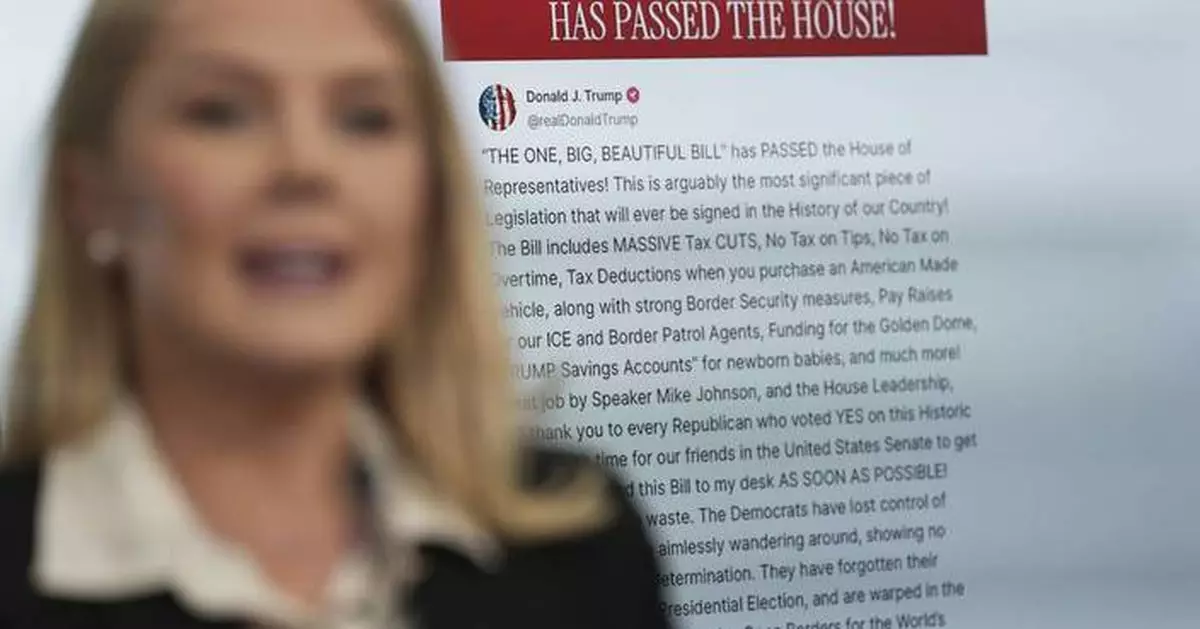
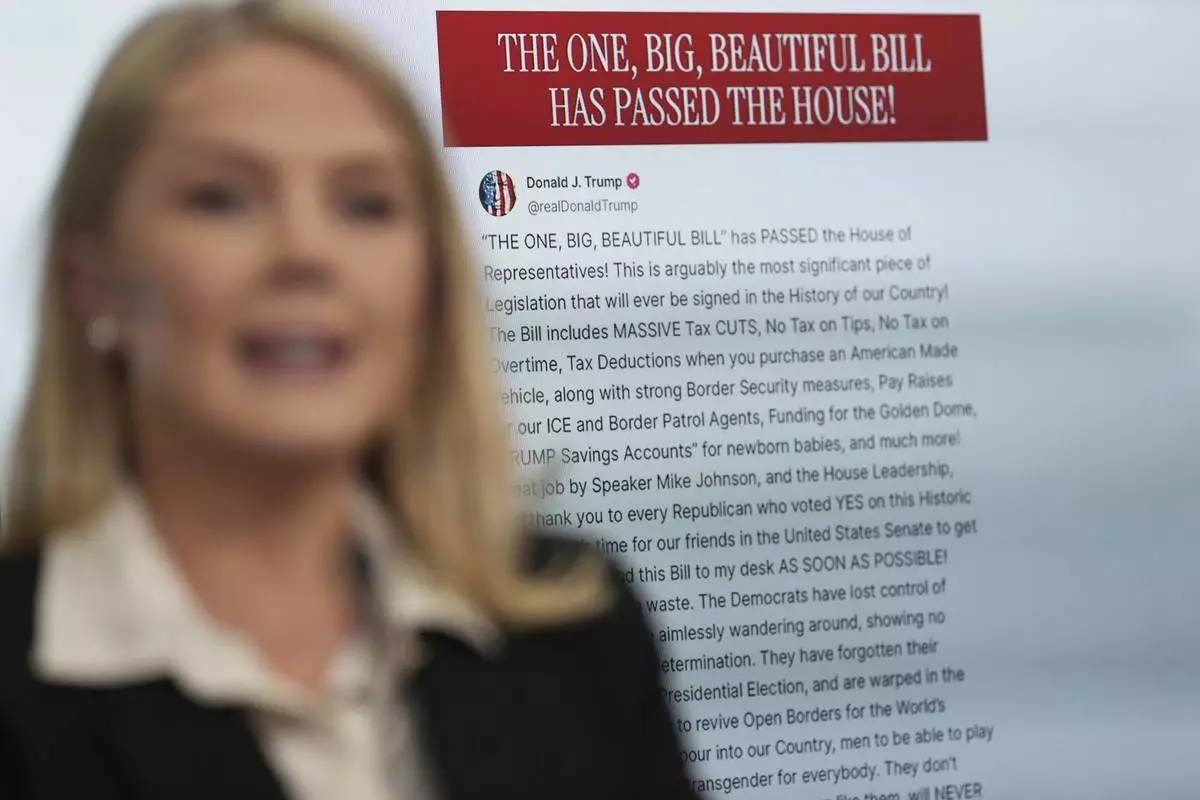
White House press secretary Karoline Leavitt speaks with reporters as an image of President Donald Trump's post on Truth Social regarding the tax cuts package appears on screen in the James Brady Press Briefing Room at the White House, Thursday, May 22, 2025, in Washington. (AP Photo/Jacquelyn Martin)
White House press secretary Karoline Leavitt speaks with reporters as an image of President Donald Trump's post on Truth Social regarding the tax cuts package appears on screen in the James Brady Press Briefing Room at the White House, Thursday, May 22, 2025, in Washington. (AP Photo/Jacquelyn Martin)
NEW YORK (AP) — Thousands of nurses in three hospital systems in New York City went on strike Monday after negotiations through the weekend failed to yield breakthroughs in their contract disputes.

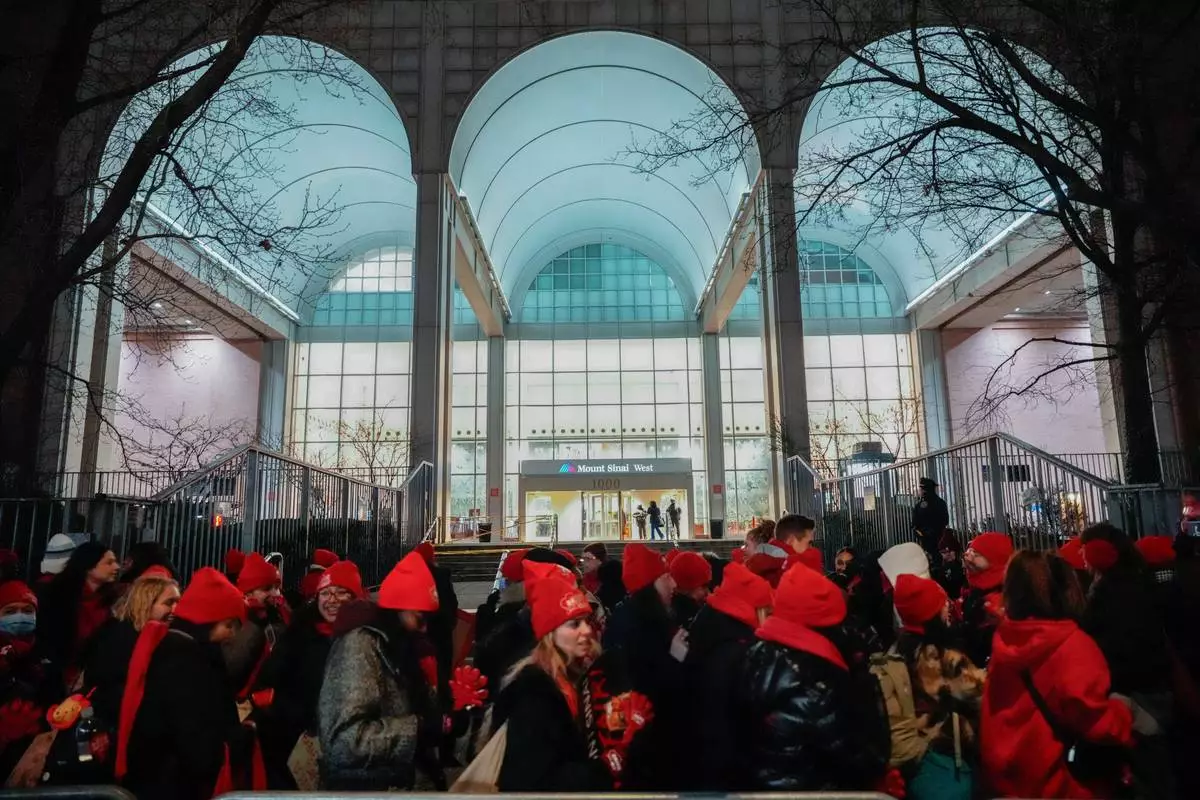
The strike was taking place at The Mount Sinai Hospital and two of its satellite campuses, with picket lines forming. The other affected hospitals are NewYork-Presbyterian and Montefiore Medical Center in the Bronx.

About 15,000 nurses are involved in the strike, according to New York State Nurses Association.

“After months of bargaining, management refused to make meaningful progress on core issues that nurses have been fighting for: safe staffing for patients, healthcare benefits for nurses, and workplace violence protections,” the union said in a statement issued Monday. “Management at the richest hospitals in New York City are threatening to discontinue or radically cut nurses’ health benefits.”

The strike, which comes during a severe flu season, could potentially force the hospitals to transfer patients, cancel procedures or divert ambulances. It could also put a strain on city hospitals not involved in the contract dispute, as patients avoid the medical centers hit by the strike.

The hospitals involved have been hiring temporary nurses to try and fill the labor gap during the walkout, and said in a statement during negotiations that they would “do whatever is necessary to minimize disruptions.” Montefiore posted a message assuring patients that appointments would be kept.

“NYSNA’s leaders continue to double down on their $3.6 billion in reckless demands, including nearly 40% wage increases, and their troubling proposals like demanding that a nurse not be terminated if found to be compromised by drugs or alcohol while on the job," Montefiore spokesperson Joe Solmonese said Monday after the strike had started. "We remain resolute in our commitment to providing safe and seamless care, regardless of how long the strike may last.”

New York-Presbyterian accused the union of staging a strike to “create disruption,” but said in a statement that it has taken steps to ensure patients receive the care they need.

"We’re ready to keep negotiating a fair and reasonable contract that reflects our respect for our nurses and the critical role they play, and also recognizes the challenging realities of today’s healthcare environment,” the statement said.

The work stoppage is occurring at multiple hospitals simultaneously, but each medical center is negotiating with the union independently. Several other hospitals across the city and in its suburbs reached deals in recent days to avert a possible strike.

The nurses’ demands vary by hospital, but the major issues include staffing levels and workplace safety. The union says hospitals have given nurses unmanageable workloads.

Nurses also want better security measures in the workplace, citing incidents like a an incident last week, when a man with a sharp object barricaded himself in a Brooklyn hospital room and was then killed by police.

The union also wants limitations on hospitals’ use of artificial intelligence.

The nonprofit hospitals involved in the negotiations say they’ve been working to improve staffing levels, but say the union’s demands overall are too costly.

Nurses voted to authorize the strike last month.

Both New York Gov. Kathy Hochul and Mayor Zohran Mamdani had expressed concern about the possibility of the strike. As the strike deadline neared, Mamdani urged both sides to keep negotiating and reach a deal that “both honors our nurses and keeps our hospitals open.”

“Our nurses kept this city alive through its hardest moments. Their value is not negotiable,” Mamdani said.

State Attorney General Letitia James voiced similar support, saying "nurses put their lives on the line every day to keep New Yorkers healthy. They should never be forced to choose between their own safety, their patients’ well-being, and a fair contract.”

The last major nursing strike in the city was only three years ago, in 2023. That work stoppage, at Mount Sinai and Montefiore, was short, lasting three days. It resulted in a deal raising pay 19% over three years at those hospitals.

It also led to promised staffing improvements, though the union and hospitals now disagree about how much progress has been made, or whether the hospitals are retreating from staffing guarantees.

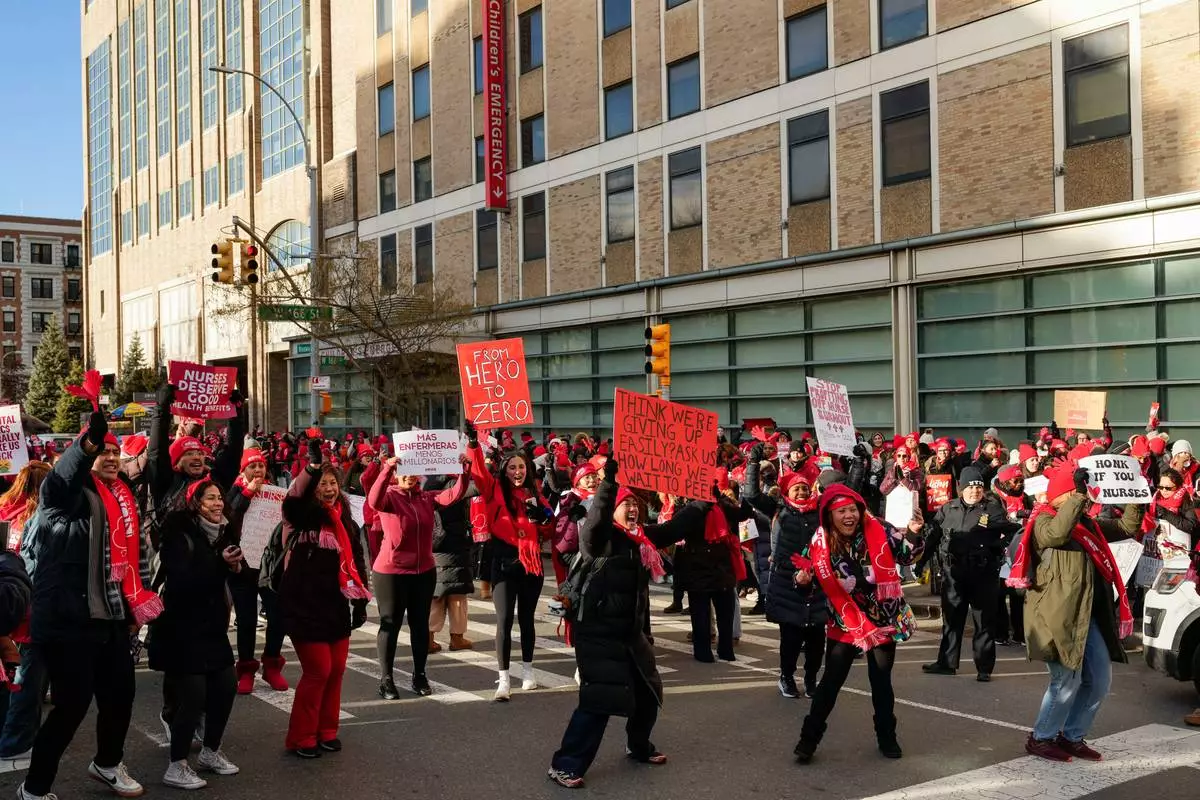
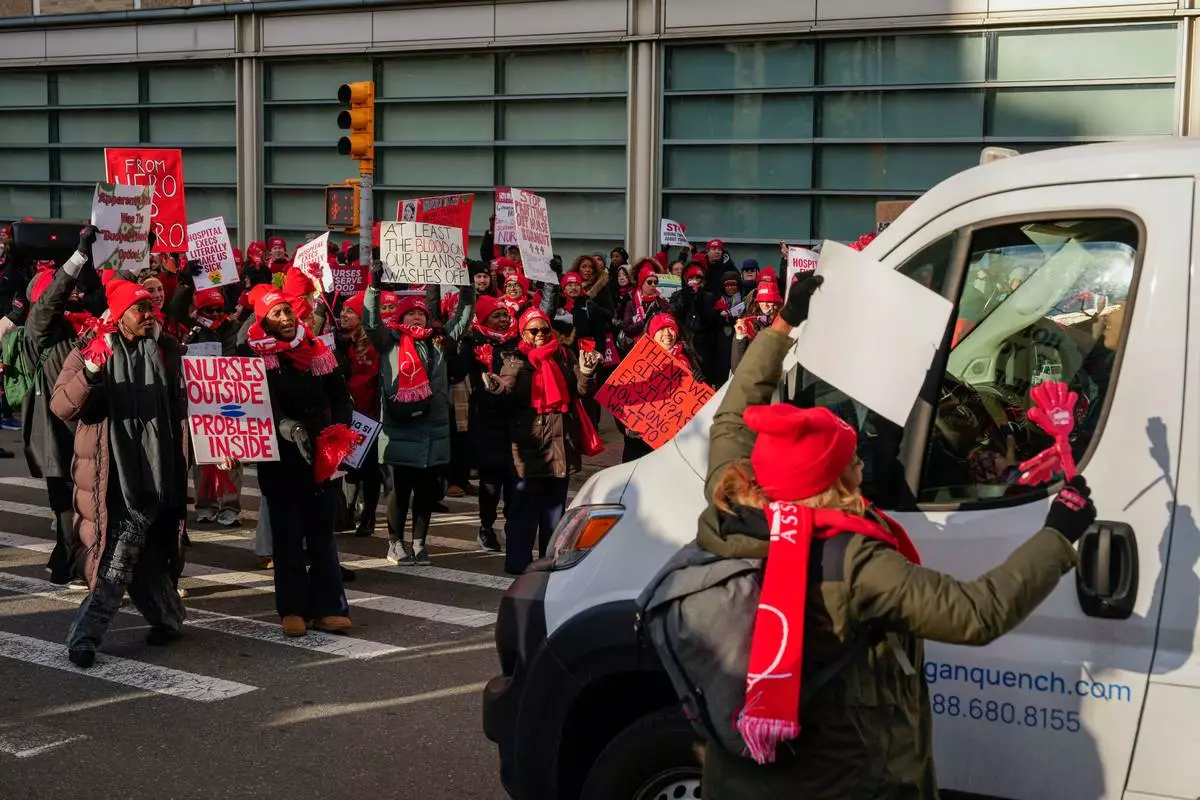
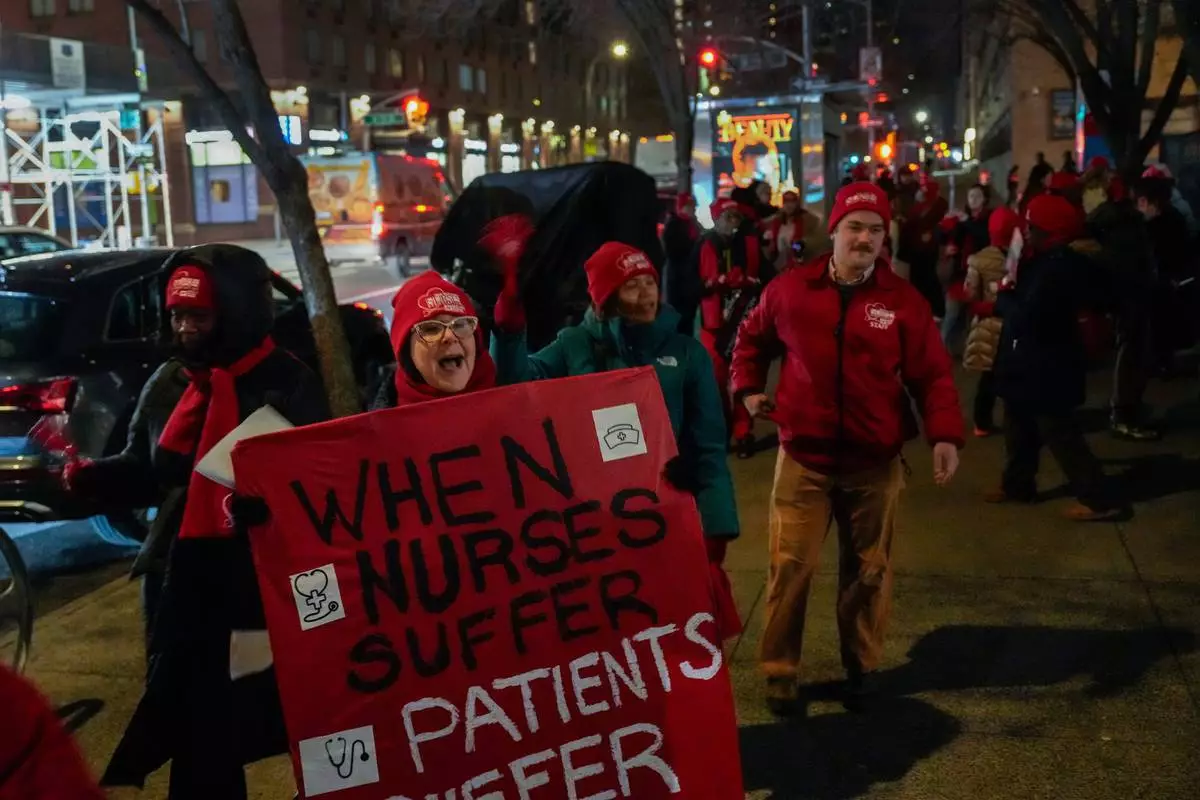
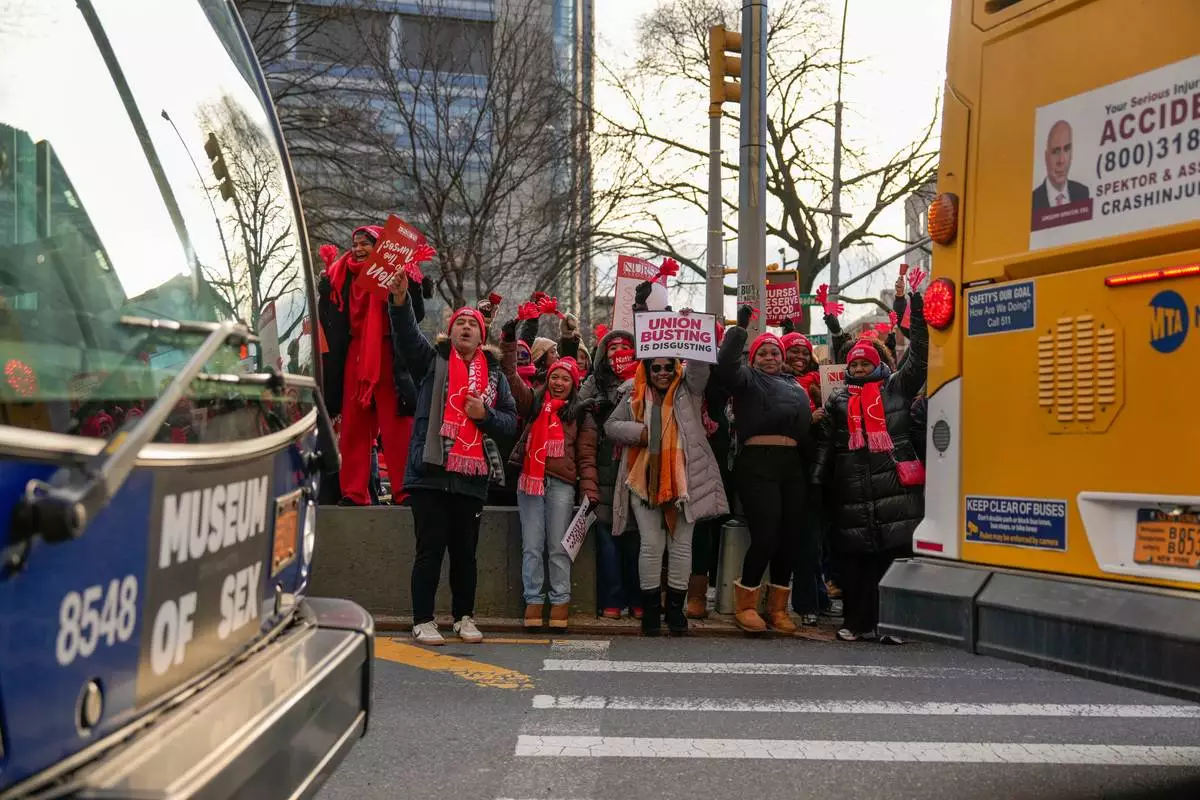
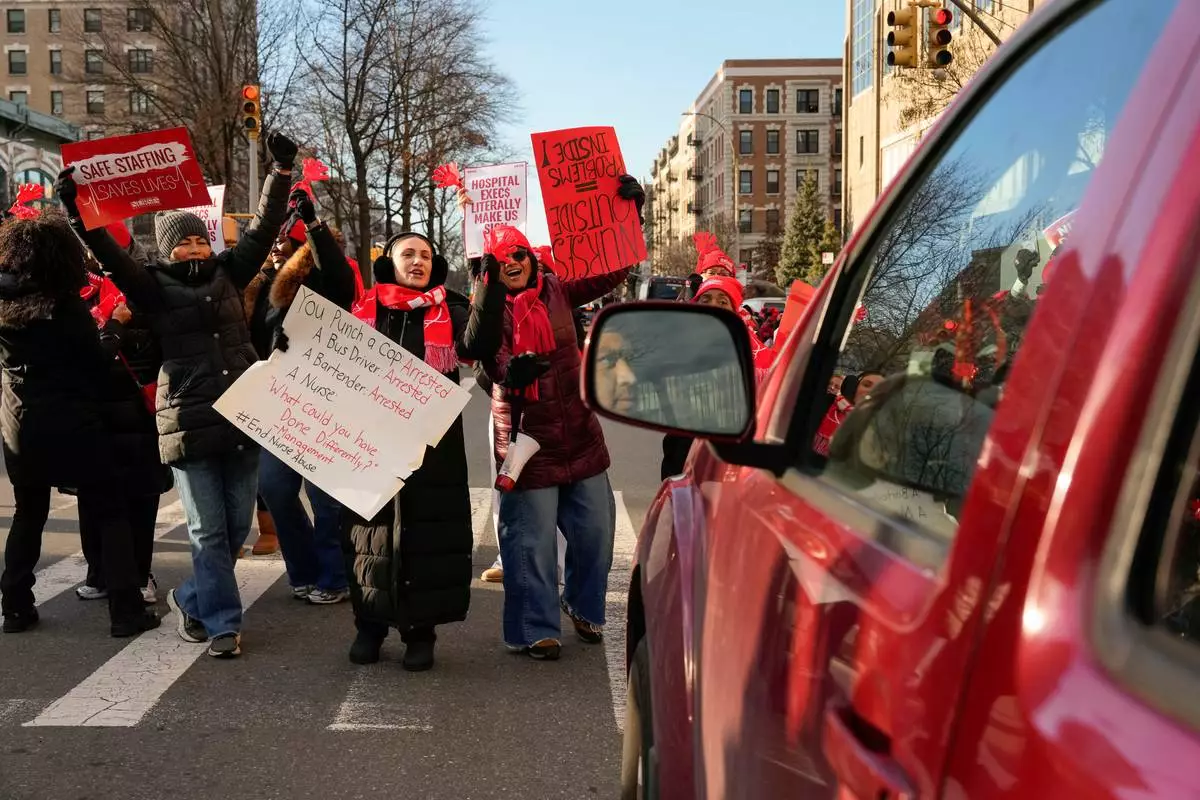
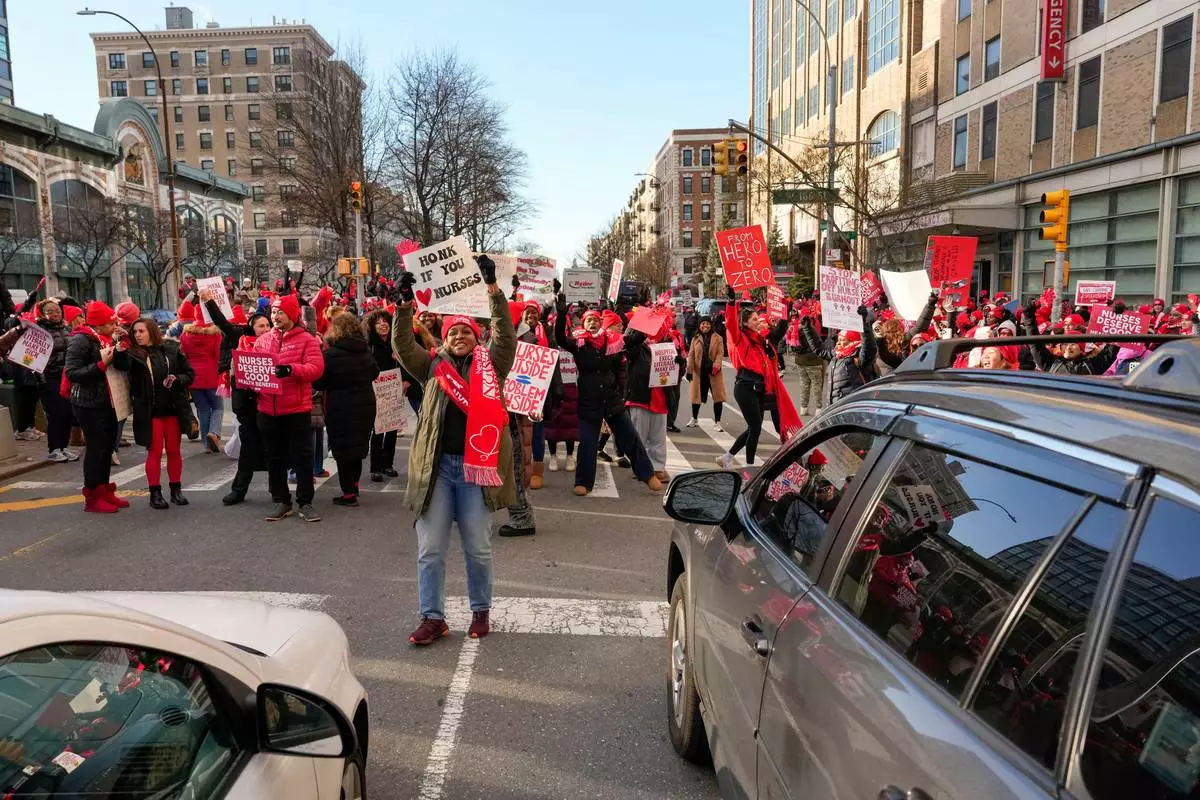
Nurses strike outside New York-Presbyterian Hospital, Monday, Jan. 12, 2026, in New York. (AP Photo/Yuki Iwamura)

Nurses strike outside New York-Presbyterian Hospital, Monday, Jan. 12, 2026, in New York. (AP Photo/Yuki Iwamura)

Nurses strike outside New York-Presbyterian Hospital, Monday, Jan. 12, 2026, in New York. (AP Photo/Yuki Iwamura)

Nurses strike outside New York-Presbyterian Hospital, Monday, Jan. 12, 2026, in New York. (AP Photo/Yuki Iwamura)

Nurses strike outside New York-Presbyterian Hospital, Monday, Jan. 12, 2026, in New York. (AP Photo/Yuki Iwamura)

Nurses strike outside New York-Presbyterian Hospital, Monday, Jan. 12, 2026, in New York. (AP Photo/Yuki Iwamura)

Nurses strike outside New York-Presbyterian Hospital, Monday, Jan. 12, 2026, in New York. (AP Photo/Yuki Iwamura)

Nurses strike outside New York-Presbyterian Hospital, Monday, Jan. 12, 2026, in New York. (AP Photo/Yuki Iwamura)

Nurses strike outside New York-Presbyterian Hospital, Monday, Jan. 12, 2026, in New York. (AP Photo/Yuki Iwamura)

Nurses strike outside New York-Presbyterian Hospital, Monday, Jan. 12, 2026, in New York. (AP Photo/Yuki Iwamura)

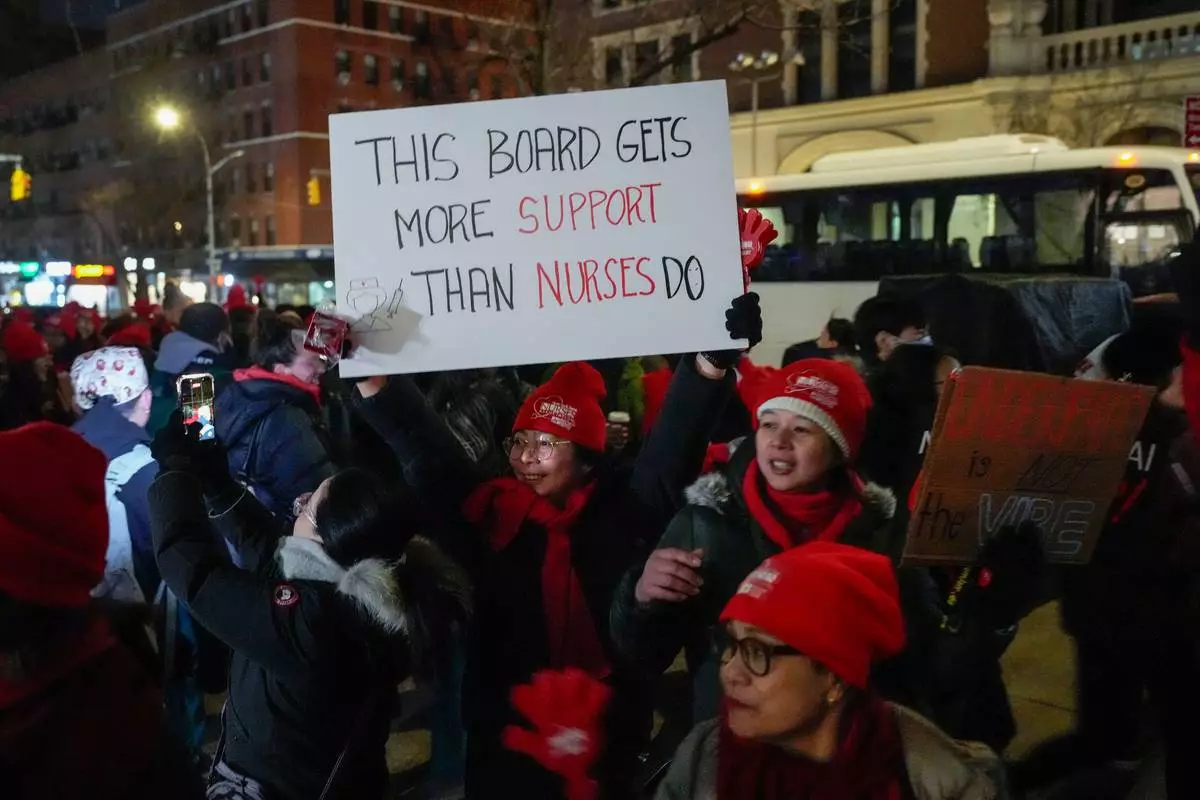
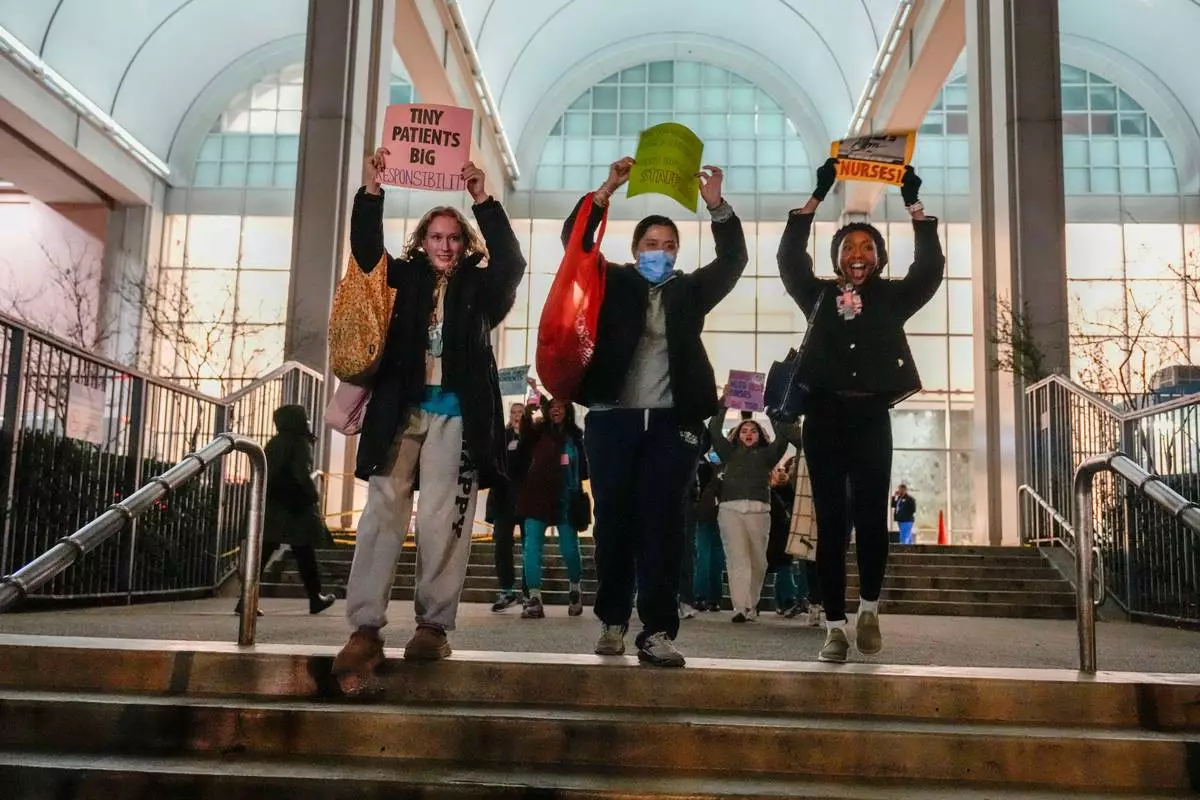
Nurses strike outside Mount Sinai West Hospital, Monday, Jan. 12, 2026, in New York. (AP Photo/Yuki Iwamura)

Nurses strike outside Mount Sinai West Hospital, Monday, Jan. 12, 2026, in New York. (AP Photo/Yuki Iwamura)

Nurses strike outside Mount Sinai West Hospital, Monday, Jan. 12, 2026, in New York. (AP Photo/Yuki Iwamura)

Nurses strike outside Mount Sinai West Hospital, Monday, Jan. 12, 2026, in New York. (AP Photo/Yuki Iwamura)

Nurses strike outside Mount Sinai West Hospital, Monday, Jan. 12, 2026, in New York. (AP Photo/Yuki Iwamura)

Nurses strike outside Mount Sinai West Hospital, Monday, Jan. 12, 2026, in New York. (AP Photo/Yuki Iwamura)

Nurses strike outside Mount Sinai West Hospital, Monday, Jan. 12, 2026, in New York. (AP Photo/Yuki Iwamura)

Nurses strike outside Mount Sinai West Hospital, Monday, Jan. 12, 2026, in New York. (AP Photo/Yuki Iwamura)

FILE - A medical worker transports a patient at Mount Sinai Hospital, April 1, 2020, in New York. (AP Photo/Mary Altaffer, File)

FILE - A medical worker transports a patient at Mount Sinai Hospital, April 1, 2020, in New York. (AP Photo/Mary Altaffer, File)

Recommended Articles