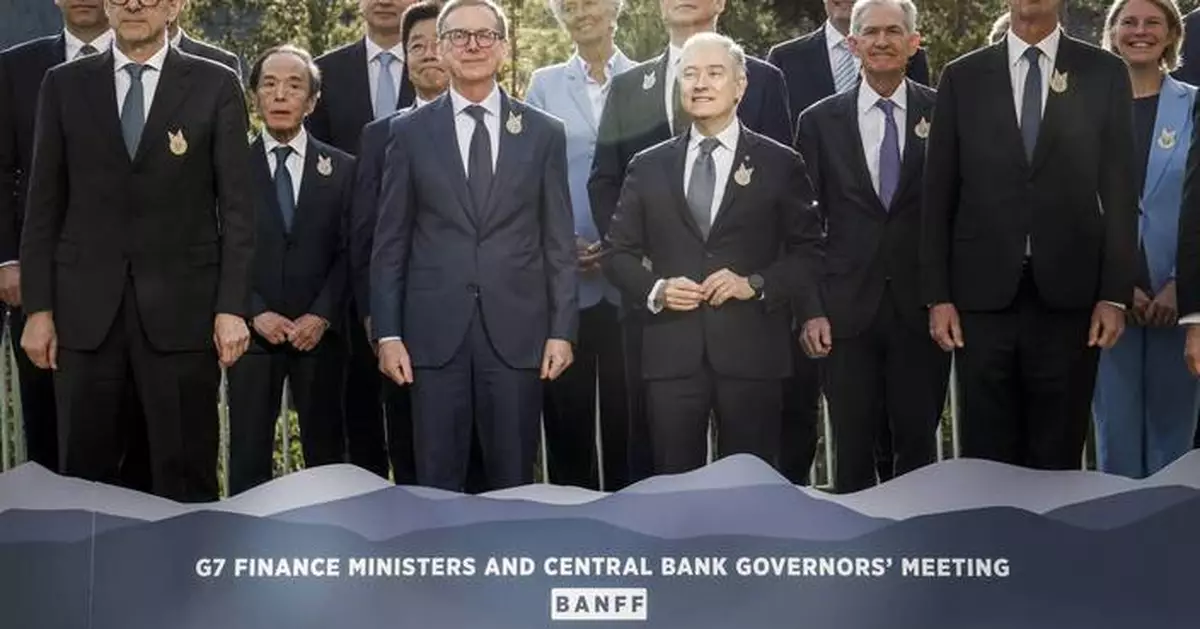
BANFF, Alberta (AP) — Top finance officials from the world's seven wealthiest democracies set aside stark differences on U.S. tariffs after two days of talks and agreed to counter global “economic imbalances,” a swipe at China's trade practices.
In a communiqué issued Thursday, the Group of Seven finance ministers and central bank governors, meeting in the Canadian Rockies, left out their traditional defense of free trade and toned down their references to Russia's war in Ukraine, compared with last year. But they did agree that further sanctions on Russia could be imposed if the two countries don't reach a ceasefire.
The communiqué said the G7 members would continue to monitor “nonmarket policies and practices” which contribute to imbalances in global trade. The statement did not mention China but nonmarket policies typically refer to that country's export subsidies and currency policies that the Trump administration charges gives it an advantage in international trade.
Treasury Secretary Scott Bessent appears to have succeeded in steering the communiqué largely in the direction the Trump administration sought, particularly regarding China's trade practices.
The high-profile gathering of officials from the United States, Canada, United Kingdom, Japan, Germany, France, and Italy also appeared to be more congenial than an earlier meeting of G7 foreign ministers in March. Yet that meeting, also in Canada, occurred as President Donald Trump was in the midst of threatening stiff tariffs on Canada and suggesting it could become the 51st state.
Canada is president of this year's G7 and the sessions this week are intended to lay the groundwork for a meeting of the heads of state on June 15-17 in Kananaskis, Canada. The White House said Thursday that Trump will attend that gathering.
“Throughout our G7 presidency, the tone of the discussions has become progressively more constructive,” Tiff Macklem, governor of the Bank of Canada, said at a news conference at the conclusion of the summit.
Yet that unity appears to have been achieved by jettisoning many items that in the past had been agreed to by the G7 countries. In addition to leaving out any mention of trade, the communiqué dropped sections on combating climate change and cooperating on international tax policy, issues the Trump administration has dismissed.
“There will always be tension around tariffs," said Francois-Philippe Champagne, Canada’s finance minister. “But there are also places where you find common ground. ... This year our focus was to return to the G7 core mission, restoring global growth and stability."
The shift comes as Trump has slapped widespread tariffs on imports, including a 10% global duty on all goods, even those from the other G7 allies. Trump has also imposed 25% tariffs on steel, aluminum, and cars, and on April 2 imposed much steeper tariffs on about 60 nations, which he then paused until early July.
Valdis Dombrovskis, European Union Trade Commissioner, said that trade was “obviously a difficult topic” during the negotiations. The EU, which participates in the G7 but doesn’t serve as one of the rotating presidents, pushed for stronger language that would have highlighted the economic harms from tariffs.
“The U.S. administration is having a somewhat different view of the situation,” Dombrovskis told reporters. He added that details about U.S. tariffs weren’t discussed because the G7 members are negotiating individually with the Trump administration about duties.
On Ukraine, the communiqué condemned “Russia's continued brutal war against Ukraine,” yet that language was milder than last year's, which referred to Russia's “illegal, unjustifiable, and unprovoked full-scale invasion.” Trump officials in the past have pushed to avoid antagonizing Russia while seeking peace talks.
Champagne, however, called the invasion “illegal” in Thursday's news conference.
Bessent also successfully included an agreement in the statement that “no country or entity” that supported Russia's war efforts would be able to profit from Ukraine's reconstruction, a restriction that would bar Chinese companies from participating.
Dombrovskis said the EU had proposed to lower the current price cap on Russian oil — previously agreed to as part of early sanctions slapped on Russia in the wake of its 2022 invasion — to $50, from $60, but the communiqué says little about specific measures.
Still, the EU was largely satisfied with the G7's agreements on Ukraine, Dombrovskis said, including the willingness to impose more sanctions. The group also agreed to continue freezing Russia's financial assets until they can be used to help pay for Ukraine's reconstruction.
Mark Sobel, a former top Treasury Department official and senior adviser to the Center for Strategic and International Studies, criticized the communiqué as “feeble.”
The statement “closes its eyes to the elephants in the room -- the word 'tariffs' or a reference to destructive U.S. trade policies are nowhere to be found,” Sobel said.
“On Ukraine, the G7 will ‘explore options’ if a ceasefire isn’t reached when the time for action is now,” he added. “This risible communiqué cannot hide the fissures in the G7 and hardly bodes well for the larger fractures looming for the upcoming G7 leaders’ summit."
Still, John Kirton, a political scientist at the University of Toronto and director of the G7 Research Group, said it was a positive sign that a communiqué had even been issued. “That was in considerable doubt to the very end,” he said.
Yet both Sobel and Kirton noted there was no reference to U.S. budget deficits and their role in the “global imbalances” the ministers seek to combat. The federal budget deficit, by contributing to higher U.S. demand, worsens the U.S. trade deficit that the Trump administration seeks to reduce.
The communiqué said that “economic policy uncertainty has declined from its peak," a view that Kirton said was “puzzling," given that the U.S. Congress is considering a tax and spending package that has unnerved financial markets this week, pushing up the interest rate on U.S. Treasury securities.
“There’s great uncertainty out there in financial markets,” Kirton said. "The dollar is going down, and we don’t know when that will end.”
Bessent held several bilateral meetings on the sidelines of the G7, including with Champagne and Japan’s Finance Minister Katsunobu Kato.
Bessent and Kato discussed trade and currencies, the Treasury Department said, with both sides agreeing that “exchange rates should be market-determined.” The U.S. has often criticized Japan in the past for intervening in currency markets to lower the yen’s value.
Yet the two sides “did not discuss foreign exchange levels,” Treasury said, a sign the U.S. isn’t pressuring Japan about the yen’s current value.
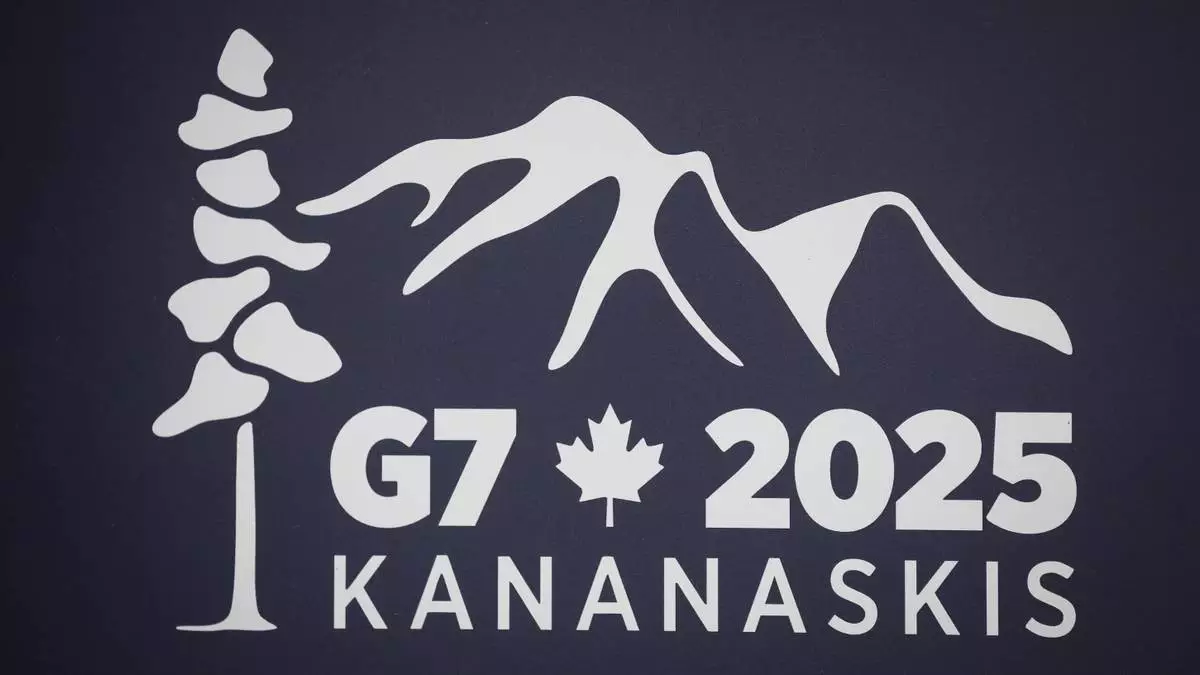
A logo for the G7 2025 Kananaskis meeting is pictured at a news conference in Banff, Alberta, Canada, Thursday, May 22, 2025. (Jeff McIntosh/The Canadian Press via AP)
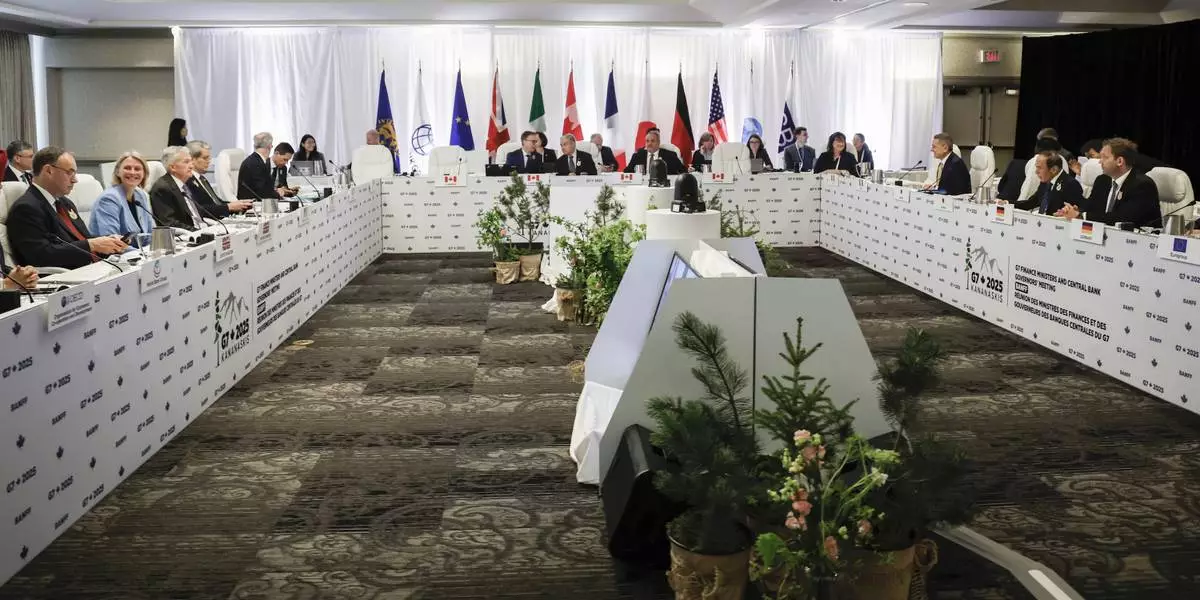
The G7 Finance Ministers attend their meeting in Banff, Alberta, Wednesday, May 21, 2025. (Jeff McIntosh/The Canadian Press via AP)
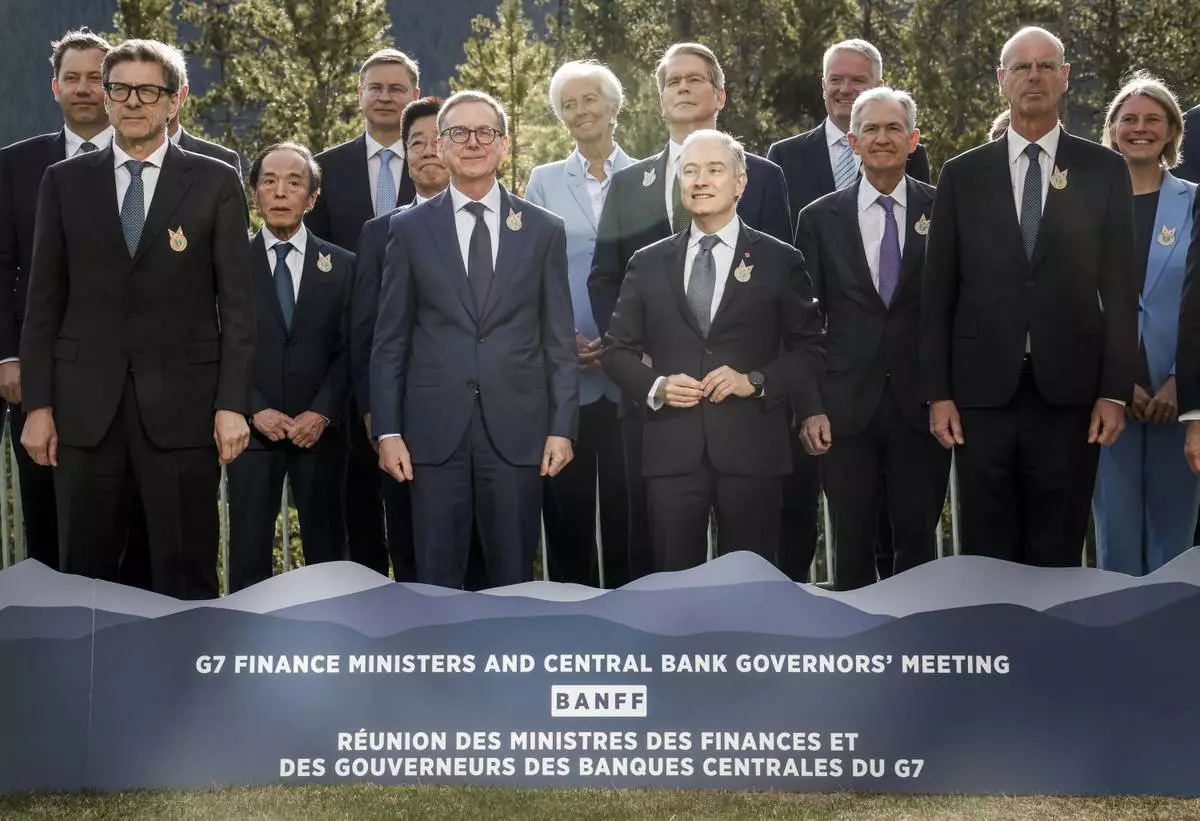
Canada's Finance Minister Francois-Philippe Champagne, centre right, and Governor of the Bank of Canada Tiff Macklem, centre left, pose for a family photo with their colleagues at the G7 Finance Ministers meeting in Banff, Alta., Wednesday, May 21, 2025. (Jeff McIntosh /The Canadian Press via AP)
SEOUL, South Korea (AP) — North Korea on Thursday displayed apparent progress in the construction of a nuclear-powered submarine, with state media photos showing a largely completed hull, as leader Kim Jong Un condemned rival South Korea’s push to acquire the technology.
North Korea’s official Korean Central News Agency said Kim visited a shipyard to inspect the construction of what the North describes as an 8,700-ton-class nuclear-propelled submarine, which the leader has called a crucial step in the modernization and nuclear armament of North Korea’s navy. The North has indicated it plans to arm the submarine with nuclear weapons, calling it a “strategic guided missile submarine” or a “strategic nuclear attack submarine.”
During the visit, Kim described South Korea’s efforts to acquire its own nuclear-powered submarine, which have been backed by U.S. President Donald Trump, as an “offensive act” that severely violates the North’s security and maritime sovereignty.
He said that the South Korean plan further underscores the need to advance and nuclear-arm North Korea’s navy, and claimed that the completion of his nuclear-powered submarine would be an “epoch-making” change in strengthening its nuclear war deterrent against what he called enemy threats.
The agency did not specify when Kim visited the shipyard but released photos showing him inspecting a huge, burgundy-colored vessel, coated with what appears to be anti-corrosion paint, under construction inside an assembly hall with senior officials and his daughter. It was the first time North Korean state media had released images of the submarine since March, when they mostly showed the lower sections of the vessel.
It was not immediately clear how close North Korea is to completing the vessel. But because submarines are typically built from the inside out, the release of what appears to be a largely completed hull suggests that many core components, including the engine and possibly the reactor, are already in place, said Moon Keun-sik, a submarine expert at Seoul’s Hanyang University.
“Showing the entire vessel now seems to indicate that most of the equipment has already been installed and it is just about ready to be launched into the water,” said Moon, a former submarine officer in the South Korean navy, who believes the North Korean submarine could possibly be tested at sea within months.
A nuclear-powered submarine was one item on a long wish list of sophisticated weaponry that Kim announced during a major political conference in 2021 to cope with what he called growing U.S.-led military threats. Other weapons were solid-fueled intercontinental ballistic missiles, hypersonic weapons, spy satellites and multi-warhead missiles.
North Korea has conducted a series of tests to develop some of those systems and recently unveiled a new naval destroyer, which Kim hailed as a major step toward expanding the operational range and preemptive strike capabilities of the country’s nuclear forces.
If North Korea obtains a submarine capable of operating stealthily for extended periods and launching missiles from underwater, it would be a worrying development for its neighbors, as such launches would be difficult to detect in advance. But there have been questions about whether North Korea, a heavily sanctioned and impoverished country, could get resources and technology to build nuclear-powered submarines.
Some experts say North Korea’s recent alignment with Russia — including sending thousands of troops and military equipment to support President Vladimir Putin’s war in Ukraine — may have helped it to receive crucial technologies in return.
While some analysts suspect North Korea may have sought a reactor from Russia, possibly from a retired Russian submarine, Moon said it's more likely that North Korea designed its own reactor, while possibly receiving some technological assistance from Russia.
During a summit with Trump in November, South Korean President Lee Jae Myung called for U.S. support for South Korea’s efforts to acquire nuclear-powered submarines, while reaffirming a commitment to increase defense spending to ease the burden on the United States.
Trump later said that the United States is open to sharing closely held technology to allow South Korea to build a nuclear-powered submarine, but it’s not immediately clear where and when the vessel would be built and how Seoul would get the nuclear fuel and reactor technology required.
In a separate report, KCNA said Kim on Wednesday supervised a test of a new, long-range anti-air missile that was fired toward its eastern sea. South Korea’s Defense Ministry didn’t immediately comment on the launch.
Tensions on the Korean Peninsula have worsened in recent years as Kim accelerated his military nuclear program and deepened alignment with Moscow following Russia’s invasion of Ukraine. His government has repeatedly dismissed calls by Washington and Seoul to revive negotiations aimed at winding down his nuclear and missile programs, which derailed in 2019 following a collapsed summit with Trump during the American president’s first term.

In this photo provided by the North Korean government, a test of a long-range anti-air missile is launched towards its eastern sea, as seen from an undisclosed location in North Korea, Wednesday, Dec. 24, 2025. Independent journalists were not given access to cover the event depicted in this image distributed by the North Korean government. The content of this image is as provided and cannot be independently verified. Korean language watermark on image as provided by source reads: "KCNA" which is the abbreviation for Korean Central News Agency. (Korean Central News Agency/Korea News Service via AP)
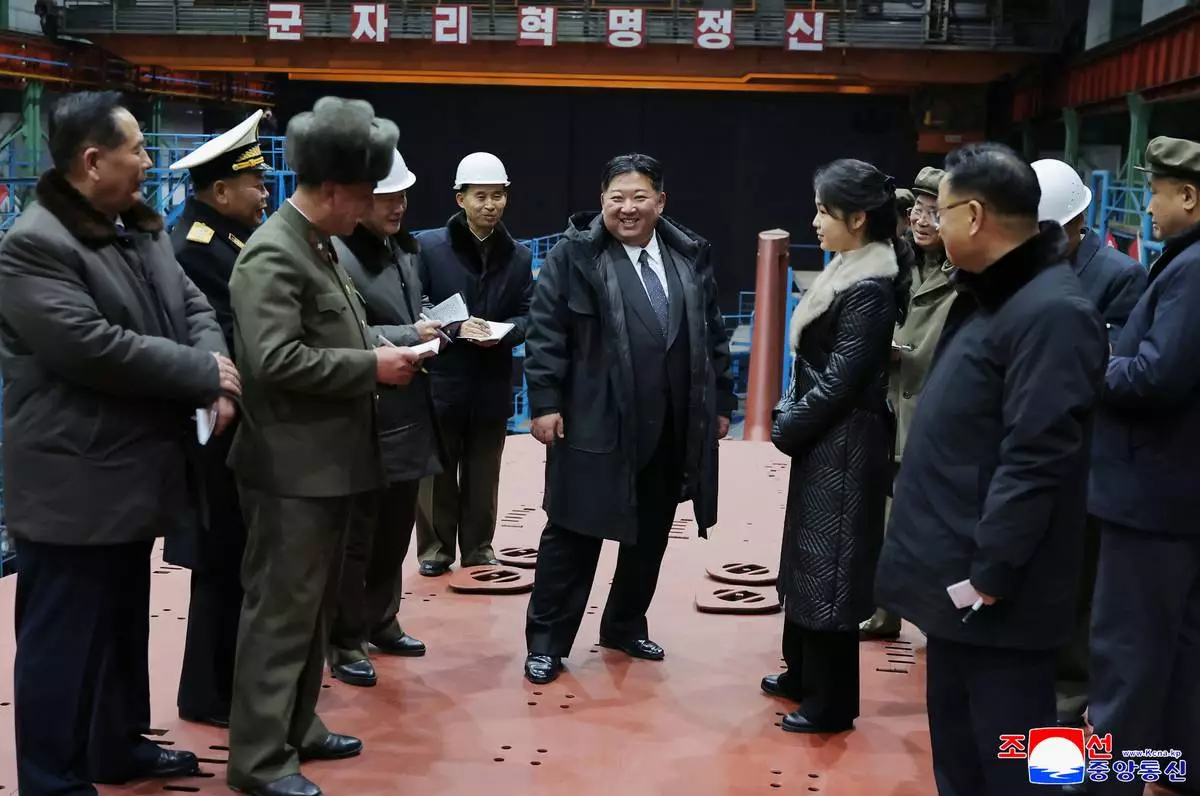
In this undated photo provided Thursday, Dec. 25, 2025, by the North Korean government, its leader Kim Jong Un, with his daughter, inspects a nuclear-powered submarine under construction at an undisclosed location in North Korea. Independent journalists were not given access to cover the event depicted in this image distributed by the North Korean government. The content of this image is as provided and cannot be independently verified. Korean language watermark on image as provided by source reads: "KCNA" which is the abbreviation for Korean Central News Agency. (Korean Central News Agency/Korea News Service via AP)

In this undated photo provided Thursday, Dec. 25, 2025, by the North Korean government, its leader Kim Jong Un, third left, visits a shipyard as he inspects a nuclear-powered submarine under construction at an undisclosed location in North Korea. Independent journalists were not given access to cover the event depicted in this image distributed by the North Korean government. The content of this image is as provided and cannot be independently verified. Korean language watermark on image as provided by source reads: "KCNA" which is the abbreviation for Korean Central News Agency. (Korean Central News Agency/Korea News Service via AP)

In this undated photo provided Thursday, Dec. 25, 2025, by the North Korean government, its leader Kim Jong Un inspects a nuclear-powered submarine under construction at an undisclosed location in North Korea. Independent journalists were not given access to cover the event depicted in this image distributed by the North Korean government. The content of this image is as provided and cannot be independently verified. Korean language watermark on image as provided by source reads: "KCNA" which is the abbreviation for Korean Central News Agency. (Korean Central News Agency/Korea News Service via AP)

In this undated photo provided Thursday, Dec. 25, 2025, by the North Korean government, its leader Kim Jong Un inspects a nuclear-powered submarine under construction at an undisclosed location in North Korea. Independent journalists were not given access to cover the event depicted in this image distributed by the North Korean government. The content of this image is as provided and cannot be independently verified. Korean language watermark on image as provided by source reads: "KCNA" which is the abbreviation for Korean Central News Agency. (Korean Central News Agency/Korea News Service via AP)