WASHINGTON (AP) — The following episode of The Story Behind the AP Story contains sound and descriptions that some listeners may find graphic or violent. Listener discretion is advised.
Haya Panjwani, host: In the summer of 2020, as the world was just beginning to grasp the COVID-19 pandemic, a video surfaced that would spark a movement like no other.
Click to Gallery

FILE - In this image taken from video, former Minneapolis Police Officer Derek Chauvin addresses the court at the Hennepin County Courthouse, June 25, 2021, in Minneapolis. (Court TV via AP, Pool, File)

FILE - Protesters and police face each other during a rally against the death of George Floyd in Minneapolis on Tuesday, May 26, 2020. (Richard Tsong-Taatarii/Star Tribune via AP, file)

FILE - Cortez Rice, left, of Minneapolis, sits with others in the middle of Hennepin Avenue on Sunday, March 7, 2021, in Minneapolis, Minn., to mourn the death of George Floyd a day before jury selection is set to begin in the trial of former Minneapolis officer Derek Chauvin, who is accused of killing Floyd. (Jerry Holt /Star Tribune via AP, file)

FILE - Protesters gather calling for justice for George Floyd on Tuesday, May 26, 2020, in Minneapolis. Four Minneapolis officers involved in the arrest of Floyd, a black man who died in police custody, were fired Tuesday, hours after a bystander's video showed an officer kneeling on the handcuffed man's neck, even after he pleaded that he could not breathe and stopped moving. (Carlos Gonzalez/Star Tribune via AP, file)
Aaron Morrison, editor: So, on May 25, 2020, George Floyd, who was a Black man from Houston, Texas, was in Minneapolis where he’d moved to find job opportunities.
PANJWANI: Aaron Morrison, the AP’s race and ethnicity editor.
MORRISON: And on this day, in particular, a store clerk reported that Floyd had allegedly used a counterfeit $20 bill. He was restrained by at least a few officers, one in particular named Derek Chauvin, who’s a white police officer, knelt on George Floyd’s neck and back for over nine minutes. Floyd was handcuffed to the ground, and while a crowd of people had assembled, essentially demanding that George Floyd be released from the hold because as a now viral and famous video of the, of the encounter shows, George Floyd repeatedly said that he could not breathe.
George Floyd, in a recorded video: I can’t breathe! They gon’ kill me, they gon’ kill me, man.
MORRISON: Before he took his last, last breath right there on the street.
PANJWANI: I’m Haya Panjwani. On this episode of the Story Behind the AP Story we revisit the murder of George Floyd five years later. We’ll hear from people who were on the ground in the days immediately after Floyd’s death, the trial that followed and how that summer shaped sentiments around race.
Noreen Nasir is a video journalist who was in Minneapolis covering the city’s reaction to the death of George Floyd.
Noreen Nasir, video journalist: Initially, I think there was a lot of anger, of course, and some of that anger then turned into, you know, the images of destruction that we then saw and then I think got a lot of focus and attention in the media.
Sound from protests in Minneapolis in 2020: He can’t breathe, he can’t breathe, he can’t breathe...
NASIR: But I think what was also lost in some of that focus that was very palpable on the ground was a deep sense of like sadness that a lot of folks felt. There was a lot of grief, I remember, on the ground especially at the site of the memorial. Going there at various times in the days that followed, that memorial just sort of like grew and grew and grew. There were these you know reverberations around like what this meant for race and racism across the country, things that and themes that then I think people were really trying to point to in the days and months that followed.
There was one night, you know, we were there, things that one of those early nights where things got really sort of tense and there were buildings that were broken into, there was looting that was happening. And I spoke to some of the business owners. A lot of them are also, you know, they’re immigrants. A lot them were Somali Americans. They had come to this country. And for them, you know, I could see the sort of like conflicted feelings that they were having just in their own emotions and the way that they themselves were processing this thing. For them, they were saying, you we are Black. We are perceived as Black in this country, we are Black. And then at the same time, they’re saying, we’re also these business owners. We are grieving, and also, we want to protect our businesses, this is our livelihood. You would see a lot of on the boarded-up businesses, signs that said minority owned, almost as a way to say, “Hey, please don’t target us, like we’re in the same boat.”
PANJWANI: Amy Forliti was a crime and courts reporter during the time of George Floyd’s killing in 2020.
Amy Forliti, editor: The centerpiece was definitely the bystander video of George Floyd’s final moments. Prosecutors played that footage really early in the case. They did it the first time during their opening statement and the prosecutor then told jurors to believe your eyes and that idea of believing your eyes or believing what you see on the video right before you was a theme that prosecutors came back to throughout the trial.
The defense took a different approach with that whole idea of believing what you see, and said that everyone there had a different perspective and came from a different vantage point and interpreted the events of that day differently. And the defense said that Chauvin’s perspective was one of a reasonable police officer.
Many of the people who did testify said that they just felt helpless, that they couldn’t do anything, and they saw Floyd’s life being basically snuffed out, and they couldn’t do anything. The teenager who recorded that video said that it seemed Chauvin just didn’t care, and she testified that she stayed up at night apologizing to George Floyd because she didn’t do more to help him.
I also remember some very poignant words at closing arguments. When we talk about the cause of death, prosecutor Jerry Blackwell referred to how the defense was saying that this was a heart issue that killed Floyd and that he had an enlarged heart. And the prosecutor said, and I’m paraphrasing here, but he told jurors that George Floyd didn’t die because his heart was too big, but because Derek Chauvin’s heart was too small.
In the end, a jury of six white people and six Black or multiracial people convicted Chauvin of three counts, including unintentional second-degree murder, which was the most serious count against him. After that verdict was read, a crowd gathered in the street and started cheering and rejoicing over that. He went on to later plead guilty to a federal count of violating George Floyd’s civil rights.
PANJWANI: Some right-wing politicians and social media personalities have called for Chauvin to be pardoned by President Donald Trump.
FORLITI: But if he does, it’s really important to note that this won’t impact Chauvin’s state murder conviction at all. He will still have to serve out the remainder of his state sentence on the murder charge. So, he’s not going to walk out of a Texas prison and be free. He would likely have to come back to Minnesota to serve the rest of his sentence.
MORRISON: Folks who maybe did not understand or support such a reckoning have increasingly dismissed everything that happened in 2020 as wokeness, so-called wokeness, gone or run amok. They are hoping and advocating for Derek Chauvin to be pardoned because, in their view, this wasn’t true justice.
NASIR: This happened at a time where it was, of course, it was the middle of the pandemic, and we were all in lockdown and we were all just at home. And frustration, I think, in different ways had been building up for a while for a lot of people. And so when this happened, it really just touched a nerve and then it sort of lit it all on fire. Everyone was watching this because no one was going anywhere. There was nothing to distract anyone.
And a lot of people were joining protests for the first time. Particularly when it came to the issue of racism in the U.S. And then, of course, in the months also that followed his initial death, Black Lives Matter as a movement sort of really spread. And the movement itself had started years earlier after the death of Trayvon Martin, but in 2020, it really took off across the country in a way that I think we had not seen before. And then it took off around the world where then folks were looking at their own interactions with police in their countries and looking at the way that racism played out in policing interactions.
PANJWANI: This has been The Story Behind the AP Story. For more on AP’s race and ethnicity coverage, visit apnews.com.
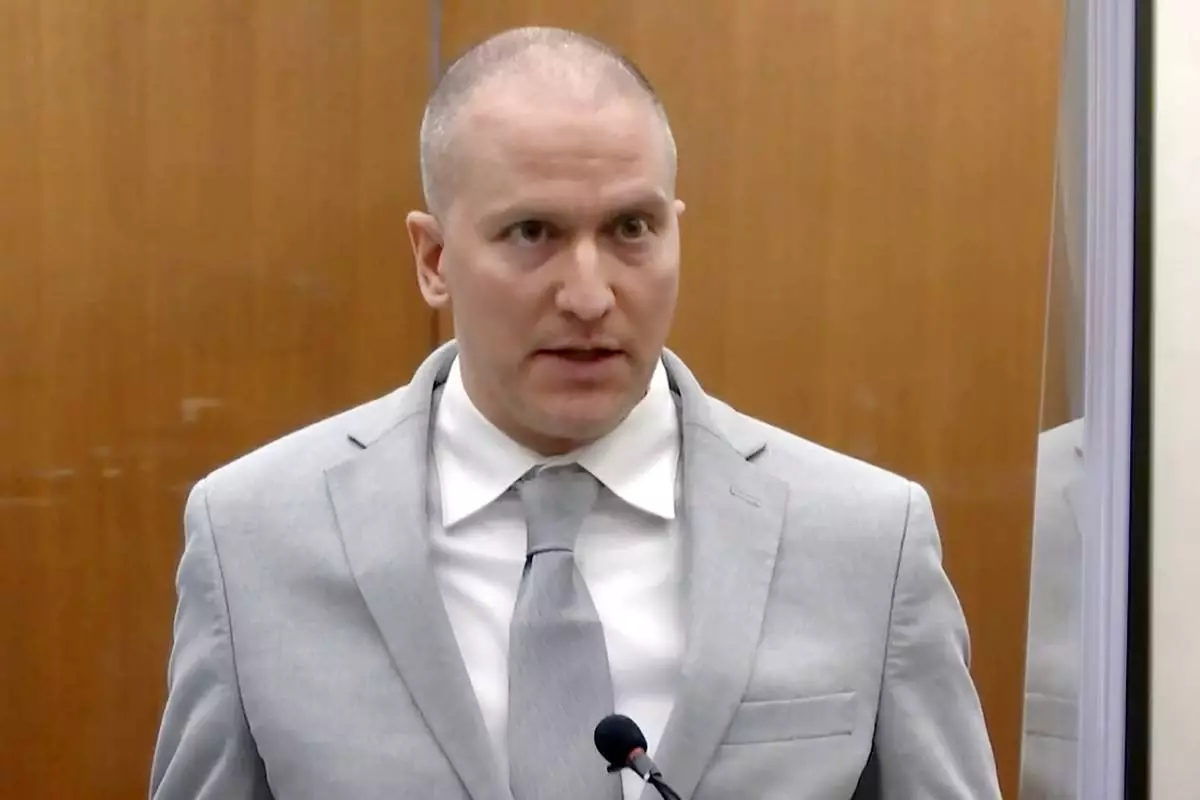
FILE - In this image taken from video, former Minneapolis Police Officer Derek Chauvin addresses the court at the Hennepin County Courthouse, June 25, 2021, in Minneapolis. (Court TV via AP, Pool, File)

FILE - Protesters and police face each other during a rally against the death of George Floyd in Minneapolis on Tuesday, May 26, 2020. (Richard Tsong-Taatarii/Star Tribune via AP, file)

FILE - Cortez Rice, left, of Minneapolis, sits with others in the middle of Hennepin Avenue on Sunday, March 7, 2021, in Minneapolis, Minn., to mourn the death of George Floyd a day before jury selection is set to begin in the trial of former Minneapolis officer Derek Chauvin, who is accused of killing Floyd. (Jerry Holt /Star Tribune via AP, file)

FILE - Protesters gather calling for justice for George Floyd on Tuesday, May 26, 2020, in Minneapolis. Four Minneapolis officers involved in the arrest of Floyd, a black man who died in police custody, were fired Tuesday, hours after a bystander's video showed an officer kneeling on the handcuffed man's neck, even after he pleaded that he could not breathe and stopped moving. (Carlos Gonzalez/Star Tribune via AP, file)