UKHIYA, Bangladesh (AP) — In moments when she is alone, when there is a break in the beatings from her husband, the girl cries for the school that was once her place of peace in a world that has otherwise offered her none.
Ever since the military in her homeland of Myanmar killed her father in 2017, forcing her to flee to neighboring Bangladesh with her mother and little sisters, the school had protected Hasina from the predators who prowl her refugee camp, home to 1.2 million members of Myanmar’s persecuted Rohingya minority.
It had also protected her from being forced into marriage. And then one day in June, when Hasina was 16 years old, her teacher announced that the school’s funding had been taken away. The school was closing. In a blink, Hasina’s education was over, and so, too, was her childhood.
With her learning opportunities gone, and her family worried that foreign aid cuts would make their fight for survival in the camps even more perilous, Hasina — along with hundreds of other girls under the age of 18 — was quickly married off. And, just like Hasina, many of the girls are now trapped in marriages with men who abuse them.
“I dreamed of being something, of working for the community,” Hasina, now 17, says softly. The Associated Press is withholding her full name to protect her from retaliation by her husband. “My life is destroyed.”
The sudden and severe foreign aid cuts imposed this year by U.S. President Donald Trump, along with funding reductions from other countries, shuttered thousands of the camps’ schools and youth training centers and crippled child protection programs. Beyond unwanted marriages, scores of children as young as 10 were forced into backbreaking manual labor, and girls as young as 12 forced into prostitution. With no safe space to play or learn, children were left to wander the labyrinthine camps, making them increasingly easy targets for kidnappers. And the young and desperate were picked off by traffickers who promised to restore what the children had lost: Hope.
In a sweltering building not far from the cramped shelter where her husband tortures her, Hasina plays nervously with the strap of her pink mobile phone case, emblazoned with the words “Forever Young.”
She is still young, she says. But the aid cuts forced her into womanhood and into a nightmare. Not long after marrying her husband, she says, he isolated her from her family and began to beat and sexually abuse her. She daydreams daily of school, where she was a whiz at English and hoped to become a teacher. Now, she is confined largely to her shelter, cooking and cleaning and waiting with dread for the next beating.
If she had any way to escape, she says, she would. But there is nowhere to go. She cannot return to Myanmar, where the military that killed thousands of Rohingya in 2017 during what the U.S. declared a genocide remains in charge of her homeland.
Now, her husband is in charge of her future, though she no longer sees one.
“If the school hadn’t closed,” she says, “I wouldn’t be trapped in this life.”
Life has always been dangerous for the 600,000 children languishing in these chaotic, overcrowded camps, where a squalid jumble of bamboo and tarpaulin shelters are jammed onto landslide-prone hills. But Trump’s decision in January to dismantle the U.S. Agency for International Development has made it even more so, the AP found in interviews with 37 children, family members, teachers, community leaders and aid workers.
Violations against children in the camps have risen sharply this year, according to UNICEF, the United Nations’ children’s agency. Between January and mid-November, reported cases of abduction and kidnapping more than quadrupled over the same time period last year, to 560 children. And there has been an eightfold increase in reports of armed groups’ recruitment and use of children for training and support roles in the camps, with 817 children affected. Many members of the armed groups are battling a powerful ethnic militia across the border in Myanmar. The actual number of cases is likely higher due to underreporting, according to UNICEF, which lost 27% of its funding due to the U.S. aid cuts and subsequently shuttered nearly 2,800 schools.
“The armed groups, with their roots in Myanmar, are operating in the camps, using the camps as a fertile ground for recruiting young people,” says Patrick Halton, a child protection manager for UNICEF. “Obviously, if children are not in learning centers and not in multipurpose centers, then they’re more vulnerable to this.”
Verified cases of child marriage, which the U.N. defines as the union of children under age 18, rose by 21% and verified child labor cases by 17% in the year to September, compared to the same time period last year. Those statistics are likely to be a significant undercount, says Halton.
“With the funding cuts, we had to downscale a lot in terms of the education,” Halton says. “It’s meant that children have not necessarily had things to do, and we’ve therefore seen this rise in children being married, children being in child labor.”
Though the U.S. spent just 1% of its budget on foreign aid, Trump dubbed USAID wasteful and shut it down, a move that has proven catastrophic for the world’s most vulnerable. In Myanmar, the AP found the aid cuts have caused children to starve to death, despite U.S. Secretary of State Marco Rubio’s statement to Congress that “No one has died” because of the dissolution of USAID. A study published in The Lancet journal in June said the U.S. funding cuts could result in more than 14 million deaths, including more than 4.5 million children under age 5, by 2030.
In the Bangladesh camps, the U.S. — which has long been the biggest provider of aid to the predominantly Muslim Rohingya — slashed its funding by nearly half compared to last year. The overall Rohingya emergency response is only 50% funded for 2025, and aid agencies say next year is expected to be far worse.
In a statement to the AP, the State Department said the U.S. has provided more than $168 million to the Rohingya since the beginning of Trump’s term, although data from the U.N.’s financial tracking service show the U.S. contribution in 2025 is $156 million. Asked about the disparity, the State Department said the U.N.’s financial tracking service had not been recently updated and “generally does not show the latest information on all U.S. funding.”
The department said it had “advanced burden sharing and improved efficiency” in the Rohingya response, resulting in 11 countries increasing their funding by more than 10% year on year, collectively contributing $72 million.
“The Trump Administration continues to pursue the diplomatic efforts to encourage additional countries to help shoulder the burden,” the statement said.
The department didn’t respond to the AP’s request for evidence that the U.S. had influenced other countries’ funding decisions for the Rohingya response.
When the schools shut down, hundreds of underage girls — some as young as 14 — were married off, says Showkutara, executive director of the Rohingya Women Association for Education and Development. Her network of contacts across the camps have also reported an increase in kidnapping and trafficking, as well as a huge surge in the prostitution of girls as young as 12 since the aid cuts.
“After the school closures, they had no space to play. ... That’s why they’re playing on the roads, far away from their blocks,” says Showkutara, who goes by one name. “There are some groups who are targeting the children.”
While UNICEF managed to repurpose some of its remaining funding, enabling the agency to recently reopen most of its learning centers, scores of schools run by other aid groups are still shut, and thousands of children remain out of class. And aid workers are anticipating even steeper funding cuts next year, leaving the schools’ futures uncertain. Save the Children has only secured a third of its funding target for life-saving services for 2026, meaning 20,000 children attending its schools are at risk of losing their education starting in January, says Golam Mostofa, the group’s area director for Cox’s Bazar, the closest city to the camps.
Meanwhile, Showkutara says, the children locked out of learning by the initial closures are forever lost: Both metaphorically, in the case of girls like Hasina who were married off to men who will never let them return to school even if they reopen, and literally, in the case of children who vanished into the trafficking network.
“It’s too late,” she says.
The little boy sits slumped on a plastic stool under the punishing sun, his cheeks streaked with sweat, a cooler of freeze pops and other treats at his dirty feet. Ever since 10-year-old Mohammed Arfan’s school closed, this is where he spends 10 hours a day, seven days a week, selling snacks and daydreaming of the small schoolroom where he once felt safe and loved.
He had just finished his math lessons the day that his teacher told him the school’s funding was gone. As he walked home, he and his friends began to cry.
“I thought that I would not see my friends anymore, and that I was losing my future,” he says.
With no lessons to occupy his time, and his parents worried about their seven children’s survival, Arfan’s mother told him he would need to work to help keep the family fed.
He was terrified. If the camp’s kidnappers or thieves targeted him while he was working, he knew he was too small to fight back.
But he had no choice, and so his daily drudgery began. Each morning, he wakes at 7 and walks for half an hour to the factory to pick up the treats. Then, hoisting the 15-kilogram (30-pound) cooler upon his bony shoulder, he walks another 30 minutes to the corner of the dusty road where he sets up shop among the garbage, rotting banana peels and swarms of flies. For his efforts, he takes home around 200 to 300 taka ($1.60 to $2.50) a day.
There are boys like Arfan all over the camps, selling food they’re desperate to eat and collecting trash in exchange for cash, shoulders slumped with exhaustion, skin seared by the sun.
In a drainage ditch next to a row of stinking latrines, 13-year-old Rahamot Ullah wades up to his waist in water clouded with raw sewage, plucking from the muck discarded pieces of plastic. Five hours of rummaging through the waste will generally net him enough plastic to trade for around 50 taka (40 cents).
His eye blazes with blood from the bamboo that pierced it 10 days earlier while slogging through the sewage. He began coming here soon after his school shut down, in the hopes he could collect enough trash to pay the 500 taka ($4) a month fee for private lessons. Many months, that fee has remained out of reach.
He worries he will drown in the ditch. And he worries that his dreams of becoming a camp official or a teacher will never come true.
Back on the street corner, Arfan, too, feels his dreams dying. He shouldn’t be here, he says, voice barely audible above the incessant shrieking of horns from the rickshaws racing past, just inches from his cooler.
“I feel shame working,” he says. “This is the time I should be studying.”
Each night when the sun sets, Arfan packs up and heads back to his shelter. And it is here where he lies on a mat on the bamboo floor, crying himself to sleep and pining for the life he was forced to leave behind.
The laughter that once filled Noor Zia’s classroom has been replaced by tears. Nearly every day, she says, her former students stop by to see if the school has reopened, only to break down when told it has not.
Zia often finds herself in tears, too. Before the aid cuts, she was the head teacher of 21 early learning centers that served 630 children aged 3-5. But the closures left her without a job, making it even harder for her to keep her family alive on the camp’s meager rations.
“My heart is still crying, because my family depends on this job,” she says, sitting in the empty classroom, where the wall behind her is adorned with a drawing of the Myanmar flag — a country most of her students, born in the camps, have never seen.
The funding cuts’ pain goes beyond the school closures. Skills development programs that kept thousands of children occupied were also halted. Healthcare, nutrition and sanitation services have been reduced. In camps crawling with scabies and other diseases, the results of the reductions are clear on the children’s scrawny bodies. Lesions line their slender limbs. The wet, rattling coughs of babies fill the fetid air. Atop a muddy hill, clusters of kids scratch ferociously at their heads, while a 4-year-old stoically plucks nits from her friend’s scalp.
Bangladesh has barred the Rohingya from leaving the camps to find work, so they are reliant upon humanitarian aid to survive. But the U.N.’s World Food Program, which had counted the U.S. as its largest donor, says it only has enough funds to continue providing food rations through March.
The prospect of a ration cut has terrified families. With no country offering the Rohingya large-scale resettlement, many have opted to make a run for it, with devastating results. Nearly a third of the 1,340 Rohingya who have fled Bangladesh by boat this year have died or gone missing en route, according to the U.N. High Commissioner for Refugees.
Noor Kaida, a 17-year-old whose dreams of becoming a doctor were dashed when she was married off after her school shut, says she has lost two young relatives to traffickers. Shattered by the school closures, the 13- and 16-year-old girls believed traffickers who promised them a better life in Malaysia, Kaida says. Other passengers on the girls’ boats later told Kaida’s family both girls were killed; one by drowning, and the other at the hands of a trafficker.
“If the school wasn’t closed, they wouldn’t have had to take these risks,” Kaida says. “Because of the funding cuts and the school closures, thousands of girls were scattered in different places and their lives have been ruined.”
The 13-year-old boy had been missing for nine days when the call came in from an unfamiliar number.
“Baba, I’m leaving,” Mohammed told his frantic father. “I’m on the big boat now. Pray for me.”
The call disconnected, and Mohib Ullah knew his worst nightmare had come true: Just like so many other children in recent months, his boy had been taken by traffickers. Ullah — who has no relation to Rahamot Ullah — called back again and again, but the phone was switched off.
Mohammed — whose full name the AP is withholding for safety reasons — had been miserable since his school closed. The kindhearted boy who loved to read and learn, especially English, had long dreamed of becoming a teacher. When his education ended, he told his father through tears that his life was over. Ullah promised to try and find money for private school, but as a widower caring for four children, it was impossible.
The teen hatched a plan, which he shared in secret with his big sister, Bibi: He would go with a trafficker to Malaysia, and find a future there. Bibi tried to talk him out of it; traffickers who take children on the long, dangerous journey generally detain the youngsters at the end until their parents pay a fee for their release. The children of parents who can’t pay are often tortured, and sometimes killed. Bibi warned her brother that their father would never be able to afford the trafficker’s payment.
But Mohammed didn’t care. “It’s better to withstand two years of torture than stay here in a hopeless camp,” he told his sister. “It’s better to die if I can’t continue learning.”
In a panic, Bibi shared her brother’s plan with their father, who was horrified; he knew how deadly the journey to Malaysia can be. He ordered his son to stay put, and to stay patient. The schools will reopen someday, he assured Mohammed. But the teen was convinced they would not.
And so, one morning in October, Mohammed left his family’s shelter and never returned. Ullah scoured the camps and called relatives, searching for any trace of his son. He couldn’t sleep, couldn’t eat. He has already lost another son, an 8-year-old who suddenly died on the anniversary of Ullah’s wife’s death, after crying all day about missing his mother and then saying he felt unwell. The prospect of losing one more child was unbearable.
Mohammed’s call came on Oct. 21. And then, for over six weeks, there was silence.
On Dec. 6, Ullah’s phone finally rang. It was Mohammed — still alive, but sick and sobbing. The traffickers were demanding 380,000 taka ($3,100) for his release — an astronomical sum that Ullah told Mohammed he did not have. But the terrified boy begged his father to try and find it.
Ullah knew if couldn’t, his son would likely be killed. And so he pleaded with anyone he could think of for any money they could spare. In the end, he collected just enough, and Mohammed was set free in Malaysia.
Ullah does not know what will become of his boy, who is still so young and wandering around a country that is alien to him.
“If he could have continued his studies, he could have been a teacher, he could have stayed near me,” Ullah says, blinking back tears. “Now he’s left me and I can’t see him. So I lost my dream, too.”
His voice cracks as he describes what was long one of his greatest joys: The sight of his son coming home from school, backpack slung across his shoulders.
Now, the stacks of workbooks Mohammed once pored over sit in his bedroom, untouched. His brown sandals are propped against the wall, alongside the sparkly pink sneakers belonging to the sister who tried in vain to stop him.
And, hanging from a piece of bamboo, gathering dust, is his backpack.
—-
Contact AP’s global investigative team at Investigative@ap.org or https://www.ap.org/tips/.
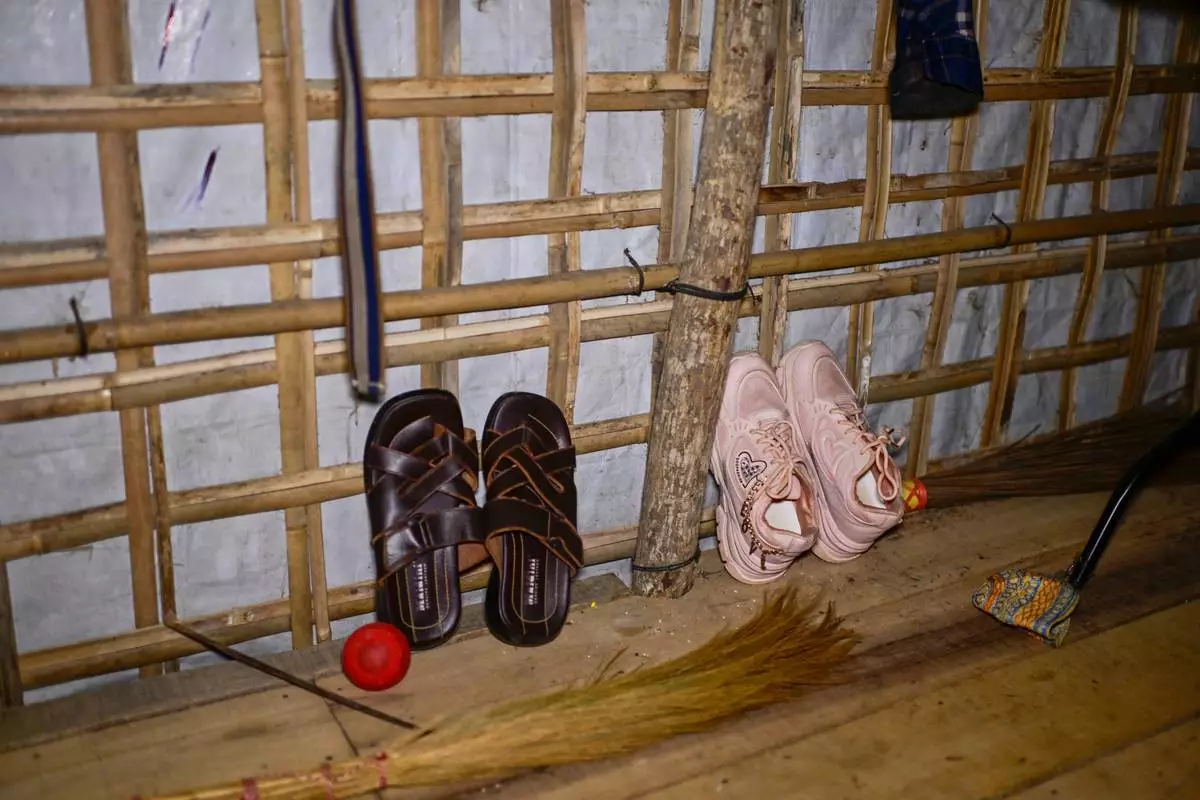
Brown sandals of 13-year-old Mohammed are propped against the wall, alongside sparkly pink sneakers belonging to his sister, inside their shelter in the Rohingya refugee camp in Cox's Bazar, Bangladesh, Saturday, Nov. 22, 2025. (AP Photo/Mahmud Hossain Opu)
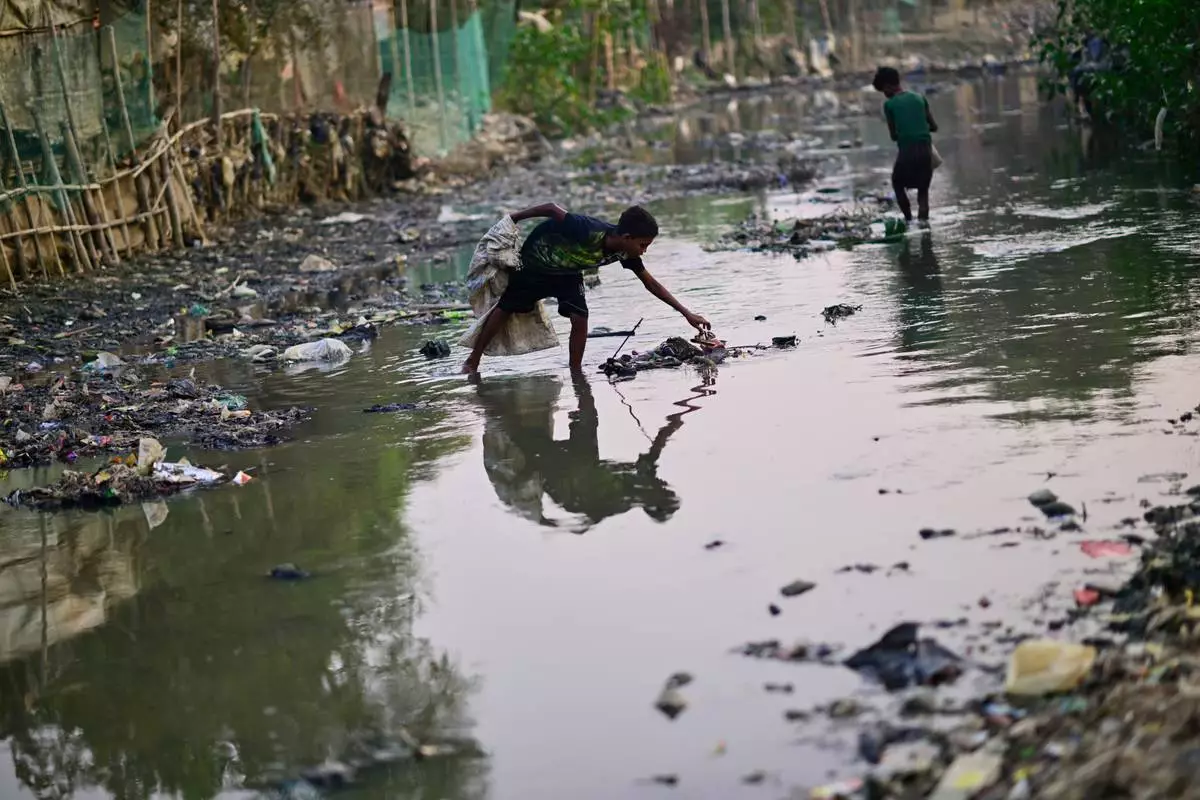
Thirteen-year-old Rohingya refugee Rahamot Ullah collects plastic waste from a drainage canal inside the Rohingya refugee camp in Cox's Bazar, Bangladesh, Saturday, Nov. 22, 2025. (AP Photo/Mahmud Hossain Opu)
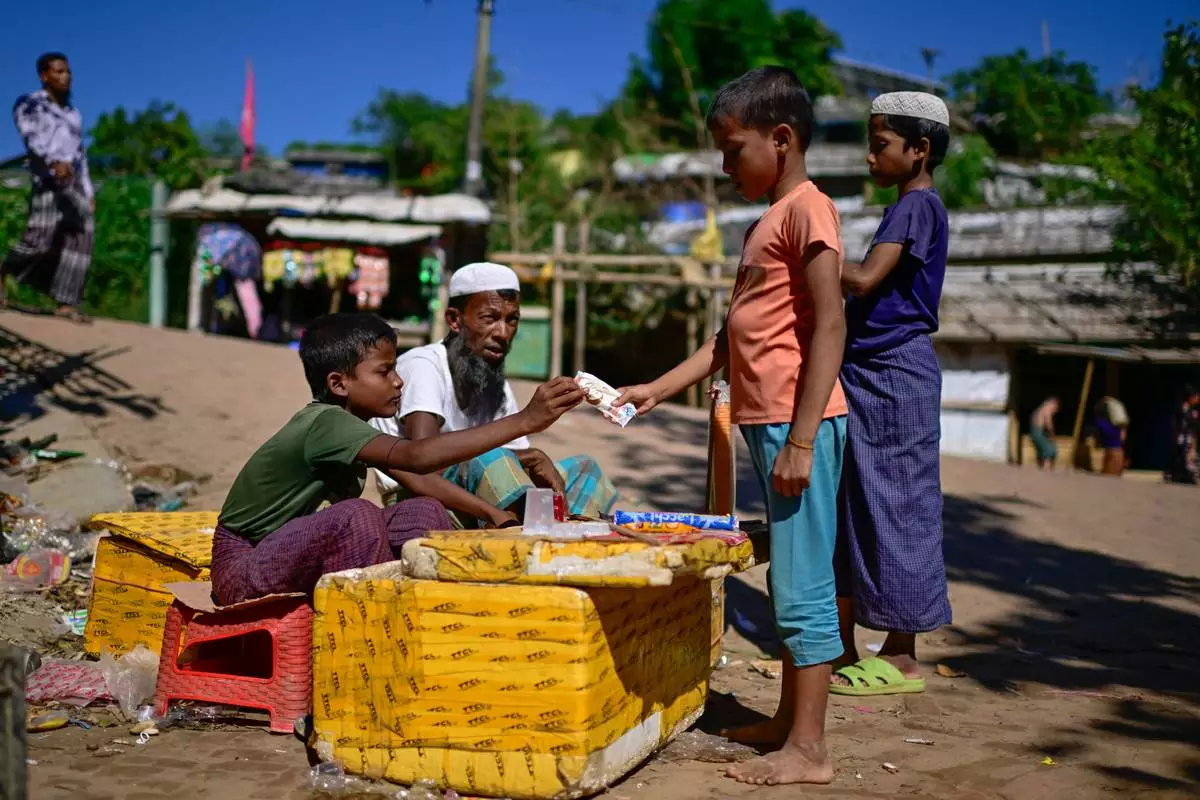
Ten-year-old Rohingya refugee Mohammed Arfan, left, sells snacks inside the Rohingya refugee camp in Cox's Bazar, Bangladesh, Friday, Nov. 21, 2025. (AP Photo/Mahmud Hossain Opu)
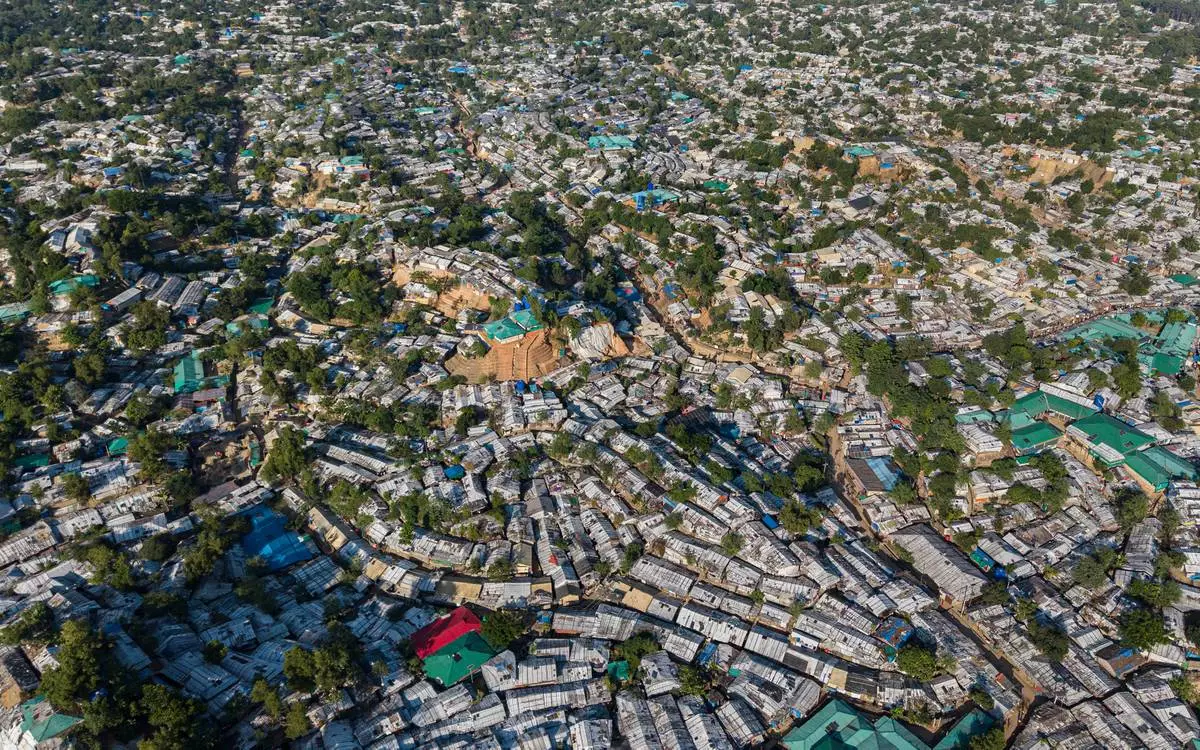
An aerial view of a Rohingya refugee camp, home to over a million of Myanmar's persecuted Rohingya minority, is pictured in Cox's Bazar, Bangladesh, Tuesday, Nov. 25, 2025. (AP Photo/Mahmud Hossain Opu)

Hasina, a Rohingya refugee girl, sits inside the Rohingya refugee camp in Cox's Bazar, Bangladesh, Thursday, Nov. 20, 2025. (AP Photo/Mahmud Hossain Opu)