As local temperatures rise, the rare migratory birds inhabiting at the Gahai Lake wetland in northwest China are now entering their breeding season, contributing to the region's vibrant ecosystem.
Located in Luqu County, Gansu Province, the Gahai Lake wetland boasts an elevation of over 3,470 meters. It serves as a crucial water source replenishment area for the upper reaches of the Yellow River, and is an essential part of the Gahai-Zecha National Nature Reserve at the northeast edge of the Qinghai-Xizang Plateau.
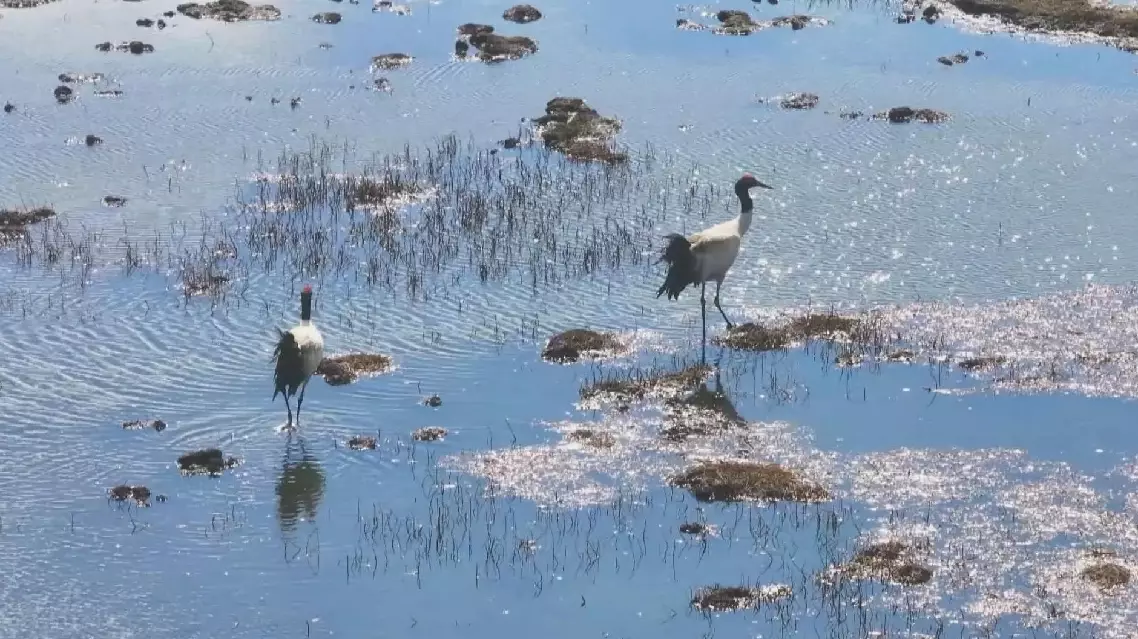
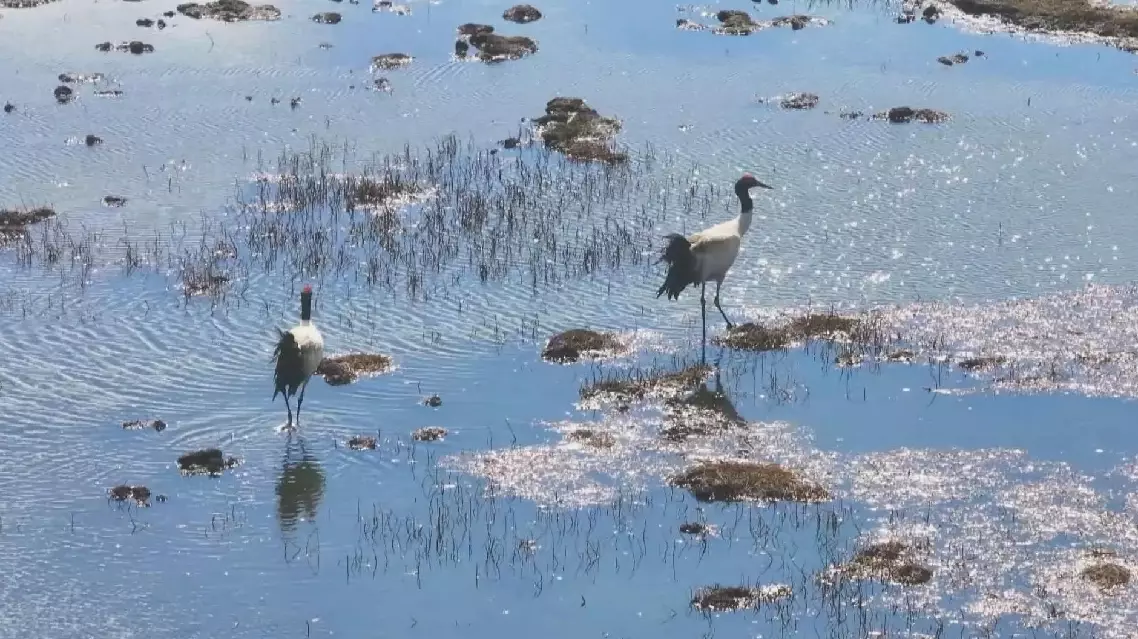
The pristine wetland is also home to various rare bird species, such as the black-necked crane and black stork, which are species under first-class state protection in China.
The conservation workers said that the black-necked cranes will soon lay their eggs, and many cormorants have already been hatching their babies.
"These are cormorant eggs, some of which have already hatched and the babies have come out of their shells. The cormorants came here early, at the end of March, and were already nesting in April," said Rinchen, deputy head of Gahai protection station of Gahai-Zecha National Nature Reserve.
In order to provide a better breeding environment for these migratory birds, the protection station has intensified inspections around the lake and assigned special personnel to guard key areas and key bird breeding sites.
"We have strengthened the inspection frequency to monitor their hatching process and living habits, as well as population changes, so as to better protect migratory birds and provide data support for scientific research," said Hong Qiangqiang, head of the Gahai protection station.
At present, there are over 80 species of birds breeding in Gahai Lake, and it is expected that the bird population will exceed 30,000 by July.
As the habits of each migratory bird species are different, the conservation workers adopt different monitoring methods.
The cormorants and bar-headed geese live on the floating islands scattered across the lake, which are mainly formed naturally from peat and aquatic plants.
To prevent the floating islands from sinking due to overloading, the protection station sends staff members with lighter body weight to install infrared cameras on these islands. This operation must be completed within 10 minutes, as the cautious birds may abandon their nests if humans stay there for too long.
The staff members have also placed man-made nests for bar-headed geese higher above the water as the homes made by the birds themselves are relatively simple and will get soaked when the water rises, resulting in a much lower hatching success rate.
It is more difficult to install infrared cameras beside the nests of black-necked cranes. These particularly cautious birds like to build nests in the marshy areas and may abandon them at the slightest disturbance. Therefore, the staff use drones to search for their homes in advance before wading through the marsh to set up monitoring devices.
Last year, the protection station installed infrared cameras next to the nests of four black-necked crane couples, and captured the entire hatching process. This precious footage has been made public for the first time to facilitate further scientific research.
Northwest China wetland ushers in peak reproduction season for migratory birds
Northwest China wetland ushers in peak reproduction season for migratory birds