Skip to Content Facebook Feature Image

Travelers caught trying to smuggle endangered species into China

China

China

China

Travelers caught trying to smuggle endangered species into China

2025-05-25 20:13 Last Updated At:21:27

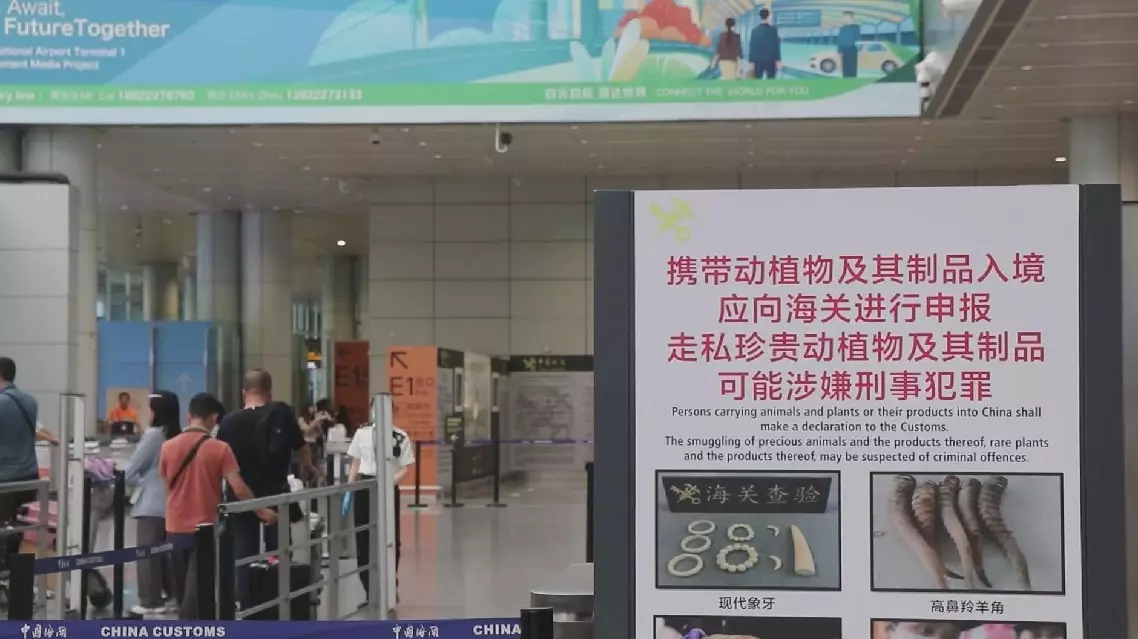
Several travelers were caught trying to smuggle endangered species and relevant products into China in border entry in Guangzhou and Shenzhen Cities of south China's Guangdong Province.

At the Guangzhou Baiyun International Airport, customs officers intercepted a passenger during routine screening of an incoming flight. The X-ray images of the passenger's luggage show four cylindrical metal cans containing numerous egg-shaped items.

"These cans showed clear signs of having been resealed. They were repacked with bird eggs wrapped in cotton and tissue paper. Two of the eggs had already hatched, while the remaining eggs exhibited signs of nestlings' movement under strong light, indicating the presence of live embryos," said Qi Wei, a customs officer at the airport.

The eggs were sent to a specialized rescue organization, where they were successfully incubated. A total of 100 parrot eggs have been hatched, with the eggs and nestlings identified to be 19 species of endangered parrots.

In a separate case, customs officers at an aviation mail processing center near the Guangzhou Baiyun International Airport discovered intricately carved hollowed-out ivory ball hidden inside a package declared as a "vase".

The carved items are confirmed to be made of African elephant ivory, according to Xiao Junhua, a customs officer. The African elephant is listed as a protected species under Appendices of the Convention on International Trade in Endangered Species of Wild Fauna and Flora (CITES), an international agreement signed between governments that aims to ensure that international trade in specimens of wild animals and plants does not threaten the survival of the species.

In Shenzhen's Futian port, four travelers have recently been found carrying endangered stony corals during a security inspection.

They were dressed in bulky clothing, appeared nervous, and failing to declare their belongings.

"After inspection, we discovered 19 transparent plastic bags taped to the four passengers' waists, chests, and hips, each containing what appeared to be live coral. After counting, a total of 161 pieces of suspected live coral, weighing 3.15 kilograms, were seized," said Fu Junwei, a customs officer at the port.

Further analysis confirmed that the corals belong to the order Scleractinia, a group of species listed as endangered and national-level second-class protected species in China. The customs reminded that under the relevant laws and regulations, it is prohibited to import or export endangered species or their products without obtaining proper permits. Individuals who are involved in severe violations constituting a crime will be prosecuted for criminal liability in accordance with law.
Travelers caught trying to smuggle endangered species into China

Travelers caught trying to smuggle endangered species into China

A civil group in Japan held a study session on Saturday to tell the historical truth about the Nanjing Massacre and called on the Japanese government and society to reflect on history and avoid repeating the tragedy of war of aggression.

Saturday marks China's 12th National Memorial Day for the Victims of the Nanjing Massacre which took place when Japanese troops occupied the then-Chinese capital on Dec 13, 1937, killing approximately 300,000 Chinese civilians and unarmed soldiers in one of the most barbaric episodes of WWII over the course of six weeks.

"Japan's army committed a brutal atrocity -- the Nanjing Massacre 88 years ago in 1937. Today, on this important day, let us observe a moment of silence for 30 seconds for the victims," said an organizer of the study session.

This study session was led by Jomaru Yoichi, a former journalist with the Asahi Shimbun, a Japanese daily newspaper. Yoichi compiled numerous articles published in Japanese newspapers after the Nanjing Massacre. Among them, an article published on December 24, 1937 detailed the atrocities committed by the invading Japanese army in China.

"Around 08:00, about 400-500 defeated Chinese soldiers fled. The Japanese soldiers drove them into houses and bamboo groves, setting fires on all sides. Many of them were driven out by thick smokes. The Japanese soldiers killed them one by one with rifles and bayonets. The Japanese soldiers lost track of how many they had stabbed and killed all of them by 16:00," Yoichi recounted.

Many Japanese citizens said the Japanese government and society must confront the truth of history, and it's important to disseminate accurate historical information in contemporary Japan.

"The Nanjing Massacre is a real incident. The remarks that 'The Nanjing Massacre didn't exist' or 'The Japanese army was powerful and righteous' ignore historical evidence and deny the facts outright. I believe these are all attempts to hide the truth of history. I think these are all wrong. Facts are facts, and we must face history squarely," said a participant at the study session.

"I used to teach history in high school. In 1988, I spent two weeks in China and visited for the first time the site documenting the war crimes of the invading Japanese army. On the 80th anniversary of the end of World War II, the social atmosphere in Japan is gradually becoming strange. We must seriously examine Japan's past history, and disseminating accurate history has become even more important," said another participant.

Some expressed their concern that the Japanese government's historical revisionism, its attempt to cover up the truth of history, and its path towards military expansion will prevent Japan from facing the future.

"The fact that the Japanese army's war of aggression is not taught in social studies or history courses. I have no choice but to learn this myself even now at my age. The idea of upholding the pacifist constitution is becoming increasingly strong. Current Japanese politicians are pursuing a military expansion strategy, which I find incomprehensible," said another participant.

In 2014, China's top legislature designated December 13 as a national memorial day for the massacre victims.

Japanese civil group calls for remembrance of Nanjing Massacre victims

Japanese civil group calls for remembrance of Nanjing Massacre victims

Recommended Articles