Speech by CS at Hospital Authority Convention 2025 (with photo/video)
Following is the speech by the Chief Secretary for Administration, Mr Chan Kwok-ki, at the Hospital Authority Convention 2025 today (May 26):
Vice-minister Cao Xuetao (Vice-minister of the National Health Commission), Henry (Chairman of the Hospital Authority, Mr Henry Fan), Tony (Chief Executive of the Hospital Authority, Dr Tony Ko), distinguished guests, ladies and gentlemen,
Good morning. I am delighted to welcome you to the Hospital Authority Convention 2025.
Over the next three days, more than 190 prominent speakers from around the world will share their knowledge and experience in some 60 sessions, offering intelligence, insight and inspiration for the more than 8 600 healthcare leaders and practitioners here from Hong Kong, the Mainland, throughout Asia and around the world.
For the next few minutes, allow me to tell you about some of the latest developments in Hong Kong's healthcare system, and our commitment to rising as a health and medical innovation hub.
We are advancing collaboration through key projects like the Greater Bay Area International Clinical Trial Institute in the Hetao Shenzhen-Hong Kong Science and Technology Innovation Co-operation Zone, and the new Hong Kong Centre for Medical Products Regulation.These initiatives aim to elevate our healthcare standards and foster partnerships.
Operating one of the world's largest healthcare systems, the Hospital Authority maintains high standards through a professional and dedicated workforce, a robust management system and an emphasis on continuous reform and enhancement, including the comprehensive application of information technology (IT).
In striving for excellence, the Hospital Authority has made a number of recent breakthroughs.
They include deepening collaboration with the Mainland, from initiating healthcare talent exchanges between hospitals to facilitating cross-boundary use of electronic health records via the territory-wide eHealth platform, as part of the Government's eHealth+ initiatives to build a comprehensive healthcare information infrastructure in support of the healthcare reform and the digital transformation of our healthcare sector.
Another area of progress is hospital accreditation.
As put forward under the Chief Executive's Policy Addresses, two Hospital Authority public hospitals were accredited under the China's International Hospital Accreditation Standards in December 2024 and March 2025 respectively.And three more hospitals here will begin the accreditation process this year.
The Hospital Authority, I am pleased to say, is contributing to the internationalisation of China's national hospital accreditation standards, improving overall healthcare quality and benchmarks in the Greater Bay Area.
Turning to technology and smart healthcare, the Hospital Authority has been integrating a wide range of advanced IT, digital technology and AI (artificial intelligence) tools into their healthcare services and facilities to enhance service quality and operational efficiency.
Examples include providing AI support to facilitate data-driven care and developing smart wards, smart clinics and smart pharmacies in hospitals.
To date, the Hospital Authority has implemented more than 45 key Smart Hospital offerings in its hospitals, and other applications are being developed to enhance hospital operation and management.
The Hospital Authority has also implemented various AI applications across different aspects of their services, including assisting in clinical diagnosis, enhancing medication safety, predicting the deterioration risks of patients' conditions, and optimising bed management and non-emergency ambulance services.
To drive research, the upcoming Real-World Study and Application Centre will open up local health and medical databases to support clinical diagnosis and treatment, as well as drug development and public health research, while promoting co-operation between Hong Kong and Shenzhen.
The Hospital Authority is also supporting research by innovation and technology institutions in Hong Kong Science Park, enabling remote access to data from about 200 000 anonymous patients. This can only accelerate medical innovation, furthering Hong Kong's goal of becoming a healthcare research centre.
Bringing together different areas of expertise from Hong Kong's healthcare sector, the Institute for Medical Advancement and Clinical Excellence was formally established earlier this month.
The Institute's work will include development and promulgation of clinical guidelines in screening, diagnosis, treatment and management of various diseases, as well as evaluation of the efficacy and cost-effectiveness of medical options. The Hospital Authority will be very much involved in the Institute's efforts, working with other major healthcare institutions together to enhance the overall quality and effectiveness of medical services in Hong Kong.
I am grateful to the Hospital Authority for once again organising this essential international gathering of healthcare professionals. Grateful, too, for its unwavering efforts in ensuring that Hong Kong's healthcare services and its public hospital system remain high-quality, sustainable and accessible to the public – staying true to its mission of "helping people stay healthy."
I wish you all an inspiring and rewarding Hospital Authority Convention.And for our guests and participants coming from around the world, I am sure you will have a memorable stay here in Hong Kong, Asia's world city.
Thank you.
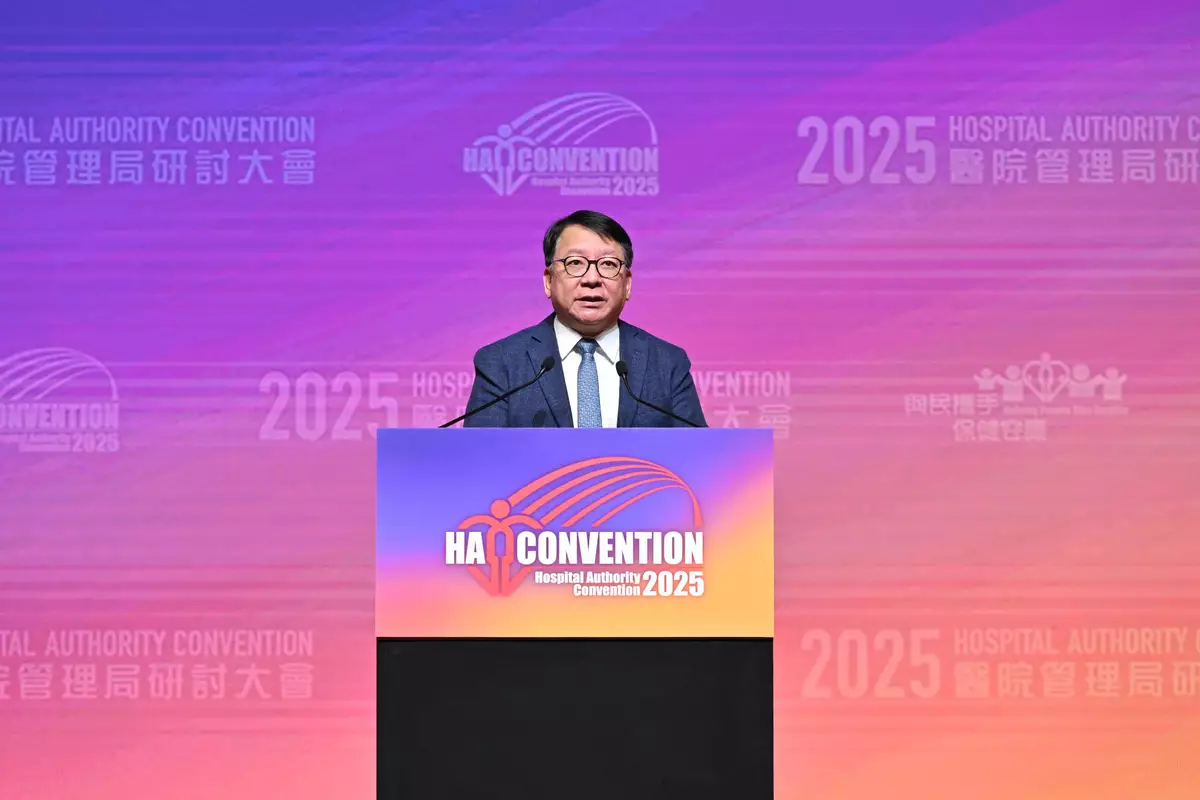
Speech by CS at Hospital Authority Convention 2025 Source: HKSAR Government Press Releases
Government implements multiple measures to promote smart, green and modern logistics development
The Transport and Logistics Bureau (TLB) announced today (January 16) the implementation of various measures, including the formal rollout of the Port Community System (PCS) and Environmental, Social and Governance (ESG) Data Collection Tools, as well as the release of the findings of the planning study on the development of a modern logistics cluster in Hung Shui Kiu/Ha Tsuen New Development Area (HSK/HT NDA), with a view to promoting the smart, green, sustainable and modern development of Hong Kong's logistics industry through a multipronged approach.
The Transport and Logistics Bureau (TLB), Photo by Bastille Post
The Secretary of Transport and Logistics, Ms Mable Chan, said, "Our country has long been providing solid backing for Hong Kong's maritime development. The Recommendations for Formulating the 15th Five-Year Plan (FYP) recently promulgated have clearly stated the objective of consolidating and enhancing Hong Kong's status as an international maritime centre. The Outline Development Plan for the Guangdong-Hong Kong-Macao Greater Bay Area also mentioned the active implementation of various measures to promote Hong Kong's maritime development. Since the Action Plan on the Modern Logistics Development (the Action Plan) has been promulgated for two years, with the full co-operation of the industry, we have completely implemented all action measures and been leading the Hong Kong logistics industry's transition towards high technology adoption and sustainable growth, thereby enhancing the industry's international competitiveness. We will continue to follow the guidance of the Recommendations for Formulating the 15th FYP, leverage Hong Kong's unique advantages of enjoying strong support of the motherland and being closely connected to the world to maintain our position as the region's leading international logistics hub, thereby better integrating into and serving the overall national development."
The logistics industry is one of the pillar industries of Hong Kong. To promote the sustainable and high-quality development of the industry, the Government promulgated the Action Plan in 2023, which formulated eight strategies and 24 action measures to assist the industry in embracing the new era of smart, green and modern logistics. Apart from a number of subsidy schemes to assist the industry in upgrading their operations by adopting smart and green logistics solutions and taking relevant training courses, as well as release land parcels to meet the industry's demand for premium logistics sites in the short to medium term, the Government is also working at full steam to build the new image of modern logistics as "smart, innovative, high-end" and reach out to young people on campus through the Curriculum on Logistics Industry and internship scheme, among others in order to attract young people to join the industry. Externally, on one hand, we commenced logistics co-operation with Guangxi, Chongqing and Chengdu with a view to exploring new cargo sources for Hong Kong. On the other hand, we enhanced overseas promotions to explore business opportunities together with the industry in Belt and Road countries.
PCS
In terms of smart logistics, the PCS, a critical digital infrastructure developed by the Government with over $200 million in funding, was formally rolled out today. It marks a significant milestone for the digital transformation of Hong Kong's port and logistics development.
The system provides one-stop, round-the-clock, real-time cargo tracking and links up sea, land, and air transport networks, thereby holistically enhancing the transparency, efficiency and interconnectivity of the logistics chain. Apart from its core function of real-time cargo tracking, the system will also offer value-added electronic services such as the "One-Data-Multiple-Declarations" function. By facilitating cargo import and export declarations by the industry, the system will provide one-stop services for local logistics and trading companies, thereby supporting the upgrading of the industry.
At today's PCS rollout ceremony, the TLB also signed a tripartite Memorandum of Understanding with the Logistics and Supply Chain MultiTech R&D Centre and a local logistics start-up company, FUNDel, to accelerate the connection between the PCS and data platforms of the logistics industry, as well as study the utilisation of the trusted cargo flow data on the PCS to help financial institutions assess trade finance applications filed by relevant logistics small and medium-sized enterprises (SMEs), thereby supporting the sustainable development of the logistics industry.
Findings of the planning study on the development of Hung Shui Kiu/Ha Tsuen modern logistics cluster
The findings of the planning study on the development of a modern logistics cluster in the HSK/HT NDA were also announced today. To address the industry's long-term demand for logistics sites, the Government proposed to develop modern logistics clusters in the HSK/HT NDA. The relevant planning study commenced in March 2024 and was completed at the end of 2025.
After conducting a comprehensive consultation with the trade and considering comments from various stakeholders, the study suggests that the logistics cluster should adopt three major development directions, namely be "enterprise-oriented", have a "market-enabling environment" and an "innovative approach to drive industry development". It also suggests measures such as providing tailor-made entry terms for anchor enterprises and increasing the flexibility of development modes, with a view to ensuring the development of the logistics cluster meets the trends and demands of the market.
The TLB plans to invite the industry to submit expressions of interest for the first logistics cluster site this year, and will draw up the relevant land lease terms and development mode after taking into account the intents of the industry to ensure that they keep pace with industry's development needs.
The Study Report has been uploaded to the website of the planning study on the development of a modern logistics cluster in HSK/HT NDA (www.lc-hskht.hk).
ESG Data Collection Tools
ESG is a new international development trend for the logistics trade. Further to the Government's announcement of the Roadmap for ESG Development for Logistics Industry in June 2025 which has outlined a clear way forward for adopting ESG by logistics SMEs, the TLB today further released a set of ESG Data Collection Tools (the Toolkit) tailored for logistics SMEs, with a view to assisting them in taking the first step towards putting ESG into practice.
The Toolkit includes a user-friendly data collection template, a data dictionary and a user manual. It aims to equip SMEs with the ability to collect and record ESG data early and use the collected data to prepare ESG data reports that fulfil international ESG disclosure requirements. In the long run, logistics SMEs may even utilise the data for reviewing and improving their ESG performance, thereby helping to build up Hong Kong logistics industry's sustainability credentials and enhance its competitiveness. Interested companies may register at the ESG Resource Centre on the website of Hong Kong Logistics Development Council (www.logisticshk.gov.hk/en/ESG/ESG_collection.php) to obtain the Toolkit for free.
The TLB will continue to closely liaise and co-operate with the industry, and further consolidate and enhance Hong Kong's status as an international logistics hub through various policies and measures. The Government will also ensure that the logistics industry will maintain its edge in the international market and drive the development of trading and maritime industries at the same time by seizing the enormous opportunities brought by national and regional development, thereby promoting the high-quality development of Hong Kong's economy.
The future development of a modern logistics cluster in Hung Shui Kiu/Ha Tsuen New Development Area (HSK/HT NDA), Photo source: the official website of the Lands Department