Speech by CE at Asia Summit on Global Health (with photos/video)
Following is the speech by the Chief Executive, Mr John Lee, at the Asia Summit on Global Health today (May 26):
Honourable Vice-minister Cao Xuetao (Vice-minister of the National Health Commission), Deputy Director Yin Zonghua (Deputy Director of the Liaison Office of the Central People's Government in the Hong Kong Special Administrative Region (HKSAR)), Deputy Commissioner Li Yongsheng (Deputy Commissioner of the Office of the Commissioner of the Ministry of Foreign Affairs of the People's Republic of China in the HKSAR), Dr Peter Lam (Chairman of the Hong Kong Trade Development Council), distinguished guests, ladies and gentlemen,
Good morning. I am delighted to join you all for this year's Asia Summit on Global Health. Delighted to welcome our friends from around the world to Hong Kong.
Global health starts with unity. This spirit of collaboration is as important today as it was in 2021, when this Summit was first launched. It was launched under the cloud of the global pandemic. We don't need any reminding of the dark days of the COVID-19 outbreak. But it is worth recalling that those difficult times also sparked a remarkable period of healthcare innovation and co-operation. These positive trends continue, here today, at this Summit.
I thank all who are attending the Summit - over 2 800 experts from some 40 countries and regions. You are medical professionals, policymakers, academics, heads of pharmaceutical and health tech enterprises, and experts in many other fields.
You are here to explore innovative solutions to chronic diseases, healthcare inequities and the challenges of an ageing population. To share knowledge and explore the promising opportunities in medicine, and medical technology, across Asia and beyond.
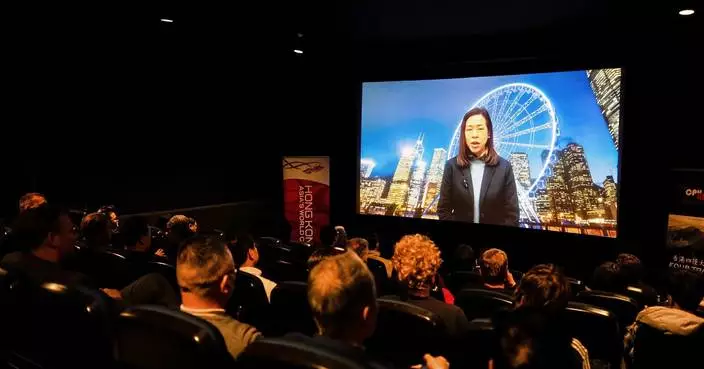
These topics, and more, will be under the microscope, during the next two days of high-level panel discussions, networking and deal-making sessions. From a global perspective, the Director-General of the World Health Organization will share with us his views by video in a few minutes.
Under the theme of "Fostering Global Collaboration for a Shared Future", this Summit reaffirms Hong Kong's pivotal role as a leading health innovation hub in the region.
Under the "one country, two systems" principle, Hong Kong enjoys unique connectivity with both Mainland China and the world. As the world's freest economy and one of the top three international financial centres, we offer an efficient, open and fair business environment with robust intellectual property protection. We maintain free flows of information, capital, goods and talent. We are also emerging as a leading hub for scientific innovation, technological advancement and world-class education.
Hong Kong is the only city in Asia with as many as five universities ranked in the top 100 globally. We are home to two of the world's top 40 medical schools, and eight State Key Laboratories in life and health disciplines. This, and more, provides fertile ground for world-class scientific research and medical technology innovation.
Under "one country, two systems", we also enjoy strong support of national strategies, coupled with ever-closer connectivity with our country, China.
The connectivity is fully evident at the Hetao Shenzhen-Hong Kong Science and Technology Innovation Co-operation Zone. Straddling our boundary with the neighbouring city of Shenzhen, the Co-operation Zone comprises the Hong Kong Park and the Shenzhen Park. It pools together the technological strengths of our two cities.
Our respective, and collective, strengths are recognised internationally, I'm pleased to add. In its annual Global Innovation Index, the World Intellectual Property Organization has ranked the Shenzhen-Hong Kong-Guangzhou science and technology cluster second, globally, for five consecutive years.
It helps that we are core cities in the Guangdong-Hong Kong-Macao Greater Bay Area, or the GBA, a cluster city development that brings together 11 cities in southern China. It has a population of some 87 million, and a GDP that closely rivals the world's 10th-largest economy.
Riding on this synergy with other GBA cities, the Hong Kong Park of the Co-operation Zone is in good shape for its operational phase later this year. We will provide over US$250 million to support the InnoHK research clusters to set up there, and another US$25 million to assist start-ups engaging in life and health technology.
The InnoHK clusters, let me add, now count 29 research centres and laboratories focusing on health tech, artificial intelligence and robotics, each formed by partnering a Hong Kong institution with a Mainland or international institution.
In other news from the Co-operation Zone, the Greater Bay Area International Clinical Trial Institute is now up and running in the Hong Kong Park.
And, just last week, the Institute started a collaboration initiative on clinical trial with our two medical schools. In more than 70 clinical trial projects expected to be launched in the coming year, the Institute will help to co-ordinate in cross-boundary clinical trials, connection with GBA institutions, and more. Well, that's what I call a healthy outcome!
Another key healthcare collaboration is on the registration for drugs and medical devices. Under a special measure of the National Medical Products Administration, several healthcare institutions in Mainland cities of the GBA may now use drugs and medical devices used in Hong Kong, but not yet registered on the Mainland. This accelerated pathway allows for the access of innovative medicines and devices into the Mainland market.
We are now working with Shenzhen to establish a Real-World Study and Application Centre, by year's end, to promote co-operation on the sharing of health and medical data. It would speed up the approval and registration of new drugs in both places.
Hong Kong is committed to establishing its own internationally recognised authority for the registration of drugs and medical devices. We have implemented the "1+" mechanism for the registration of new drugs, vaccines and advanced therapy products. The mechanism allows for a drug to be registered in Hong Kong, once it has been registered with a reference drug regulatory authority, and supported by local clinical data.
These and other efforts will drive the development of Hong Kong into an international health and medical innovation hub. More importantly, they will expedite patients' access to advanced diagnostic and treatment services.
To boost Hong Kong's research prowess, we have launched a subsidy to support local universities in setting up health technology research institutes. With an allocation of some US$770 million, the programme will foster academic collaboration in life and health sciences research.
Beyond funding research, let me add, we are also investing into developing our research talent. As a result, publicly funded PhD places increased by about one-third to 7 200 over the past two academic years. Places under the Hong Kong PhD Fellowship Scheme also saw a one-third rise.
We endeavour to ensure the timely, and efficient, commercial returns from Hong Kong's excellent research outcomes, including healthcare innovations. For this, we have set aside over US$1.2 billion for the Research, Academic and Industry Sectors One-plus Scheme, and another US$1.2 billion for the New Industrialisation Acceleration Scheme. These Schemes support enterprises to adopt new innovations, and set up smart productions facilities, respectively.
Ladies and gentlemen, in fighting a virus, isolation is vital - quarantining the infected to protect the healthy. But in tackling healthcare, trade, and other societal issues, isolation is not the answer. While walls may stem the spread of a disease, they stifle free and open exchange, which is the lifeblood of prosperity.
With unilateralism and protectionism sweeping the world like a contagion, we should remember a fundamental truth: Trade thrives on openness. Much as how a human body can only stay healthy when its interconnected systems work in harmony, our global economy can only prosper with an ecosystem of trust, collaboration and multilateralism. For in trade, as in health, resilience lies not in isolation, but in collaboration. And Hong Kong is here to build meaningful partnerships and innovative co-operations, with all of you.
My thanks to the Hong Kong Trade Development Council for jointly organising this Summit with the HKSAR Government. I encourage all of you to visit the Hong Kong International Medical and Healthcare Fair, another key event of this International Healthcare Week, over the next three days.
As the saying goes, "Laughter is the best medicine". Therefore, while this Summit focuses on the serious topic of global health, I would like to see all of you rejoice here and participate in a happy mood. Find time, also, to relax and enjoy the colourful cultural experiences here in our world city.
I wish you all a very successful Summit, a delightful stay in Hong Kong and, of course, the best of health!
Thank you.
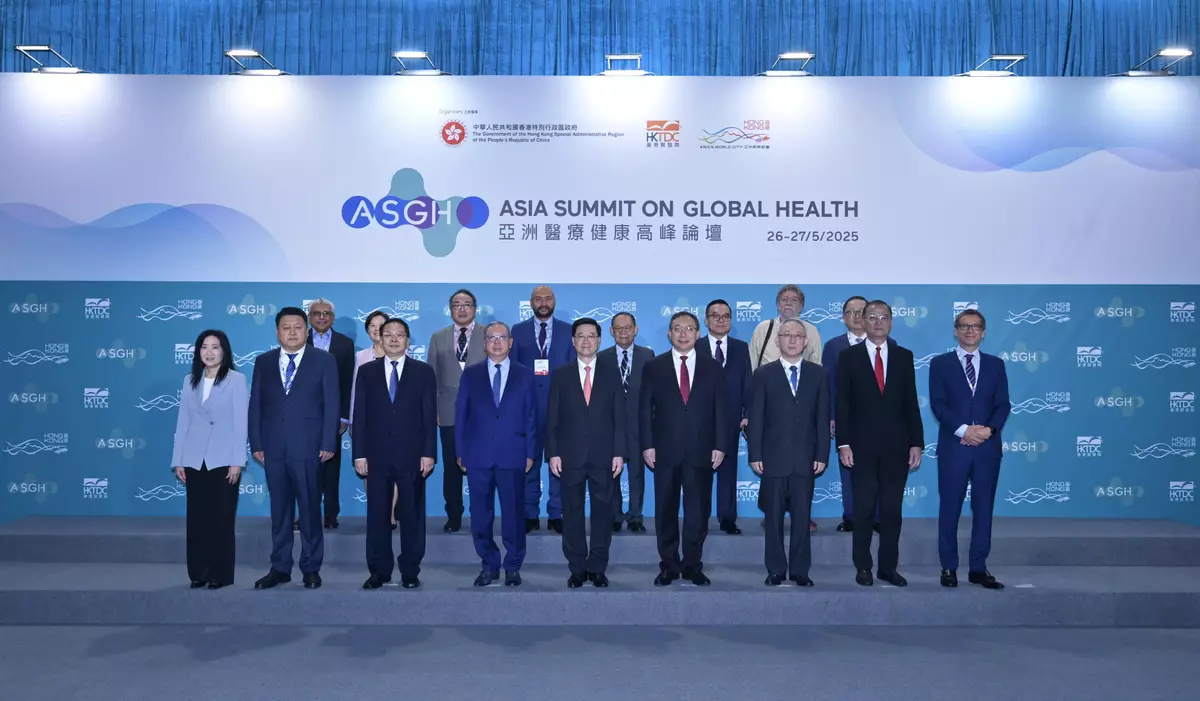
Speech by CE at Asia Summit on Global Health Source: HKSAR Government Press Releases
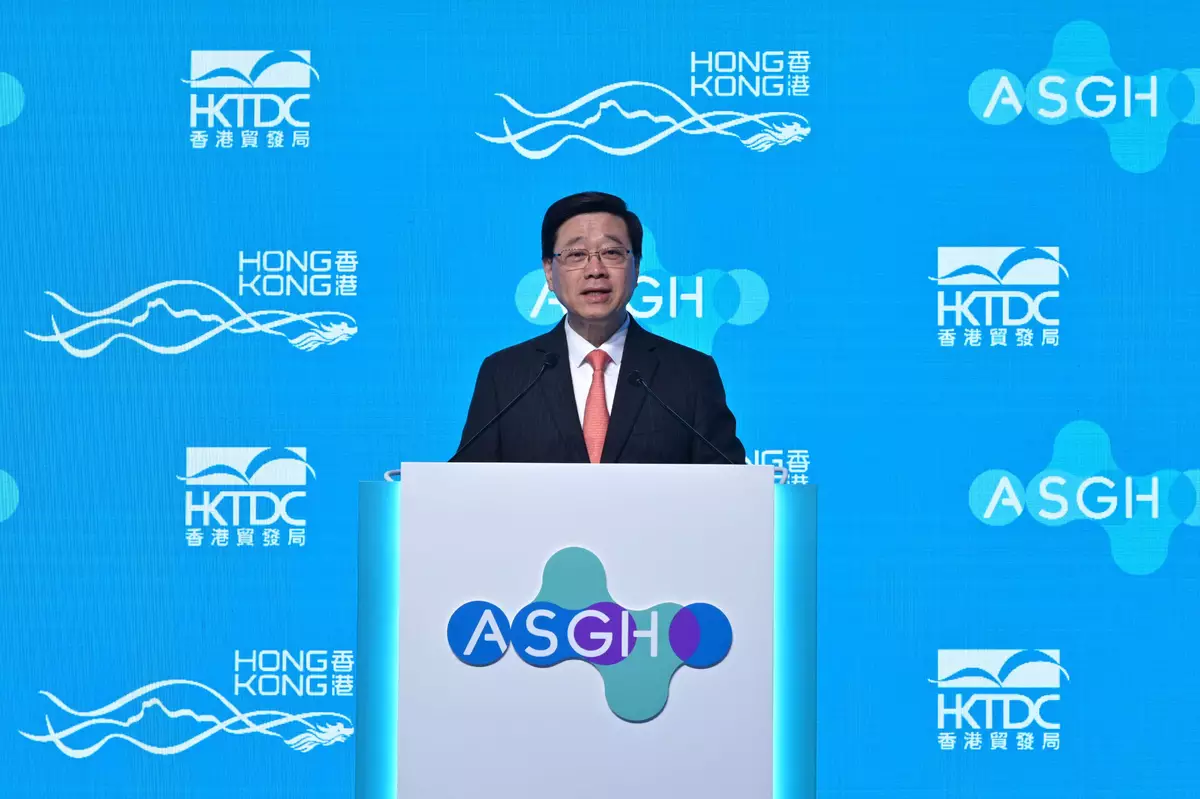
Speech by CE at Asia Summit on Global Health Source: HKSAR Government Press Releases